Hawker Siddeley Harrier variant
Hawker Siddeley Harrier AV-8S Matador
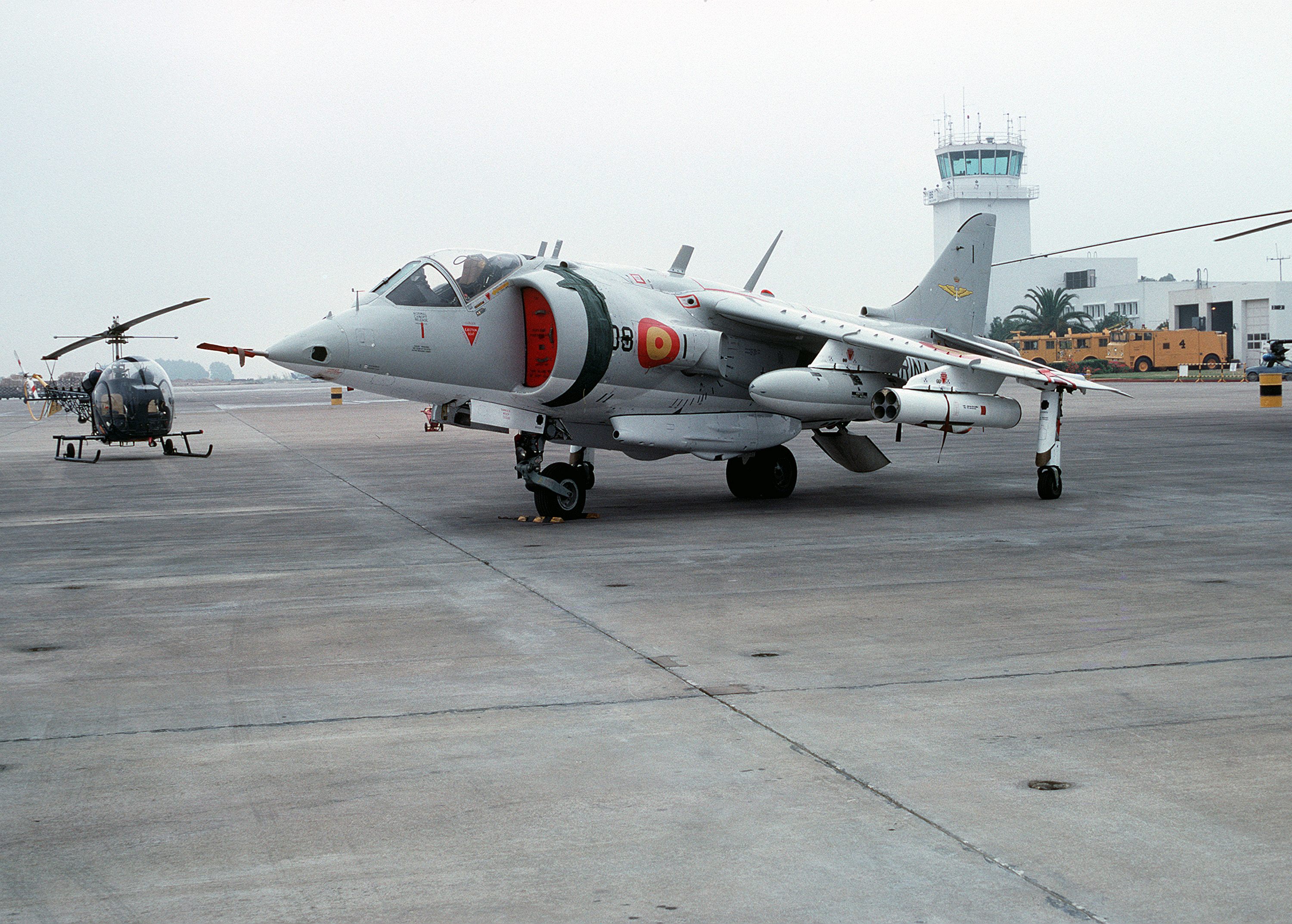
Export version of the AV-8A Harrier for the Spanish Navy, which designated it VA.1 Matador (the two-seat member of the family was the TAV-8S or VAE.1). Almost identical to the Marine Corps Harriers apart from its radios, it was bought with the United States as intermediary because of a British embargo, flew with 8th Escuadrilla from the carrier Dédalo from 1976 and in 1998 passed to the Royal Thai Navy, which retired it in 2006.

- 10
- Units built
- 1,900 km
- Range
History
An aircraft for Dédalo
The Spanish Navy wanted a fixed-wing aircraft to defend its ships beyond the reach of land-based air power, and the only vertical take-off design that had become fully operational was the British Harrier, heir to the P.1127 and Kestrel demonstrators. The initial aim was to acquire eight aircraft to fly from the helicopter carrier Dédalo, but there was a political obstacle: the United Kingdom had barred military sales to Spain since 1966, and the Spanish government, because of the Gibraltar dispute, did not want to buy from Britain either.
The November 1972 trials
To build support for the purchase, a shipboard demonstration was arranged. An RAF Harrier GR.1 flown by John Farley flew directly from the United Kingdom and landed over the stern on Dédalo on 8 November 1972, in international waters off Cape Creus. The trials, which the most detailed account says ran until the 10th, covered deck handling, lifts and hangar, short and vertical take-offs and landings, hovering and a brief firing exercise. Above all they showed that the ship's wooden deck could withstand the temperature of the engine exhaust, the main technical doubt. The result won over the sceptics, and the Chief of Naval Staff, Admiral Pita da Veiga, announced a first order for eight aircraft.
A triangular purchase
The embargo was circumvented through the United States: the aircraft were not bought from Britain but through McDonnell Douglas, which assembled the Marine Corps AV-8As at its St. Louis plant from British-supplied parts. The Spanish version received the American designation AV-8S for the single-seater and TAV-8S for the two-seater; in Spanish service they were VA.1 and VAE.1, and the Spanish source says the name Matador came from a nickname given to them in the United States. The Matadors were almost identical to the Marine Corps Harriers, differing only in the radios fitted. The manufacturer's designation for the first batch of single-seaters was Harrier Mk 53.
8th Escuadrilla
The new unit was formed on 28 September 1973. Dédalo was reclassified from helicopter carrier to aircraft carrier with the pennant PA-01, and the Helicopter Flotilla became the Aircraft Flotilla. Ten volunteers were chosen from the Navy's helicopter pilots, all lieutenants with at least 400 flying hours, and trained at Naval Air Station Pensacola, flying the T-2 Buckeye jet trainer. When Dédalo reached Naval Station Mayport, Spanish pilots landed five AV-8Ss and two TAV-8Ss on her deck; one single-seater was missing, having crashed in the United States months earlier without injury. From 1976 the squadron flew from Rota and from Dédalo, giving the fleet both air defence and strike capability against surface targets.
The second batch
In 1980 five more AV-8S single-seaters arrived, this time bought directly from the British manufacturer, with their pilots also trained in the United Kingdom; their manufacturer's designation was Mk 55. According to Revista Naval they were practically the same as the first batch but carried additional VHF antennas for communicating with helicopters at sea. The same source credits the Spanish Harriers with a Marconi Skyguardian 2000 radar warning receiver, a Smiths Industries head-up display and a Sperry gyrocompass, and with weapons that combined 30 mm ADEN cannon, 127 mm Zuni rockets, Mk 82 and Snakeye bombs, Rockeye cluster bombs and Sidewinder air-to-air missiles. When Spain joined NATO, Dédalo's pennant changed to R-01.
Exercises and the 'magic cross'
The international debut came in Exercise Ocean Venture 81, between August and September 1981, which involved some 250 ships from many countries. Dédalo embarked seven Matadors, which at one point escorted a pair of B-52 bombers. On board, US Rear Admiral William A. Kearns watched the so-called 'cruzado mágico' ('magic cross'), a method devised by Captain Salas Cardenal and the Spanish pilots: the aircraft lined up aft, each pointing at the opposite corner of the deck, and made short diagonal take-offs, putting four aircraft in the air very quickly. One of the visiting officers judged it faster than the four steam catapults of a Nimitz-class carrier.
Losses and replacement
The Navy had thirteen first-generation Harriers in all, of which four were lost in accidents; there was a single fatality, Lieutenant César Jáuregui, who disappeared with aircraft 01-801 on 28 May 1980. Before retirement the Matadors trialled the 12-degree ski-jump of the new carrier Príncipe de Asturias, from which they also operated. They were succeeded by 9th Escuadrilla, activated in 1987 with EAV-8B Harrier IIs; the AV-8Ss were withdrawn in October 1996 and 8th Escuadrilla was deactivated on 1 July 1997.
A second life in Thailand
The nine survivors, seven single-seaters and two two-seaters, were sold to the Royal Thai Navy for about US$90 million and arrived together with the light carrier HTMS Chakri Naruebet, built in Spain by Bazán and commissioned in 1997; there they were designated B.KhL.1 and formed the first squadron of Wing 3. Thailand, new to carrier aviation, suffered from the outset from a lack of funds for spares, above all engines: in 1999, two years after delivery, only one airframe was airworthy. Around 2003 it considered replacing them with British Sea Harrier FA2s, but no purchase followed, and the last first-generation Harriers in service were retired in 2006. Examples survive in museums, such as 3109 at the Royal Thai Air Force Museum and the former 01-814 in Thai colours.
Multimedia


