Douglas A-1 Skyraider variant
Douglas A-1 Skyraider AD-5 (A-1E)
Widened-fuselage Skyraider seating two crew side by side; as the A-1E it was the USAF's Skyraider in Vietnam and the aircraft of Bernard Fisher's Medal of Honor.

- 212
- Units built
History
The AD-5 was the most far-reaching change the Skyraider went through during its production life. Until then the attack versions of the family, from the AD-1 to the AD-4, had been single-seaters, and the extra crew of the specialised variants rode in the fuselage, apart from the pilot. Douglas significantly widened the AD-5's fuselage so that two crew, pilot and co-pilot, could sit side by side in the cockpit, and it did away with the dive brakes that had characterised the earlier models. It was not the first variant with more than one crew member, since the AD-1Q was already a two-seater and the AD-3N carried three, but it was the first in which the cockpit itself was redesigned to take two people abreast. The fuselage was lengthened and widened, and the whole was covered by a longer, metal canopy instead of the earlier plastic sections.
The widened airframe turned the AD-5 into a versatile platform. The US Navy produced it as a multi-role aircraft, with conversion kits that allowed it to serve as a twelve-seat transport, cargo carrier, ambulance or target tug. The specialised variants grew from the same basis: the four-seat AD-5N night attacker, the AD-5Q electronic countermeasures aircraft, the AD-5W airborne early warning version with its AN/APS-20 radar, the AD-5S used to test magnetic anomaly detector anti-submarine equipment, and the AD-5U target tug, which became the UA-1E in 1962 and which, when converted as a transport, was sometimes referred to as the AD-5R. Of the AD-5 proper, 212 were built.
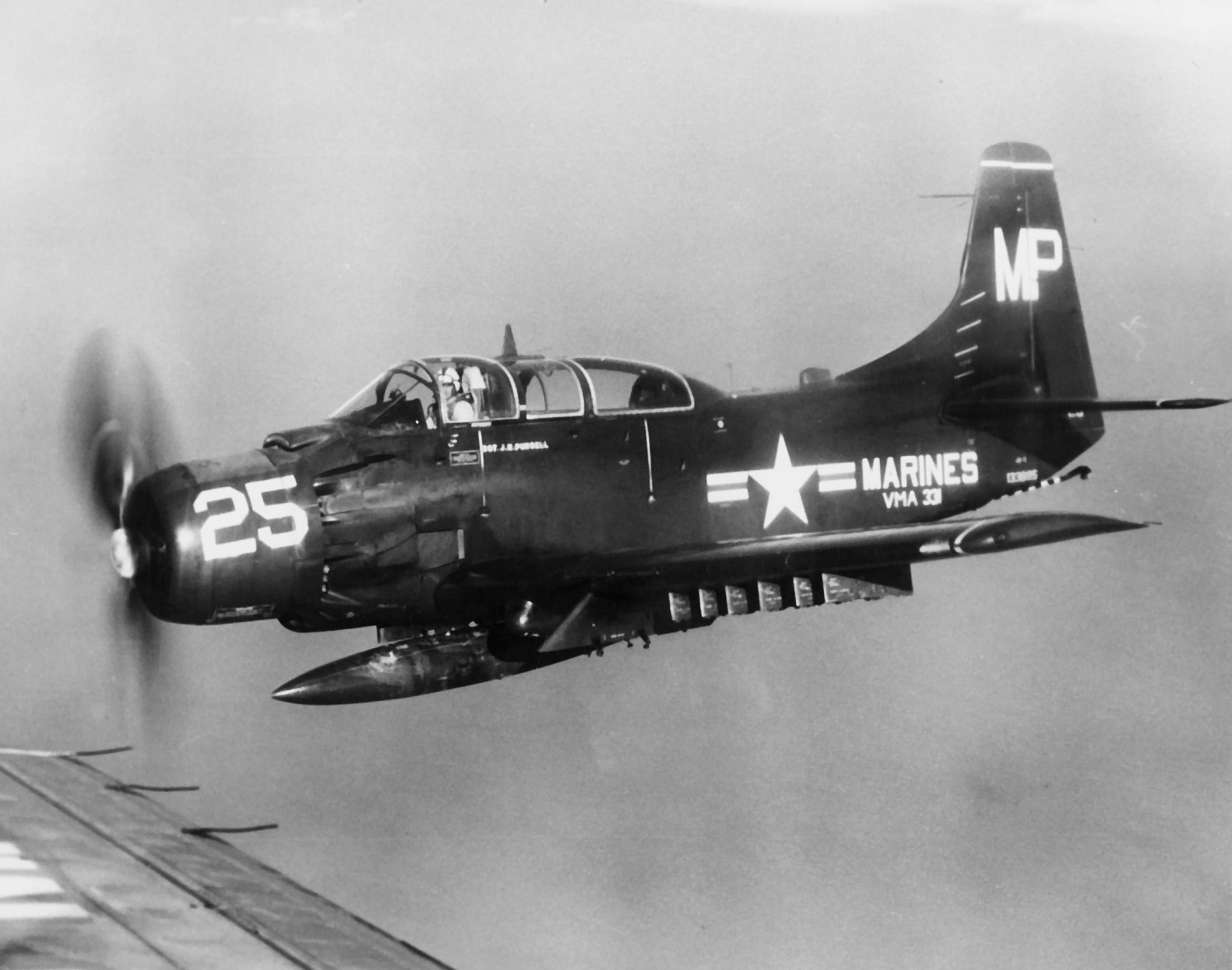
In 1962, when Navy and Air Force designations were unified, the AD-5s in service became A-1Es. It was under that name that the model won its greatest fame, far from the carriers. During the Vietnam War many retired Skyraiders were refurbished for the United States Air Force (USAF) and for the Republic of Vietnam Air Force, and AD-5, AD-5Q and AD-5W airframes became 'new' USAF A-1E attack aircraft. The two-seat cockpit suited an advisory war: many of the aircraft delivered to the South Vietnamese were two-seaters because an American pilot and a Vietnamese pilot were expected to fly together. About one third of the more than 350 Skyraiders acquired by South Vietnam were A-1Es or A-1Gs, and when the country collapsed, the eleven Skyraiders that fled to Thailand in 1975 included five A-1Es.
The USAF flew its A-1Es with air commando and special operations squadrons: support for the Special Forces, night attacks on the Ho Chi Minh Trail, operations over Laos and, above all, the 'Sandy' escort of combat rescue helicopters, in which the Skyraiders kept the enemy at bay around the pick-up point. For Vietnam, USAF Skyraiders were fitted with the Stanley Yankee extraction system, which acted much like an ejection seat, using twin rockets to pull the pilot out of the cockpit.
The A-1E's most famous moment came on 10 March 1966 in the A Shau Valley. Major Bernard F. Fisher, of the 1st Air Commando Squadron at Pleiku, was leading a two-ship element of Skyraiders supporting a Special Forces camp. Six 'Spads' were striking enemy emplacements when the A-1 flown by Major Dafford Wayne 'Jump' Myers was hit and had to belly-land on the camp's airstrip. The nearest helicopter was 30 minutes away and the enemy only about 200 yards from Myers, so Fisher decided to land his two-seat A-1E on the strip, taxi to Myers and load him into the empty seat. Covered by the other A-1s, he took off again, dodging shell holes and debris on the steel-planked runway, despite many small-arms hits on his aircraft. Fisher, who flew 200 combat sorties in A-1E and A-1H Skyraiders between July 1965 and June 1966, received the Medal of Honor from President Lyndon B. Johnson on 19 January 1967, the first Air Force member to be awarded it in the Vietnam War.
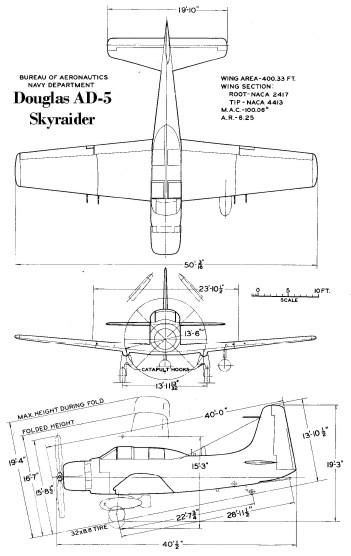
Three-view drawing
Multimedia


Elsewhere


Where to see it today
| Serial | Place | City | Country | Status |
|---|---|---|---|---|
| 132463 | Aerospace Museum of California | North Highlands | United States | On display |
| 52-132649 | National Museum of the United States Air Force | Dayton | United States | On display |
| Serial | Place | City | Country | Status |
|---|---|---|---|---|
| 52-247 (Rebuilt) | Hill Aerospace Museum | Roy | United States | On display |
List reviewed on October 31, 2026 against Wikipedia (en): List of surviving Douglas A-1 Skyraiders.