Dornier Do X variant
Dornier Do X1
The first Do X in its original configuration, with twelve air-cooled Siemens Jupiter radials in tandem above the wing. It hopped off Lake Constance on 12 July 1929 and on 21 October carried 169 people, a record that lasted twenty years; the engines overheated and it could not climb past 425 m, so in 1930 it was re-engined as the Do X1a.
_vom_Typ_Dornier_Do_X_(Kiel_63.612)-800.webp)
- July 12, 1929
- First flight
- 1
- Units built
- 100
- Passengers
History
A shipyard on the Swiss shore
The Treaty of Versailles barred Germany from building aircraft above set speed and range limits, so Claude Dornier put up a purpose-built plant at Altenrhein, on the Swiss side of Lake Constance, and assembled the world's largest flying boat there. His first sketches of a monoplane flying boat date from September 1924. Sources disagree on when formal design began: English Wikipedia and Histaviation say late 1925, while German Wikipedia dates the official start of work on project P 51 335 to 22 December 1926. That phase was overshadowed by the Lohmann affair, which exposed the Reichswehr Ministry as a hidden backer and forced it out; the money ended up flowing through Doflug, a company set up with a stake held by the German state.
Construction of works number 1 began on 19 December 1927 at the Doflug plant in Altenrhein. It took about 240,000 work-hours, or 570 days, before the boat was declared finished in June 1929.
A ship's hull with twelve engines on top
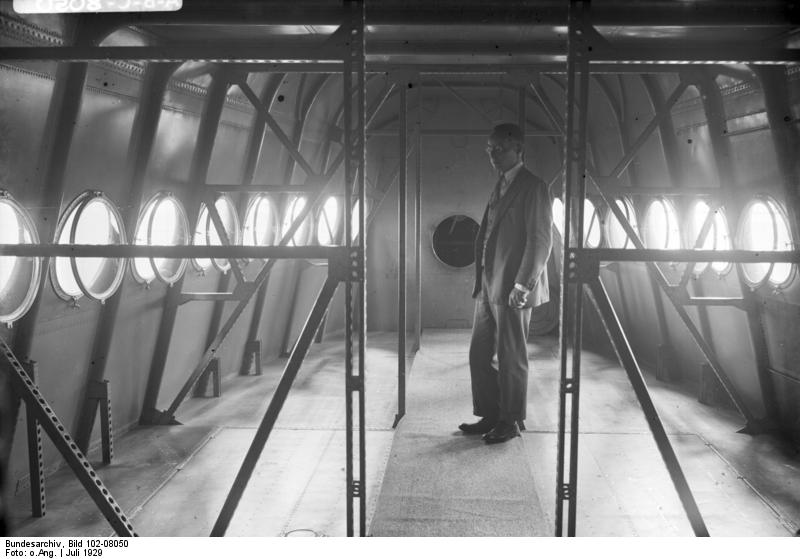
The Do X1 was a semi-cantilever monoplane with an all-duralumin hull and wings built from a steel-reinforced duralumin frame, covered in heavy linen and painted with aluminium. Instead of wing floats it carried sponsons, stub wings on the hull sides that steadied the boat on the water and doubled as boarding platforms. Above the wing, six strut-mounted nacelles linked by an auxiliary aerofoil held twelve engines in tandem pairs: six tractor propellers and six pushers. They were Siemens Jupiters, a licence-built version of the British Bristol Jupiter radial and the most powerful German-made engine then available. Their rated output depends on the source: 500 PS (368 kW) in German Wikipedia, 391 kW (524 hp) in English Wikipedia.
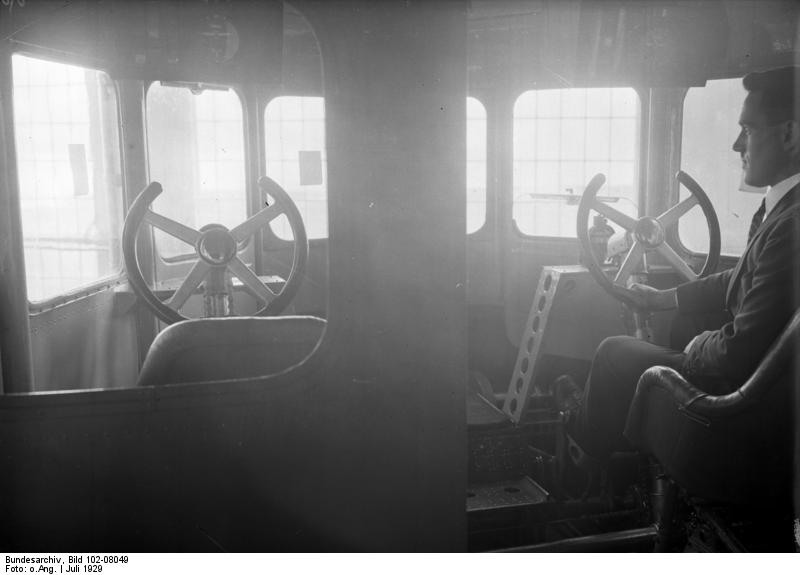
Nobody in the cockpit worked those engines. A flight engineer sat behind twelve throttles and twelve sets of gauges, and the pilot asked him for power through an engine order telegraph, exactly as on a ship of the period, from a flight deck that looked like a bridge.
A hop over the lake
To run the trials, Dornier brought engineer Heinrich Schulte-Frohlinde back from the Italian subsidiary CMASA; at the controls sat the company's chief test pilot, Richard Wagner. On 12 July 1929 the boat was launched at Altenrhein and taxiing trials began. During one of them, meant only to test handling on the water, Wagner pulled back a little too hard while skimming at full throttle — out of curiosity, the Hannover aviation museum suggests — and the hull came free of the water for a few metres. That hop is what the sources record as the first flight; for the first proper flight they give two dates, 15 July according to German Wikipedia and 29 July according to Histaviation.
The record flight
On 21 October 1929, on what English Wikipedia counts as its 70th test flight (Flug Revue says the 42nd), the Flugschiff lifted off Lake Constance with 169 people aboard, even though it was not yet cleared to carry passengers. The breakdown depends on who tells it: 150 passengers, ten crew and nine stowaways in the English account; ten crew and 159 passengers, factory workers and their families, in the German one. A few journalists came along too. After a fifty-second take-off run it climbed slowly to about 200 metres, and passengers were asked to bunch up on one side or the other to help the turns. It stayed up for about 40 minutes according to English Wikipedia, 53 according to German Wikipedia and the Hannover museum, at up to 170 km/h, before settling back on the lake. No aircraft had ever carried so many people, and the record stood for twenty years, until the Lockheed Constellation (168 passengers and 11 crew).
Where air cooling ran out
The air-cooled radials were the weak point of this configuration: they lost power on long runs and could not be turned faster without overheating, so the boat could barely climb past 425 metres. Spanish Wikipedia notes that later studies blamed excessive wing loading more than a lack of power. After 103 flights in 1930 the twelve engines were swapped for liquid-cooled Curtiss V-1570 Conquerors; according to Histaviation, the first flight with the new engines took place on 4 August 1930. From then on the aircraft is known as the Do X1a, but it is the same airframe: the D-1929 registration, which it only received in October 1930 on acceptance by the German aeronautical test institute, the voyage to the Americas and the hull's eventual fate all belong to that second configuration, as do the published dimensions and performance figures for the type.
.jpg)
Multimedia
-1600.webp)
-1600.webp)