Why Airlines Couldn't Ignore the Bristol Britannia
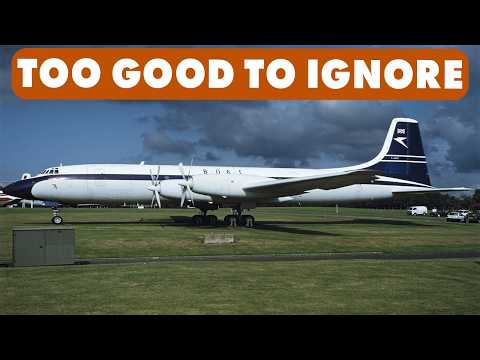
Video from the channel Flightscope Aviation about Bristol Britannia, linked on its Above Ten Thousand entry. Duration: 10:58. Language: English. Video type: Documentary.
What it's about
Documentary about the Bristol Britannia, the postwar British four-engined turboprop, which explains why an aircraft so admired for its engineering sold far fewer units than expected. It opens with a 1956 demonstration flight, after which Howard Hughes, TWA's majority shareholder, ordered 30 aircraft that he never received.
Historical context
The project stems from the 1943 Brabazon committee as a medium-range aircraft for BOAC's routes. Bristol opted for the Proteus turboprop and the design grew to 74 seats and Atlantic-crossing range. The prototype flew at Filton on 16 August 1952, piloted by Bill Pegg. Trouble followed: in February 1954 the second prototype had to make an emergency landing on the mudflats of the Severn estuary, another aircraft crashed during testing killing 15 people, and the Proteus engines suffered icing in their air intakes. BOAC turned this last fault into a public crisis that delayed entry into service by about two years. By the time the aircraft was ready, Bristol could not deliver it to American airlines in time, and the Boeing 707 and Douglas DC-8 were about to arrive.
Key facts
Bristol had planned to build around 180 aircraft and sold about 80. In December 1957, the Series 300 gave BOAC its first nonstop service between London and New York. BOAC retired it in April 1965, but the aircraft kept flying with Canadian Pacific, with El Al (which in 1960 used it to smuggle a captured Nazi war criminal out of Argentina), with Cubana for more than three decades, and with the RAF until 1975. In Zaire it was hauling cargo in the early 1990s, and its last flight was in 1997.