Bristol Britannia variant
Bristol Britannia 314
Long-range Series 310 version built for Canadian Pacific Air Lines: six aircraft delivered from April 1958 for the Canadian carrier's polar and trans-Pacific routes.

- 6
- Units built
- 7,130 km
- Range
- 139
- Passengers
History
The Britannia 314 was the Series 310 version built specifically for Canadian Pacific Air Lines, the privately owned Canadian carrier that had made the great-circle routes from its Vancouver base to the Far East and Europe the cornerstone of its business. Six were built, all production aircraft with no prototype of their own. The Series 310 shared the long fuselage and the cabin of up to 139 seats with the 305, but added strengthened fuselage skin and undercarriage and an enlarged fuel capacity, which is why it was originally known as the 300LR, for long range. Within that family, the 312 designation covered the 18 aircraft for BOAC, the 313 the four for El Al and the 314 the six for Canadian Pacific; the Canadian airline would later also receive two Model 324s, built to the longer-range 320 standard, which it sold to Cathay Pacific in 1961.
The Canadian order took shape while the programme was at its lowest ebb. The first prototype, G-ALBO, had flown from Filton on 16 August 1952 with Bill Pegg at the controls, but development dragged on far longer than planned: after the unexplained Comet crashes of 1953 and 1954 the Air Ministry demanded lengthy testing; in February 1954 the second prototype, G-ALRX, was lost on the mudflats of the Severn Estuary after a reduction-gear failure and engine fire; and the inlet-icing problems of the Proteus turboprops pushed entry into service back to February 1957, roughly two years late. Even so, while BOAC was still running route-proving trials through 1955, orders from El Al and Canadian Pacific were already on Bristol's books, and it was those two airlines, together with BOAC itself, that gave the transatlantic Series 310 its commercial purpose.
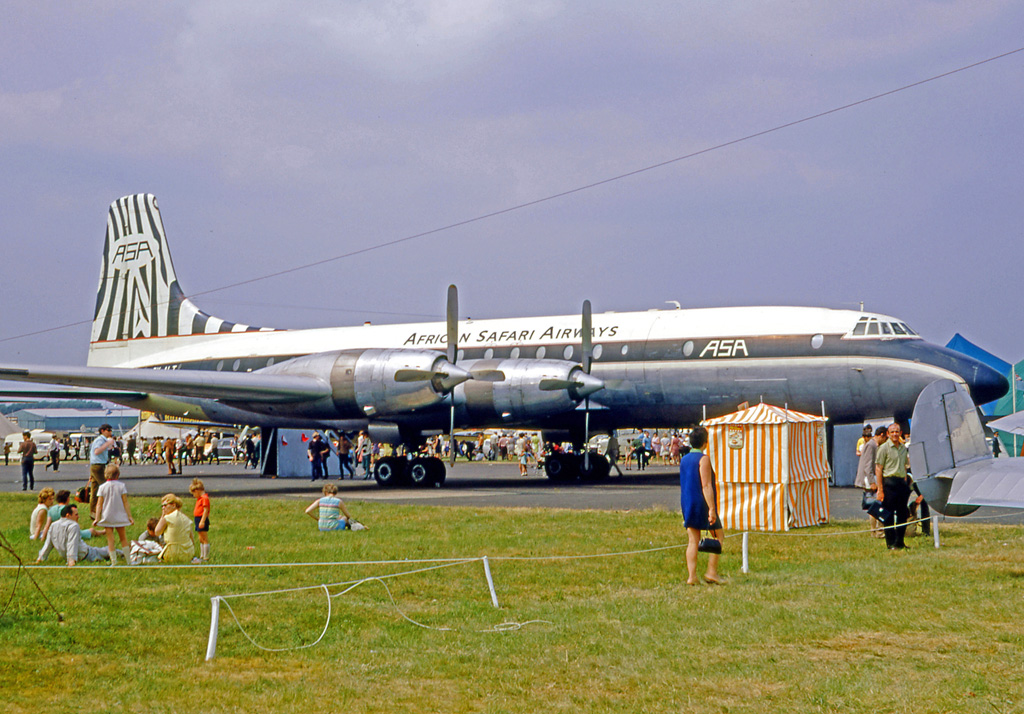
Canadian Pacific took delivery of the first of its six Model 314s on 1 April 1958. The aircraft that would become the best known of the fleet, registered CF-CZB, first flew on 14 April 1958 and was delivered new on 29 April that year, named Empress of Vancouver and later renamed Empress of Lima in keeping with the airline's custom of giving its aircraft "Empress" names; another, CF-CZW, carried the name Empress of Rome. With the Britannias the airline replaced its DC-4s and DC-6Bs on international services. The 1959 intercontinental timetable shows Flights 301/302 linking Sydney, Nadi, Honolulu, Vancouver and Edmonton, with a non-stop extension over the polar route to Amsterdam, alongside services to Tokyo and Hong Kong, to Lima, Santiago and Buenos Aires, and to Mexico City, Lisbon and Madrid. The type was also used on a non-stop Windsor, Ontario to Mexico City service originating in Toronto.
The 314's front-line career was short. Douglas DC-8 jets began to replace the turboprops from 1961, although the Britannias stayed on well into the decade on routes the new jets could not serve, such as Auckland, flown until Whenuapai closed to civil traffic in November 1965. The fleet's gravest episode came in that final stretch. On 22 July 1962 CF-CZB was operating Flight 301 from Honolulu to Nadi when, shortly after take-off, the crew received a fire warning on the number one engine, feathered it and jettisoned fuel before returning to the airport 40 minutes later. The three-engined approach appeared normal, but at the last moment the crew elected to go around; the aircraft banked and veered left, the wing tip struck the ground and the airframe was destroyed by fire apart from the rear fuselage and tail. Twenty-seven of the 40 people on board died. The investigation board attributed the probable cause to the attempted three-engine go-around in full landing configuration at insufficient airspeed and altitude to maintain control. It remains the worst civil air carrier accident in Hawaii's history.
The 314 sums up the fate of the whole Britannia programme: an aircraft popular with passengers and technically mature by the time it reached the fleets, but left without time by the protracted Proteus development as the DC-8 and Comet 4 arrived. Of the 180 Britannias once projected only about 80 were sold (85 were built before production ended in 1960, 30 of them at Belfast by Short Brothers and Harland), and among them the six Canadian 314s were, together with BOAC's 312s and El Al's 313s, the only Series 310 aircraft ordered new by scheduled airlines for long-haul service.
Multimedia


-1600.webp)

