Fighter · Military · United States
Boeing F/A-18E/F Super Hornet
- November 29, 1995
- First flight
- 1999
- Introduced
- In service
- Status


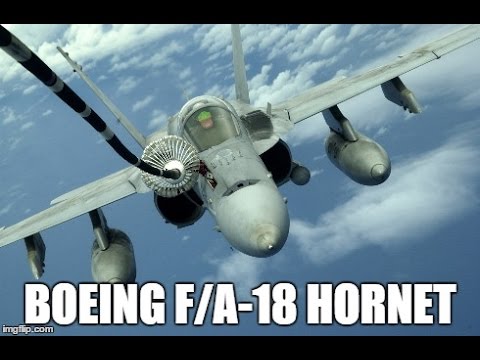
The F/A-18E/F Super Hornet is a supersonic, twin-engine, carrier-based multirole fighter that began life as an enlarged development of the McDonnell Douglas F/A-18 Hornet and is now built by Boeing. The E is a single-seater, while the F carries a crew of two in tandem. It kept its predecessor's designation so that it could be sold to Congress as a low-risk derivative, yet it is essentially a new aircraft: roughly 20% bigger, with a third more internal fuel, a larger wing, more powerful F414 engines and a much smaller frontal radar signature. Navy crews call it the “Rhino”, a nickname that keeps it distinct from older Hornets on the radio. The programme grew out of the turmoil that hit US naval aviation at the end of the Cold War. The cancellation of the A-12 Avenger II in 1991, the demise of a navalised F-22 and deep budget cuts left the Navy without a replacement for the A-6 Intruder and without an affordable successor to the F-14 Tomcat. Ordered in 1992, the Super Hornet first flew on 29 November 1995 at St. Louis. Full-rate production began in September 1997, one month after Boeing took over McDonnell Douglas, with Northrop Grumman building the centre and aft fuselage and the vertical tails. It joined the fleet in 1999 and reached initial operating capability in September 2001 with squadron VFA-115. Since then it has been the backbone of American carrier air wings. It replaced the F-14, the A-6, the S-3 Viking and the KA-6D tanker, can refuel other aircraft from a buddy store, and spawned the EA-18G Growler electronic-warfare variant. It has flown combat missions over Iraq and Afghanistan, against the Islamic State and against the Houthis in the Red Sea, and in 2017 it scored its first air-to-air kill, a Syrian Su-22. Only two foreign customers have bought it: Australia, which took 24 F/A-18Fs from 2010 as a stop-gap after retiring the F-111, and Kuwait, with 22 single-seaters and 6 two-seaters. Boeing pitched it widely, to Brazil, India, Canada, Denmark, Finland, Germany, Switzerland and Spain among others, and usually lost to the F-35, the Rafale, the Gripen or the Typhoon. The Block II standard, with the APG-79 electronically scanned radar, and Block III, with a large touchscreen cockpit and open mission systems, have kept it relevant. Production was due to end in 2027, and the Navy plans to replace it with the future F/A-XX from the 2030s. The very first Super Hornet built has been on display at the National Museum of Transportation in St. Louis since 2024.
Related events
- First flight of the Boeing F/A-18E/F Super Hornet
- Service entry of the Boeing F/A-18E/F Super Hornet
- Super Hornet reaches initial operational capability with VFA-115
- First combat use of the Super Hornet over Iraq
- First RAAF Super Hornets arrive at Amberley
- Super Hornet shoots down a Syrian Su-22, its first aerial kill
Related sheets
Category
Boeing F/A-18E/F Super Hornet in the news
After completing a series of milestones in its process of joining the fleet, the future nuclear carrier USS John F. Kennedy (CVN-79) continues advancing with compatibility testing of…

The test carried two prototypes without release; the program advances toward initial operational capability… The post appeared first on…

After resuming operations following an extensive maintenance period, the nuclear aircraft carrier USS Dwight D. Eisenhower (CVN-69) will return to Naval Station Norfolk, Virginia (USA), for…

Strike Fighter Squadron 41's F/A-18Fs let loose hundreds of air-to-surface and air-to-air weapons during the war with Iran. The post All The Weapons A Single Navy Fighter Squadron Launched During…
As VFA-41 returned to NAS Lemoore on Oct. 1, one of their jets carried a unique decoration indicating its involvement in the destruction of an unidentified Iranian submarine during the squadron’s…


History
Origins: from the YF-17 to the “Hornet 2000”
The Super Hornet's wing and tail layout go back to a Northrop study of about 1965, the P-530, which reworked the light F-5E with a bigger wing, twin fins and a leading-edge root extension. As the YF-17 Cobra it lost the Air Force's Lightweight Fighter contest to the YF-16, but the Navy judged the twin-engine layout better suited to carrier work. Redesigned and enlarged, it became the F/A-18 Hornet, developed by Northrop together with McDonnell Douglas, which ended up as prime contractor.
The Hornet proved effective but short-legged. In the 1980s McDonnell Douglas was already marketing an enlarged version, first called “Hornet II” and then “Hornet 2000”, with a bigger wing, a stretched fuselage holding more fuel and more powerful engines. The idea gathered dust until the end of the Cold War changed everything.
A derivative for an age of cuts
By the early 1990s US naval aviation was in trouble. The A-12 Avenger II, meant to replace the ageing A-6 Intruder, was cancelled in 1991 after serious problems. The Navy started the A-X advanced attack programme, which grew into A/F-X once fighter capabilities were added, and between 1991 and 1992 it gradually dropped NATF, a carrier version of the F-22 whose costs had spiralled.
Meanwhile Defense Secretary Dick Cheney cut F-14D purchases in 1989 and halted production in 1991, dismissing the Tomcat as 1960s technology. Grumman's “Quick Strike” and later, more ambitious upgrades were judged either too modest or too expensive. The Super Hornet looked like the low-risk answer, and the 1993 Bottom-Up Review cancelled A/F-X. An aircraft first conceived as an interim solution became the mainstay of the carrier air wing. Betting everything on the Hornet family was controversial: Congressman Duke Cunningham, a Vietnam War ace, attacked it as an unproven design that gave away air superiority.
Order, development and testing
The Navy ordered the Super Hornet in 1992, with the engineering and manufacturing development phase capped at 4.88 billion dollars in fiscal 1990 terms. Keeping the F/A-18 designation helped present it as a derivative, and the approach was deliberately cautious: incremental improvements over the F/A-18C/D, affordability and reliability before raw performance. Hornet and Super Hornet shared avionics, ejection seats, radar, weapons, mission computer software and maintenance procedures. The F414 engine was derived from the Hornet's F404 and borrowed advances from the F412 planned for the A-12. Work was split as on the Hornet: McDonnell Douglas (later Boeing) built the forward fuselage, wings and stabilators, and Northrop Grumman the centre and aft fuselage and the fins. Design life was 6,000 flight hours.
The first aircraft, E1, Navy serial 165164, took off from St. Louis Lambert airport on 29 November 1995 with McDonnell Douglas test pilot Fred Madenwald at the controls. Flight testing ramped up in 1996, and on 18 January 1997 then-Lieutenant Francis Morley made the first Super Hornet carrier landing, in F1; he later became a vice admiral. Low-rate production began in March 1997 and full-rate production that September, a month after McDonnell Douglas merged with Boeing. Testing ran until 1999 with sea trials and air-refuelling demonstrations, and required fixes for a sudden “wing drop” and possible store-separation problems. In all, 3,100 test flights logged 4,600 flight hours. Operational evaluation in 1999 led to approval in February 2000. The Navy regards the acquisition as a success, meeting cost, schedule and weight targets, the last with 181 kg to spare.
A new aircraft under a familiar name
Only the forward fuselage was kept; the rest shares little with the F/A-18C/D. The aircraft is about 20% bigger, some 3,200 kg heavier empty and 6,800 kg heavier at maximum weight than the original Hornet. The fuselage was stretched by 86 cm to hold fuel and future avionics and the wing area rose by 25%, yet the new design has 42% fewer structural parts. It carries 33% more internal fuel, extending mission range by 41% and endurance by 50%. Compared with the F-14 it replaced it is around 5,000 kg lighter empty; it cannot quite match the Tomcat's payload and range, but it handles better and is more reliable and cheaper to run.
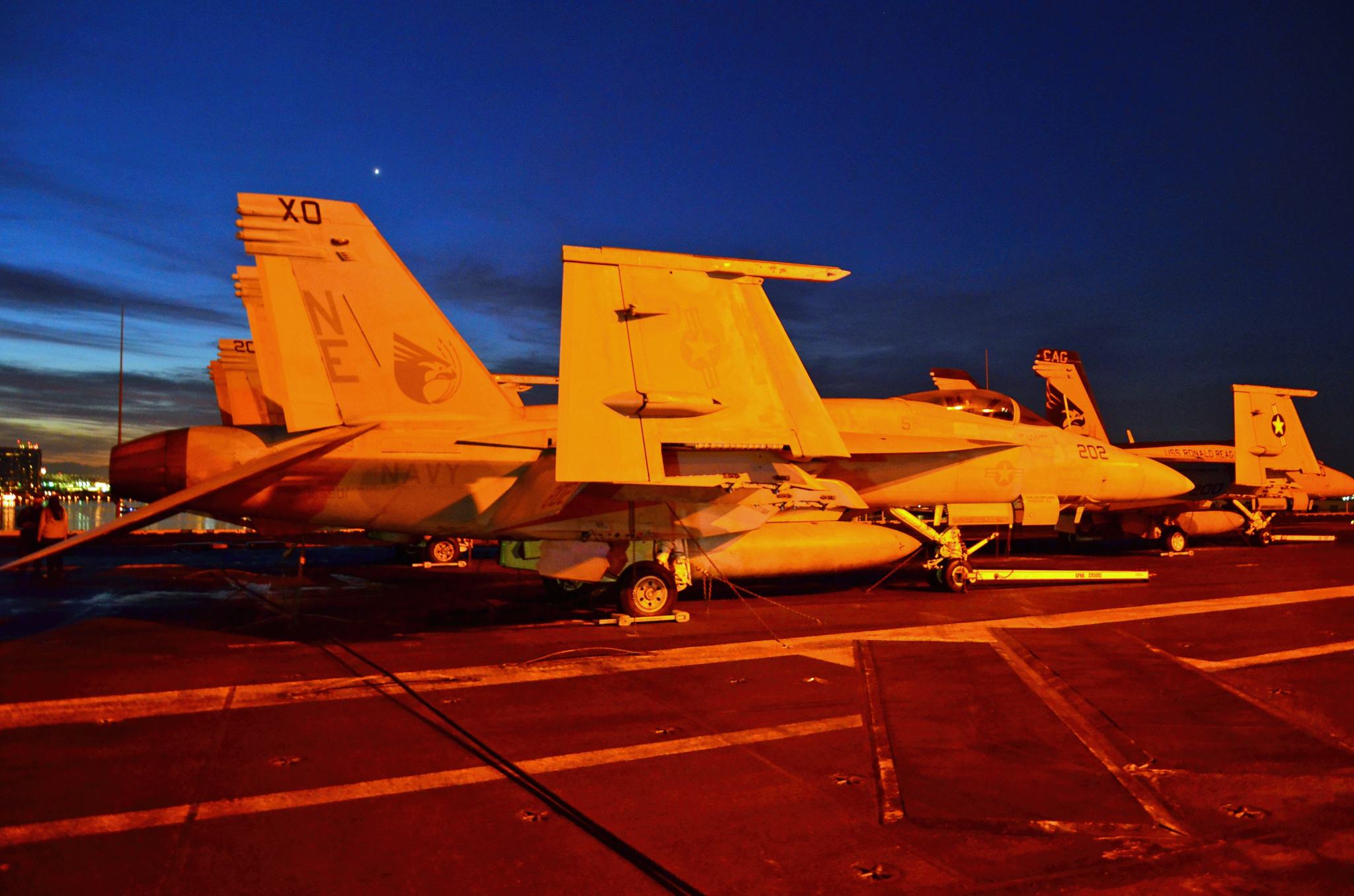
The intakes became rectangular caret designs with fixed ramps, feeding F414 engines that give 35% more thrust across most of the envelope and 98 kN in afterburner. Two extra wing stations brought the total to 11. Enlarged leading-edge extensions improve vortex lift at high angles of attack and allow pitch rates above 40 degrees per second with strong resistance to departure. To cure the wing drop, the wing gained a dogtooth and a strip of porous surface near the fold joint. The underwing pylons are canted slightly outwards, a fix for a store-strike risk spotted in early wind-tunnel work; it later proved unnecessary, but the tooling was already built and the pylons stayed to avoid re-flying the test programme, at the cost of extra transonic and supersonic drag.
One of its most valued qualities at sea is bringback, the ability to land back aboard with unused fuel and weapons, in excess of 4,100 kg. Its weight also means catapults and arresting gear must be set differently. The “Rhino” nickname, once worn by the F-4 Phantom II, owes something to the AN/APX-111 IFF antenna bulging on top of the nose.
A reduced radar signature
The Navy took a “balanced approach” to survivability: not a stealth aircraft like the F-22, but a trimmed radar signature combined with advanced electronic warfare, reduced ballistic vulnerability and stand-off weapons. Its frontal radar cross-section is an order of magnitude smaller than that of earlier-generation fighters. The caret intakes scatter energy sideways and fixed structures in the ducts steer it away from the fan blades; panel joints are serrated and aligned, gaps and resonant cavities are filled, and the grilles of earlier Hornets gave way to perforated panels that look opaque to radar.
Avionics and self-protection
At first avionics and software were 90% common with the F/A-18C/D of the time, to save development money. New items included an up-front touchscreen, a large colour multifunction display and a fuel display. Flight control is quadruplex digital fly-by-wire, able to sense and compensate for battle damage. Early aircraft used the APG-73 radar, later replaced by the AN/APG-79 active electronically scanned array. The AN/ASQ-228 ATFLIR pod is its main electro-optical sensor and laser designator, while communications rely on the AN/ARC-210 radio and MIDS terminals for Link 16.
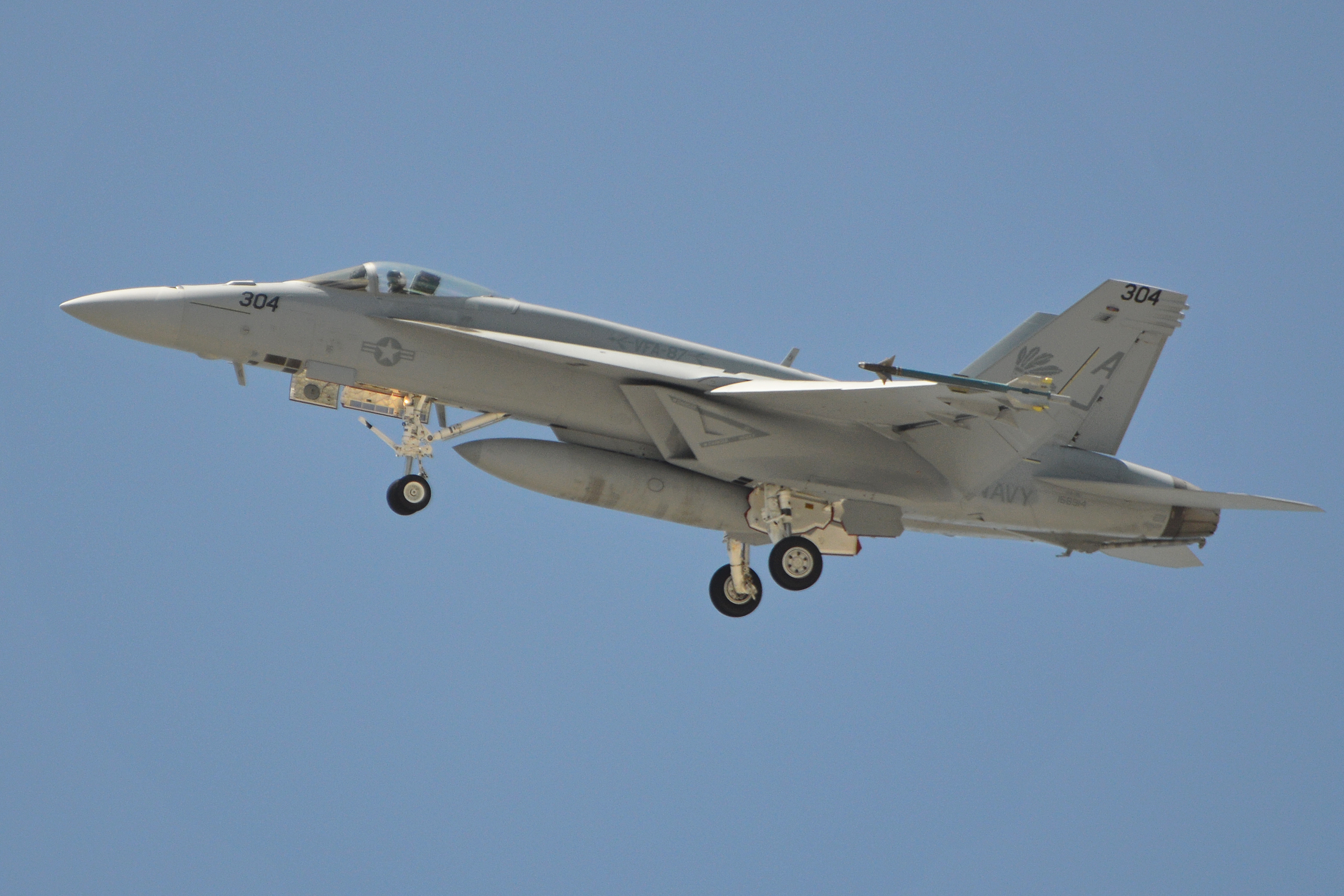
Block I self-protection combined the AN/ALR-67(V)3 radar warning receiver, the AN/ALE-47 dispenser, the AN/ALE-50 towed decoy and the AN/ALQ-165 jammer. Block II swapped the latter for the AN/ALQ-214 IDECM suite, made the lighting compatible with night-vision goggles and began replacing ALE-50 decoys with ALE-55s that can jam using IDECM data. VFA-213 became the first squadron flying AESA-equipped Super Hornets, declared safe for flight on 27 October 2006, and on 18 May 2007 received the first aircraft fitted with the JHMCS helmet-mounted cueing system. The SHARP pod added high-resolution digital tactical reconnaissance.
The fleet's tanker
Unlike the Hornet, the Super Hornet can carry a buddy refuelling store, taking over the organic tanker role the Navy lost when it retired the KA-6D and the S-3B Viking. In that fit it carries a 1,200-litre centreline tank with hose reel plus four 1,800-litre wing tanks, for some 13,000 kg of fuel on board. On typical missions a fifth of the air wing is tasked with tanking, which eats into fatigue life faster than other work.
Block II, Block III and the Advanced Super Hornet
Block II brought the AESA radar, larger displays, JHMCS and other avionics changes, some drawn from systems intended for the Boeing X-32. New-build aircraft received the APG-79 from 2005, and in January 2008 the retrofit of 135 earlier aircraft was announced. That year Boeing began discussing a Block III with more stealth features and longer range, plus a strengthened airframe good for 10,000 flight hours. In 2010 it offered prospective customers an “International Roadmap” with conformal fuel tanks, improved engines, an enclosed weapons pod (three of them could hold up to 12 AMRAAMs and 2 Sidewinders), a next-generation cockpit and an infrared search and track sensor.
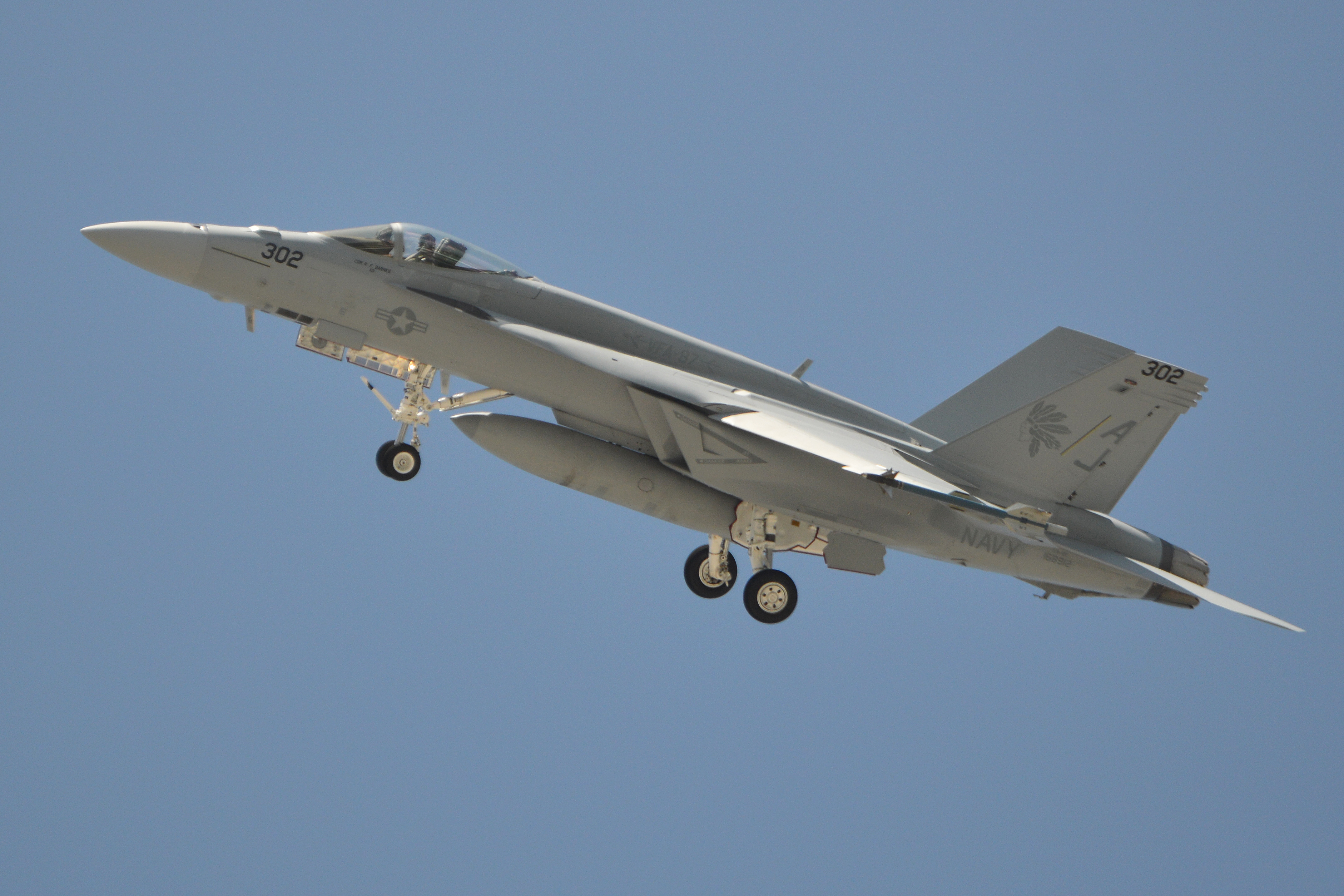
That sensor, the AN/ASG-34(V) IRST21, sits in the front of a modified centreline tank. Lockheed Martin was chosen in May 2009 to develop it and received a contract in November 2011; an F/A-18F flew with it in February 2014 and low-rate production was approved in December 2014. The 2013 sequestration cuts caused years of delay; the Navy skipped straight to the Block II sensor, which after early quality problems became operational in January 2025.
Boeing and Northrop Grumman self-funded an Advanced Super Hornet demonstrator, with a 50% cut in frontal radar cross-section, conformal tanks and an enclosed weapons pod, which flew from 5 August 2013 for three weeks. The conformal tanks added 1,600 kg of fuel, slightly reduced drag and stretched combat range by 480 km; the prototype set weighed 680 kg and production tanks were expected at 390 kg, though they hurt transonic acceleration. The Navy did not buy the package, but several elements migrated into Block III, and in 2021 it dropped plans to fit conformal tanks as standard because of cost, schedule and performance.
The first Block III aircraft were delivered in 2021 with a 25 by 48 cm panoramic touchscreen in place of the multifunction displays, a new processor, better networking and an open mission systems architecture. In 2019 Boeing won a 4 billion dollar contract for 78 Block III jets, and a service life modification line at St. Louis is turning Block II aircraft into Block IIIs with additional flight hours; the Navy plans to finish the conversions by 2033. The ATFLIR is due to give way to the AN/AAQ-28(V) Litening pod.
Procurement and production
Planned numbers swung widely. The 1997 Quadrennial Defense Review cut the original target of about 1,000 aircraft by nearly half. By October 2008 Boeing had delivered 367 Super Hornets, yet the Navy still faced a strike-fighter shortfall as old types retired, the Iraq and Afghanistan wars wore on and the F-35 slipped; in 2006 it was 60 fighters below its validated requirement. On 28 September 2010 a multiyear deal for 66 Super Hornets and 58 Growlers was signed, reportedly saving 600 million dollars over annual contracts. Boeing announced an end to production in 2025, later pushed back to 2027 with 17 more Navy orders. In 2025 the Navy had 416 F/A-18E/Fs in service and 93 on order; each deployable squadron has a standard establishment of 12 aircraft. The Navy paid around 52 million dollars per aircraft.
In US Navy service
The Super Hornet joined the fleet in 1999 and reached initial operating capability in September 2001 with VFA-115 at Naval Air Station Lemoore, California, also the first unit to take it into combat. On 6 November 2002, during Operation Southern Watch, two F/A-18Es struck surface-to-air missile launchers at Al Kut and a command bunker at Tallil in Iraq, and one of them dropped 910 kg JDAM bombs in combat for the first time. In the invasion of Iraq, VFA-14, VFA-41 and VFA-115 flew close air support, strike, escort, defence-suppression and tanker sorties; the VFA-14 jets acted mostly as tankers and the VFA-41 crews as airborne forward air controllers.
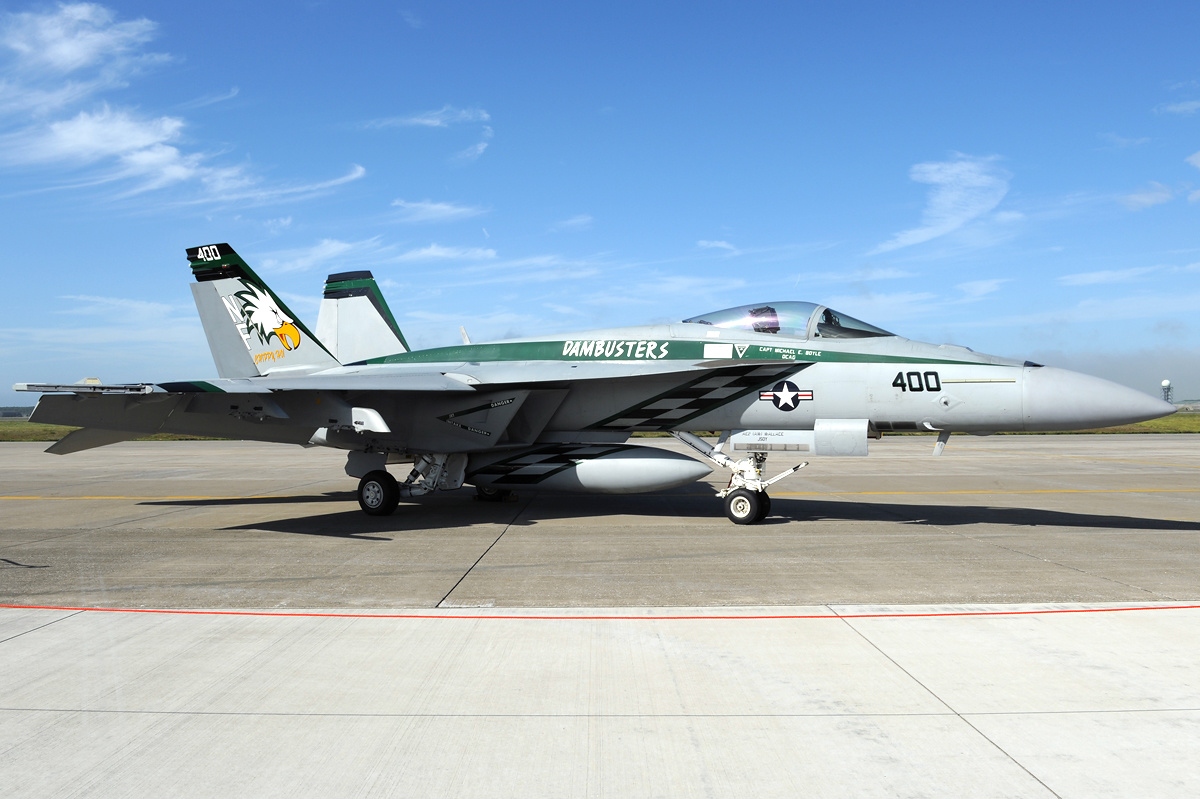
On 8 September 2006 VFA-211 F/A-18Fs attacked Taliban positions near Kandahar during Operation Medusa. On the 2006-2007 cruise of Dwight D. Eisenhower, VFA-103 and VFA-143, alongside legacy Hornet squadrons, expended 140 precision weapons and flew nearly 70 strafing runs. The type can also operate from the French carrier Charles de Gaulle. In August 2014, to protect US personnel in Irbil and the airdrops to Yazidi civilians, two Super Hornets from George H.W. Bush bombed an Islamic State artillery piece.
On 18 June 2017 an F/A-18E of VFA-87 flown by Lieutenant Commander Michael Tremel shot down a Syrian Su-22 near Tabqa after it had bombed near Syrian Democratic Forces positions. An AIM-9X missed and an AIM-120 hit; the engagement lasted eight minutes. It was the first kill of a crewed aircraft by a US fighter since 1999, the Navy's first since the 1991 Gulf War and the Super Hornet's first ever. In 2018 Boeing was contracted to convert nine F/A-18Es and two F/A-18Fs for the Blue Angels, the Navy's flight demonstration squadron.
In the Red Sea, on 26 December 2023 Super Hornets from Eisenhower and the destroyer Laboon downed drones, anti-ship missiles and cruise missiles fired by the Houthis, and on 12 January 2024 they joined allied strikes that hit 60 targets at 16 sites.
Accidents and losses
On 6 April 2011 an F/A-18F of the VFA-122 demonstration team crashed while attempting a roll with too much speed, killing both crew; the manoeuvre was dropped from the routine. On 31 July 2019 a VFA-151 F/A-18E hit the wall of the so-called Star Wars Canyon in California, killing the pilot and injuring seven French tourists at a viewpoint. On 3 June 2022 a VFA-113 F/A-18E crashed near China Lake, killing its pilot.
The Red Sea campaign brought a run of unusual losses. On 22 December 2024 a VFA-11 F/A-18F was shot down by mistake by the cruiser Gettysburg; both crew survived. On 28 April 2025 a VFA-136 F/A-18E went over the side from Harry S. Truman's hangar as the ship turned hard to evade a Houthi attack, and on 6 May 2025 another Super Hornet was lost when the arresting gear failed on landing, its crew ejecting and being recovered. On 20 August 2025 a VFA-83 F/A-18E went down off Virginia, and on 26 October 2025 an F/A-18F from Nimitz was lost in the South China Sea.
Australia: the stop-gap
On 3 May 2007 the Australian government signed for 24 F/A-18Fs as an interim replacement for its ageing F-111s and a hedge against F-35 delays; with ten years of training and support the expected cost was about 6 billion Australian dollars. The deal drew fire: retired RAAF officers such as Peter Criss and Ted Bushell questioned spending so much on an interim jet unable to fill the F-111's strategic role. The incoming Labor government reviewed it at the end of 2007 but confirmed it on 17 March 2008, arguing that the F-111's retirement was irreversible and cancellation would be costly. The aircraft were Block IIs with APG-79 radar and Link 16, and in February 2009 it was decided to pre-wire 12 of them on the line for possible Growler conversion.
The first Australian F/A-18F flew at St. Louis on 21 July 2009. The first five reached RAAF Base Amberley, Queensland, on 26 March 2010, six more followed on 7 July, and the first squadron was declared operational on 9 December 2010. In 2013 Australia chose to buy 12 new EA-18Gs rather than convert any F/A-18Fs. In September 2014 eight F/A-18Fs deployed to the United Arab Emirates against the Islamic State, and on 8 October they made their first strike, in northern Iraq. In 2017 No. 6 Squadron's F/A-18Fs moved to No. 1 Squadron as the former re-equipped with Growlers. On 8 December 2020 A44-223 ran off the runway at Amberley on take-off; the crew ejected, the fleet was grounded during the investigation, which blamed pilot error, and the aircraft returned to service in mid-2021.
Kuwait
In 2015 a Kuwaiti order for 28 aircraft with options on 12 more was reported, but that September Kuwait signed for 28 Eurofighters instead. In November 2016 the US approved the sale of 32 F/A-18Es and 8 F/A-18Fs, and in June 2018 Kuwait ordered 22 F/A-18Es and 6 F/A-18Fs for 1.5 billion dollars. Deliveries planned for January 2021 slipped because of the COVID-19 pandemic. The E1 prototype was even used to test weapon mounts for the Kuwaiti programme.
A long list of lost competitions
Boeing pitched the Super Hornet as the logical next step for Hornet users, yet it usually lost. Malaysia looked at it in 2002 and chose the Su-30MKM in 2007. Brazil made it one of three finalists in 2008 and went for the Gripen in December 2013, amid tension over US spying. India evaluated an F/A-18IN version in 2009 and dropped it in 2011 in favour of the Rafale, which its navy also picked in 2025. Canada announced an interim buy of 18 Super Hornets in November 2016, but Boeing's trade complaint against Bombardier's CSeries airliners, with a proposed 219% tariff, sank the deal; Canada bought used Hornets from Australia instead, and in November 2021 Boeing was out of the definitive competition.
Denmark preferred 27 F-35As to 38 Super Hornets in 2016, and Boeing lost the lawsuit it brought. Finland flight-evaluated it at Tampere-Pirkkala in February 2020 and ordered the F-35 in February 2022. Germany announced in April 2020 a plan including 30 Super Hornets and 15 Growlers, abandoned after Russia invaded Ukraine. Switzerland, Belgium, Poland and Spain chose other fighters; Britain considered it in 2010 as a substitute for the F-35B, and the US Marine Corps shunned the programme to protect its F-35B plans.
Surviving aircraft
E1, serial 165164, the first Super Hornet built, flew the initial test programme, ended up in outdoor storage at Boeing and was close to disposal when Tim Bischof, its flight test engineer from 1994 to 1999 and now director of the National Museum of Transportation in St. Louis, Missouri, rallied support to save it. With help from the Navy office that manages stricken aircraft and more than a hundred volunteers, the museum dedicated it on 3 August 2024.

Serial 165536, the ninth production aircraft (construction number 1471/E009), served with test squadrons VX-23 at Patuxent River and VX-31 at China Lake, where it also flew chase during F-35 development. In 2019 and 2020 it flew alongside 165667 for the filming of Top Gun: Maverick in special markings. Delivered to the Blue Angels on 27 July 2020, it was their number 5 jet from the 2021 season to the 2024 season. Now retired, it was still under restoration at the Palm Springs Air Museum in California in July 2026, being prepared in Blue Angels colours as a highlight of the museum's 30th anniversary celebrations in 2026–2027.
Main characteristics (F/A-18E/F)
The aircraft is 18.31 m long, with a 13.62 m span and a height of 4.88 m, and a wing area of 46.5 m². Empty weight is 14,552 kg and maximum take-off weight 29,937 kg. Internal fuel is 6,668 kg in the E and 6,241 kg in the F, with up to four 1,817-litre external tanks. Power comes from two General Electric F414-GE-400 turbofans rated at 58 kN dry and 98 kN with afterburner. Top speed is Mach 1.8 (1,908 km/h) at altitude and Mach 1.06 (1,296 km/h) at sea level; service ceiling is 15,940 m, climb rate 228 m/s and design load factor 7.5 g. Combat radius on a hi-lo-hi mission with two laser-guided bombs, missiles and three drop tanks is 1,033 km, and ferry range is 3,330 km. Armament comprises an M61A2 20 mm rotary cannon with 412 rounds and 11 stations for up to 8,050 kg of AMRAAM and Sidewinder air-to-air missiles, anti-ship and stand-off missiles, guided bombs and mines; carrier bringback is 4,491 kg for the E and 4,082 kg for the F.
Succession
From the F-14's retirement in 2006 until the F-35C arrived, every Navy combat jet was a Hornet variant. Folding so many missions into one type was expected to save a billion dollars a year across the fleet. Modernised to Block III, the Super Hornet will stay in the front line until the F/A-XX, its planned successor, begins arriving in the 2030s.
Variants
| NEA-18G | Advanced Super Hornet | EA-18G Growler | F/A-18E | F/A-18E/F Block II | F/A-18E/F Block III | F/A-18F | Growler Lite | |
|---|---|---|---|---|---|---|---|---|
| First flight | August 15, 2006 | — | — | — | — | — | — | — |
| Aircraft type | — | — | — | Carrier-based multirole fighter (attack and fighter) | — | — | — | — |
| Powerplant | — | — | — | 2 × General Electric F414-GE-400 afterburning turbofans (62.3 kN dry; 97.9 kN with afterburner, each) | — | — | — | — |
| Powerplant | 2 × General Electric F414-GE-400 | 2 × General Electric F414-GE-400 | 2 × General Electric F414-GE-400 | 2 × General Electric F414-GE-400 | 2 × General Electric F414-GE-400 | 2 × General Electric F414-GE-400 | 2 × General Electric F414-GE-400 | — |
| Thrust per engine | — | — | 98 kN Best value in this row | 98 kN Best value in this row | — | — | 98 kN Best value in this row | — |
| Length | — | — | 18.3 m Best value in this row | 18.3 m Best value in this row | — | — | 18.3 m Best value in this row | — |
| Wingspan | — | — | 13.6 m Best value in this row | 13.6 m Best value in this row | — | — | 13.6 m Best value in this row | — |
| Height | — | — | 4.9 m Best value in this row | 4.9 m Best value in this row | — | — | 4.9 m Best value in this row | — |
| Wing area | — | — | 46.5 m² Best value in this row | 46.5 m² Best value in this row | — | — | 46.5 m² Best value in this row | — |
| Empty weight | — | — | 15,011 kg | 14,552 kg Best value in this row | — | — | 14,552 kg Best value in this row | — |
| MTOW | — | — | 29,964 kg Best value in this row | 29,937 kg | — | — | 29,937 kg | — |
| Top speed | — | — | 1,900 km/h | 1,908 km/h Best value in this row | — | — | 1,908 km/h Best value in this row | — |
| Max speed altitude | — | — | 12,190 m | 12,192 m | — | — | 12,192 m | — |
| Cruise speed | — | — | — | 893 km/h Best value in this row | — | — | 893 km/h Best value in this row | — |
| Service ceiling | — | — | 15,000 m | 15,940 m Best value in this row | — | — | 15,940 m Best value in this row | — |
| Initial climb rate | — | — | — | 228 m/s Best value in this row | — | — | 228 m/s Best value in this row | — |
| Range | — | — | 2,346 km Best value in this row | 2,346 km Best value in this row | — | — | 2,346 km Best value in this row | — |
| Ferry range | — | — | 3,330 km Best value in this row | 3,054 km | — | — | 3,330 km Best value in this row | — |
| Combat radius | — | — | 722 km | 1,033 km Best value in this row | — | — | 1,033 km Best value in this row | — |
| Range conditions | — | — | — | Range of 2,346 km clean plus two AIM-9s (US Navy); ferry range 3,330 km per Wikipedia and 3,054 km per the US Navy (two AIM-9s and three 480-gallon tanks); combat radius 558 nautical miles on a hi-lo-hi mission (SAC) | — | — | — | — |
| Armament | — | — | — | 1 × 20 mm M61A2 Vulcan cannon (412 rounds); 11 hardpoints (2 wingtip, 6 underwing, 3 underfuselage) for AIM-9 Sidewinder, AIM-120 AMRAAM and AIM-7 Sparrow air-to-air missiles, AGM-65 Maverick, AGM-84 Harpoon, SLAM-ER, AGM-88 HARM, AGM-154 JSOW, AGM-158 JASSM/LRASM air-to-surface missiles, JDAM, Paveway and Mk 80 bombs, and mines | — | — | — | — |
| Max weapons load | — | — | 8,050 kg Best value in this row | 8,050 kg Best value in this row | — | — | 8,050 kg Best value in this row | — |
| Payload | — | — | — | 0 kg | — | — | — | — |
| Cargo capacity | — | — | — | No cargo hold or passengers; maximum external payload of 8,050 kg on 11 hardpoints | — | — | — | — |
| Crew | 2 | — | 2 | 1 Best value in this row | — | — | 2 | 2 |
| Passengers | — | — | — | 0 | — | — | — | — |
| Units built | 2 Best value in this row | — | — | — | — | — | — | 0 |
Where to see it today
| Serial | Variant | Place | City | Country | Status |
|---|---|---|---|---|---|
| 165164 | — | National Museum of Transportation | Kirkwood | United States | On display |
| First production F/A-18E (E1), which first flew on 29 November 1995 from Lambert Field; loaned by the National Naval Aviation Museum and on display since August 2024. | |||||
| 165536 | — | Palm Springs Air Museum | Palm Springs | United States | Under restoration |
| Former Blue Angels No. 5 (2021-2024) and the aircraft used in the filming of "Top Gun: Maverick"; it arrived by road in May 2026 and was being reassembled for display in Blue Angels livery. | |||||
List reviewed on October 31, 2026 against Wikipedia (EN) — Boeing F/A-18E/F Super Hornet, «Aircraft on display», National Museum of Transportation — F/A-18 E1 Super Hornet, HMDB — F/A-18 E1 Super Hornet (BuNo 165164), Vintage Aviation News — Palm Springs Air Museum Prepares Top Gun: Maverick F/A-18E Super Hornet for Display (14-07-2026).
Images
Elsewhere
- Wikimedia CommonsF/A-18E Super Hornet at RIAT 2016 ↗
- Wikimedia CommonsA44-203 Boeing F/A-18F Super Hornet, RAAF ↗
- Wikimedia CommonsF/A-18F after launch from USS Abraham Lincoln (CVN-72) ↗
- Wikimedia CommonsBoeing F/A-18F Super Hornet taking off, Danish Air Show 2014 ↗
- DVIDSF/A-18E Super Hornet ↗
- DVIDSSuper Hornet Performs Fly-By ↗
- DVIDSF/A-18E Super Hornet Conducts Flight Operations ↗
- Boeing ImagesBoeing Images: F/A-18E/F Super Hornet (asset 2F3XC5MDC8) ↗
- Boeing ImagesBoeing Images: F/A-18E/F Super Hornet (asset 2JRSXLJX8BOU) ↗
- NET-MAQUETTESF-18F Super Hornet walkaround photos ↗
- AlamyUnited States Navy F/A-18F Super Hornet jet fighter rolling into rainbow ↗
- 501st Combat Support Wing (USAFE)Boeing F/A-18 Super Hornet performs at the Royal International Air Tattoo ↗
Videos
 Boeing F/A-18E vs Super Hornet What Is the Difference Between FA-18E and F?| Hidden Fighter Upgrades
 The F/A-18 Super Hornet — Why the U.S. Navy Still Relies on a 30-Year-Old Fighter | Full Documentary



Show the 54 more
 Dietro le quinte di Top Gun: Maverick | Insegnare a volare a Tom Cruise | Pilota di F/A-18 | Patr...
 TOP GUN 2: Maverick à Paris. Des simulateurs d'avion de chasse F18 pour la sortie du film en Blu-ray
 Ecco come sarebbe andato davvero il duello aereo tra l'F-14 e il Su-57 di Top Gun | Top Gun: Mave...
 Duello aereo di Top Gun: Maverick | F/A-18 SuperHornet contro F-14 Tomcat | Digital Combat Simula...
 F/A-18 Super Hornet In Action - Carrier Break, Missile Launches & Chasing, HI-Speed Maneuvers & More