Beechcraft 1900 variant
Beechcraft 1900
The original Beechcraft 1900: a pressurised 19-seat commuter airliner derived from the Super King Air, with two airstair doors. Only three were built, serial numbers UA-1 to UA-3.

- September 3, 1982
- First flight
- 3
- Units built
- 19
- Passengers
History
The original Beechcraft 1900, known simply as the «1900», was the first version of Beechcraft's third regional airliner, after the Model 18 and the Model 99 Airliner. Its lineage goes back to 1949 and the Model 50 Twin Bonanza, which led to the Queen Air, the King Air and the Model 200 Super King Air. Beechcraft developed the 1900 directly from the latter to offer a pressurised commuter airliner able to compete with the Swearingen Metro and the British Aerospace Jetstream. Compared with the Super King Air, the fuselage was stretched by 4.26 m, new engines were fitted and aerodynamic features were added for stability: the «stabilons», small horizontal surfaces at the rear of the fuselage that overcome T-tail blanking when the aircraft flies at high angles of attack. The cabin seated 19 passengers plus two crew.
The prototype, registered N1900A, first flew at Beech Field, Wichita, Kansas, on 3 September 1982; the second prototype followed a month later. The FAA granted certification on 22 November 1983 under type certificate A24CE, which covers the King Air family, as the «Model 1900, Airliner», in the normal category and under Special Federal Aviation Regulation 41C, effective from 13 September 1982. The 1900C was also certified under that regulation, whereas the 1900D would later be certified to Part 23 «Commuter Category» standards. The type entered service in February 1984. At launch Beechcraft offered the commuter airliner, a version with a large rear cargo door for freight work (what became the 1900C) and a 12-seat executive model with two club-style sections separated by a galley; quick-release seats allowed conversion from passenger to cargo configuration in 20 minutes.
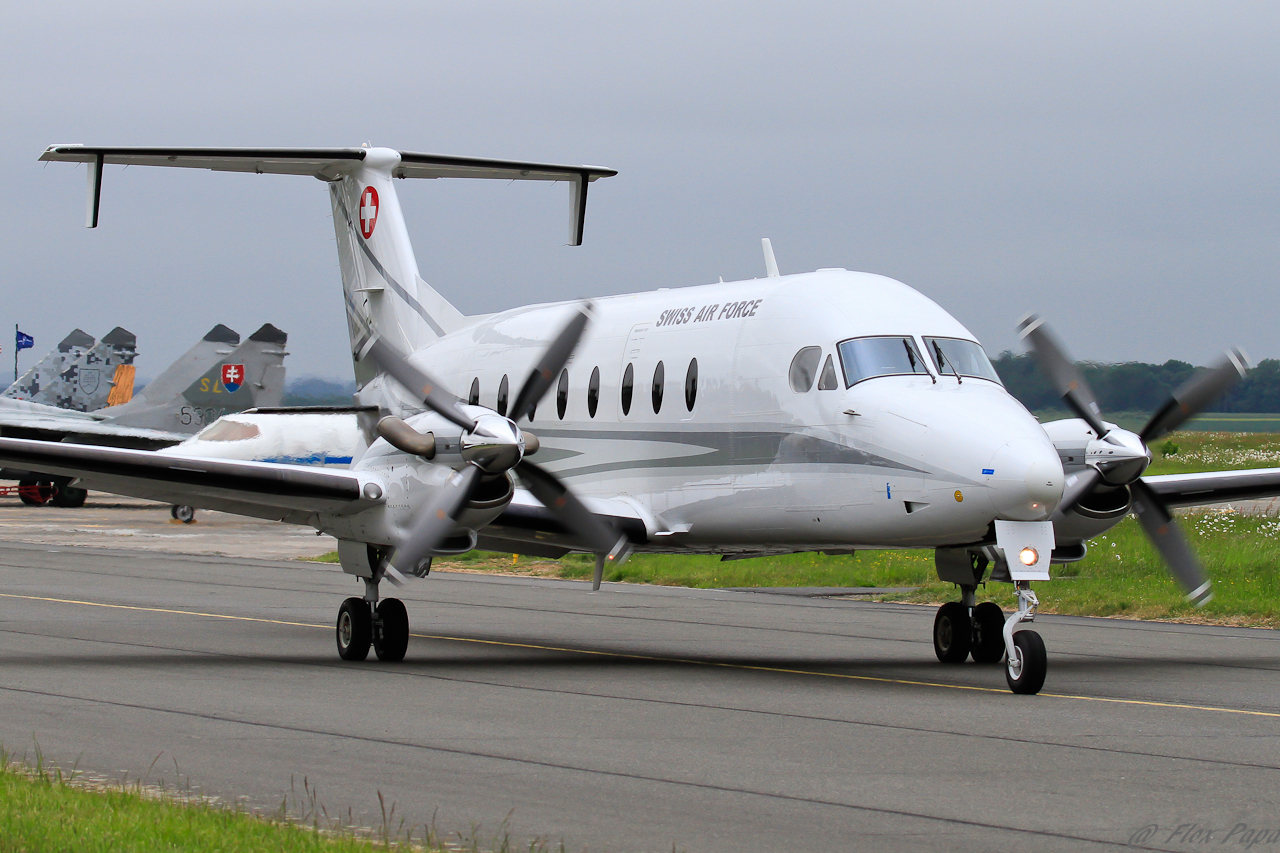
What defines this first version is its door layout: two airstair doors for passenger boarding, one near the tail, much like the smaller King Airs, and a second at the front just behind the cockpit, plus a small cargo door near the tail giving access to the baggage compartment behind the passenger cabin. It soon became clear that two airstairs were excessive on an aircraft holding only 19 passengers, so the 1900C kept the front airstair and replaced the aft one with an enlarged cargo door; otherwise the early 1900Cs were substantially similar to the original 1900.
The type certificate data sheet records its figures. It was powered by two Pratt & Whitney Canada PT6A-65B turboprops, each flat rated at about 820 kW for take-off, driving Hartzell HC-B4MP-3A four-blade composite propellers about 2.78 m in diameter. Maximum take-off weight was about 7.5 t and maximum landing weight about 7.3 t. It could carry up to 21 occupants including crew and was certified for single-pilot operation, although US rules require two pilots on airline passenger services; maximum operating altitude was about 7.6 km with the pressurised cabin. Maximum operating speed was 247 knots (about 457 km/h) indicated, with a maximum operating Mach number of 0.48, and manoeuvring speed was 188 knots (about 348 km/h). Like the early UB-series 1900Cs, it carried its fuel in bladder tanks inside the wings, with about 804 litres usable in each main tank; later 1900Cs moved to a «wet wing».
Only three were built, with serial numbers UA-1, UA-2 and UA-3. The first two were stored at a Beechcraft facility in Wichita, and the type certificate data sheet lists only UA-3 as an eligible Model 1900 airframe. UA-3, registered FAB-043, served in Bolivia with the Ministry of National Defence in La Paz until it was lost on 30 November 2011: on a flight from Uyuni to La Paz, on approach to El Alto, the crew made an emergency landing in an open field about 6 km from the airport; the undercarriage was torn off and the aircraft was written off, but all seven occupants escaped unhurt.
Multimedia
