Bomber · Military · United Kingdom
Avro Lancaster
- January 9, 1941
- First flight
- 1942
- Introduced
- 1964
- Retired
- 7,374–7,377
- Units built


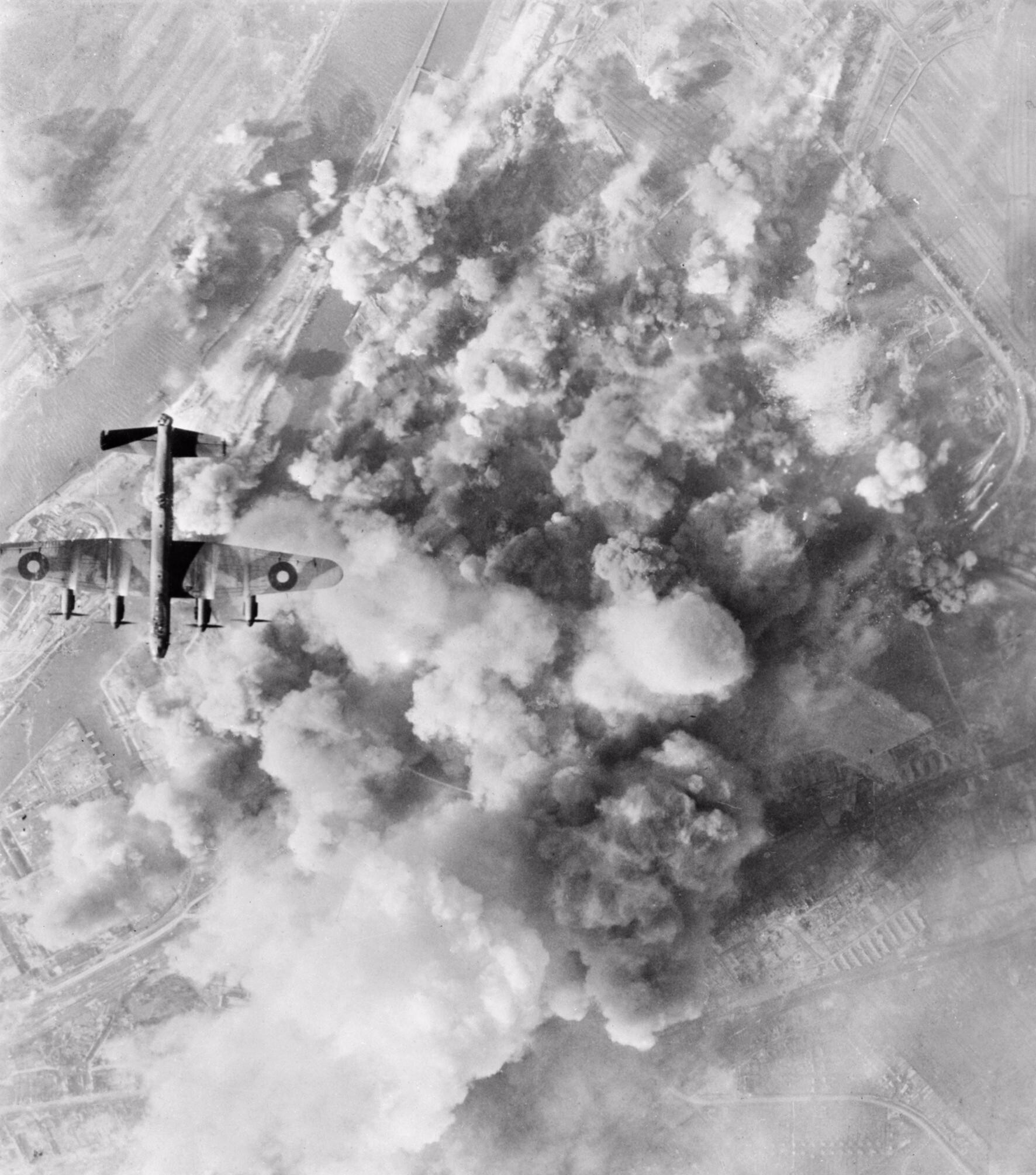


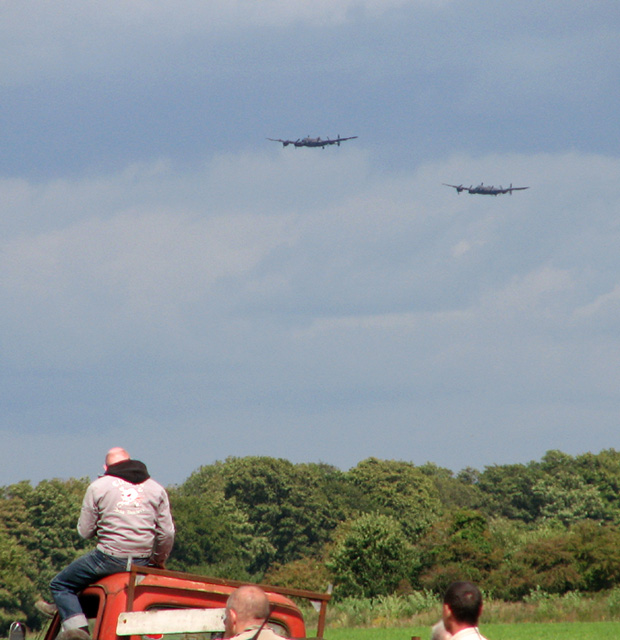


The Avro Lancaster was the four-engined heavy bomber with which RAF Bomber Command sustained its night offensive over Germany from 1942 until the end of the Second World War. It first flew on 9 January 1941 and 7,377 were built across ten factories in Britain and Canada. It grew out of a failure. The twin-engined Avro Manchester, designed to Air Ministry Specification P.13/36, was crippled by Rolls-Royce Vulture engines that were both underpowered and unreliable. In 1940 Avro's chief designer, Roy Chadwick, rebuilt the aeroplane around a larger wing and four Rolls-Royce Merlins; the improvement was so obvious that Manchester airframes still on the line were completed as Lancasters. The type's decisive virtue was neither speed nor ceiling but a ten-metre bomb bay free of internal obstructions. That bay carried the 4,000, 8,000 and 12,000 lb "blockbusters" and later, in specially modified aircraft, Barnes Wallis's earthquake bombs: the 12,000 lb (5,400 kg) Tallboy and the 22,000 lb (10,000 kg) Grand Slam, the heaviest offensive load of any bomber of the war. The Lancaster went to war in March 1942 with No. 44 Squadron and became the backbone of the British strategic bombing campaign, flying 156,000 sorties and dropping 608,612 long tons of bombs between 1942 and 1945, at a cost of 3,249 aircraft lost in action and an average life expectancy of twenty-one operations per airframe. It was also the instrument of the RAF's best-known special operations: Operation Chastise against the Ruhr dams in May 1943 and the sinking of the battleship Tirpitz in 1944. After the war it served as a photo-reconnaissance aircraft, maritime patroller, air-sea rescue platform, flying tanker and jet-engine testbed, and its airframe gave rise to the Lincoln, the York, the Lancastrian airliner and, indirectly, the Shackleton. It flew with France, Argentina and Canada, where the Royal Canadian Air Force retired it in 1964. Seventeen aircraft survive today, two of them airworthy.
Related events
Related sheets
Category
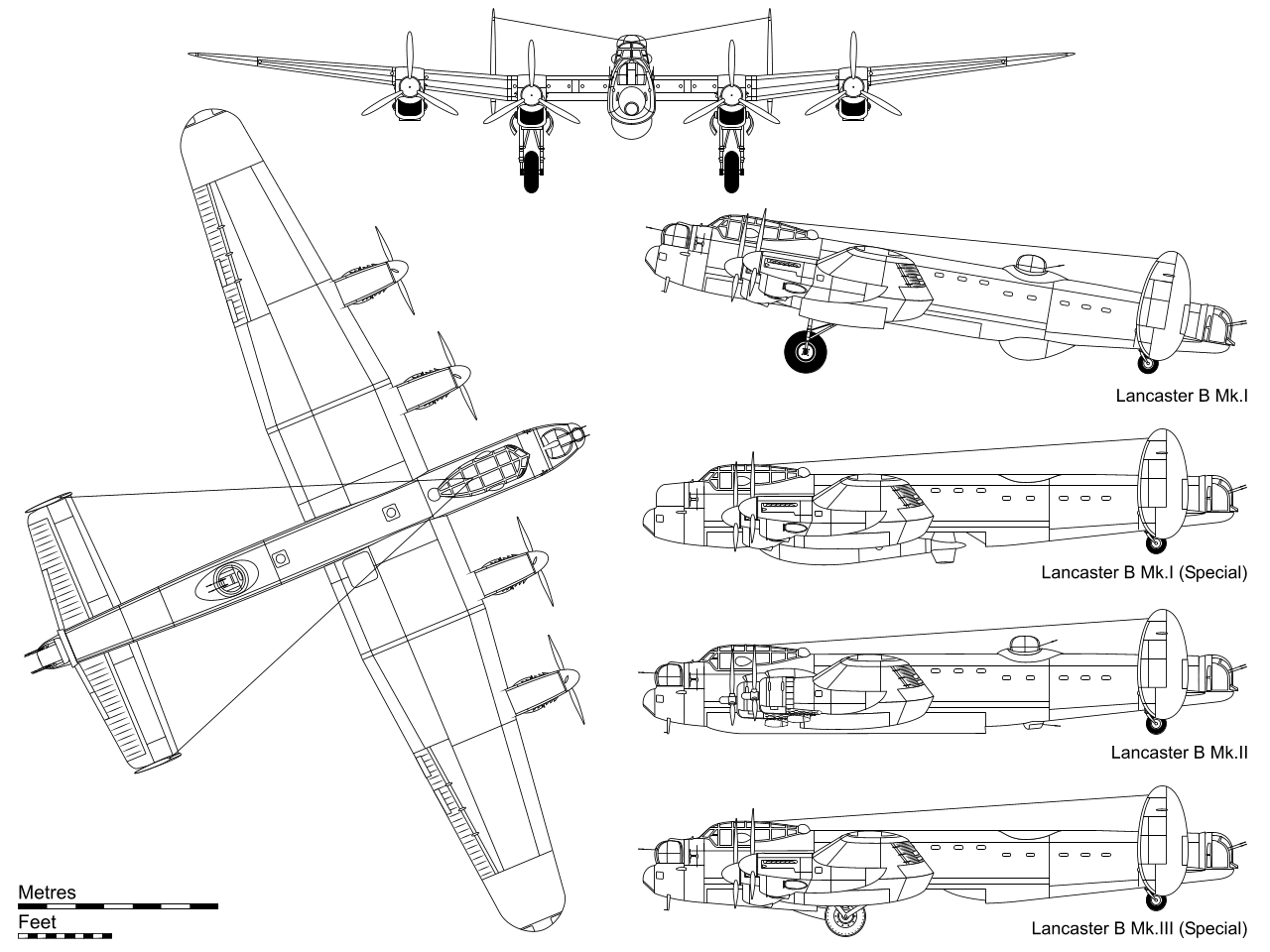
Three-view drawing
History
The Lancaster's story is that of an aeroplane conceived as the cure for another one's failure that ended up defining Britain's air offensive. Between its first flight in January 1941 and the retirement of the last operational Canadian airframe in 1964, the type passed through area bombing by night, precision special operations, Arctic photographic survey and even the flight testing of Britain's first turbojets.
From the Manchester to the Lancaster
Through the 1930s the RAF favoured twin-engined bombers, largely because British engine manufacturing and maintenance were already stretched. Power limitations were severe enough that the country invested heavily in very large engines of the 2,000 hp class, none of which were ready by the end of the decade. The United States and the Soviet Union, meanwhile, were building bombers around four smaller engines and getting good range and lifting capacity out of them, and in 1936 the RAF decided to examine the four-engined option too.
Air Ministry Specification P.13/36, issued that same year, called for a medium bomber for worldwide use able to carry a torpedo internally and to make shallow dive-bombing attacks, with a mid-mounted cantilever wing and all-metal construction; the Rolls-Royce Vulture, then under development, was encouraged. Avro tendered the Type 679 and in February 1937 its submission was chosen, with Handley Page's as a back-up; a pair of prototypes of each was ordered in April.
Avro's aircraft, named the Manchester, flew on 25 July 1939 and entered RAF service in November 1940. It was a disappointment: the Vultures were underpowered and unreliable, production was cut short at two hundred airframes and the type was withdrawn in 1942. The Manchester nevertheless bequeathed two decisive features to the Lancaster — a structure designed to be built in sections and an unusually long bomb bay, a direct consequence of the torpedo requirement.
Prototype BT308 and flight testing
By mid-1940 Avro's chief designer, Roy Chadwick, was already working on an improved Manchester with four Rolls-Royce Merlins — less powerful than the Vulture but far more dependable — installed in the "power-egg" arrangement developed for the Beaufighter II, on a wing of increased span. The initial designation, Type 683 Manchester III, was soon dropped in favour of the name Lancaster.
The prototype, serialled BT308, was assembled by Avro's experimental flight department at Ringway from a production Manchester fuselage combined with the new wing. Test pilot H. A. "Sam" Brown took it up for the first time on 9 January 1941. Testing quickly showed the aircraft to be a substantial advance on its predecessor. The first prototype retained the Manchester I's three-finned tail; the second, DG595, introduced the larger elliptical twin-finned unit that became characteristic of the type, improving stability and the dorsal turret's field of fire, and was fitted with more powerful Merlin XX engines. The first production Lancaster, L7527, flew in October 1941.
Production: Chadderton, Woodford and the Lancaster Aircraft Group
Avro received an initial contract for 1,070 aircraft, and outstanding Manchester orders were converted into Lancaster orders. Most wartime machines came out of Avro's Chadderton works near Oldham and were flight-tested from Woodford Aerodrome in Cheshire. It was soon clear that demand exceeded Avro's capacity, so the Lancaster Aircraft Group was formed: a consortium of firms that either carried out primary assembly or produced sub-sections and components for the others. Even Wythenshawe bus garage, built in reinforced concrete between 1939 and 1942, was requisitioned by the Ministry of Aircraft Production and used by Avro.
Besides Avro, Lancasters were built by Metropolitan-Vickers — 1,080 of them, also tested at Woodford — and by Armstrong Whitworth, and later by the Austin Motor Company at Longbridge, Birmingham, and post-war by Vickers-Armstrongs at Chester and Castle Bromwich. Short Brothers in Belfast received an order for two hundred B.Is that was cancelled before any were completed.
The industrial effort was vast. According to the Royal Air Force Museum, six major companies built 7,377 aircraft at ten factories on two continents, and at the height of production more than 1,100,000 men and women were employed by over 920 companies working on the programme. The Bomber Command Museum of Canada, by contrast, puts total production at 7,374: the discrepancy is recorded rather than silently resolved.
Canada: Victory Aircraft and the Mark X
In early 1942 it was decided to build the bomber in Canada as well, where it was manufactured by Victory Aircraft at Malton, Ontario. That August a British-built B.I was flown out as a pattern aircraft, becoming the first Lancaster to cross the Atlantic. The first Canadian-built machine was named "Ruhr Express". The first batch delivered to England arrived with faulty ailerons, a defect traced to the use of unskilled labour. By the end of the war more than 10,000 Canadians were working on the line, which was turning out one Lancaster a day; 430 B Xs were built between 1943 and 1945, differing from their British counterparts chiefly in their Packard-built Merlins and American-pattern instruments and electrics.
Design: an unobstructed bomb bay
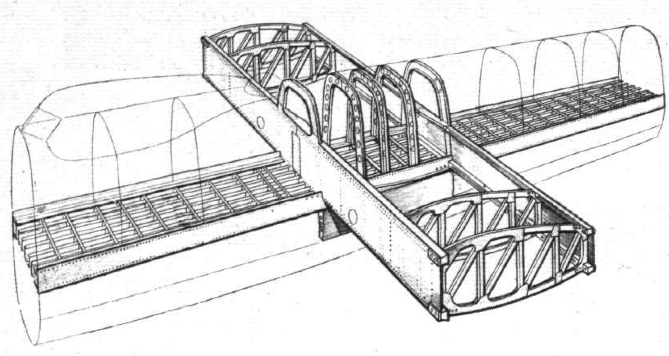
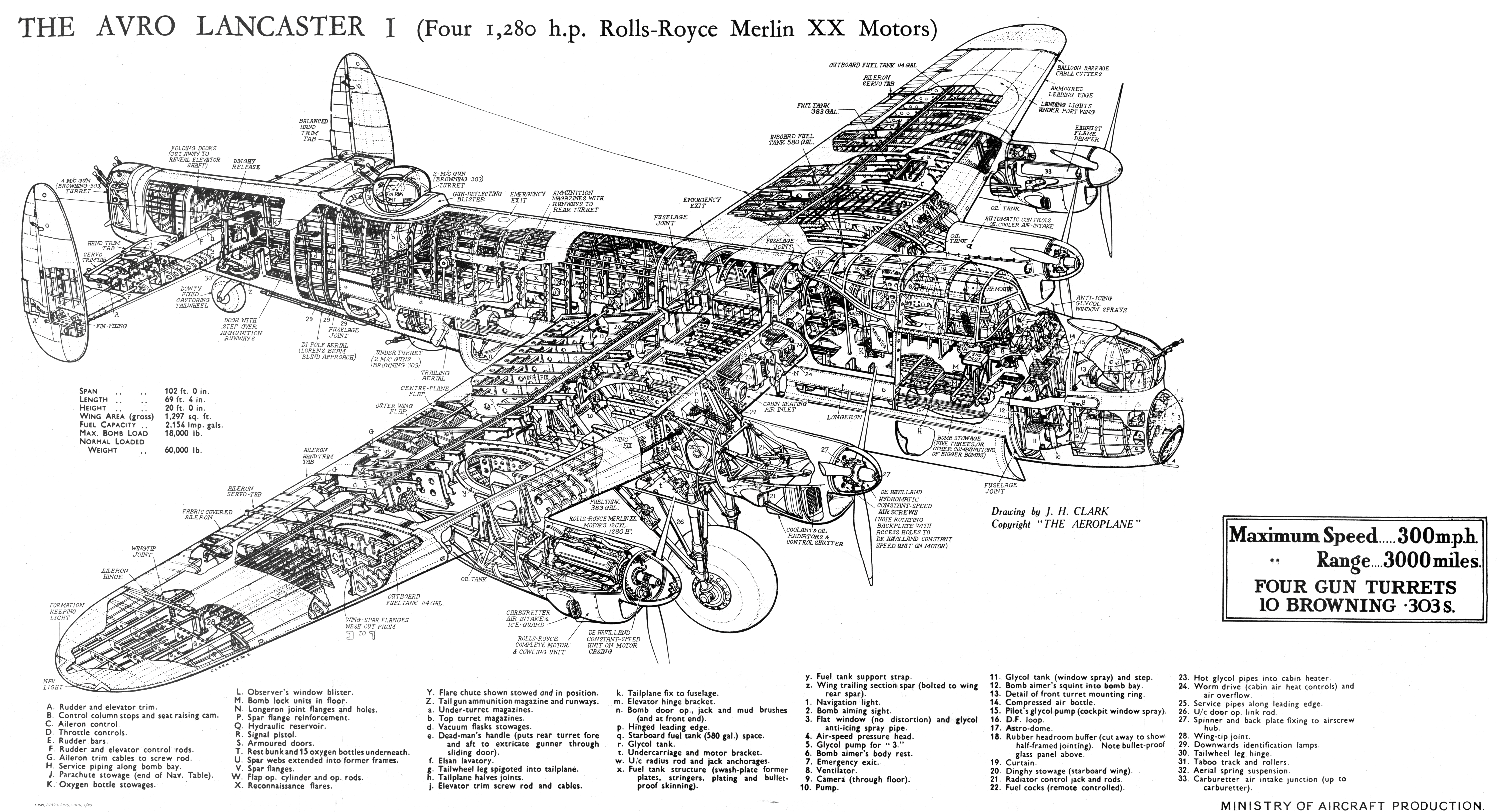
The Lancaster was a mid-wing cantilever monoplane, all-metal apart from details such as the fabric-covered ailerons. The wing was made up of five sections and the oval-section fuselage of another five, each fitted out separately before final assembly to speed production. The main undercarriage retracted hydraulically rearwards into the inboard engine nacelles and the tailwheel was fixed. The twin elliptical fins completed an airframe deliberately designed for maximum structural strength per unit of weight.
What set it apart from its contemporaries was the bomb bay: ten metres of continuous, unobstructed space. At first the heaviest weapon carried was the 4,000 lb (1,800 kg) HC "Cookie", but thirty per cent of B.Is were given bulged doors to take the 8,000 lb (3,600 kg) and later the 12,000 lb (5,400 kg) versions. At the other end of the scale it carried Small Bomb Containers holding up to 236 four-pound incendiaries, along with parachute mines, armour-piercing bombs and depth charges.
The four Merlins drove 13 ft (4.0 m) de Havilland Hydromatic three-bladed propellers. The aircraft could make it home on two engines and cover short distances on one. Experienced crews could out-manoeuvre German fighters, though the type had its vices: it tended to tighten into a dive as speed built up and suffered longitudinal instability above 200 mph (320 km/h).
In B.I form it measured 69 ft 4 in (21.13 m) long with a span of 102 ft (31.09 m) and 1,297 sq ft (120.5 m²) of wing area. Empty weight was 36,900 lb (16,738 kg) and maximum take-off weight 68,000 lb (30,844 kg). With 1,280 hp (950 kW) Merlin XXs it reached 282 mph (454 km/h), had a range of 2,530 mi (4,070 km) and a service ceiling of 21,400 ft (6,500 m). The maximum normal bomb load was 18,000 lb (8,200 kg) and the maximum specialist load 22,000 lb (10,000 kg).
Seven men aboard
The standard crew numbered seven: pilot, flight engineer, navigator, bomb aimer — who doubled as nose gunner — wireless operator and two gunners, mid-upper and rear. The bomb aimer worked prone in the glazed nose with the Mark XIV sight to his left and the release selectors to his right. The pilot sat alone above the bomb bay with the flight engineer beside him on a folding seat; unlike American practice there was no second set of controls. Behind them, screened by a curtain so he could work with a light on, sat the navigator, and beyond him the wireless operator under the astrodome used for visual signalling and celestial navigation.
Comfort was poor and escape worse. The nose emergency hatch measured 22 by 26.5 inches (56 by 67 cm), and only fifteen per cent of the crews of downed Lancasters managed to bail out, against twenty-five per cent in the Halifax and Stirling, whose hatches were two inches wider. The physicist Freeman Dyson, then a nineteen-year-old member of Bomber Command's Operational Research Section, compiled those figures by cross-checking the lists of airmen who reappeared in prisoner-of-war camps; his section's attempts to have the hatch enlarged came to nothing. Neither gunner's position was heated, so both wore electrically heated suits against hypothermia and frostbite.
Defensive armament, radar and countermeasures
The original armament comprised four hydraulically operated Frazer Nash turrets — nose, tail, mid-upper and ventral — with four .303 Browning machine guns in the tail and two in each of the others. The ventral FN-64 proved to be dead weight: it was aimed through a periscope that limited the gunner to a twenty-degree arc and traversed too slowly, so it was usually removed. When the Luftwaffe began attacking from below with upward-firing Schräge Musik cannon in the winter of 1943–1944, squadrons improvised observation blisters and mounted .50 calibre guns, or even 20 mm cannon, in the vacated ventral opening.
The tail turret was the most important defensive position and never entirely satisfactory. Many gunners had the centre perspex panel removed to see better at night — the "Gransden Lodge" modification — although trials showed that a Mosquito night fighter could still close undetected. The answer came from radar rather than optics: the FN-121 carried the "Village Inn" automatic gun-laying system, and aircraft so fitted flew behind the main stream as bait for the night fighters that picked off stragglers. Before the end of the war British production standardised on the FN-82 with two .50 calibre guns and gun-laying radar.
The electronic fit grew relentlessly. British-built aircraft carried the R1155 receiver and T1154 transmitter, to which were added H2S ground-mapping radar and its Fishpond adjunct covering the underside, the rearward-looking Monica warning set — removed in July 1944 once it was realised German fighters were homing on its emissions — the GEE, Oboe and GEE-H navigation systems, the Boozer radar-warning lamps and the Airborne Cigar jammer of No. 101 Squadron, which carried a German-speaking crewman to jam fighter control transmissions and consequently suffered the highest casualty rate of any squadron.
1942: into action
In early 1942 No. 44 Squadron at RAF Waddington, Lincolnshire, became the first unit to convert to the Lancaster, closely followed by No. 97 Squadron. The first operational sortie came on 2 March 1942, laying mines off Heligoland Bight in place of a strike against the battleship Tirpitz postponed by weather. The first bombing mission followed on 10 March against Essen, and the first loss on 24 March, when R5493 fell to anti-aircraft fire over Lorient.
On 17 April twelve Lancasters of Nos. 44 and 97 Squadrons attacked the MAN engine works at Augsburg at low level; three were shot down by Bf 109s over France and at least two more were lost over the target, but the factory was hit and Churchill praised the raid personally. The attack revealed the new bomber to Germany and to the British public at the same time. On the night of 30/31 May the type took part in Operation Millennium, the first thousand-bomber raid, against Cologne.
August 1942 brought the Pathfinder Force, formed to fly ahead of the main stream and mark targets with indicator flares; early results were mixed but the attack on Kassel on 27/28 August proved the method. On 17 October ninety Lancasters of No. 5 Group made an audacious daylight raid on the Schneider works at Le Creusot in France, losing a single aircraft by flying beneath German radar cover. By the end of the year sixteen squadrons were operational and some two hundred Lancasters were on Bomber Command's strength.
1943–1944: the Ruhr, Hamburg and Berlin
On 16 January 1943 an all-Lancaster force attacked Berlin for the first time in over a year. On 5 March the Battle of the Ruhr opened with a raid on Essen by 412 bombers, 140 of them Lancasters, and the attrition rate forced a threefold increase in production.
In late July and early August Hamburg endured Operation Gomorrah. On the night of 27 July, 787 aircraft — 74 Wellingtons, 116 Stirlings, 244 Halifaxes and 353 Lancasters — bombed the city; an estimated 18,474 people died that night alone, many from carbon monoxide poisoning in shelters and cellars surrounded by fire, and 8,621 tons of bombs were dropped by the end of the operation. On 17/18 August Operation Hydra struck the Peenemünde research centre, birthplace of the V-2 rocket, at a cost of seventeen Lancasters.
Between 15 November 1943 and 24 November 1944 came the Battle of Berlin: sixteen major operations against the German capital in which 7,256 of the 9,111 sorties flown were made by Lancasters. In March 1944 the effort shifted towards communications targets in France and the Low Countries ahead of the Normandy landings. By May, Bomber Command's daily average strength was around 1,100 aircraft, of which 616 were Lancasters, 354 Halifaxes, 72 Mosquitos and 58 Stirlings. On 14 June the first large daylight raid since 1942 was flown against shipping at Le Havre and Boulogne; fuel shortages had so weakened the Luftwaffe that daylight operations soon became routine.
Operation Chastise: the Ruhr dams
No. 617 Squadron was formed in March 1943 from picked RAF, Canadian, Australian and New Zealand crews for a single purpose: to breach the dams that supplied hydroelectric power and water to the industrial Ruhr. Barnes Wallis, assistant chief designer at Vickers, had devised a cylindrical mine — codenamed Upkeep — fitted with a hydrostatic fuse and given a backspin of 500 rpm so that it would skip over the torpedo nets, sink against the dam wall and detonate at its base.
The aircraft, officially designated "Type 464 (Provisioning)" and modified at Woodford, lost their bomb bay doors, which were replaced by side struts driven by a hydraulic motor to spin the weapon; the mid-upper turret was removed to save weight and two Aldis lamps were fitted whose beams converged exactly at the sixty-foot (18 m) release height. The sight was a wooden triangle with a peephole and two nails that lined up with the towers of each dam. The aircraft also carried VHF radios, normally reserved for fighters, so that Guy Gibson could direct the attack over the target — an early instance of the master bomber role.
On the night of 16/17 May 1943 nineteen Lancasters set out, flying most of the way at very low level. The Möhne and Eder dams were breached, causing catastrophic flooding in their valleys; the Sorpe suffered only minor damage. Two hydroelectric stations were destroyed and several more damaged, along with factories and mines, but German output was back to normal by September. The RAF lost eight aircraft and 56 aircrew, 53 of them killed and three taken prisoner; among civilians an estimated 1,600 died, about 600 Germans and 1,000 enslaved labourers, mostly Soviet. The raid became a book and then the 1955 film The Dam Busters, for which several stored B VIIs were converted back to B.III (Special) configuration.
Tallboy, Grand Slam and the Tirpitz
After the dams raid No. 617 Squadron was reconstituted as a high-altitude precision unit awaiting Barnes Wallis's earthquake bombs. The same aircraft that had carried Upkeep were adapted for the 12,000 lb (5,400 kg), 21 ft (6.4 m) Tallboy, first used in action around the summer of 1944. Its larger relative, the 22,000 lb (10,000 kg) Grand Slam, demanded far deeper modification: the dorsal turret, two of the tail guns and the pilot's armour plating were removed, Merlin 24 engines were fitted for better take-off performance, the bomb bay doors were deleted and the rear of the bay cut away, the undercarriage was strengthened and eventually the nose turret came off as well.
These aircraft formed the B.I (Special) series. Sources disagree on how many there were: the reference encyclopaedia's variant listing and the article on the Grand Slam both give 32, while its operational narrative puts at 33 the number of B.Is modified in early 1945 to carry the heavier weapon. The first operational Grand Slam fell on 14 March 1945 on the Bielefeld viaduct in North Rhine-Westphalia, released from 11,965 ft by a 617 Squadron Lancaster alongside fourteen Tallboys; photographic reconnaissance afterwards showed some sixty metres of the northern viaduct and nearly eighty of the southern one brought down. Forty-two Grand Slams were dropped on Germany between 14 March and 19 April 1945.
Through the second half of 1944, Nos. 617 and 9 Squadrons devoted three successive operations — Paravane, Obviate and Catechism — to the German battleship Tirpitz, moored in a Norwegian fjord. The Lancasters involved were a mixture of B.Is and B.IIIs with enlarged bomb bay doors for the Tallboys and additional fuel tanks for endurance. The first attack disabled the ship and the third sank her.
Operation Manna and the end of the war
In April 1945 the Lancaster exchanged bombs for food. With the acquiescence of the German occupation forces, the RAF dropped supplies over the Dutch province of Holland to relieve a population on the edge of starvation, in an operation named Manna. It involved 145 Mosquitos and 3,156 Lancasters from Nos. 1, 3 and 8 Groups, flying 3,298 sorties between them. The first of the two aircraft chosen for the trial run, nicknamed "Bad Penny", took off in bad weather on the morning of 29 April 1945 without any ceasefire agreement in place and delivered its load safely.
With hostilities over, the bomber repatriated thousands of prisoners of war from the continent to the British Isles, a task that continued until November 1945. The type was to have formed the bulk of Tiger Force, the Commonwealth bomber contingent earmarked for the invasion of Japan, with aircraft painted white over black and fitted with extra radio and navigation equipment; the Japanese surrender rendered the plan unnecessary. The Lancaster was also considered for the atomic bomb, being one of only two Allied bombers able to carry it internally, but the B-29 Superfortress was preferred: it flew higher, faster and farther, and using a British aircraft would have complicated the programme.
The balance sheet
Between 1942 and 1945 the Lancaster flew 156,000 sorties and dropped 608,612 long tons of bombs. Some 3,249 aircraft were lost in action, only thirty-five completed more than a hundred operations, and the most successful survivor reached 139 before being retired and scrapped in 1947. The Royal Air Force Museum records that Lancasters averaged twenty-one missions before being lost and that the average age of the seven-man crew was just twenty-two; Bomber Command suffered the highest casualty rate of any branch of the British services in the war. The Bomber Command Museum of Canada, which counts 7,374 aircraft built, puts the number destroyed at 3,932 — a figure resting on a different reckoning from that of losses in action.
By the end of the war in Europe roughly fifty squadrons were equipped with the type. Adolf Galland, commanding the German fighter force, called it "the best night bomber of the war"; his opponent Arthur Harris called it Bomber Command's "shining sword". Ten Lancaster crewmen received the Victoria Cross, among them Guy Gibson, Andrew Mynarski, John Nettleton, Ian Bazalgette and Leonard Cheshire.
After the war: the RAF, France, Argentina and Canada
The Lancaster remained in service for years. B.Is gave way to tropicalised B.I (FE) and B.VII (FE) machines, and in 1947–1948 No. 82 Squadron received the PR.1 photo-reconnaissance version, painted silver and stripped of turrets, which surveyed central and east Africa. Coastal Command operated a handful of grey MR.1s from Kinloss. The Avro Lincoln arrived slowly enough that the last Bomber Command Lancaster was not retired until December 1953, and the last in active RAF service, a reconnaissance aircraft, is believed to have flown until late 1954.
Avro overhauled 59 B.Is and B.VIIs at Woodford and Langar for the French Aéronavale, delivered in 1952 and 1953 and flown until the mid-1960s by four squadrons in France and New Caledonia on maritime reconnaissance and search-and-rescue duties. Between 1948 and 1949 fifteen former RAF aircraft were refurbished at Langar for the Argentine Air Force.
Canada was the longest-serving operator. From 1946 the Mk Xs were adapted to a wide range of roles, each with its own designation: 10AR for Arctic reconnaissance, 10BR for bomber reconnaissance, 10DC as controllers for Ryan Firebee drones, 10MR and later 10MP for maritime anti-submarine patrol, 10N for navigation training, 10P for photographic mapping and 10O as a testbed for the Orenda turbojet. Some seventy maritime patrol conversions — with new radar, sonobuoy operators' stations, an extra fuel tank in the bomb bay and even a cooking stove — served through the 1950s until the Neptune and the Canadair Argus replaced them, while the photo-mapping aircraft charted much of northern Canada until 1962. The last RCAF Lancaster flight was made by KB976 on 4 July 1964 at the Calgary air show.
In transport work, four aircraft were converted into freighters for British South American Airways in 1946 without commercial success, and four B.IIIs went to Flight Refuelling Limited to develop air-to-air refuelling; the resulting tankers flew 757 sorties during the Berlin Airlift. From 1943 the Canadian Government Trans-Atlantic Air Service operated nine passenger-and-mail Mk Xs known as XPPs; the inaugural Dorval–Prestwick flight on 22 July 1943 was made non-stop in 12 hours 26 minutes.
Derivatives and testbeds
An entire family grew out of the Lancaster airframe. The B.IV and B.V projects, with greater span and a longer fuselage, were renamed Avro Lincoln B.1 and B.2 before production. The York was a transport with a square-section fuselage married to the bomber's wings and engines, and the Lancastrian a civil conversion with nose and tail fairings and seats in place of bombs: in March 1946 a BSAA Lancastrian flew the first scheduled service out of the new London Heathrow Airport. By way of the Lincoln came the Shackleton maritime patrol aircraft, which stayed with the RAF until 1991 in the airborne early warning role.
The Lancaster was also much in demand as an engine testbed. One was converted in 1943 to trial the Metropolitan-Vickers F.2 turbojet, and others later flew the Armstrong Siddeley Mamba and Rolls-Royce Dart turboprops and the Avro Canada Orenda and STAL Dovern turbojets.
Survivors
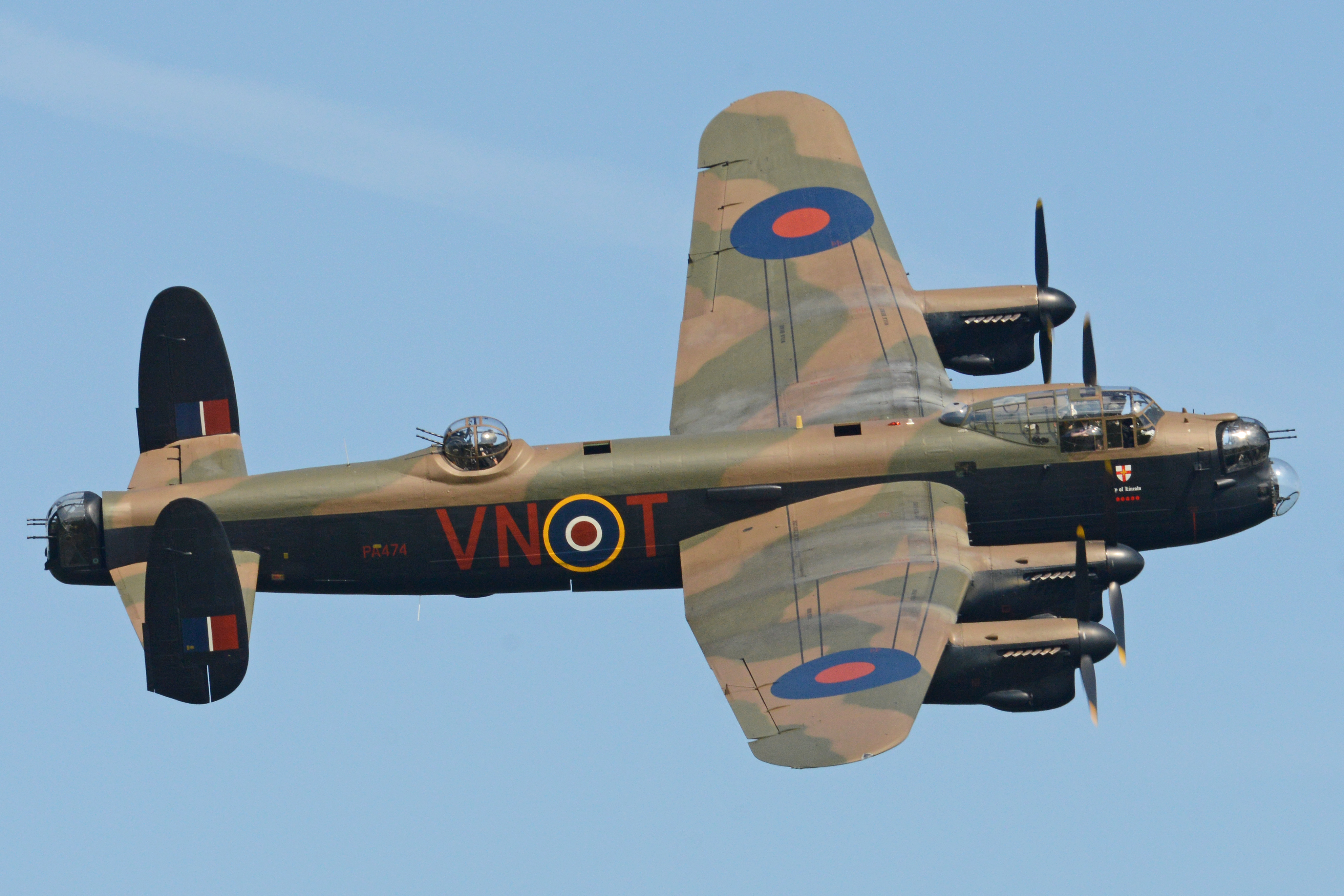
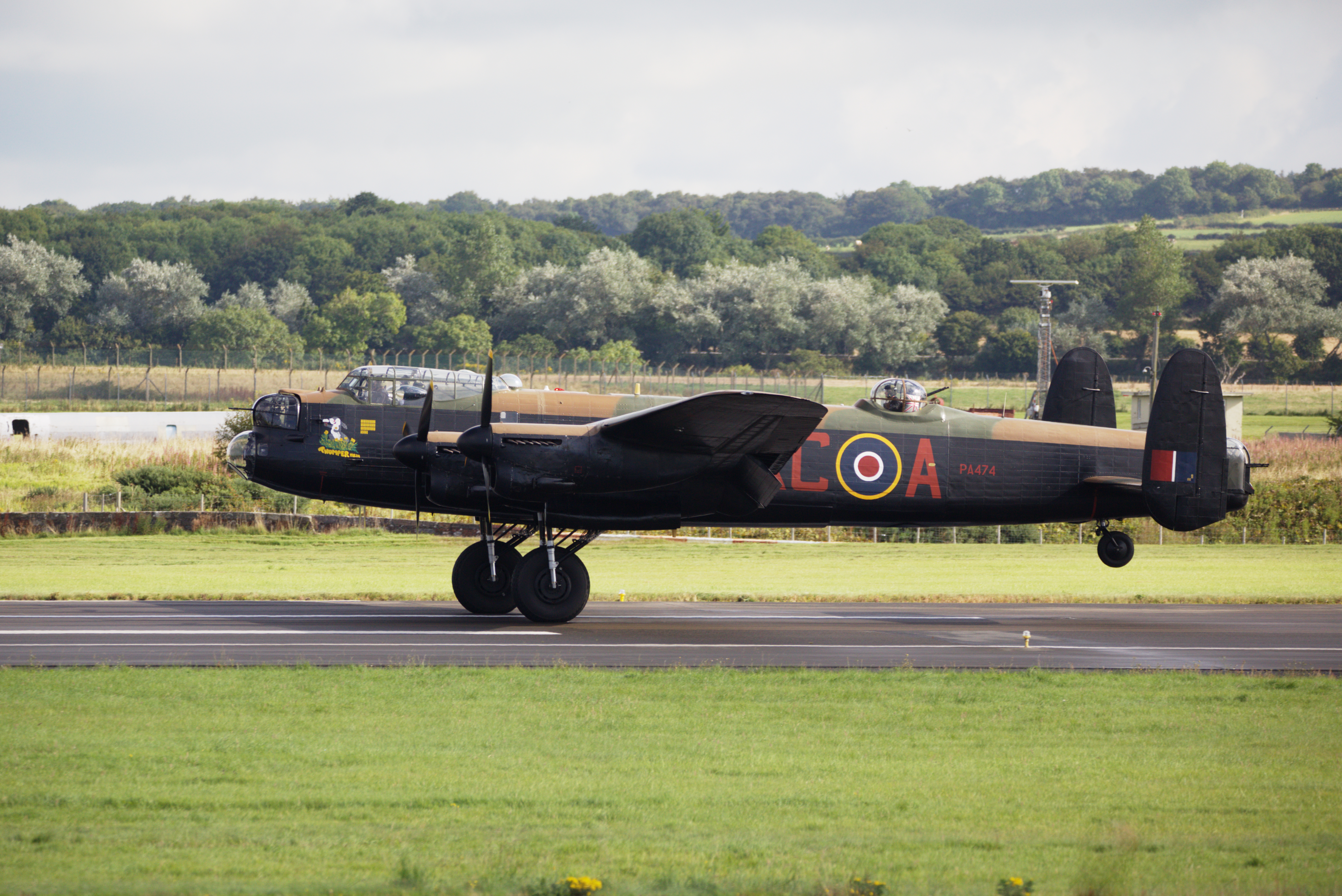
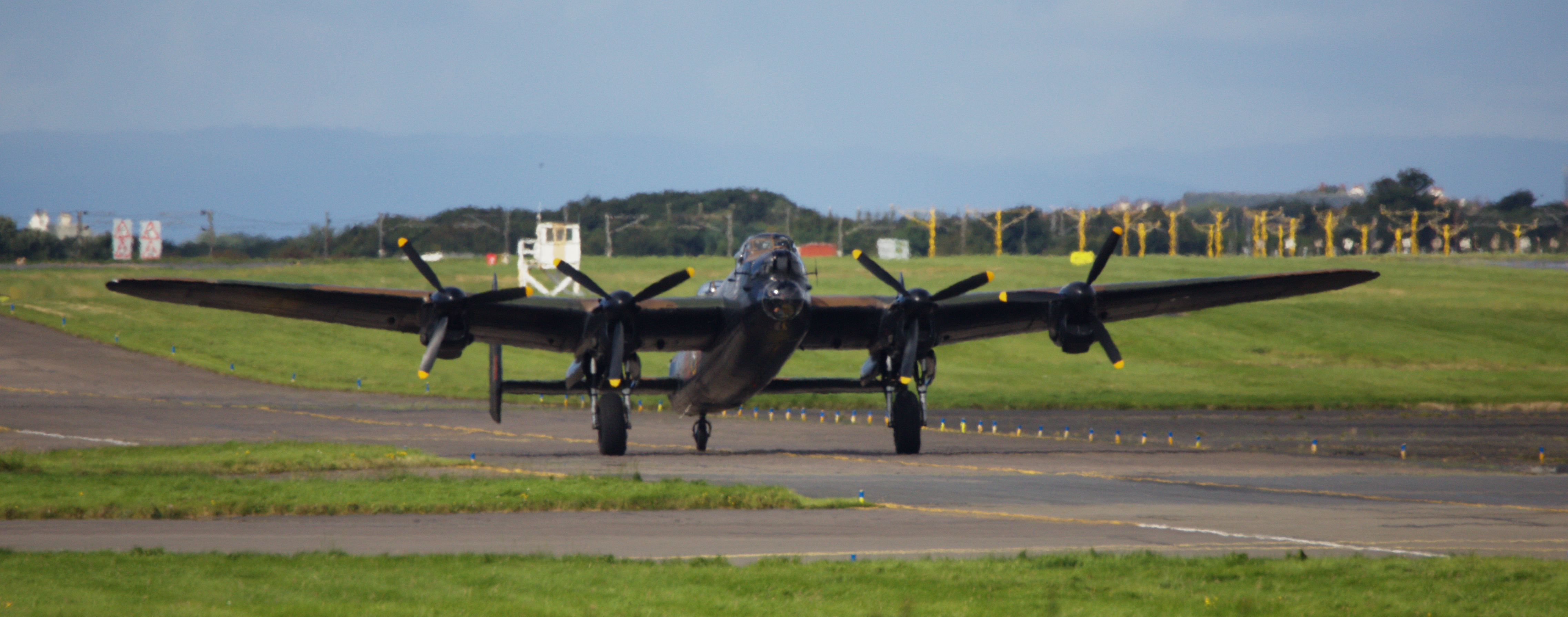
Seventeen substantially complete Lancasters survive and only two fly. PA474, a B.I of the Battle of Britain Memorial Flight, operates from Coningsby in Lincolnshire. FM213, a B X of the Canadian Warplane Heritage Museum in Hamilton, Ontario, was built at Malton in July 1945, later converted to 10MR configuration and retired from the RCAF in late 1963; acquired in 1977 with help from the Sulley Foundation, it took eleven years to restore and flew again on 24 September 1988. It carries the civil registration C-GVRA and the markings of KB726 "VR-A" in memory of Andrew Mynarski, awarded a posthumous Victoria Cross for trying to free his aircraft's trapped rear gunner as it burned on 13 June 1944.
Two more aircraft keep their engines running without flying: the B VII NX611 "Just Jane" at the Lincolnshire Aviation Heritage Centre at East Kirkby, and FM159 at the Bomber Command Museum of Canada in Nanton, Alberta, rescued after years of vandalism and able to taxi under its own power. In 2014 the two airworthy machines toured the United Kingdom together, and in 2018 FM213 was repainted in the AJ-G markings of Guy Gibson's ED932 to mark the 75th anniversary of Operation Chastise. In 2017, after more than fifty years on display at Edmundston, New Brunswick, KB882 was moved to the National Air Force Museum of Canada at Trenton for restoration.
Variants
| ASR.III / ASR.3 | B.I | B.I (FE) | B.II | B.III | B.III (Special) | B.I (Special) | B.IV | B.V | B.VI | B.VII | B.X | B.XV | GR.3 / MR.3 | MR.1 | PR.1 | |
|---|---|---|---|---|---|---|---|---|---|---|---|---|---|---|---|---|
| Aircraft type | Air-sea rescue aircraft | Four-engined heavy bomber | Tropicalised heavy bomber (Far East) | Heavy bomber with radial engines | Four-engined heavy bomber | Heavy bomber for the bouncing bomb | Heavy bomber for super-heavy bombs | Long-range heavy bomber (prototype) | Long-range heavy bomber (prototype) | High-altitude heavy bomber | Four-engined heavy bomber | Four-engined heavy bomber (Canadian production) | Long-range heavy bomber (pattern airframe) | Maritime reconnaissance aircraft | Maritime reconnaissance aircraft | Photographic reconnaissance aircraft |
| Powerplant | 4 × Packard Merlin 28 or 38 piston engines of 969 kW (1,300 hp) and 1,044 kW (1,400 hp) each respectively, as fitted to the B.III from which these airframes were converted. | 4 × Rolls-Royce Merlin XX liquid-cooled 27-litre V-12 piston engines with two-speed supercharging, 954 kW (1,280 hp) each, driving three-blade constant-speed propellers. Late-production B.Is left the line with Merlin 22 or Merlin 24 engines. | 4 × Rolls-Royce Merlin 24 piston engines of 1,200 kW (1,610 hp) each, the standard fit of the late-production B.I on which the conversion was based. | 4 × Bristol Hercules VI or XVI 14-cylinder sleeve-valve radial piston engines with two-speed supercharging, 1,204 kW (1,615 hp) each. The VI had manual mixture control, requiring an extra lever on the throttle pedestal. | 4 × Packard-built Merlin piston engines: Merlin 28 of 969 kW (1,300 hp) or Merlin 38 of 1,044 kW (1,400 hp), with the Merlin 224 of 1,219 kW (1,635 hp) on late aircraft. Their Bendix-Stromberg pressure-injection carburettors required slow-running cut-off switches in the cockpit. | 4 × Packard Merlin 28 or 38 piston engines of 969 kW (1,300 hp) and 1,044 kW (1,400 hp) each respectively, as fitted to the B.III from which these airframes came. | 4 × Rolls-Royce Merlin 24 piston engines of 1,200 kW (1,610 hp) each, with paddle-blade propellers to restore thrust at maximum weight. | 4 × Rolls-Royce Merlin piston engines with two-stage superchargers: Merlin 85 of 1,219 kW (1,635 hp) inboard and, later, Merlin 68 outboard. | 4 × Rolls-Royce Merlin 85 piston engines with two-stage superchargers, 1,219 kW (1,635 hp) each. | 4 × Rolls-Royce Merlin 85 or 87 piston engines with two-stage superchargers, 1,219 kW (1,635 hp) each, under Lincoln-style annular cowlings and driving three-blade paddle propellers. High-altitude performance improved sharply, but rough running and a tendency to surge and hunt made synchronising them impossible. | 4 × Rolls-Royce Merlin 24 piston engines of 1,200 kW (1,610 hp) each, the highest-boost Merlin used in production Lancasters. | 4 × Packard Merlin 224 piston engines of 1,219 kW (1,635 hp) each, the American-built counterpart of the British Merlin 24. | 4 × Rolls-Royce Merlin 85 or Packard Merlin 68 liquid-cooled V-12 piston engines of 1,300 kW (1,750 hp) each, driving four-blade propellers. | 4 × Packard Merlin 28 or 38 piston engines of 969 kW (1,300 hp) and 1,044 kW (1,400 hp) each respectively, inherited from the parent B.III. | 4 × Rolls-Royce Merlin 22 or 24 piston engines of 1,036 kW (1,390 hp) and 1,200 kW (1,610 hp) each respectively, inherited from the B.I on which the conversion was based. | 4 × Rolls-Royce Merlin 22 or 24 piston engines of 1,036 kW (1,390 hp) and 1,200 kW (1,610 hp) each respectively, as fitted to the late-production B.I from which the conversion was made. |
| Powerplant | 4 × Packard Merlin 28 o 38 | 4 × Rolls-Royce Merlin XX | 4 × Rolls-Royce Merlin 24 | 4 × Bristol Hercules VI o XVI | 4 × Packard Merlin 28, 38 o 224 | 4 × Packard Merlin 28 o 38 | 4 × Rolls-Royce Merlin 24 | 4 × Rolls-Royce Merlin 85 (interiores) y Merlin 68 (exteriores) | 4 × Rolls-Royce Merlin 85 | 4 × Rolls-Royce Merlin 85 o 87 | 4 × Rolls-Royce Merlin 24 | 4 × Packard Merlin 224 | 4 × Rolls-Royce Merlin 85 o Packard Merlin 68 | 4 × Packard Merlin 28 o 38 | 4 × Rolls-Royce Merlin 22 o 24 | 4 × Rolls-Royce Merlin 22 o 24 |
| Power per engine | 1,299 hp | 1,279 hp | 1,609 hp | 1,615 hp | 1,299 hp | 1,299 hp | 1,609 hp | 1,635 hp | 1,635 hp | 1,635 hp | 1,609 hp | 1,635 hp | 1,743 hp Best value in this row | 1,299 hp | 1,609 hp | 1,609 hp |
| Length | — | 21.1 m | — | — | — | — | — | — | — | — | — | — | — | — | — | — |
| Wingspan | — | 31.1 m | — | — | — | — | — | — | — | — | — | — | — | — | — | — |
| Height | — | 6.3 m | — | — | — | — | — | — | — | — | — | — | — | — | — | — |
| Wing area | — | 121 m² | — | — | — | — | — | — | — | — | — | — | — | — | — | — |
| Empty weight | — | 16,738 kg | — | — | — | — | — | — | — | — | — | — | — | — | — | — |
| MTOW | — | 30,844 kg | — | — | — | — | 32,657 kg Best value in this row | — | — | — | — | — | — | — | — | — |
| Top speed | — | 454 km/h | — | — | — | — | — | — | — | 504 km/h Best value in this row | — | — | — | — | — | — |
| Max speed altitude | — | 3,962 m | — | — | — | — | — | — | — | 5,547 m | — | — | — | — | — | — |
| Cruise speed | — | 320 km/h | — | — | — | — | — | — | — | — | — | — | — | — | — | — |
| Cruise altitude | — | 4,572 m | — | — | — | — | — | — | — | — | — | — | — | — | — | — |
| Service ceiling | — | 6,500 m | — | — | — | — | — | — | — | 8,700 m Best value in this row | — | — | — | — | — | — |
| Initial climb rate | — | 3.7 m/s | — | — | — | — | — | — | — | 5.5 m/s Best value in this row | — | — | — | — | — | — |
| Range | — | 4,070 km | — | — | — | — | — | — | — | — | — | — | — | — | — | — |
| Range conditions | A B.III conversion for search and rescue: three ventral dipole aerials aft of the radome, observation windows on both sides of the rear fuselage and, on some aircraft, Lincoln-style rudders. | 2,530 miles (4,070 km) with a 3,175 kg (7,000 lb) bomb load; operating radius fell sharply with maximum loads. Fuel capacity 9,750 litres in wing tanks. | Tiger Force variant for the Pacific: modified radio, radar and nav-aids plus a 400 imp gal tank in the bomb bay to extend range. | The bulged bomb-bay doors — built in three different forms across the run — fouled the H2S radar installation, which was rarely fitted to this mark. | Externally indistinguishable from the B.I and built alongside it: performance and range matched the British Merlin XX aircraft. | Attack was flown at very low level: lamps in the bay and nose formed an optical altimeter to hold release height precisely at night. | Two airframes (HK541 and SW244) trialled a 5,500-litre dorsal "saddle tank" to stretch range for the Pacific; handling with the tank full ruled it out. | Increased wingspan and lengthened fuselage; the redesign ran so deep that prototypes PW925, PW929 and PW932 were renamed Avro Lincoln B.1. | Increased wingspan and lengthened fuselage like the B.IV; the mark was renamed Avro Lincoln B.2 before entering service. | 504 km/h at 5,547 m and a ceiling of 8,700 m, both at 65,000 lb take-off weight; climb to 28,000 ft took 44.8 minutes. Withdrawn from operations in November 1944. | The last production Lancaster, with "Far East" (B.VII FE) tropical and "Western Union" sub-variants, the latter delivered to France. | A B.III built by Victory Aircraft in Canada with North American instruments and electrics. The RCAF flew it on maritime patrol, search and rescue and photo-reconnaissance until 1964. | The Canadian counterpart of the B.IV/Lincoln B.1, built by Victory Aircraft. A single pattern airframe was completed; the follow-on order was cancelled at the end of the war. | A B.III conversion for maritime reconnaissance, sister to the ASR.3 and forerunner of the role later taken over by the Avro Shackleton. | A small grey-painted batch for RAF Coastal Command, normally based at RAF Kinloss on the Moray Firth. | Flown by RAF Nos. 82 and 541 Squadrons in wartime and by No. 683 (PR) Squadron from 1950, on aerial mapping from Fayid and Kabrit (Egypt) and Habbaniya (Iraq) until 1953. |
| Armament | None in postwar service: armament was removed and the mid-upper turret faired over. | 8 × 0.303 in (7.7 mm) Browning Mark II machine guns in three hydraulic turrets: two in the nose, two in the mid-upper and four in the tail, with 14,000 rounds in all; early aircraft also carried a periscope-aimed ventral turret. The 10 m unobstructed bay took a design bomb load of 6,350 kg (14,000 lb) and a maximum normal load of 8,200 kg (18,000 lb), including the 1,800, 3,600 and 5,400 kg high-capacity "cookies". | B.I defensive armament: 8 × 0.303 in Browning machine guns in nose, mid-upper and tail turrets. Part of the bay was taken by an extra tank, so the bomb load fell below the B.I maximum. | 8 × 0.303 in Browning machine guns in nose, mid-upper and tail turrets. Early examples carried an FN.64 ventral turret, quickly removed because of its poor periscopic aiming; field fits of 20 mm cannon or 0.50 in guns followed in the vacant opening until the official Mod 925 fitted a 0.303 in gun. | Identical to the B.I: 8 × 0.303 in Browning Mark II machine guns in the nose (2), mid-upper (2) and tail (4) turrets, over the same unobstructed bay and the same range of loads. | One 4,200 kg (9,250 lb) "Upkeep" bouncing mine — 3,000 kg of it Torpex — slung in Vickers struts in place of the bomb-bay doors and spun up by a hydraulic motor. The mid-upper turret was removed and its gunner moved to the nose; nose and tail turrets were retained. | A single 5,400 kg (12,000 lb) "Tallboy" or 9,979 kg (22,000 lb) "Grand Slam" carried under bulged bomb-bay doors — removed and faired over entirely for the Grand Slam. The mid-upper turret, later the nose turret and two of the tail guns were deleted to save weight. | A Boulton Paul F turret with two 0.5 in Browning machine guns and framed "bay window" nose glazing, alongside the type's usual defensive fit. | The defensive fit of the B.IV/Lincoln development, with nose, mid-upper and tail turrets. | Only the tail turret with four 0.303 in Browning machine guns: the mid-upper and nose turrets were removed and faired over. All nine aircraft flew with Pathfinder units and as "Master Bomber" ships. | A Martin 250CE mid-upper turret with two 0.50 in Browning Mark II guns, moved forward of earlier marks, and a Nash & Thomson FN-82 tail turret with two more 0.50 in guns in place of the FN.20's four 0.303 in. The first fifty Austin-built aircraft, delivered before the Martin turrets arrived, were known as Mark VII (Interim). | B.III armament, with the Nash & Thomson FN-50 mid-upper turret replaced in later batches by the heavier Martin 250CE, mounted further forward to keep the centre of gravity in balance. | Lincoln B.1 armament: nose, mid-upper and tail turrets with 0.50 in Browning heavy machine guns. | Defensive armament reduced or removed depending on the airframe; the patrol role called for no bomb load. | B.I defensive turrets on the airframes that kept them; the role was patrol and surveillance rather than bombing. | None: all armament and all three turrets were removed and the nose reprofiled; the camera was carried in the bomb bay. |
| Max weapons load | 0 kg | 6,350 kg | 6,350 kg | 6,350 kg | 6,350 kg | 4,200 kg | 9,979 kg Best value in this row | — | — | 6,350 kg | 6,350 kg | 6,350 kg | — | — | — | 0 kg |
| Payload | 0 kg Best value in this row | 0 kg Best value in this row | 0 kg Best value in this row | 0 kg Best value in this row | 0 kg Best value in this row | 0 kg Best value in this row | 0 kg Best value in this row | 0 kg Best value in this row | 0 kg Best value in this row | 0 kg Best value in this row | 0 kg Best value in this row | 0 kg Best value in this row | 0 kg Best value in this row | 0 kg Best value in this row | 0 kg Best value in this row | 0 kg Best value in this row |
| Cargo capacity | No civil cargo capacity: the adapted bay carried an airborne lifeboat, not revenue payload. | No civil cargo capacity: a military bomber whose bay holds ordnance and mission equipment only. | No civil cargo capacity: a military bomber prepared for tropical service. | No civil cargo capacity: a military bomber with a bulged bay for ordnance. | No civil cargo capacity: a military bomber with no passenger cabin or freight hold. | No civil cargo capacity: a "Type 464 Provisioning" airframe modified for a single weapon. | No civil cargo capacity: a lightened airframe dedicated to one penetration bomb. | No civil cargo capacity: a heavy-bomber prototype. | No civil cargo capacity: a heavy-bomber prototype. | No civil cargo capacity: a target-marking and raid-controlling bomber. | No civil cargo capacity: the final production military bomber. | No civil cargo capacity: a military bomber; the passenger conversion derived from this airframe took its own designation (Lancastrian, "Mark 10 Passenger Plane"). | No civil cargo capacity: a military bomber. | No civil cargo capacity: a military general-reconnaissance and maritime patrol airframe. | No civil cargo capacity: a military maritime patrol airframe. | No civil cargo capacity: a military reconnaissance airframe with the bay given over to camera equipment. |
| Crew | — | 7 Best value in this row | 7 Best value in this row | 7 Best value in this row | 7 Best value in this row | 7 Best value in this row | 7 Best value in this row | — | — | 7 Best value in this row | 7 Best value in this row | 7 Best value in this row | — | — | — | — |
| Passengers | — | 0 | — | — | — | — | — | — | — | — | — | — | — | — | — | — |
| Units built | — | 3,425 Best value in this row | — | 300 | 3,030 | 23 | 32 | — | — | 9 | — | 430 | 1 | — | — | — |
Images