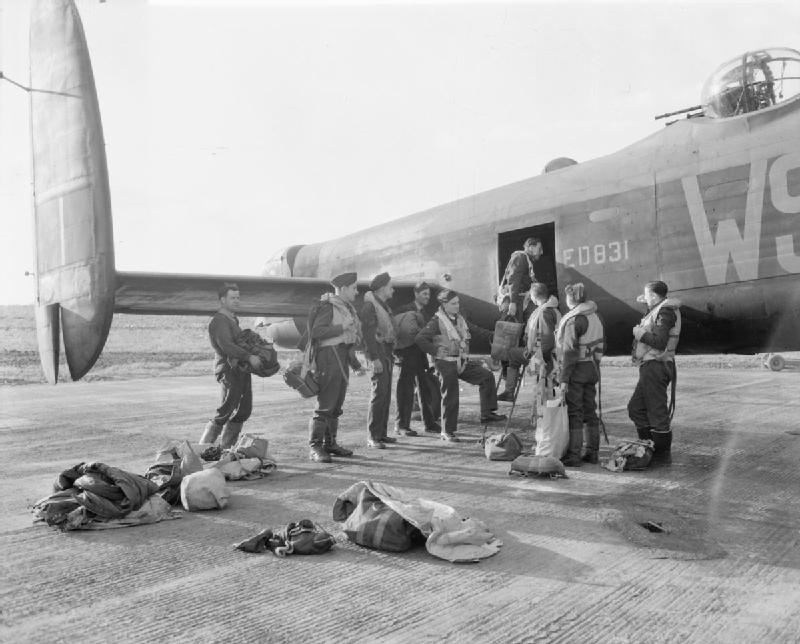
Avro Lancaster variant
Avro Lancaster B.III
The Lancaster B.III was the version of Avro's heavy bomber powered by Merlin engines built under licence by Packard in the United States. Externally identical to the B.I, it was built alongside it on the same lines, and which mark an airframe became depended only on which engines were available. It entered production towards the end of 1942 and service in 1943, and was built throughout the war, almost all at Avro's Newton Heath factory. Sources give 3,030 or 3,039 aircraft. It gave rise to the B.III (Special) of the Dams raid, the ASR.III air-sea rescue and maritime reconnaissance conversions, and the Canadian B.X.

- 3,030
- Units built
History
An insurance policy for the engine
During the Second World War, demand for the Rolls-Royce Merlin constantly threatened to outstrip supply. The shadow factories at Crewe, Manchester and Glasgow were not enough, and the British government looked to US manufacturers to expand production. In August 1940 drawings of the Merlin XX were sent to the Packard Motor Car Company, and in September 1940 Rolls-Royce and Packard reached a licence agreement, a $130 million order. The first Packard-built engine, a version of the Merlin XX designated Merlin 28 by the RAF and V-1650-1 by the USAAF, ran in August 1941. Packard went on to build 55,523 Merlins, and their biggest consumer was probably the Lancaster B.III: according to History of War, its production required over 12,000 of them.
What changed from the B.I
The B.III was built concurrently with the B.I and was externally indistinguishable from it. The differences were confined to the engine installation. The Packard Merlins used Bendix-Stromberg pressure-injection carburettors, which required slow-running cut-off switches to be added in the cockpit. In its initial modifications to the engine, Packard also changed the main crankshaft bearings from a copper-lead alloy to a silver-lead combination with indium plating, which improved running-in and the load-carrying ability of the surface.

The Air Ministry pilot's notes of May 1944 describe the Mark III with four Merlin 28 or 38 engines. The Merlin 28, with a single-stage, two-speed supercharger, delivered 1,300 hp (969 kW) at 3,000 rpm; the Merlin 38, 1,400 hp (1,044 kW); and late aircraft received the Merlin 224 of 1,635 hp (1,219 kW), listed for the Lancaster Mk.I, Mk.III and Mk.X. History of War credits the Merlin 28 with 1,420 hp at take-off.
Production
B.Is and B.IIIs came off the same Avro lines, with one engine or the other fitted according to availability. The two designations were effectively interchangeable: changing the engines was enough to turn one into the other, and this was occasionally done. As further batches were ordered, both marks received the same minor modifications, such as moving the pitot head from the nose to the side of the cockpit and replacing de Havilland needle-blade propellers with Hamilton Standard or Nash Kelvinator paddle-blade propellers.
The B.III entered production towards the end of 1942 and service in 1943, and production continued throughout the war, almost all of it at Avro's Newton Heath factory. The total differs by source: 3,030 aircraft according to the English Wikipedia, Grace's Guide and Skytamer; 3,039 according to the Spanish Wikipedia and History of War. The figure excludes the 430 Lancaster B.Xs built in Canada by Victory Aircraft, which also used Packard Merlins but are a separate variant.
In service
The performance of the Packard-powered Lancaster was very close to that of aircraft with British-built Merlins, and many RAF squadrons flew both, No. 619 Squadron among them. The one exception was that the Packard Merlin was slightly more prone to overheating on take-off and landing, which made it less suitable for training units.

The most celebrated B.III was ED888 "Mike Squared", built by A. V. Roe at Manchester early in 1943 and assigned to B Flight of No. 103 Squadron at RAF Elsham Wolds. It began its career on 4 May 1943 with a raid on Dortmund. After 66 operations it moved to No. 576 Squadron, formed at Elsham Wolds on 25 November 1943, as one of its founding aircraft; on 31 October 1944 it returned to 103 Squadron for nine more operations. It completed its 140th sortie on 24 December 1944, with two Luftwaffe fighters shot down and 974 flying hours on active service, and became known as "Mother of Them All". It was struck off charge on 8 January 1947 and scrapped soon afterwards.
In the second half of 1944, Lancaster B.Is and B.IIIs of Nos. 617 and 9 Squadrons, fitted with enlarged bomb bay doors for the Tallboy bomb and extra fuel tanks, attacked the battleship Tirpitz three times at its fjord anchorage in occupied Norway (Operations Paravane, Obviate and Catechism); the third attack sank it.
Derivatives
Several versions grew out of the B.III. The B.III (Special), officially designated Type 464 (Provisioning), was modified to carry the Upkeep bouncing bomb and equipped No. 617 Squadron for Operation Chastise in 1943; it has its own page. After the war, the end of Lend-Lease left the RAF without air-sea rescue aircraft, and B.IIIs were converted into ASR.IIIs carrying an airborne lifeboat under the bomb bay and fitted with observation windows; others were modified for maritime reconnaissance (GR.3/MR.3). Nine aircraft were converted from B.IIIs to B.VIs. The Canadian B.X was in essence a Canadian-built B.III with Canadian- and US-made instruments and electrics. Flight Refuelling Limited converted four Mk.IIIs into two tanker-and-receiver pairs to develop in-flight refuelling; in 1947 one of them flew 5,567 km non-stop from London to Bermuda. For the 1955 film The Dam Busters, several B.VIIs were modified to look like B.III (Specials).
Gaps
The material consulted does not record the first flight date of the first B.III, its serial number or the breakdown of production by manufacturer, and identifies no surviving B.III.
Multimedia