Avião comercial · Civil · Rússia
Ilyushin Il-18
- 4 de julho de 1957
- Primeiro voo
- 1959
- Entrada ao serviço
- Em serviço
- Estado
- 678
- Unidades construídas


-1600.webp)
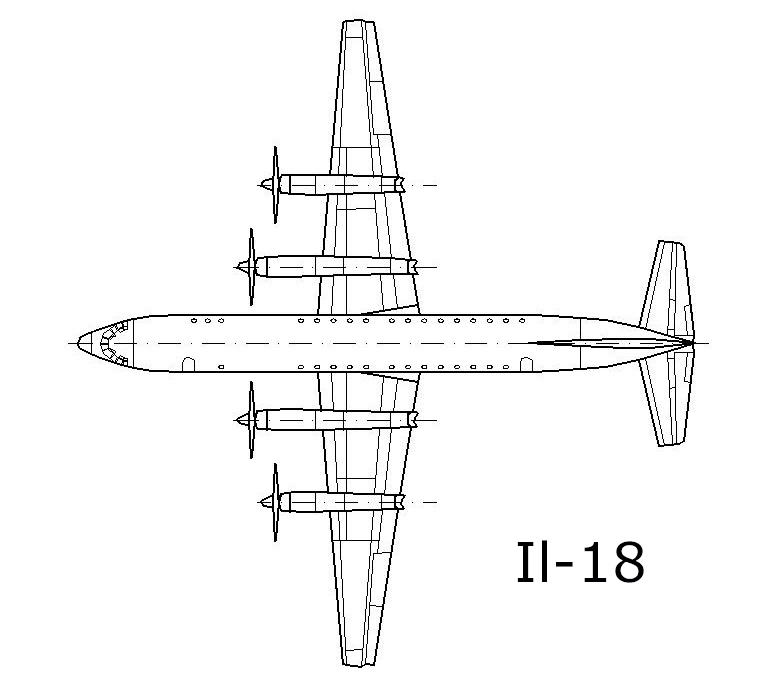
O Ilyushin Il-18 (designação NATO «Coot») é um avião comercial quadrimotor turboélice de asa baixa que o gabinete de projeto soviético Ilyushin concebeu em meados dos anos cinquenta para satisfazer um requisito da Aeroflot: um aparelho de médio curso capaz de transportar entre 75 e 100 passageiros. O protótipo, com a matrícula SSSR-L5811, descolou de Khodynka a 4 de julho de 1957 e no dia 10 foi apresentado em Vnukovo perante uma comissão governamental, ao lado do Antonov An-10 e do Tupolev Tu-114. A Aeroflot inaugurou os serviços de passageiros a 20 de abril de 1959 nas rotas Moscovo-Sochi e Moscovo-Alma-Ata. Dezassete companhias estrangeiras adquiriram cerca de 125 aparelhos, com cabinas de 100 a 120 lugares, e o tipo tornou-se um dos emblemas do transporte aéreo do bloco socialista. Entre 1958 e 1960 o Il-18 estabeleceu vinte e cinco recordes mundiais, entre eles vários de alcance e altitude com diferentes cargas, e em 1958 recebeu o Grande Prémio da Exposição Universal de Bruxelas. A sua robustez é proverbial: numerosos exemplares ultrapassaram as 45.000 horas de voo. Da célula derivaram versões militares como o Il-20M de informações eletrónicas, o posto de comando aerotransportado Il-22 e o patrulha antissubmarino Il-38, que prolongaram a vida do projeto muito para além da sua carreira comercial. Nas rotas de longo curso o seu substituto foi o Ilyushin Il-62.
Eventos relacionados
Fichas relacionadas
Categoria
História
Um turboélice para renovar a Aeroflot
O trabalho de projeto arrancou em 1954, antes mesmo de o Conselho de Ministros soviético emitir, a 30 de dezembro de 1955, a diretiva que encarregava Kuznetsov e Ivchenko de novos turboélices e Ilyushin e Antonov dos aviões que deveriam empregá-los. Daquela encomenda saíram dois aparelhos, o Il-18 e o Antonov An-10. Ilyushin recuperou uma designação já usada por um quadrimotor de pistões de 1946 que nunca passou de protótipo, mas o avião era inteiramente novo: monoplano de asa baixa, fuselagem pressurizada de secção circular, cauda convencional e trem triciclo com bogies de quatro rodas que rodavam 90 graus ao recolherem. Incorporava duas novidades notáveis para o seu tempo: radar meteorológico no nariz e o primeiro sistema de aproximação automática montado num avião de linha soviético.
Do protótipo à linha de montagem
O protótipo saiu da oficina em junho de 1957, iniciou as corridas de alta velocidade a 1 de julho e voou no dia 4 a partir de Khodynka. O tipo foi batizado oficialmente Moskva, nome que chegou a ser pintado na fuselagem mas que foi abandonado ao entrar em produção. O fabrico foi atribuído à Fábrica de Maquinaria n.º 30 de Moscovo, que foi reduzindo a produção do Il-14 para preparar a do novo modelo. Os primeiros exemplares montavam motores Kuznetsov NK-4, cheios de problemas; em julho de 1958 o Conselho de Ministros ordenou que toda a produção posterior a novembro desse ano usasse o Ivchenko AI-20 e que os aparelhos já entregues fossem remotorizados. A 17 de setembro de 1958 voou o primeiro Il-18 com o novo grupo motopropulsor, com Vladimir Kokkinaki como piloto de ensaios. Construiu-se apenas uma vintena de Il-18A antes de se passar ao Il-18B; em dezembro de 1959 apareceu o Il-18V, do qual se entregaram 334 unidades até 1965, e as versões posteriores Il-18I, Il-18D e Il-18E, com motores AI-20M de 3.169 kW, elevaram a capacidade até 122 lugares.
Meio século ao serviço
Os números de produção diferem consoante a fonte: a enciclopédia inglesa fala de pelo menos 678 aparelhos construídos entre 1957 e 1985, ao passo que a espanhola cifra em mais de 850 os fabricados entre 1959 e 1978. O que não varia é a longevidade do tipo. Em abril de 1979 inaugurou-se um monumento comemorativo no aeroporto moscovita de Sheremetyevo; em julho de 2018 ainda restavam sete Il-18 ao serviço de linha com seis operadores, e exemplares fabricados em meados dos anos sessenta continuavam a voar em África e no sul da Ásia em 2014. As variantes militares tiveram uma vida ainda mais longa: o Il-22PP de guerra eletrónica entrou ao serviço em outubro de 2016 e um Il-20M modernizado fê-lo em julho de 2020. Um Il-18 da Interflug que serviu de transporte aos dirigentes da RDA acabou convertido em suite de hotel no aeródromo neerlandês de Teuge.
Variantes
| Il-18 (prototipo) | Il-18B | Il-18T | Il-38 | Il-20M | Il-18Gr | Il-118 | Il-18A | Il-18 Combi | Il-18D | Il-18DORR | Il-18D Pomor | Il-18E | Il-18GrM | Il-18I | Il-18LL | Il-18RT | Il-18S | Il-18TD | Il-18USh | Il-18V | Il-20RT | Il-22 (Coot-B) | Il-22M | Il-22PP | Il-24N | |
|---|---|---|---|---|---|---|---|---|---|---|---|---|---|---|---|---|---|---|---|---|---|---|---|---|---|---|
| Primeiro voo | 4 de julho de 1957 | 30 de setembro de 1958 | 29 de fevereiro de 1960 | 28 de setembro de 1961 | 21 de março de 1968 | 4 de março de 1978 | — | — | — | — | — | — | — | — | — | — | — | — | — | — | — | — | — | — | — | — |
| Tipo de aeronave | Medium-haul airliner prototype | Medium-haul airliner | Military transport and medevac aircraft | Maritime patrol and anti-submarine warfare aircraft | COMINT/ELINT reconnaissance aircraft | Converted freighter | Proposed propfan re-engining | Medium-haul airliner | Mixed passenger/cargo airliner | Medium-haul airliner | Long-range fishery resources survey aircraft | Fishery reconnaissance aircraft | Medium-haul airliner | Modified freighter | Medium-haul airliner | Flying testbed | Airborne telemetry relay aircraft | Government and VIP transport | Military transport and paratroop aircraft | Navigator trainer | Medium-haul airliner | Space programme telemetry relay aircraft | Airborne command post | Airborne command post | Electronic warfare and reconnaissance aircraft | Ice reconnaissance aircraft |
| Grupo motopropulsor | 4 × Kuznetsov NK-4 turboprops of 2,985 kW (4,000 shp) each | 4 × Ivchenko AI-20A turboprops of 2,985 kW (4,000 shp) each | 4 × Ivchenko AI-20 turboprops, in whichever series the donor airframe carried (Il-18A, Il-18B or Il-18V) | 4 × Ivchenko AI-20M turboprops of 3,169 kW (4,250 ehp) each | 4 × Ivchenko AI-20M turboprops of 3,169 kW (4,250 ehp) each | 4 × Ivchenko AI-20 turboprops, in whichever series the donor airframe carried (AI-20K or AI-20M) | 2 × Lotarev D-236-T propfans replacing the four AI-20 turboprops; a proposal that was never built | 4 × Kuznetsov NK-4 turboprops of 2,985 kW (4,000 shp) each; poor reliability grounded the batch in January 1959 and the aircraft were re-engined with the Ivchenko AI-20 | 4 × Ivchenko AI-20 turboprops, in whichever series the donor airframe carried (AI-20K or AI-20M) | 4 × Ivchenko AI-20M turboprops of 3,169 kW (4,250 ehp) each, driving 4.5 m four-blade constant-speed AV-68I propellers | 4 × Ivchenko AI-20M turboprops of 3,169 kW (4,250 ehp) each | 4 × Ivchenko AI-20M turboprops of 3,169 kW (4,250 ehp) each | 4 × Ivchenko AI-20M turboprops of 3,169 kW (4,250 ehp) each | 4 × Ivchenko AI-20M turboprops of 3,169 kW (4,250 ehp) each | 4 × Ivchenko AI-20M turboprops of 3,169 kW (4,250 ehp) each | 4 × Ivchenko AI-20 turboprops on the donor airframe; one of the aircraft served precisely as an engine testbed | 4 × Ivchenko AI-20K turboprops of 2,985 kW (4,000 shp) each, as fitted to the donor Il-18V | 4 × Ivchenko AI-20A turboprops of 2,985 kW (4,000 shp) each, as fitted to the donor Il-18B | 4 × Ivchenko AI-20 turboprops inherited from the donor Il-18T | 4 × Ivchenko AI-20K turboprops of 2,985 kW (4,000 shp) each, as fitted to the donor Il-18V | 4 × Ivchenko AI-20K turboprops of 2,985 kW (4,000 shp) each | 4 × Ivchenko AI-20M turboprops of 3,169 kW (4,250 ehp) each | 4 × Ivchenko AI-20M turboprops of 3,169 kW (4,250 ehp) each | 4 × Ivchenko AI-20M turboprops of 3,169 kW (4,250 ehp) each | 4 × Ivchenko AI-20M turboprops of 3,169 kW (4,250 ehp) each | 4 × Ivchenko AI-20M turboprops of 3,169 kW (4,250 ehp) each |
| Motorização | 4 × Kuznetsov NK-4 | 4 × Ivchenko AI-20A | 4 × Ivchenko AI-20 | 4 × Ivchenko AI-20M | 4 × Ivchenko AI-20M | 4 × Ivchenko AI-20 | 2 × Lotarev D-236-T | 4 × Kuznetsov NK-4 | 4 × Ivchenko AI-20 | 4 × Ivchenko AI-20M | 4 × Ivchenko AI-20M | 4 × Ivchenko AI-20M | 4 × Ivchenko AI-20M | 4 × Ivchenko AI-20M | 4 × Ivchenko AI-20M | 4 × Ivchenko AI-20 | 4 × Ivchenko AI-20K | 4 × Ivchenko AI-20A | 4 × Ivchenko AI-20 | 4 × Ivchenko AI-20K | 4 × Ivchenko AI-20K | 4 × Ivchenko AI-20M | 4 × Ivchenko AI-20M | 4 × Ivchenko AI-20M | 4 × Ivchenko AI-20M | 4 × Ivchenko AI-20M |
| Potência unitária | 4003 hp | 4003 hp | — | 4250 hp Melhor valor da linha | 4250 hp Melhor valor da linha | — | — | 4003 hp | — | 4250 hp Melhor valor da linha | 4250 hp Melhor valor da linha | 4250 hp Melhor valor da linha | 4250 hp Melhor valor da linha | 4250 hp Melhor valor da linha | 4250 hp Melhor valor da linha | — | 4003 hp | 4003 hp | — | 4003 hp | 4003 hp | 4250 hp Melhor valor da linha | 4250 hp Melhor valor da linha | 4250 hp Melhor valor da linha | 4250 hp Melhor valor da linha | 4250 hp Melhor valor da linha |
| Comprimento | — | — | — | 40,2 m Melhor valor da linha | 35,9 m | — | — | — | — | 35,9 m | — | — | — | — | — | — | — | — | — | — | — | — | 35,9 m | — | — | — |
| Envergadura | — | — | — | 37,4 m | 37,4 m Melhor valor da linha | — | — | — | — | 37,4 m | — | — | — | — | — | — | — | — | — | — | — | — | 37,4 m | — | — | — |
| Altura | — | — | — | 10,2 m Melhor valor da linha | 10,2 m Melhor valor da linha | — | — | — | — | 10,2 m Melhor valor da linha | — | — | — | — | — | — | — | — | — | — | — | — | 10,2 m Melhor valor da linha | — | — | — |
| Área alar | — | — | — | 140 m² | 141 m² Melhor valor da linha | — | — | — | — | 140 m² | — | — | — | — | — | — | — | — | — | — | — | — | — | — | — | — |
| Peso vazio | — | — | — | 35 500 kg | 33 760 kg Melhor valor da linha | — | — | — | — | 35 000 kg | — | — | — | — | — | — | — | — | — | — | — | — | 35 000 kg | — | — | — |
| MTOW | — | — | — | 66 000 kg Melhor valor da linha | 64 000 kg | — | — | — | — | 64 000 kg | — | — | — | — | — | — | — | — | — | — | — | — | 65 000 kg | — | — | — |
| Velocidade máxima | — | — | — | 645 km/h | 675 km/h Melhor valor da linha | — | — | — | — | 675 km/h Melhor valor da linha | — | — | — | — | — | — | — | — | — | — | — | — | 675 km/h Melhor valor da linha | — | — | — |
| Altitude da velocidade máxima | — | — | — | — | 8000 m | — | — | — | — | — | — | — | — | — | — | — | — | — | — | — | — | — | — | — | — | — |
| Velocidade de cruzeiro | — | — | — | — | 620 km/h | — | — | — | — | 625 km/h Melhor valor da linha | — | — | — | — | — | — | — | — | — | — | — | — | 625 km/h Melhor valor da linha | — | — | — |
| Altitude de cruzeiro | — | — | — | — | — | — | — | — | — | 8000 m | — | — | — | — | — | — | — | — | — | — | — | — | — | — | — | — |
| Teto de serviço | — | — | — | 11 000 m | 10 000 m | — | — | — | — | 11 800 m | — | — | — | — | — | — | — | — | — | — | — | — | 12 000 m Melhor valor da linha | — | — | — |
| Razão de subida inicial | — | — | — | 5,3 m/s | — | — | — | — | — | 7 m/s Melhor valor da linha | — | — | — | — | — | — | — | — | — | — | — | — | — | — | — | — |
| Alcance | — | — | — | 7500 km Melhor valor da linha | 6200 km | — | — | — | — | 6500 km | — | — | — | — | — | — | — | — | — | — | — | — | 6500 km | — | — | — |
| Alcance de transferência | — | — | — | 7500 km | — | — | — | — | — | — | — | — | — | — | — | — | — | — | — | — | — | — | — | — | — | — |
| Raio de ação | 0 km Melhor valor da linha | 0 km Melhor valor da linha | 0 km Melhor valor da linha | — | 0 km Melhor valor da linha | 0 km Melhor valor da linha | 0 km Melhor valor da linha | 0 km Melhor valor da linha | 0 km Melhor valor da linha | 0 km Melhor valor da linha | 0 km Melhor valor da linha | 0 km Melhor valor da linha | 0 km Melhor valor da linha | 0 km Melhor valor da linha | 0 km Melhor valor da linha | 0 km Melhor valor da linha | 0 km Melhor valor da linha | 0 km Melhor valor da linha | 0 km Melhor valor da linha | 0 km Melhor valor da linha | 0 km Melhor valor da linha | 0 km Melhor valor da linha | 0 km Melhor valor da linha | 0 km Melhor valor da linha | 0 km Melhor valor da linha | 0 km Melhor valor da linha |
| Autonomia | — | — | — | 780 min | — | — | — | — | — | — | — | — | — | — | — | — | — | — | — | — | — | — | — | — | — | — |
| Condições de alcance | — | — | — | 7,500 km ferry range and thirteen hours of endurance. | 6,200 km range, 10,000 m ceiling. | — | — | — | — | 6,500 km with maximum fuel, a 6,500 kg payload and one hour of reserves; 3,700 km with the maximum 13,500 kg payload. | — | — | — | — | — | — | — | — | — | — | — | — | Up to 6,500 km without refuelling. | — | — | — |
| Armamento | None | None | None | Up to 9,000 kg of disposable stores — depth charges, mines, torpedoes and bombs — plus Kh-35E anti-ship missiles. | None: an unarmed signals-intelligence platform | None | None | None | None | None | None | None | None | None | None | None | None | None | None | None | None | None | None | None | None: its payload consists of electronic jamming systems | None |
| Carga bélica máxima | 0 kg | 0 kg | 0 kg | 9000 kg Melhor valor da linha | 0 kg | 0 kg | 0 kg | 0 kg | 0 kg | 0 kg | 0 kg | 0 kg | 0 kg | 0 kg | 0 kg | 0 kg | 0 kg | 0 kg | 0 kg | 0 kg | 0 kg | 0 kg | 0 kg | 0 kg | 0 kg | 0 kg |
| Carga útil | — | — | — | — | — | — | — | — | — | 13 500 kg | — | — | — | — | — | — | — | — | — | — | — | — | — | — | — | — |
| Capacidade de carga | Sole prototype, named Moskva; the initial production layout was settled at 75 seats. | 84 seats: the first production version with the Ivchenko engine, in Aeroflot service from early 1959. | No seats, lavatories or wardrobes: a clear cabin for freight or casualty evacuation. | No commercial seating: weapons bays and systems-operator consoles; a crew of seven or eight. | No commercial seating: six operator stations for the electronic systems, cameras in the nose and the radar antenna in the underfuselage pod. | No passenger fittings: reinforced floor and an overhead hoist rail along the cabin ceiling. Converted from airliners with life remaining, from 1978. | A proposed upgrade of the Il-18 cabin that never left the drawing board. | 75 seats in the initial Aeroflot layout. | Cabin split between a passenger section and a cargo section; a conversion of airliners already in service. | Between 65 and 122 seats depending on layout and a maximum commercial payload of 13,500 kg; flight crew of five. | Two Il-18Ds fitted with mission equipment for the Polar Institute of Oceanic Fishery and Oceanography; they flew in 1985 and were later returned to Il-18D standard. | A single converted Il-18D for fishing-ground surveillance; Pomor is the name of the people of the Russian Arctic coast. | Between 100 and 110 seats with a reworked air-conditioning system; without the Il-18D extra centre tank. | Large pressurised cargo door on the left side plus floor handling gear; several Il-18Ds converted between 1990 and 1996. | Up to 122 seats thanks to the aft pressure bulkhead moved 1.64 m rearwards to enlarge the cabin; without the Il-18D extra centre tank. | No commercial layout: an Il-18A adapted for anti-icing trials and an Il-18V used as an engine testbed by the Czechoslovak flight test centre. | Two Il-18Vs converted in 1964, with telemetry reception and recording equipment and fifteen operator stations in the cabin. | Salon layout on an Il-18B airframe, with lounges and an office in place of the standard passenger cabin. | Up to 69 stretchers or 118 paratroopers; a single 1968 example that, rejected by the military, was converted to Il-18D standard. | Twenty navigator stations in the cabin and two dorsal astro-sextant windows; a single converted Il-18V, developed in 1972. | Between 90 and 100 seats across three cabins; the standard Aeroflot version from 1961. | Four aircraft on Il-18D airframes with telemetry reception stations; they shadowed launchers out of Baikonur over routes without ground coverage and were replaced by Il-76 versions. | No commercial seating: command and relay consoles for the mission crew, on an Il-18D airframe with a long underfuselage pod and a bullet-shaped fin cap. | No commercial seating: identical to the Il-22 apart from the renewed mission equipment, with a shorter underfuselage pod. | No commercial seating: four bulbous countermeasures fairings on the sides and tail. Development started in the autumn of 2009. | Two Il-18Ds with civilian survey equipment similar to the Il-20M fit; both were later restored to standard configuration and sold. |
| Tripulação | — | 5 Melhor valor da linha | — | 8 | 13 | — | — | 5 Melhor valor da linha | — | 5 Melhor valor da linha | — | — | 5 Melhor valor da linha | — | 5 Melhor valor da linha | — | — | — | — | — | 5 Melhor valor da linha | — | 14 | — | — | — |
| Passageiros | 75 | 84 | — | 0 | 0 | 0 | — | 75 | — | 122 Melhor valor da linha | 0 | 0 | 110 | 0 | 122 Melhor valor da linha | 0 | 0 | 84 | 118 | 0 | 100 | 0 | 0 | 0 | 0 | 0 |
| Unidades construídas | — | 64 | — | — | — | — | — | 20 | — | 122 | 2 | 1 | 23 | — | — | — | 2 | — | 1 | 1 | 334 Melhor valor da linha | 4 | — | — | 1 | 2 |
Imagens
Noutros sítios
- Airliners.netIl-18 de Aeroflot ↗
- Airliners.netIl-18V de Aeroflot ↗
- Airliners.netIl-18 de la CAAC china ↗
- Airliners.netIl-18V de ČSA Československé Aerolinie ↗
- Airliners.netIl-18V de Air Koryo ↗
- Airliners.netIl-18D de Interflug ↗
- Airliners.netIl-18V de Interflug conservado en Erfurt-Weimar ↗
- Airliners.netIl-18V de Interflug en Leipzig-Halle ↗
- Airliners.netIl-18V de Interflug ↗
- Airliners.netIl-18V de Interflug conservado en Flugausstellung Hermeskeil ↗
- Airliners.netIl-18E de LOT Polish Airlines ↗
- Airliners.netIl-18V de Balkan Bulgarian Airlines ↗
Ver as 17 restantes
- Airliners.netIl-18V de TABSO Bulgarian Air Transport ↗
- Airliners.netIl-18V HA-MOE de Malév en Budapest ↗
- Airliners.netIl-18V de Malév Air Cargo ↗
- Airliners.netIl-18 de la Fuerza Aérea Rusa ↗
- Airliners.netIl-18 de la Fuerza Aérea Rusa ↗
- Airliners.netIl-38 de la Aviación Naval rusa ↗
- Airliners.netIl-38 «22 rojo» de la Aviación Naval rusa ↗
- Airliners.netIl-38N Novella de la Aviación Naval rusa ↗
- Airliners.netIl-20RT de telemetría de la Aviación Naval rusa ↗
- JetPhotosIl-18Gr UN-75004 de Irbis Airlines ↗
- JetPhotosIl-18D P-835 de Air Koryo en Samjiyon ↗
- JetPhotosIl-18D P-835 de Air Koryo en Wonsan Kalma ↗
- JetPhotosIl-18D P-835 de Air Koryo en Pyongyang-Sunan ↗
- JetPhotosIl-18 P-835 de Air Koryo ↗
- JetPhotosIl-18 P-835 de Air Koryo ↗
- JetPhotosIl-18D 3X-GGU de Sky Guinee Airlines ↗
- FlightGlobalDespiece numerado (cutaway) del Ilyushin Il-18, lámina del archivo de Flight International ↗