Family: Soyuz-2 (R-7) · RKTs Progress
Soyuz 2.1b
Launch statistics
- 86
- Launches (as of August 24, 2026)
- 2
- Successes
- 0
- Failures
- 100.0 %
- Success rate


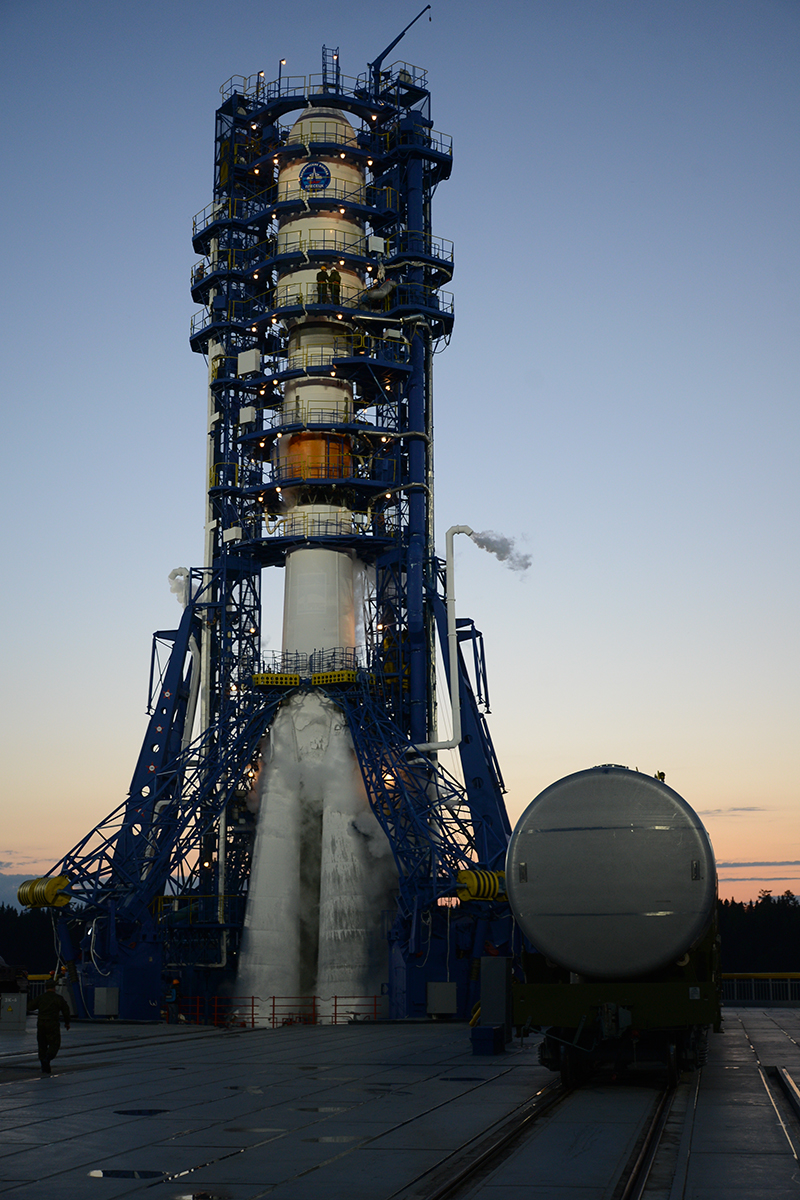


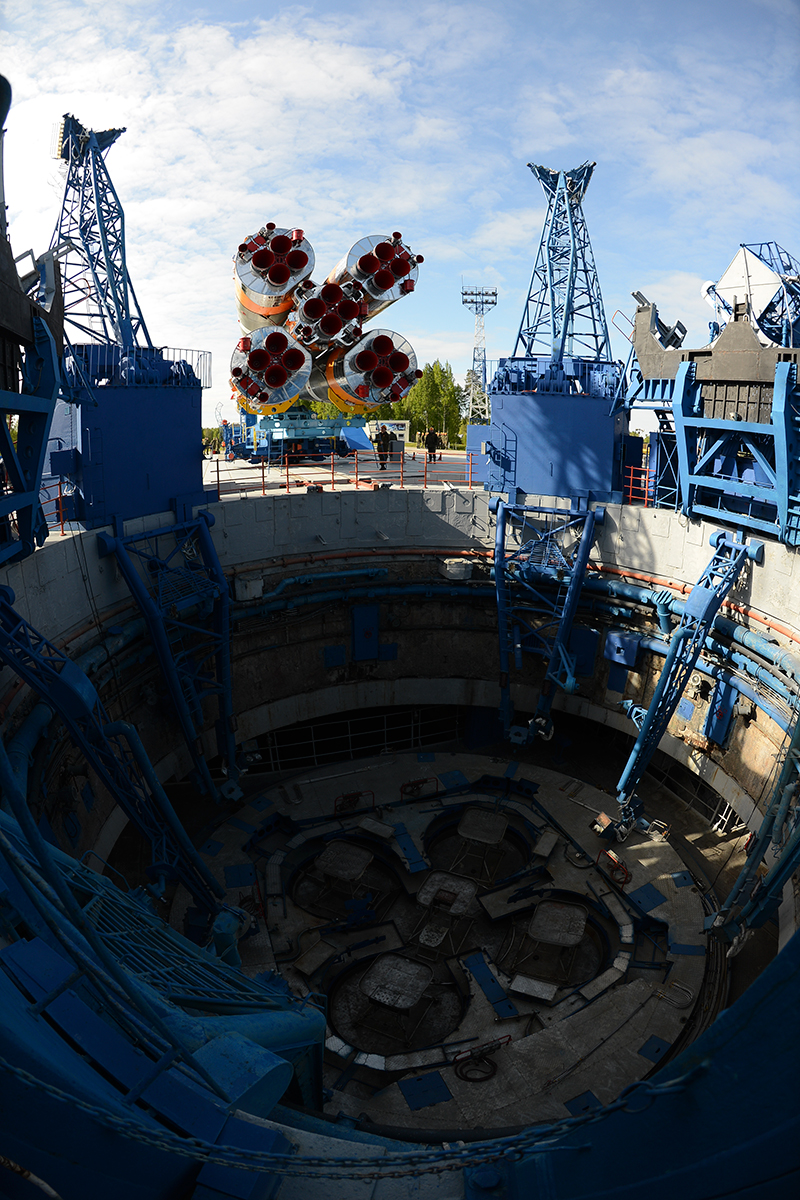

Soyuz-2.1b is the higher-performance variant of the Russian Soyuz-2 family, and therefore not a separate rocket but a configuration: it shares with the baseline 2.1a its airframe, its four strap-on boosters, its core stage and all of its digital avionics, differing only in the third stage. Where the 2.1a retains the veteran RD-0110 engine, the 2.1b fits the RD-0124, which uses an oxygen-rich staged combustion cycle. The change matters more than it sounds. Specific impulse rises from 326 to 359 seconds and, although maximum thrust drops slightly from 298 to 294 kN, the longer burn time on the same propellant load improves overall performance. In payload terms, capacity to low Earth orbit from Baikonur goes from roughly 7,430 kilograms for the 2.1a to 8,670 kilograms for the 2.1b; from Vostochny the comparison is 7,460 against 8,600 kilograms. Like the rest of the family it is 46.3 metres tall, 10.3 metres across at its widest and 312 tonnes at lift-off, and it is built by the Progress Rocket Space Centre in Samara. In its basic form it is a three-stage launcher, but it accepts an optional fourth stage — Fregat, or the cheaper Volga — for high-orbit missions; with Fregat from Baikonur it can send 2,350 kilograms towards a trans-lunar injection.
History
The second phase of the upgrade
When RKTs Progress laid out the "Rus" programme in the early 1990s, modernising the Soyuz meant three blocks of work: improved engines for the boosters and core stage, new digital avionics, and a fully redesigned third-stage engine. Financial pressures late in that decade forced the improvements to be spread over time. The RD-107A and RD-108A came first, on the transitional Soyuz-FG; the digital avionics debuted with the Soyuz-2.1a in 2004; and the RD-0124 was left for the final step, which gave the Soyuz-2.1b its name.
The RD-0124 engine
The RD-0124 uses an oxygen-rich staged combustion cycle, a technology in which Soviet and Russian engineering always held an edge. Its specific impulse gain — from 326 to 359 seconds — is substantial for an upper stage and more than offsets the slight thrust loss against the RD-0110. The result was roughly a 15 percent more powerful third stage and a marked capacity jump from all three cosmodromes.
Entry into service and missions
Soyuz-2.1b first flew on 27 December 2006, on a mission that used a Fregat upper stage to place the European space telescope CoRoT into orbit. It has since become the workhorse for Russia's most demanding payloads, with the GLONASS navigation satellites among its regular customers, alongside the Meteor-M weather satellites, Arktika-M and Ionosfera-M.
Replacing the previous generation
Between 2010 and 2019 the Soyuz-2 family progressively replaced the Molniya-M, Soyuz-U and Soyuz-FG. In parallel came Soyuz-ST, the derivative adapted for the Guiana Space Centre, which began flying in 2011 and whose operations were suspended in 2022 following the Russian invasion of Ukraine. In 2018 the price of a 2.1b launch without a fourth stage was quoted at about US$35 million.
Record
Soyuz-2.1b has accumulated 84 launches with two failures, its most recent flight dated 16 April 2026. It operates from Baikonur, Plesetsk and Vostochny, the last of these active since the first successful lift-off there on 28 April 2016.
Launch timeline
| Date | Launch site | Program | Outcome | Payload |
|---|---|---|---|---|
| Sep 16, 2026, 1:33 PM | 31/6 | — | Success | Progress resupply mission to the International Space Station. |
| Jul 19, 2026, 5:51 PM | Unknown Pad | — | Success | Note: Payload identities uncertain. Batch of 16 Rassvet-3 Low Earth Orbit communication satellites for the Russian Byuro-1440 (Bureau 1440) constellation for broadband high-speed internet access in Russia. |
Images










![[Liftoff 42:38] Roscosmos Launch Soyuz 2.1b LIVE | Launch of "Arktika-M" for Russian Space Forces](https://i.ytimg.com/vi/fB-nWfeqepY/hqdefault.jpg)