Saturn V (Documentary) Chapter 2: The F-1 engine
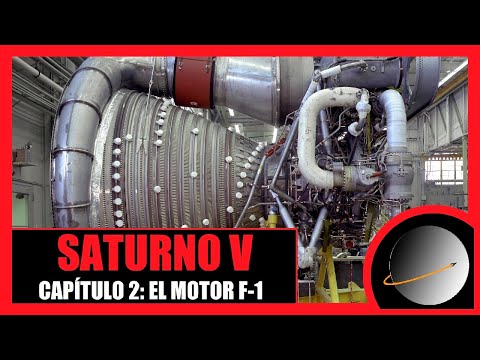
Video from the channel Astrofriki about Saturn V, linked on its Above Ten Thousand entry. Duration: 36:13. Language: Spanish. Video type: Documentary.
What it's about
Second chapter of a Spanish-language educational series about the Saturn V, devoted entirely to Rocketdyne's F-1 engine, which powered the first S-IC stage. It reviews the difficult history of its development, describes its components one by one and explains how it was started and shut down.
Historical context
The F-1 originated in 1955 as a United States Air Force project, which ended up favoring existing missiles such as Thor, Atlas and Titan. In 1959 NASA contracted Rocketdyne and inherited the project, more than two years before the Saturn V was even conceived. The major obstacle was combustion instability: on July 28, 1962, an engine was destroyed on the test stand. Engineers ended up deliberately triggering instability with small explosive charges in the injector, a technique inherited from the H-1, and through trial and error got the engine to recover in less than a tenth of a second. Between November 1967 and May 1973, 65 engines powered 13 flights. The video also recalls the 2013 recovery, in a project backed by Jeff Bezos, of remains of the center engine from Apollo 11's S-IC-6, and reviews its successors: the Soviet RD-170/171 and the F-1A, which was never completed due to lack of funding.
Key facts
It burned RP-1 and liquid oxygen and produced 6.7 MN of thrust at sea level. Every second, the turbopump, driven by a 53,000-horsepower turbine at 5,500 rpm, sent 1.8 tons of liquid oxygen and 0.8 tons of RP-1 to the chamber. The chamber, made of Inconel X-750, was cooled with 70% of the fuel, which flowed through a network of tubes welded in a single operation inside a furnace. The injector had 2,816 orifices and baffles that divided it into 13 compartments. Gases from the gas generator passed through a heat exchanger and protected the nozzle extension, which raised the expansion ratio from 10:1 to 16:1. Ignition combined four pyrotechnic igniters and a hypergolic cartridge of triethylborane and triethylaluminum; the five engines took 8.9 seconds to reach full power before the rocket was released.