How One Man Won The Space Race For America (Apollo Program: Saturn V Documentary) | Spark
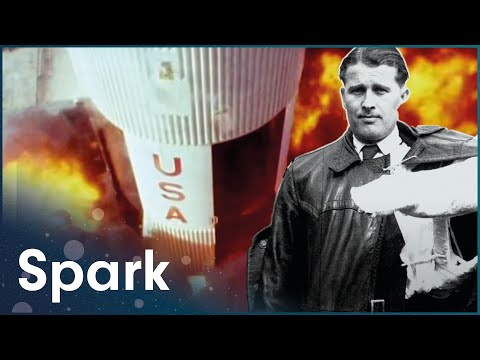
Video from the channel Spark about Saturn V, linked on its Above Ten Thousand entry. Duration: 52:01. Language: English. Video type: Documentary.
What it's about
Documentary about the development of the Saturn V, the launch vehicle of the Apollo program. It follows the project from the German origins of Wernher von Braun's rocketry to the lunar flights. It combines NASA archive footage, mission control communications and interviews with specialists. It explains the technical problems that had to be solved at each stage of the rocket.
Historical context
The story begins with the V2, the first ballistic missile, built in Nazi Germany under von Braun's direction. After the war ended, he and his team moved to the United States in September 1945 along with more than a hundred V2 rockets, which they continued to develop for the Army. The Cold War turned space into a battleground for rivalry. Sputnik 1 (4 October 1957), Sputnik 2 with the dog Laika, and the failure of Vanguard on 6 December 1957 forced Washington to react. Von Braun's team put the first American satellite into orbit on 31 January 1958, and NASA was created that same year. After Gagarin's flight and Alan Shepard's, Kennedy committed in 1961 to landing a man on the Moon before the decade was out. NASA dropped the giant Nova rocket and chose a three-stage rocket combined with a lightweight lunar module. Before that, it tested the Saturn I, of which it launched ten units, and the Saturn IB. Neither Kennedy's assassination in 1963 nor the fire of January 1967, which killed Grissom, White and Chaffee, stopped the program.
Key facts
The first stage, 42 m tall, carried five F-1 engines that together produced about 7.5 million pounds of thrust. Its combustion instability was fixed with baffles. The third stage used a single restartable J-2. An explosion during testing, caused by a faulty weld, led to all welds being tested to failure. The second stage saved weight with a common bulkhead between the liquid hydrogen and oxygen. IBM built the instrument unit, 22 feet in diameter, and Lockheed Propulsion the escape system. The rocket measured 110 m, and at its peak the program employed 375,000 people. Apollo 4 was the Saturn V's maiden flight. On Apollo 6 (April 1968), the pogo effect broke a fuel line and shut down two second-stage engines. Apollo 8 (December 1968) was the first crewed Saturn V and orbited the Moon ten times. It was followed by the tests of Apollo 9 and Apollo 10 and the Apollo 11 Moon landing in July 1969. Between 1968 and 1972, 24 men traveled to the Moon and 12 walked on it. The last Saturn V launched the first American space station in 1973.