Family: Saturn
Saturn V
Launch statistics
- 0
- Total launches
- 0
- Successes
- 0
- Failures
- —
- Success rate


_liftoff_from_Launch_Complex_39A.jpg)



The Saturn V was the three-stage super heavy-lift launch vehicle NASA developed for the Apollo programme and the first to carry humans beyond low Earth orbit. Thirteen vehicles flew between 1967 and 1973; nine sent twenty-four astronauts towards the Moon and the last one placed Skylab in orbit.
Related events
Three-view drawing
History
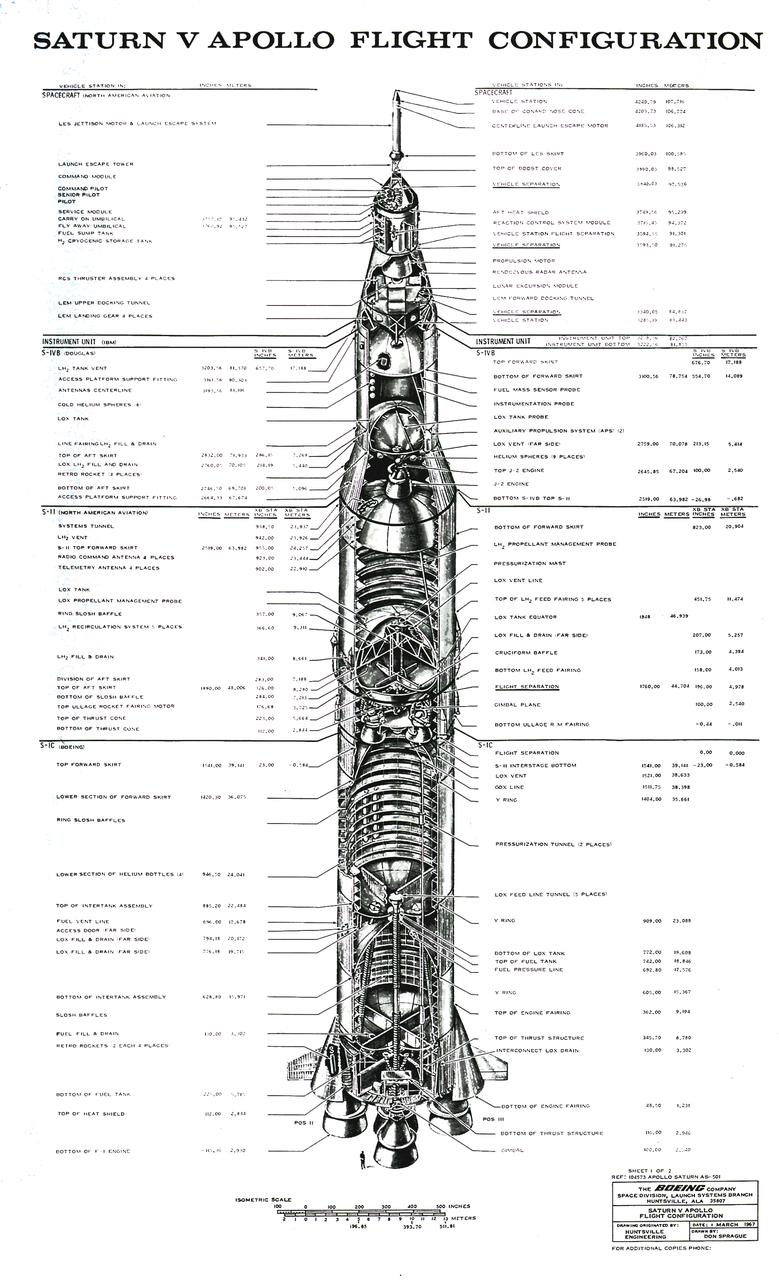
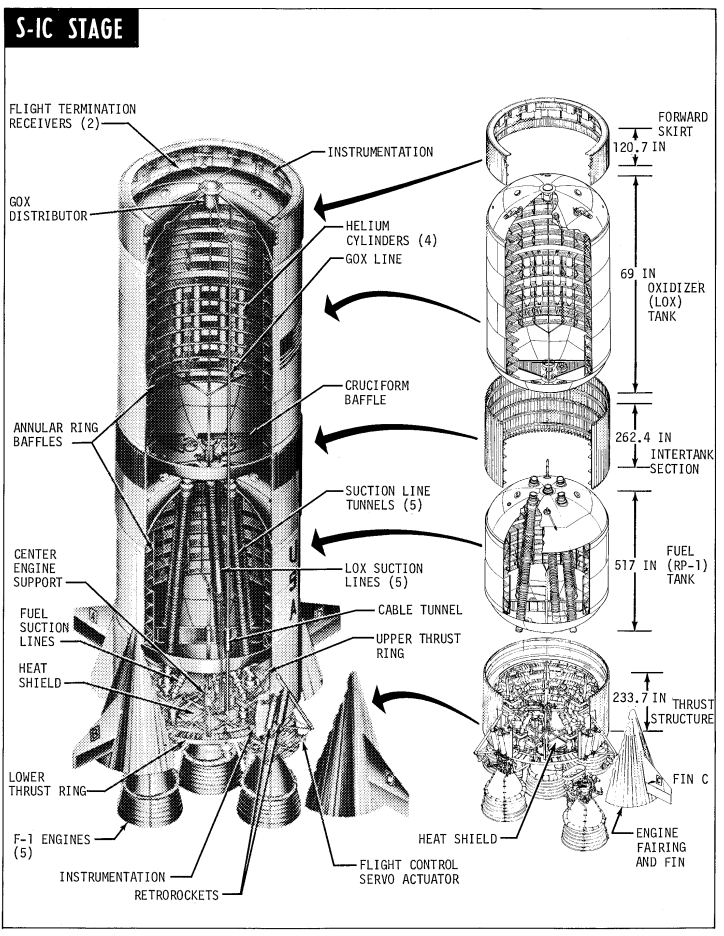
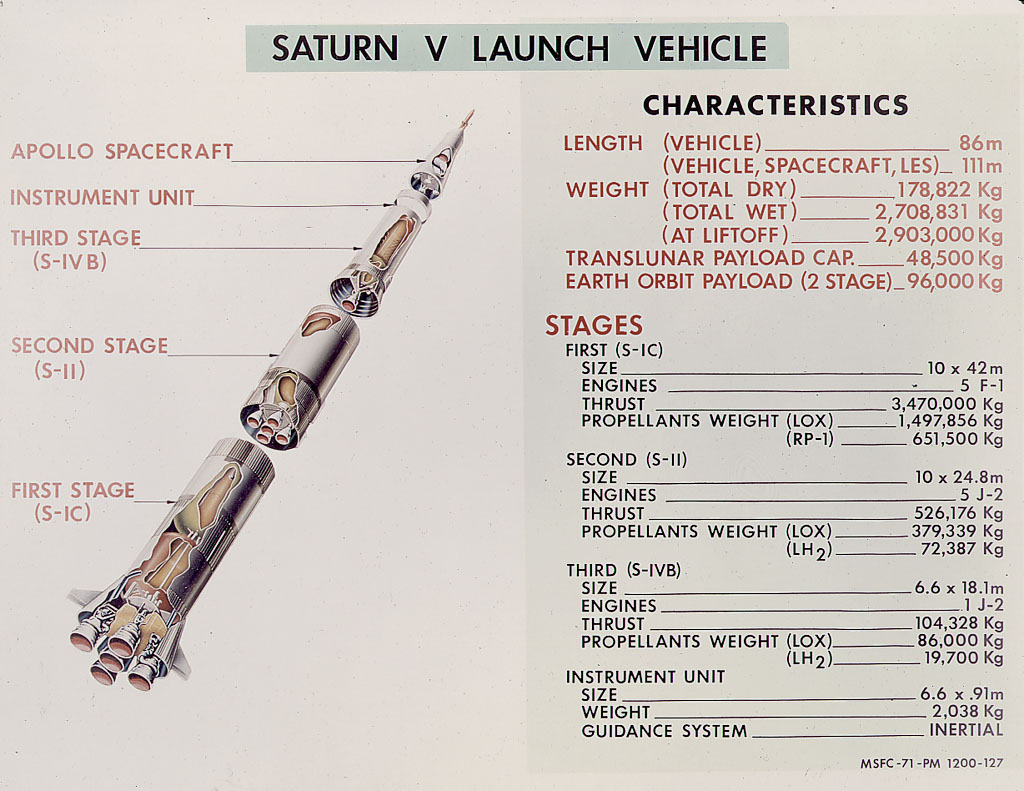
The Saturn V was designed at the Marshall Space Flight Center in Huntsville, Alabama, as the largest production model of the Saturn family. The programme was managed by George Mueller and the technical design led by the group of scientists who had come from Germany, headed by Wernher von Braun with Kurt Debus and Arthur Rudolph alongside him — the same team that had developed the first US launch vehicles of the Redstone family at the Army Ballistic Missile Agency. The industrial split was as colossal as the rocket: Rocketdyne built every engine; Boeing the S-IC first stage, burning kerosene and liquid oxygen and driven by five F-1 engines that remain the most powerful single-chamber liquid-fuelled engines ever built; North American Aviation the S-II second stage and the Douglas Aircraft Company the S-IVB third stage, both hydrogen-oxygen and powered by five J-2 engines and one respectively. IBM and Marshall itself signed the instrument unit that served as its brain.
With the Apollo spacecraft on top, the stack stood some 111 metres tall. Its first flight was the Apollo 4 test mission in November 1967. Thirteen Saturn V vehicles were launched in all, every one of them from Launch Complex 39 at the Kennedy Space Center, and nine of them sent twenty-four astronauts towards the Moon between Apollo 8 and Apollo 17; Apollo 11 carried the first crew to set foot on the lunar surface in 1969. The rocket still holds the record for the largest payload capacity to low Earth orbit, 140,000 kilograms, a figure that includes the S-IVB third stage with the propellant it had yet to burn to send the command and service module and the Lunar Module towards the Moon. At 34.5 meganewtons of thrust at liftoff it is the fourth most powerful rocket ever flown and the second most powerful among those that have carried a crew.
The last Saturn V did not go to the Moon: it launched Skylab, the first American space station, converted from one of its own third stages. Two further vehicles were built but never flew, once assigned to the cancelled Apollo 19 and 20, along with three ground test articles. Budget cuts buried a long list of follow-on projects — the Saturn II, the Saturn MLV, the Saturn V ELV, the C-5N variant with a NERVA nuclear stage, the Saturn-Shuttle — and with them any prospect of building more. Until the Space Launch System repeated the feat, the Saturn V was the only launch vehicle that had ever carried people beyond low Earth orbit.
Launch timeline
| Date | Launch site | Outcome | Payload |
|---|
Versions
| Saturn V (three-stage Apollo configuration) | Saturn INT-21 | |
|---|---|---|
| First launch | November 9, 1967 | May 14, 1973 |
| Last launch | December 7, 1972 | May 14, 1973 |
| Height | 111 m Best value in this row | 98.5 m |
| Diameter | 10.1 m Best value in this row | 10.1 m |
| Mass | 2,965,241 kg Best value in this row | 2,916,080 kg |
| Liftoff thrust | 33,000 kN Best value in this row | 33,000 kN Best value in this row |
| Stages | 3 | 2 Best value in this row |
| LEO capacity | 140,000 kg Best value in this row | 115,900 kg |
| Reusable | No | No |
Images