Saturn V version
Saturn V (three-stage Apollo configuration)
The three-stage arrangement — S-IC, S-II and S-IVB, topped by the Instrument Unit — in which the Saturn V flew every Apollo mission, from the uncrewed Apollo 4 test on 9 November 1967 to Apollo 17 on 7 December 1972: twelve launches. Its third stage could restart in orbit for trans-lunar injection, and it sent crews toward the Moon nine times. Topped by the Apollo spacecraft it stood about 111 m tall and left the pad at up to 2,965,241 kg.

- November 9, 1967
- First launch
- 140,000 kg
- LEO capacity
- 33,000 kN
- Thrust
- No
- Reusable
History
From C-5 to Saturn V
NASA approved the C-5 on 25 January 1962: a three-stage launcher made up of an S-IC with five F-1 engines, an S-II with five J-2s and an S-IVB with a single J-2. It was confirmed as the Apollo programme's rocket in mid-1962 and named Saturn V in February 1963. Design fell to the Marshall Space Flight Center in Huntsville, Alabama, which chose to reuse as much Saturn I technology as possible: the third stage was derived from the S-IVB conceived as a second stage in that programme. Manufacture was split among contractors. Boeing built the S-IC at the Michoud Assembly Facility in New Orleans and tested it at the Mississippi Test Facility; North American Aviation built the S-II at Seal Beach, California; Douglas Aircraft built the S-IVB at Huntington Beach, California; and IBM built the Instrument Unit in Huntsville. Every engine came from Rocketdyne.
The boldest call of the programme was procedural rather than technical: testing the rocket all-up, with complete versions of all three stages from the very first flight, instead of qualifying one stage at a time, so that far fewer test flights were needed before a crew could ride. Before any launch, the SA-500D dynamic test vehicle was shaken in three configurations, one for each phase of flight, and on 3 August 1967 Marshall announced the programme complete and the structure ready for its first launch.
Why three stages
The architecture followed from the choice of lunar orbit rendezvous. The S-IC burned RP-1 with liquid oxygen, denser and higher-thrust, which is what a first stage wants while drag and gravity losses dominate, and delivered 33,000 kN at sea level. The upper stages switched to liquid hydrogen, with higher energy per unit mass, better suited to high-energy trajectories such as trans-lunar injection. The key piece was the S-IVB: it burned only part of its propellant to reach Earth orbit and could restart later. That is why the 140,000 kg credited to this configuration in low orbit include the S-IVB itself with its remaining propellant; of that stack, about 43,500 kg headed for the Moon. Above the third stage sat the Instrument Unit, a short aluminium-honeycomb cylinder holding guidance, navigation and control, telemetry and crew safety systems.
How it flew
Ignition began at T−8.9 s with the S-IC centre engine, followed by opposing pairs of outboard engines at 300-millisecond intervals to spread the loads. At about T+2 min 15 s, with the crew at 4 g, the centre engine was shut down to bring it back to 3 g; the four outboard engines cut off around T+2 min 40 s, and eight small solid-fuel motors pushed the spent stage away. The S-II then fired for about 395 seconds. The S-IVB made a first burn of about 2.5 minutes into a parking orbit around 190 km up, at 28,048 km/h. After one and a half turns around the Earth, at about T+2 h 44 min, it restarted for trans-lunar injection, burning for almost six minutes. From Apollo 13 onward the spent third stage was aimed at the Moon so that seismometers left by earlier crews could record the impact.
Twelve flights
Apollo 4 (SA-501) opened the account on 9 November 1967, uncrewed and with all three stages live. Apollo 6, on 4 April 1968, delivered the scare: J-2 problems shut down two second-stage engines early and prevented the third-stage restart. The next flight carried a crew anyway: Apollo 8 lifted off on 21 December 1968 and performed the first trans-lunar injection of an Apollo spacecraft. Apollo 9 (3 March 1969) tested the complete spacecraft with the Lunar Module in low Earth orbit; Apollo 10 (18 May 1969) was the only Saturn V launched from Pad 39B; and Apollo 11, on vehicle SA-506, left on 16 July 1969 for the first landing. Apollo 12 (14 November 1969) was struck twice by lightning shortly after liftoff without serious damage. On Apollo 13 (11 April 1970) severe pogo oscillations in the second stage shut down its centre engine early, and guidance compensated by burning the other four longer; the mission was later aborted by a service module failure, not by the launcher. Apollo 14 (31 January 1971), Apollo 15 (26 July 1971), the first extended mission with the Lunar Roving Vehicle, and Apollo 16 (16 April 1972) followed. Apollo 17, on 7 December 1972, was the only night launch and the last flight of this configuration.
Afterwards
Once the lunar programme ended, the three-stage stack never flew again: the thirteenth Saturn V went up without an S-IVB to place Skylab in orbit. Two complete vehicles, SA-514 and SA-515, had been assigned to cancelled missions and were never used; their stages were split among museums, and the SA-515 third stage became the backup Skylab orbital workshop. A second production run, also cancelled, would very likely have brought an uprated F-1, bigger fins and a stretched S-IC. Between 1969 and 1971 an Apollo mission on a Saturn V cost 185 million dollars of the day.
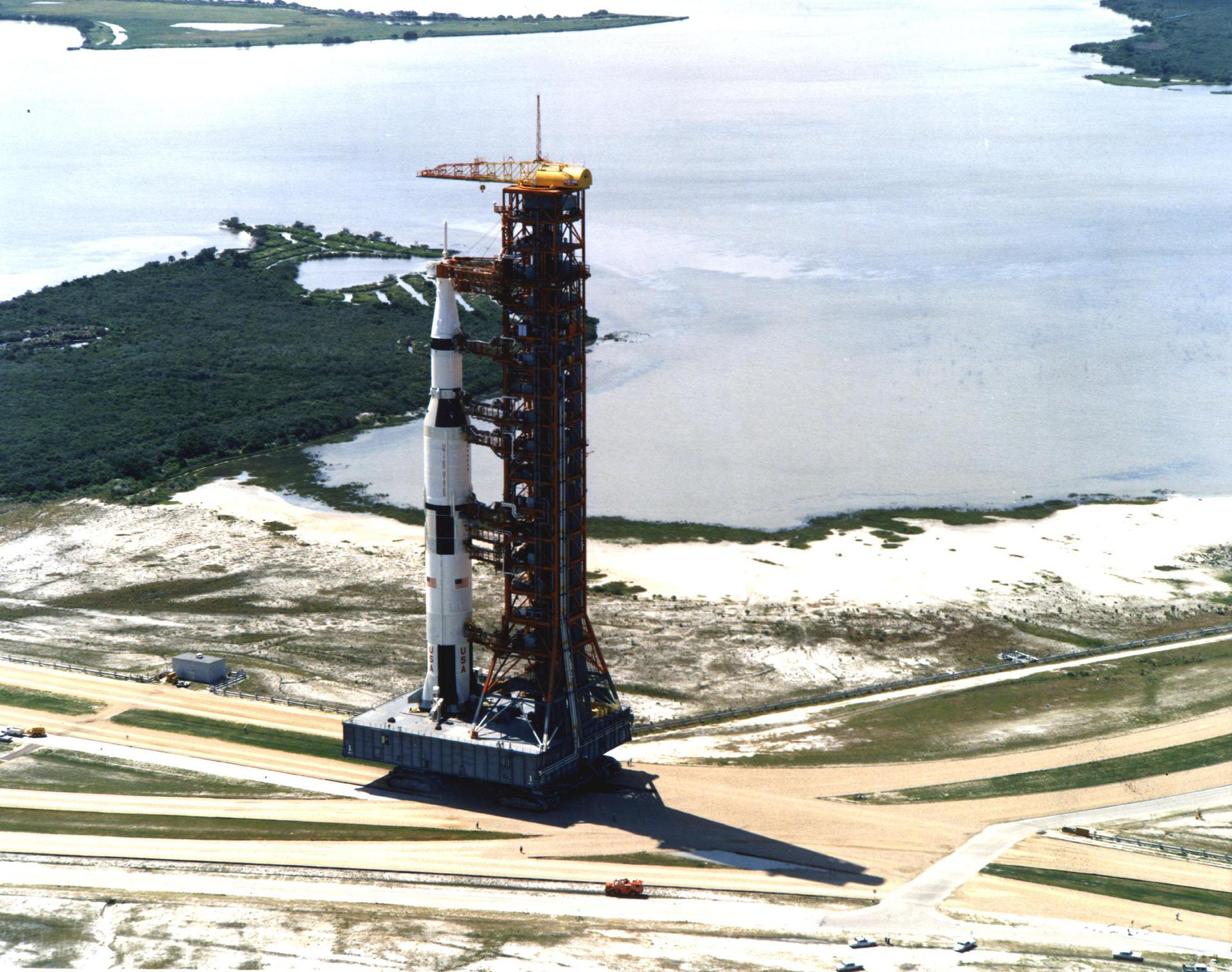
Stages and propulsion
S-IC first stage (Boeing): five Rocketdyne F-1s in a quincunx, liquid oxygen and RP-1; 33,000 kN at sea level, 42 m tall and 10 m across, about 137,000 kg dry and 2,214,000 kg fuelled; about 150 s burn. S-II second stage (North American Aviation): five Rocketdyne J-2s, liquid oxygen and liquid hydrogen; 4,400 kN in vacuum, 24.87 m tall, about 43,000 kg dry and 470,000 kg fuelled (including the interstage); 395 s. S-IVB third stage (Douglas): one restartable Rocketdyne J-2, liquid oxygen and liquid hydrogen; 1,000 kN in vacuum, 17.86 m tall and 6.60 m across, about 15,200 kg dry and 120,500 kg fuelled (including the Instrument Unit); two burns of 165 and 312 s. Instrument Unit (IBM) carrying guidance and control.
| Stage | Powerplant | Propellant | Thrust | Propellant mass | Gross mass | Burn time |
|---|---|---|---|---|---|---|
| S-IC | 5 × Rocketdyne F-1 | LOX / RP-1 | 33,000 kN | — | 2,214,000 kg | 150 s |
| S-II | 5 × Rocketdyne J-2 | LOX / LH2 | 4,400 kN | — | 470,000 kg | 395 s |
| S-IVB | 1 × Rocketdyne J-2 | LOX / LH2 | 1,000 kN | — | 120,500 kg | — |
Multimedia

_liftoff_from_LC-39A%2C_16_Jul_1969-1600.webp)
_at_LC-39A_awaiting_launch%2C_9_Nov_1967-800.webp)

_Saturn_V_leaving_the_Vehicle_Assembly_Building_for_Pad_A%2C_9_Oct_1968-800.webp)
_Saturn_V_at_Pad_A_at_night_with_searchlights%2C_Nov_1972-800.webp)
_Saturn_V_launch%2C_7_Dec_1972-1600.webp)
_Saturn_V_launch_from_Pad_A%2C_LC-39%2C_21_Dec_1968-800.webp)