Family: Proton
Proton
Launch statistics
- 0
- Total launches
- 0
- Successes
- 0
- Failures
- —
- Success rate


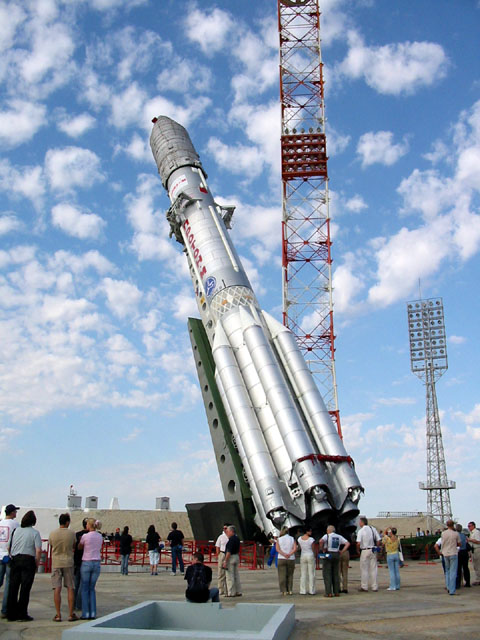
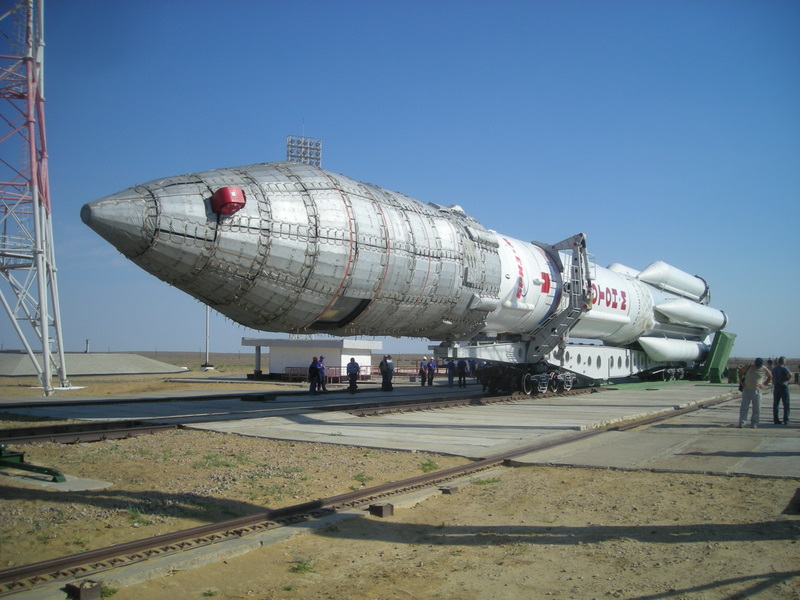


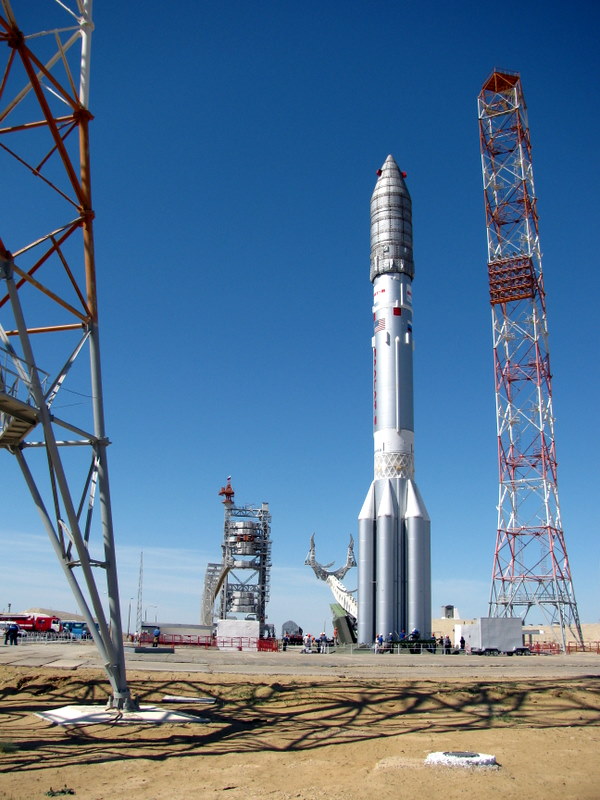


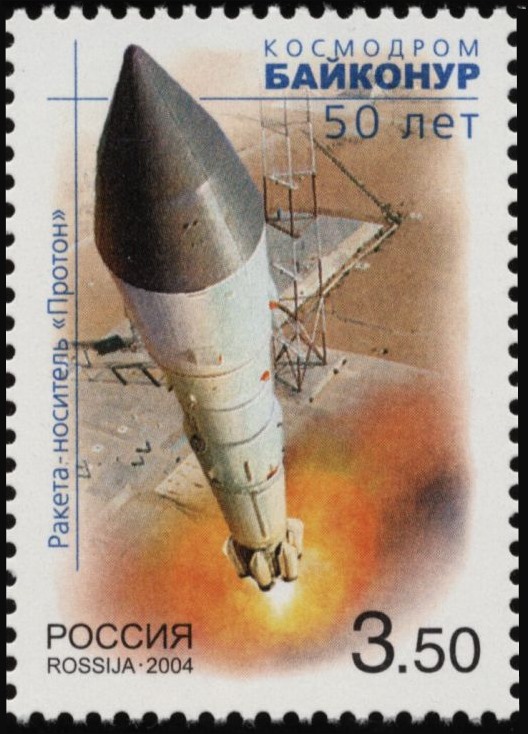

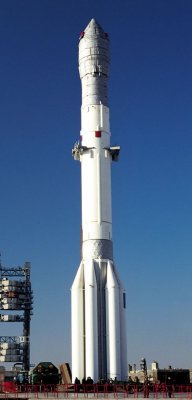
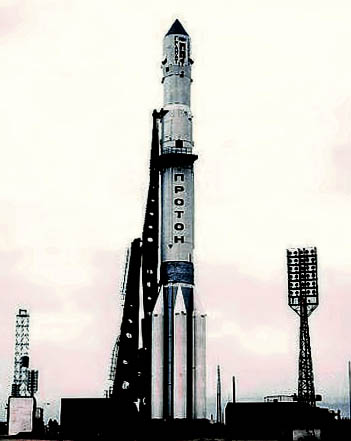

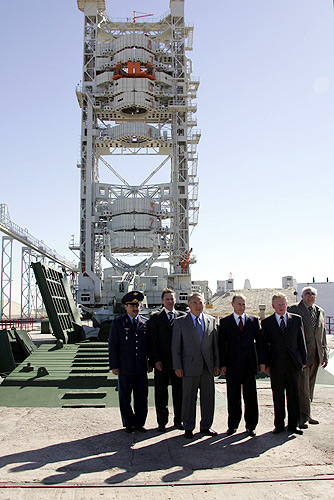
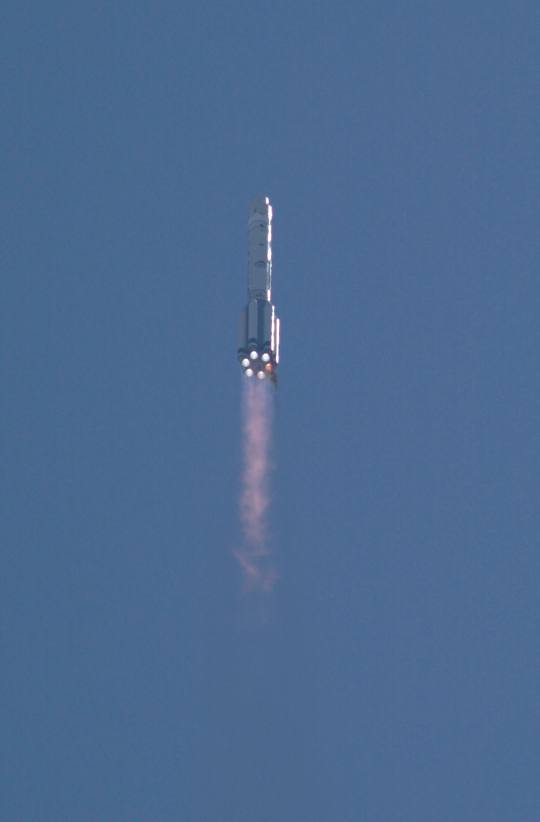

Proton, conceived as an oversized intercontinental missile that was never deployed as one, became the heavy workhorse of the Soviet and later Russian space programme. It flew the Venus and Mars probes, every Salyut station, almost all of Mir and the Russian modules of the International Space Station.
Three-view drawing
_circumlunar_missions.jpg)
History
The vehicle, formally designated UR-500, came out of Vladimir Chelomei's design bureau as a counterweight to Korolev's N1, and it began life not as a space launcher but as a ballistic missile meant to carry a hundred-megaton thermonuclear warhead over 13000 km. The concept was disproportionate even by Cold War standards and was never fielded in that role. Korolev also objected openly to Chelomei's designs because of their toxic propellants: Proton burns hypergolic combinations rather than cryogenic ones.
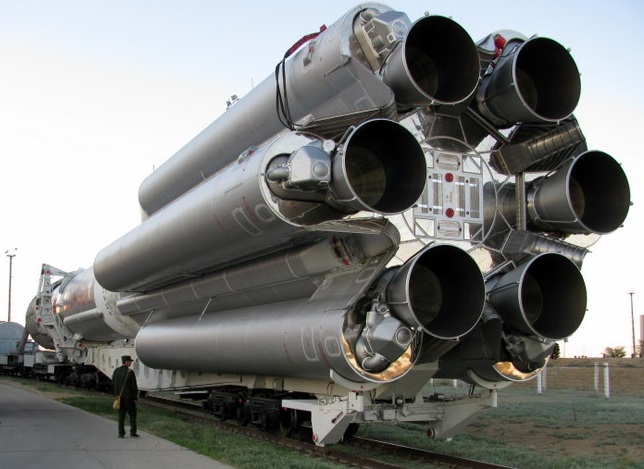
Its distinctive shape is a consequence of the railway. The central oxidiser tank takes up the maximum width the track loading gauge allows, and the six tanks around it hold the fuel and serve as mounting points for the engines; they look like strap-on boosters but never separate from the core. The first two stages are joined by a lattice structure that lets the second-stage engine ignite before separation, a hot-staging technique that removes the need for ullage motors.
The first launch took place on 16 July 1965. A rushed development programme produced dozens of failures up to 1972, and the vehicle did not finish its State Trials until 1977, by which point its reliability was rated above 90 %. Its design stayed secret until 1986: the public had only seen upper stages in photographs, and the complete rocket was not shown to the outside world until the televised launch of Mir. It stands 53 m tall and 7.4 m across, and lifts on the order of 22.8 tonnes to low Earth orbit and some 6.3 tonnes to geostationary transfer orbit.
In its three-stage configuration it launched the circumlunar flights of the Zond programme and all seven Salyut stations; with the Blok D fourth stage it sent every Soviet Venera and Mars probe on its way. From 1986 it placed six of the seven Mir modules in orbit and, from 1998, the Zarya, Zvezda and Nauka modules of the International Space Station's Russian segment, along with the first two generations of GLONASS satellites. Proton-M, using Briz family upper stages, first flew in 2001, and its commercial launches are marketed through International Launch Services. Angara A5 is taking over the heavy-lift role and no new contracts are expected: the last scheduled launches are planned for 2029.
Launch timeline
| Date | Launch site | Outcome | Payload |
|---|
Versions
| Proton (UR-500, 8K82) | Proton-K (8K82K) | Proton-M (8K82M) | Proton Light | Proton-M/Briz-M Fase III | Proton Medium | |
|---|---|---|---|---|---|---|
| First launch | July 16, 1965 | March 10, 1967 | April 7, 2001 | — | — | — |
| Last launch | July 6, 1966 | March 30, 2012 | February 12, 2026 | — | — | — |
| Height | — | 50 m | 58.2 m Best value in this row | — | — | — |
| Diameter | 7.4 m Best value in this row | 7.4 m Best value in this row | 7.4 m Best value in this row | — | — | — |
| Mass | — | — | 705,000 kg | — | — | — |
| Stages | 2 | — | — | — | — | — |
| LEO capacity | — | 19,760 kg | 23,000 kg Best value in this row | — | — | — |
| GTO capacity | — | — | 6,300 kg Best value in this row | 3,600 kg | 6,150 kg | 5,000 kg |
| Reusable | No | No | No | No | No | No |
Images