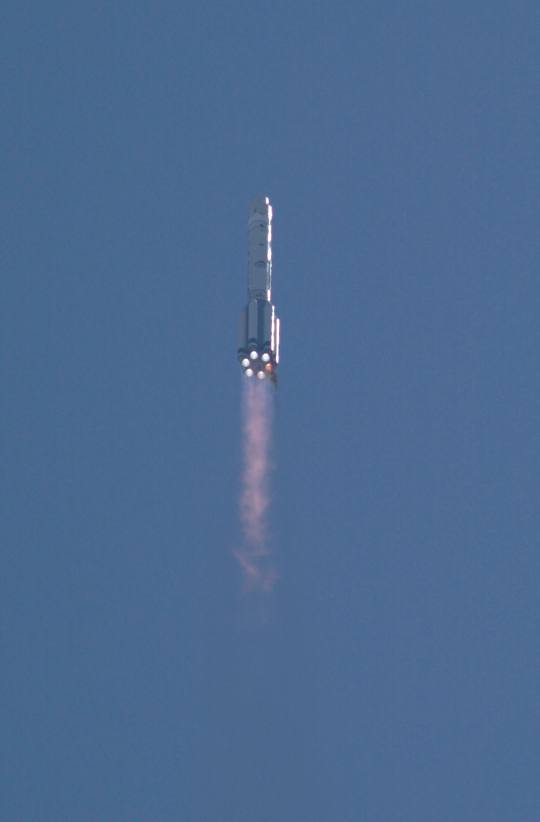
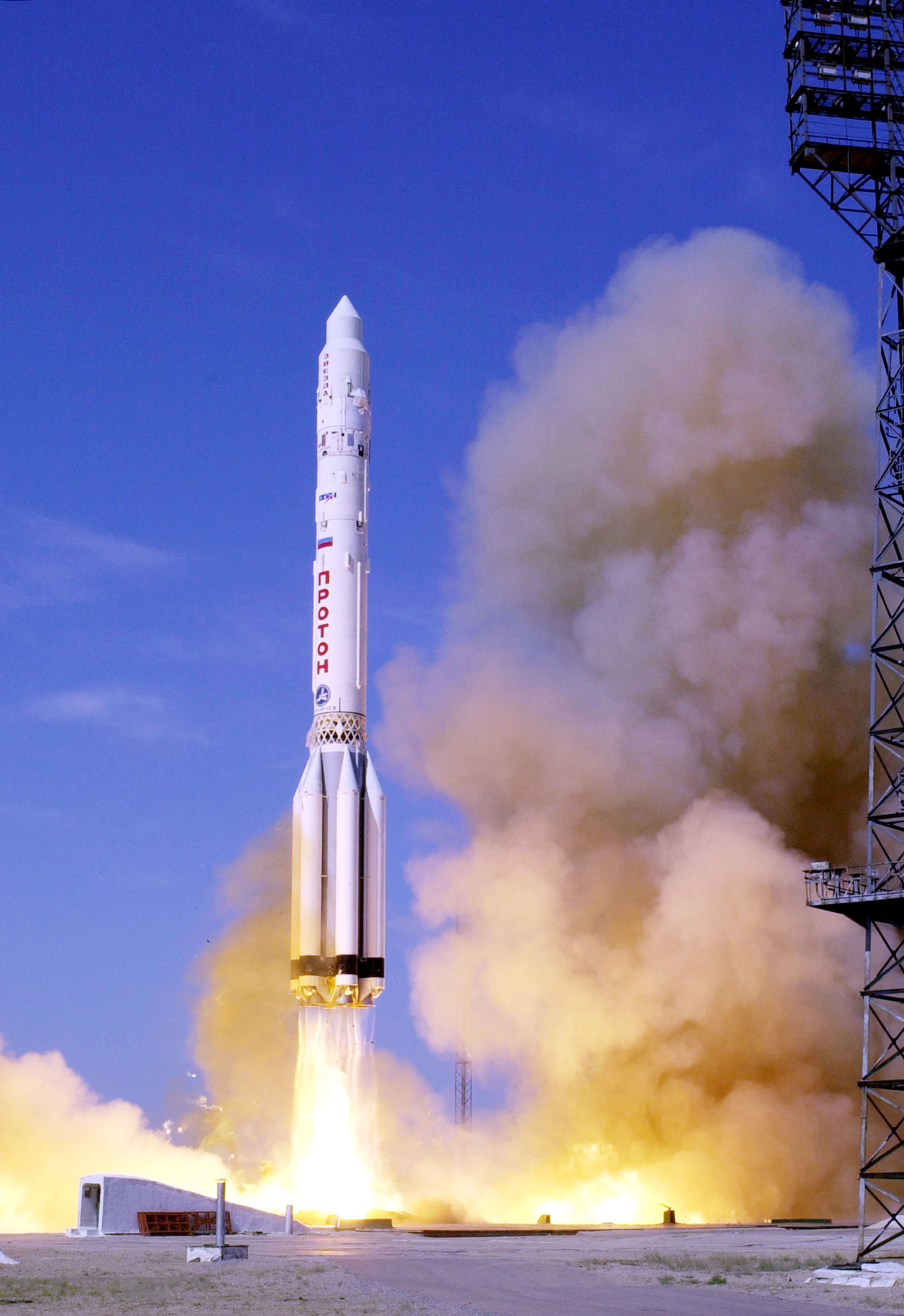
Proton version
Proton-K (8K82K)
Three-stage (four with an upper stage) derivative of the UR-500: it flew 310 times between 1967 and 2012 from Baikonur, launching the Zond, Venera and Mars probes, all seven Salyut stations, six Mir modules and the Zarya and Zvezda modules of the ISS. Up to 19,760 kg to low Earth orbit.

- March 10, 1967
- First launch
- 19,760 kg
- LEO capacity
- 10,470 kN
- Thrust
- No
- Reusable
History
From UR-500 to 8K82K
The Proton-K (Russian Протон-К, GRAU index 8K82K; Sheldon names D-1, D-1-e and D-1-h; US Department of Defense designations SL-12 and SL-13) was born as the three-stage version of Vladimir Chelomey's two-stage UR-500. Development, under the designation UR-500K, began in July 1965 at Branch No. 1 of the OKB-52 bureau, today's Khrunichev. Its immediate purpose was the Moon race: the UR-500K-L-1 project was to send the two-module 7K-L1 spacecraft, a Soyuz variant, around the Moon and back to Earth, first uncrewed and then with cosmonauts. A fourth stage, Blok D, derived from the fifth stage of the giant N-1, was developed alongside it.
Compared with the UR-500, the first stage was carried over unchanged; the second gained larger propellant tanks and a redesigned lattice interstage; the third was made by shortening the UR-500 second stage and fitting one engine instead of four. That engine, Semyon Kosberg's RD-0212, combines a single-chamber main engine (RD-0213, 588 kN in vacuum) with a four-chamber vernier engine (RD-0214, 32 kN in vacuum) that steers the vehicle without gimballing the main engine and aids stage separation. The autonomous inertial guidance system, designed by Nikolai Pilyugin's team with triple redundancy and built at the Kommunar plant in Kharkiv, sat in a toroidal bay atop the third stage and also controlled the first two stages.
A 50-metre vehicle
The Proton-K stood 50 m tall, was 7.4 m across at its widest and burned nitrogen tetroxide and unsymmetrical dimethylhydrazine, hypergolic propellants that ignite on contact and store at ambient temperature. The first stage, 21.2 m long and 450,510 kg fuelled, carried six Valentin Glushko RD-253 engines delivering 10,470 kN for 124 s; in the early 1990s their thrust rose by 7.7% and the engine was renamed RD-275. The second stage, with four RD-0210s, gave 2,399 kN for 206 s, and the third 613.8 kN for 238 s. As a three-stage vehicle it put up to 19,760 kg into low Earth orbit; its record was the 22,776 kg Zvezda module. It flew from pads 81/23, 81/24, 200/39 and 200/40 at Baikonur.
A difficult start
The first launch, on 10 March 1967, carried the 7K-L1P prototype, registered as Kosmos 146, on a Blok D; that date is regarded as the Proton-K's birthday. Rushed development took its toll: between March 1967 and August 1970 only 6 of 21 launches were fully successful. On 27 September 1967 a first-stage engine failed to start because a rubber plug had been left inside it; on 19 February 1969 the payload fairing collapsed at 51 s and the rocket exploded; on 2 April 1969 an engine fire brought down the rocket, carrying a Mars probe, seconds after liftoff. Of 11 launches of 7K-L1 spacecraft only Zond 7 was a complete success, and five missions were lost to launcher failures. As a result the Proton-K was not formally accepted into service until 1978, after its 61st launch.
Stations, probes and satellites
In its baseline three-stage form it flew thirty times, always with heavy low-orbit payloads: from 1971 it launched all seven Salyut stations, flew four uncrewed TKS test flights before that programme was cancelled, orbited six of the seven Mir modules from 1986 and, from 1998, the Zarya and Zvezda modules of the International Space Station. With a fourth stage it launched every Soviet Venera and Mars probe of the 1970s and 1980s, as well as Luna and Zond missions. Upper stages were many: Blok D flew forty times, D-1 ten and D-2 three (Fobos 1, Fobos 2 and Mars 96); Blok DM 66 times; DM-2, the most used, 109 times, mostly with GLONASS and Raduga satellites; DM-2M fifteen times, mostly with Ekspress satellites; and DM3 twenty-five times, almost exclusively with commercial satellites. Briz-M made its debut on it on 5 July 1999 and flew four times in all.
Final years
Several later failures came down to upper stages or manufacturing defects; the July 1999 loss and that of Ekspress 1A in October 1999 were blamed on poor workmanship in a 1993 batch of engines from the Voronezh plant. From 2001 the Proton-K was gradually replaced by the Proton-M, which kept its structure but introduced a digital control system. The last Proton-K, built in the late 2000s and held in storage, lifted off on 30 March 2012 with the last satellite of the US-KMO series and the last DM-2 stage. It was its 310th launch (311th by another count), 275 of them successful.
Multimedia