Proton version
Proton-M (8K82M)
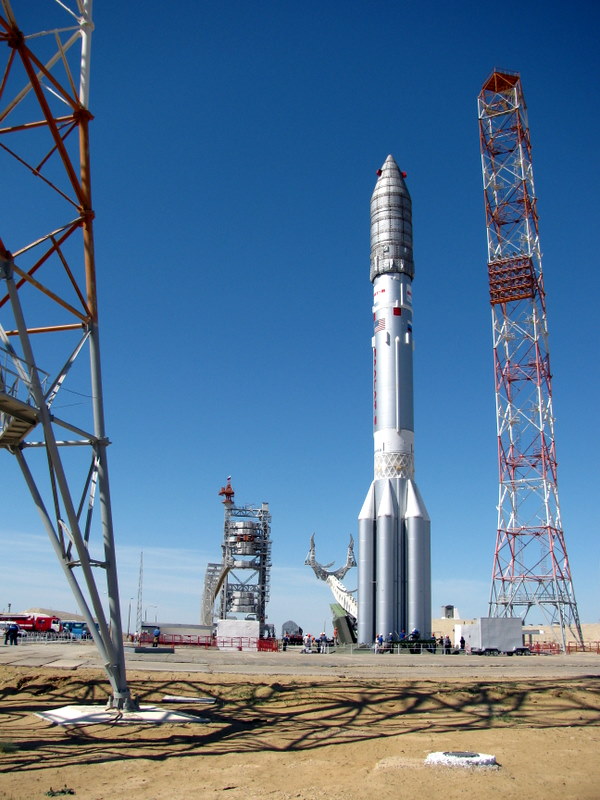
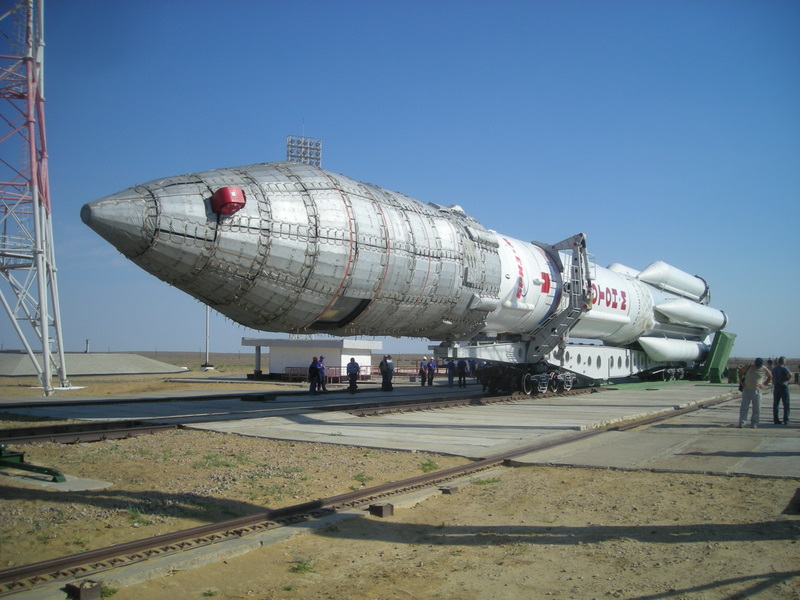
The modernised and final Proton (GRAU index 8K82M), flying since 7 April 2001: 58.2 m, 705,000 kg at lift-off and 23,000 kg to a 51.5° low Earth orbit. It almost always flies with the Briz-M upper stage and has mostly launched commercial and state communications satellites.
- April 7, 2001
- First launch
- 23,000 kg
- LEO capacity
- 10,532 kN
- Thrust
- No
- Reusable
History
Origin and design
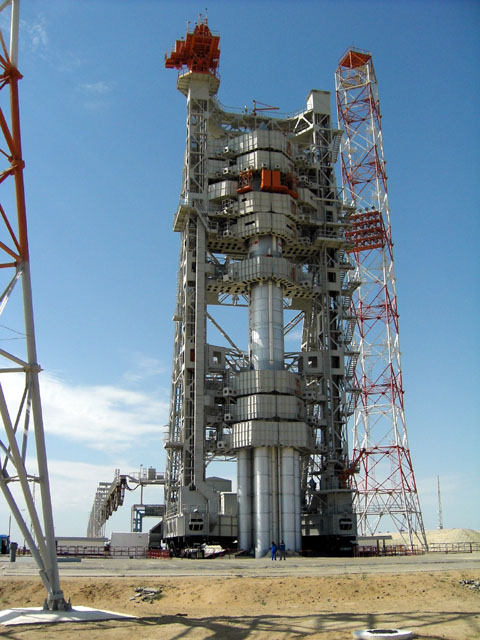
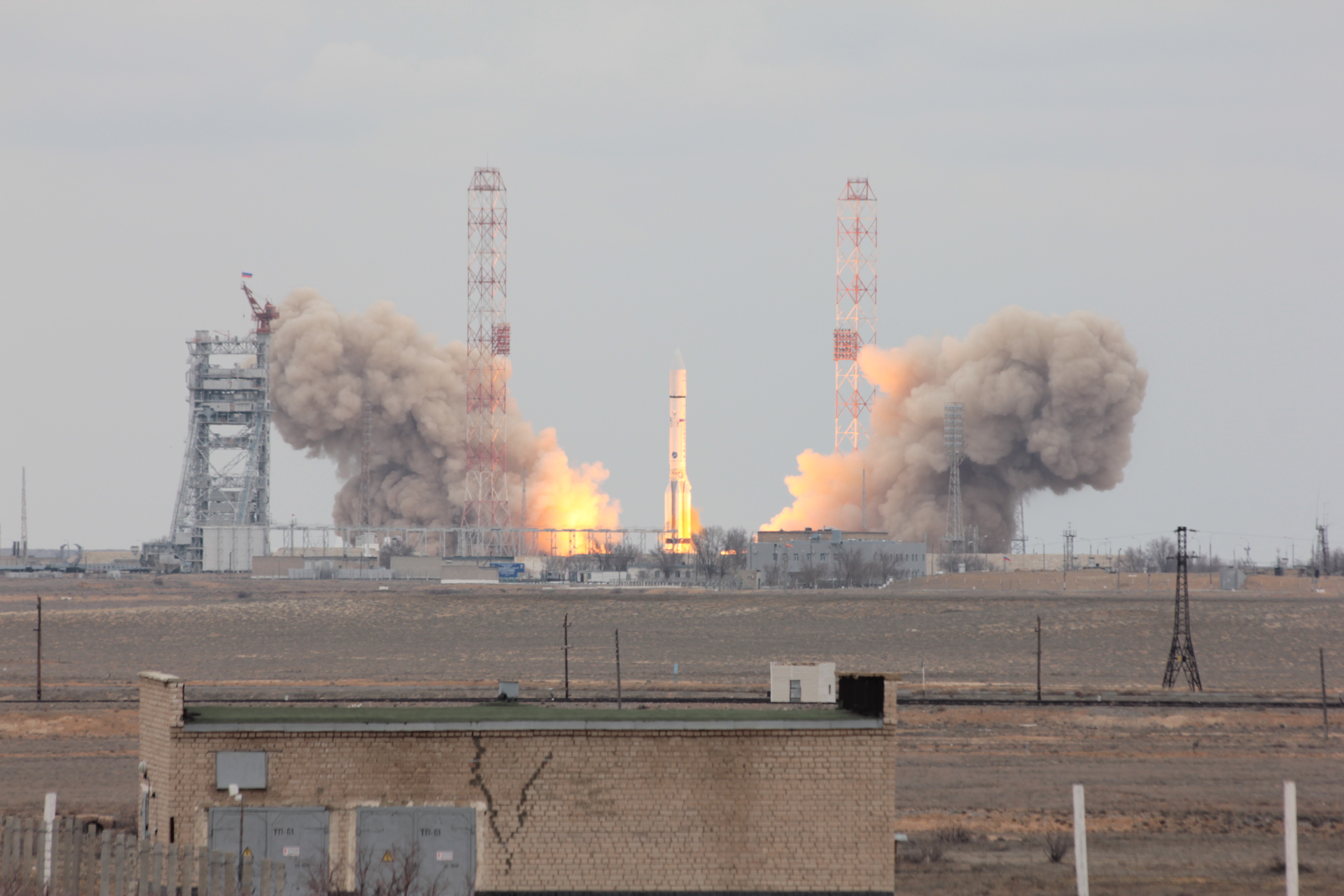
The Proton-M (Протон-М, GRAU index 8K82M or 8K82KM) is the modernisation of the Proton-K, built by Khrunichev in Moscow and launched from pads 81/24 and 200/39 at Baikonur in Kazakhstan. Its improvements centred on the lower stages: less structural mass, more thrust and full use of the propellants. The first stage gained closed-loop guidance that burns the propellant more completely, slightly improving performance and reducing the toxic residue left in the stage when it impacts downrange. Efforts were also made to depend less on foreign, usually Ukrainian, suppliers.
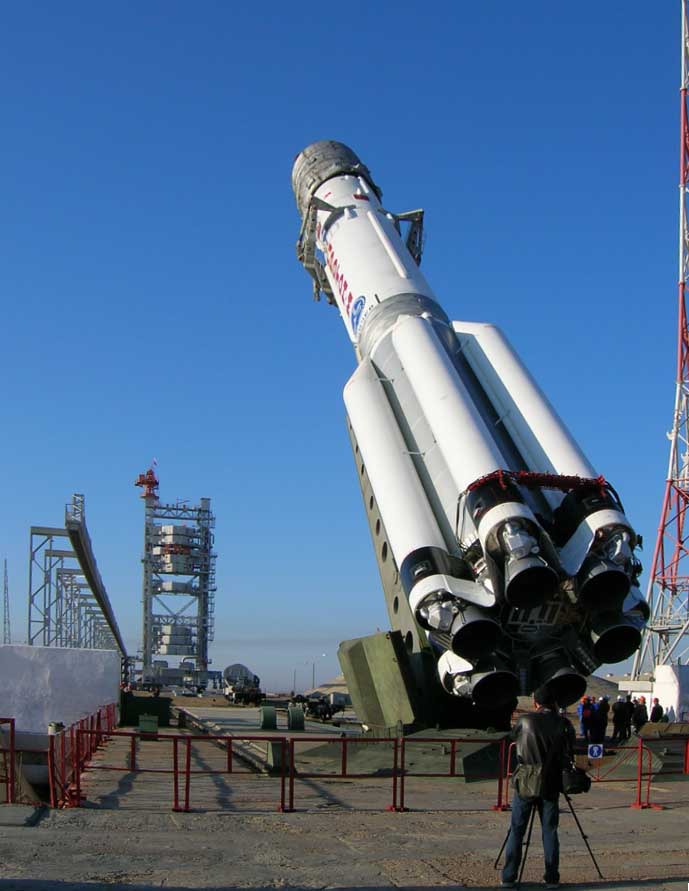
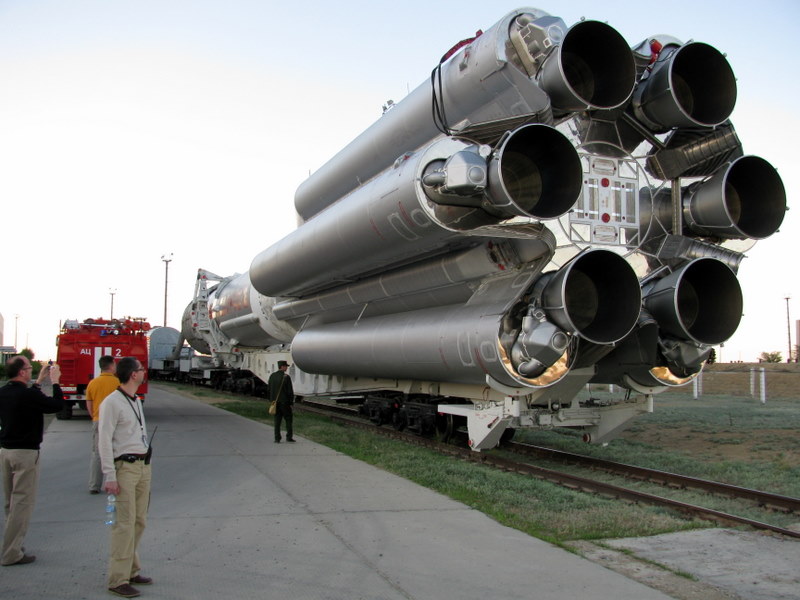
Its three stages burn the hypergolic combination of dinitrogen tetroxide and unsymmetrical dimethylhydrazine. The first stage combines a central oxidiser tank with six fuel tanks around it, each carrying an RD-275M engine that swivels up to 7°; it delivers 10,532 kN for 108 seconds and holds 428,300 kg of propellant in a stage 21.18 m long and 7.4 m across. The second stage carries three RD-0210 engines and one RD-0211 (fitted with a heat exchanger to pressurise the tanks), producing 2,399 kN for 206 seconds, and separates by hot staging through an open lattice. The third stage, which houses the avionics that control the first two, has a fixed RD-0213 and the four-nozzle RD-0214 vernier, giving 613.8 kN for 238 seconds.
Performance
The initial version could place 3 to 3.2 tonnes in geostationary orbit, 5.5 tonnes in geostationary transfer orbit and up to 22 tonnes in a 51.6° low Earth orbit, that of the International Space Station. The vehicle's current data sheet gives 23,000 kg to a 180 km circular orbit at 51.5° from Baikonur, 6,920 kg to geostationary transfer with 1,800 m/s remaining, 6,300 kg with 1,500 m/s and 3,250 kg directly to geostationary orbit. Commercial ILS launches use two 4.35 m diameter fairings, the short PLF-BR-13305 and the long PLF-BR-15255.
Upper stages and flight profile
Most flights add the storable-propellant Briz-M instead of the Blok D or Blok DM, which needed several propellant supplies and oxygen top-off because of boil-off. Six launches used the Blok DM-02 with GLONASS satellites and seven more the Blok DM-03; only one flew without an upper stage: the launch of the Nauka module and the European Robotic Arm (ERA) to the International Space Station on 21 July 2021, with 20,200 kg. In a typical mission the Proton-M leaves the payload, adapter and Briz-M on a slightly suborbital trajectory; the Briz-M reaches a 170 to 230 km parking orbit at 51.5° and from there places the payload in its final or transfer orbit.
Flight record
It first flew on 7 April 2001, carrying the Ekran-M satellite from pad 81/24. On 7 July 2007 the Proton-M Enhanced (M+) debuted with DirecTV-10: it was the 326th Proton launch and the 16th Proton-M/Briz-M. The baseline model was retired in November 2007 in favour of this version, which was followed by the Phase III and Phase IV enhancements of the Briz-M combination. Its payloads include GLONASS, Ekspress, Blagovest, ExoMars and Nauka. By 12 February 2026, when it launched Elektro-L No. 5 and Iran's Jame-e-Jam 1 with the Blok DM-03 on the last flight of that configuration, it had made 116 launches: 105 successes, 9 failures and 2 partial failures.
Failures
In September 2007 the first and second stages failed to separate because of a damaged pyrotechnic cable and JCSAT-11 fell in Kazakhstan. On 5 December 2010 the upper stage, overloaded with 1,500 kg of liquid oxygen, failed to reach orbital velocity and three GLONASS satellites were lost. On 2 July 2013 another Proton-M with three GLONASS satellites began oscillating just after lift-off and crashed beside the pad after 30 seconds: three yaw angular velocity sensors had been installed upside down. The accident ended thirty years without a first-stage failure and prompted the creation, in August 2013, of the United Rocket and Space Corporation. Third-stage failures followed in May 2014 (an Ekspress) and May 2015 (MexSat-1), traced to the RD-0214 vernier, along with others caused by the Briz-M. In January 2017 the second- and third-stage engines built in Voronezh were recalled over cheaper materials and falsified paperwork; the Proton-M returned to flight on 8 June 2017.
Retirement
In 2013 it was expected to retire before 2030. In June 2018 Roscosmos announced that production would end as Angara came into service, and on 9 October 2019 it flew its last scheduled commercial mission, with Eutelsat 5 West B and Mission Extension Vehicle-1. Russian state missions such as Ekspress-AMU4 remain on its manifest, along with Iran's Ekvator.
Multimedia