Atlas (familia) version
Atlas (familia) Atlas-Centaur
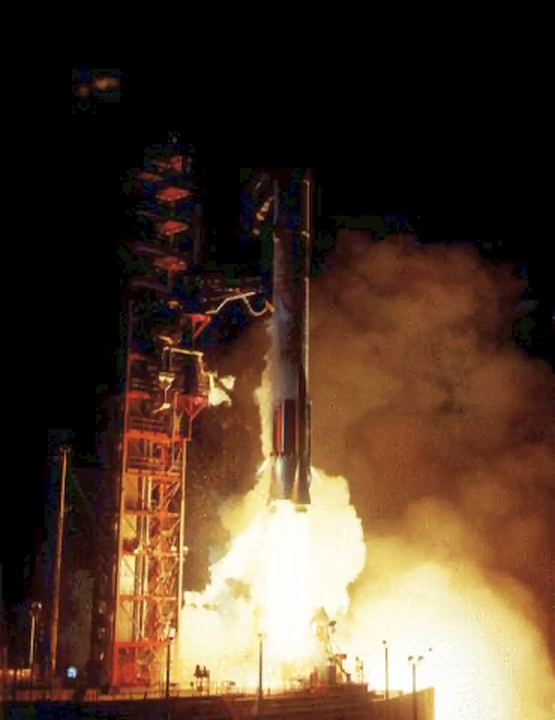
An Atlas topped by Centaur, the first rocket stage to burn liquid hydrogen. After a troubled development that nearly ended in cancellation, it launched all seven Surveyors, Pioneer 10 and 11, several Mariners and many Intelsat satellites in its LV-3C, SLV-3C and SLV-3D versions.
-1600.webp)
- May 8, 1962
- First launch
- No
- Reusable
History
A hydrogen stage for Atlas
Atlas-Centaur was the American expendable launch vehicle created by placing the Centaur stage, the first rocket stage to burn liquid hydrogen and liquid oxygen, on top of an Atlas derived from the SM-65D missile. Convair, the maker of Atlas, designed Centaur specifically for that booster and gave it the same pressure-stabilised tank structure, which allowed it to be built on the Atlas assembly line. Hydrogen offered outstanding performance, but it had to be kept colder than liquid oxygen and its low density demanded very large tanks. Earlier experience came from the Air Force's secret Suntan programme, the Lockheed CL-400 reconnaissance aircraft of the mid-1950s, whose progress Convair and others picked up for rocket stages. Centaur's engines were built by Pratt & Whitney under a separate government contract.
To carry such a large upper stage, Convair prepared a special version of the Atlas D: an MA-5 booster section with twin turbopumps on each engine, a reinforced structure and lengthened tanks. The insistence on modifying Atlas components rather than designing new ones — for schedule and budget reasons and to use the existing line — made development harder.
A programme that nearly died
The project began in 1958 under the Advanced Research Projects Agency (ARPA) and passed to NASA in July 1959. The Air Force kept overall supervision because it meant to use Centaur for ADVENT, a network of military communications satellites that never left the drawing board; Centaur quickly found work with the Mariner and Surveyor probes instead. A lack of funds stretched the schedule: the first flight, planned for January 1961, slipped by more than a year.
.jpg)
The first vehicle (Atlas 104D with Centaur F-1) reached Cape Canaveral in October 1961 and was erected on the new LC-36A, where it sat for seven months while hydrogen leaks through the intermediate bulkhead and guidance and propulsion faults were chased down. It lifted off on 8 May 1962 (9 May according to Gunter's Space Page) and, 54 seconds later, Centaur broke apart and took the Atlas with it: an insulation panel had come off too early, the hydrogen overheated and tank pressure exceeded the structure's strength. A congressional investigation in June 1962 called the programme's management "weak", and Wernher von Braun proposed replacing it with a Saturn I carrying an Agena stage. NASA moved Centaur from the Marshall centre to the Lewis Research Center in Ohio, where a team led by Abe Silverstein fixed the panels and other design flaws. In November 1962 President Kennedy suggested cancelling it, but was persuaded that experience with hydrogen engines was vital to Apollo, and Centaur became a high-priority project.
Test flights
AC-2 flew on 27 November 1963, five days after Kennedy's assassination, and the redesigned Centaur worked flawlessly with its insulation panels bolted to the stage. AC-3 (30 June 1964) lost control after an engine's hydraulic gimbal actuator failed. On AC-4 (11 December 1964), carrying a Surveyor mass model, Centaur could not restart because its ullage rockets had been shrunk to save weight. AC-5, on 2 March 1965, was the first Atlas-Centaur with the uprated MA-5 booster engines: the booster fuel prevalves opened only partway, the engines shut down at 1.7 seconds and the rocket fell back onto LC-36A in the biggest pad explosion Cape Canaveral had yet seen. A second congressional inquiry complained that 600 million dollars had been spent with little to show for it, but NASA argued that no other company could build Centaur's balloon tanks. With LC-36B rushed into service, AC-6 flew successfully on 11 August 1965.
From LV-3C to SLV-3D
The first stage was initially a modified Atlas D, the LV-3C, which flew with Centaur A, B, C and D and launched Surveyor 1 on 30 May 1966. From AC-13 (Surveyor 5, 8 September 1967) the vehicle switched to the standardised SLV-3C core, without the tapered forward section needed for Agena. All seven Surveyor probes flew on Atlas-Centaur, and the SLV-3C also launched the OAO 2 and OAO 3 observatories, the ATS 4 and ATS 5 satellites, Mariner 6, 7 and 9 to Mars — Mariner 8 was lost in 1971 — and the first Intelsat IV satellites. On 3 March 1972 a version with a spin-stabilised Star-37E solid third stage sent Pioneer 10 towards Jupiter.
.jpg)
The SLV-3D kept the same Atlas with an improved Centaur, first the D1A and then the D1AR. It launched Pioneer 11 towards Jupiter and Saturn on 6 April 1973, Mariner 10 on 3 November 1973, the two Pioneer Venus craft of 1978, the HEAO 1, 2 and 3 observatories, Intelsat IV, IVA and V satellites, the Comstar series and four Navy FLTSATCOM satellites to geosynchronous transfer orbit. It suffered two notable failures: AC-33 (20 February 1975), whose guidance computer reset when a lanyard failed to release at booster separation, and AC-43 (September 1977), destroyed by a thrust-section fire caused by a badly brazed pipe that had spent six years in storage by the sea. The last SLV-3D lifted off on 19 May 1983 with an Intelsat V.
Legacy
After Agena was retired in 1978, every later Atlas flew with Centaur except a few refurbished Atlas E/F missiles. The AC numbering carried on through Atlas G, I, II and III — variants with their own pages — from AC-1 in 1962 to AC-206 in 2005. According to English Wikipedia, Atlas-Centaur vehicles with a Rocketdyne first stage made 167 launches between 1962 and 2004, when they were superseded by the RD-180-powered Atlas V, which is not called Atlas-Centaur and does not share the AC series.
Powerplant
Atlas first stage with the MA-5 booster section (two jettisonable booster engines and a sustainer, burning RP-1 and liquid oxygen); Centaur stage with two Pratt & Whitney RL10 liquid hydrogen/liquid oxygen engines, in successive RL10A-1, RL10A-3, RL10A-3-1 and RL10A-3-3 versions. The Pioneer 10 and 11 missions added a Star-37E solid third stage.
Multimedia
-800.webp)
-1600.webp)
-1600.webp)
-1600.webp)
.jpg)
-1600.webp)
-1600.webp)
-1600.webp)
.jpg)
.jpg)
-1600.webp)