Project Mercury · NASA · Uncrewed
Mercury-Atlas 2
- February 21, 1961
- Launch date
- 17 min
- Duration
- Success
- Outcome


Mercury-Atlas 2 (MA-2) was the second flight test of the Mercury capsule and Atlas missile combination, and the first in which that pairing worked. It lifted off from Launch Complex 14 at Cape Canaveral on 21 February 1961, uncrewed, with production spacecraft number 6 riding on Atlas launch vehicle 67-D. The profile was suborbital and brief — 17 minutes and 56 seconds from liftoff to splashdown — but deliberately punishing: the trajectory had been designed to heat and load the capsule's ablation shield and afterbody harder than any normal return from orbit ever would. The mission existed because of a failure. On 29 July 1960 the first attempt to fly the combination, Mercury-Atlas 1, broke up about 59 seconds after liftoff following a structural failure of the launch vehicle and of the adapter joining it to the spacecraft. None of the primary objectives were met, the capsule was destroyed on water impact, and Project Mercury was left without the heat-and-load qualification it needed before a crewed orbital flight could be contemplated. MA-2 was planned expressly to fulfil the mission MA-1 had not. Between the two launches, NASA, Convair, McDonnell, the Air Force Ballistic Missile Division and Space Technology Laboratories put the whole Mercury-Atlas programme through an exhaustive review that ran from August 1960 to February 1961. Three decisions came out of it: stiffen the adapter rings, strengthen the Atlas structure with a band stiffener where testing had shown moderately high stresses near a welded joint just aft of the adapter, and instrument the interface area far more densely on MA-2 itself, so that loads, adapter pressures and structural responses would finally be measured rather than inferred. That work cost time. Spacecraft 6 reached Cape Canaveral on 1 September 1960 and Atlas 67-D on 20 September, yet the launch slipped five months, giving twenty-five weeks of preparation at the launch site — the longest turnaround of any Mercury capsule to that point. Formal endorsement arrived only four days before liftoff, when the NASA/Air Force ad hoc group known as the Rhode-Worthman committee reviewed the Space Task Group proposals from 13 to 17 February 1961 and approved both the test findings and the planned modifications. The flight itself was clean. MA-2 closely matched the intended trajectory, reached a maximum altitude of 114.04 statute miles and a range of 1,431.6 statute miles, and the spacecraft was recovered and inspected aboard the recovery ship some 55 minutes after launch: structure and heat protection elements appeared to be in excellent condition. With that, the capsule side of the system was demonstrated against the most severe abort case foreseen, and the programme's attention could shift to the launch vehicle — which from MA-3 onward would fly in a "thick-skin" configuration — and to orbital flight.
Payload
The payload of MA-2 was Mercury production spacecraft number 6, delivered to Cape Canaveral on 1 September 1960 after 25 weeks of preparation and flown on Atlas 67-D, which had arrived on 20 September; the flight was unmanned and the sources record no living occupant and no dummy aboard. The mission, defined as maximum acceleration and maximum afterbody heating, unmanned, carried the complete spacecraft with its ablation shield, its afterbody shingles and its escape system, whose compatibility with the Mercury-Atlas combination was one of the stated objectives. Additional instrumentation was integrated into that configuration, in both spacecraft and launch vehicle, for three explicit purposes: to define the loads in the interface area, to measure pressure on and inside the adapter, and to detect any undue response in that area; the Atlas also carried a band stiffener at the welded joint just aft of the adapter. The profile exposed that payload to the most severe design conditions foreseen: a maximum dynamic pressure of 991 psf, a maximum load of 15.9 g, a peak altitude of 114.04 statute miles, a range of 1,431.6 statute miles and 13,227 mph, over a flight of 17 minutes 56 seconds. Inspection of the spacecraft aboard the recovery ship some 55 minutes after launch found the structure and the heat protection elements in excellent condition. The sources consulted give neither the spacecraft mass nor a breakdown of onboard experiments.
History
A programme halted by the loss of MA-1
On 29 July 1960 Mercury-Atlas 1 lifted off from Cape Canaveral with two stated objectives: to check the integrity of the spacecraft structure and afterbody shingles for a reentry associated with a critical abort, and to evaluate the open-loop performance of the Atlas abort-sensing instrumentation system. The spacecraft, production number 4, carried no escape system and no test subject; standard posigrade rockets were fitted to separate it from the Atlas, but the retrorockets were dummies. Launch vehicle performance was normal until about 57.6 seconds into the flight, and the vehicle was destroyed at 59 seconds by a structural failure of the launch vehicle and adapter. The capsule, whose recovery system was not designed to actuate under those conditions, was destroyed on impact with the water; most of the spacecraft, the booster engines and the liquid oxygen vent valve were later recovered from the ocean floor.
The blow landed twice. Mercury had lost the flight meant to prove that its ablation shield and afterbody could survive the harshest case imaginable, and the failure compounded that of Big Joe 1 in September 1959, where the Atlas had failed to stage, velocity and range had fallen considerably below nominal values, and spacecraft separation had been delayed by recontact. Two Atlas flights, no primary objectives achieved. Neither flight carried enough instrumentation to pinpoint the exact cause, so what faced the programme was not a defect to repair but an uncertainty to remove.
The investigation: where the fault actually lay
On 11 August 1960 representatives of NASA, McDonnell, the Ballistic Missile Division, Space Technology Laboratories and Convair met at Cape Canaveral, and met again at Convair Astronautics on 30 August. James A. Chamberlin of the Space Task Group was appointed chairman of a joint committee with a precise charge: resolve the problems and provide a solution before the Mercury-Atlas 2 mission. The work agreed at that meeting shows the scale of the effort — a complete analysis of MA-1 flight data correlated with data from every previous Atlas flight, a special dynamic load analysis, vibration testing of spacecraft, adapter and the Atlas upper tank section, and a review of wind tunnel studies of buffeting loads on those same elements.
The chain of meetings and tests ran for half a year: a summary evaluation of MA-1 data in Los Angeles on 9 August; an evaluation meeting at the Atlantic Missile Range on 11 August; investigation panels at McDonnell on 22 August and at Convair Astronautics on 9 September; a management meeting at the Atlantic Missile Range on 14 September; an instrumentation and wind tunnel test conference at the Space Task Group on 26 September; vibration tests at McDonnell and wind tunnel tests at the Arnold Engineering Development Center, both from 3 to 8 October; and, on 16 November, a summary of the test programme at the Space Task Group. That last meeting, held at Langley Field, dealt explicitly with establishing the causes of the MA-1 failure and with the readiness status of MA-2.
The conclusion, shared by the Space Task Group and the other parties, was that the trouble had developed in the spacecraft interface area: not in the heat shield, not in the avionics, but where the capsule sat on a missile conceived as a weapon rather than as a launcher for people. The Atlas owed its lightness to balloon-tank construction, with pressurised, very thin-walled tanks; on top of that wall now rode an adapter and a spacecraft whose dynamic behaviour and buffeting loads nobody had yet measured in flight.
Rings, a band stiffener, and the thick-skin argument
Two concrete fixes and one programme decision came out of the testing. The first fix was stiffening the adapter rings; later tests showed that solution to be quite satisfactory. The second followed from the finding that moderately high stresses existed in the launch vehicle near a welded joint just aft of the adapter: that area was strengthened by adding a band stiffener, which likewise proved satisfactory.
The third decision was the expensive one, and it drew the line between MA-2 and everything after it: beginning with Mercury-Atlas 3, the Atlas would fly in a "thick-skin" configuration. The deep remedy — thickening the missile's structure rather than patching the joint — would therefore not be flown in February 1961. MA-2 would go with the available configuration plus local reinforcement, and its own instrumentation would deliver the verdict: for that mission it was decided to integrate additional instrumentation into spacecraft and launch vehicle for three explicit purposes, to define loads on the vehicle in the interface area, to measure pressure on and in the adapter, and to measure any undue responses there.
That division of labour explains the delay. Spacecraft 6 was delivered to Cape Canaveral on 1 September 1960 for an uncrewed mission intended to gain data on maximum dynamic pressure and maximum heat on the afterbody; Atlas 67-D arrived on 20 September. With both elements at the Cape since the autumn, the launch did not take place until 21 February 1961 — twenty-five weeks of preparation, against the ten weeks spacecraft 4 had needed for MA-1. The review was not paperwork; the review was the work.
Formal closure came late and from high up. From 13 to 17 February 1961 a NASA/Air Force ad hoc group, known by the names of its principals as the Rhode-Worthman committee, studied the Space Task Group proposals for launch vehicle and adapter modifications and approved both the test findings and the contemplated action. Four days later Atlas 67-D flew.
What the flight set out to prove
The eight test objectives NASA recorded for MA-2 describe a structural and thermal qualification flight rather than a demonstration of capability. They were: to determine the integrity of the spacecraft structure, ablation shield and afterbody shingles for a reentry from a critical abort; to evaluate the performance of the operating spacecraft systems throughout the flight; to determine full-scale spacecraft motions and afterbody heating rates during that reentry; to evaluate the compatibility of the spacecraft escape systems with the Mercury-Atlas system; to establish the adequacy of location and recovery procedures; to determine the closed-loop performance of the Abort Sensing and Implementation System; to determine the ability of the Atlas booster to release the spacecraft at the position, altitude and velocity defined by the guidance equations; and to evaluate the aerodynamic loading, vibrational characteristics and structural integrity of the liquid oxygen boiloff valve, the tank dome, the spacecraft adapter and associated structures.
That last objective is the direct answer to MA-1: what had broken was now what was being measured. And the sixth was a step beyond MA-1, where the abort-sensing instrumentation had only been evaluated open-loop.
The trajectory was chosen to match. On 17 February 1961, four days before the flight, NASA Headquarters released word that Space Task Group engineers had selected a profile reproducing the most severe reentry heating conditions that could be encountered in an emergency abort during an orbital flight attempt. The reentry heating rate was estimated at 30 percent above a normal Mercury orbital reentry, temperatures were predicted to be about 25 percent higher at certain afterbody locations, and the deceleration g-load was calculated at roughly twice that of a normal return from orbit. From 17 to 20 February, Space Task Group personnel reviewed the spacecraft, mission and launch vehicle flight safety rules for capsule number 6.
21 February 1961
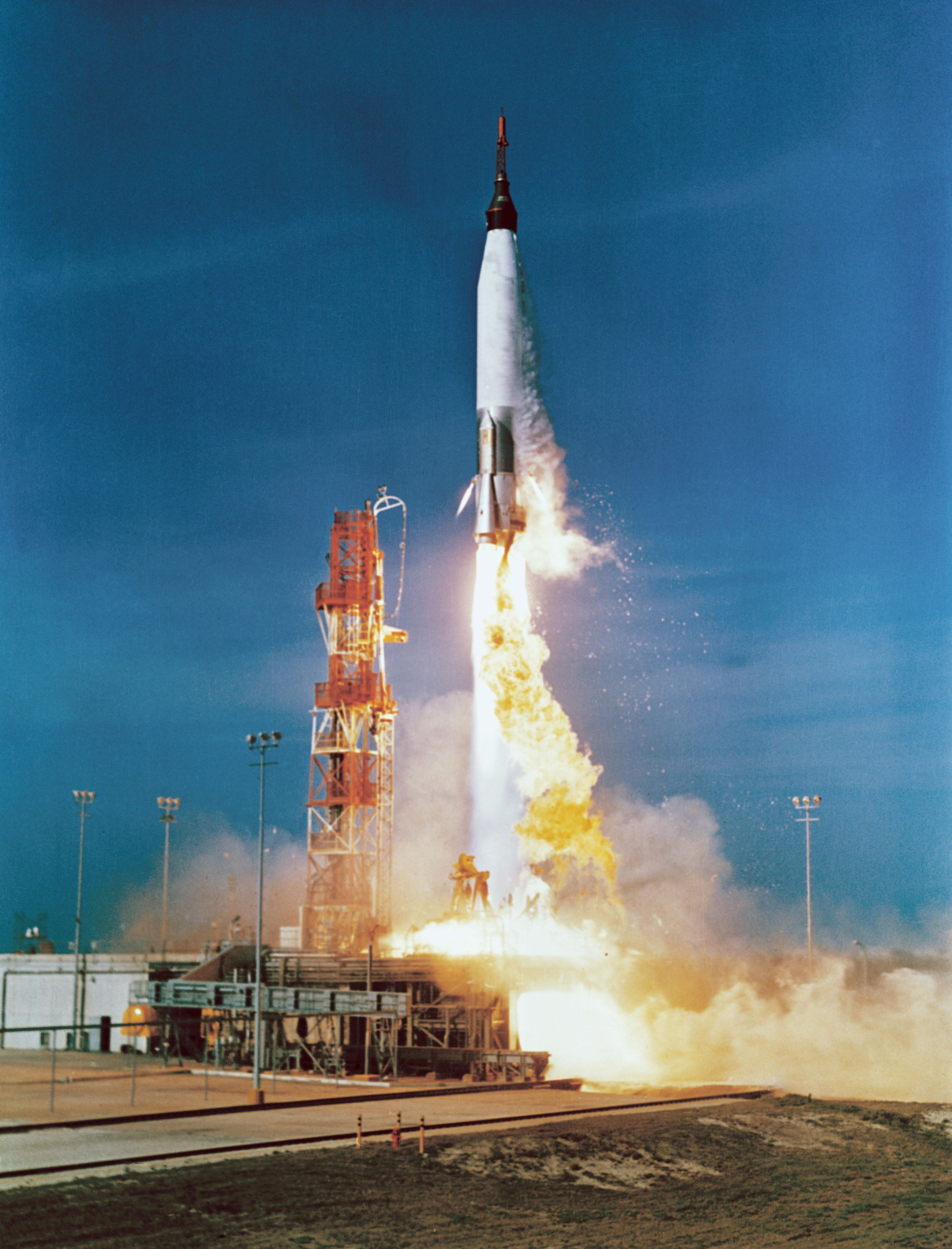
MA-2 lifted off from LC-14 at Cape Canaveral and closely matched the intended trajectory. It reached a maximum altitude of 114.04 statute miles — 602,140 feet — and a maximum range of 1,431.6 statute miles. Maximum velocity was 18,100 feet per second earth-fixed and 19,400 feet per second space-fixed, or 13,227.3 miles per hour. Maximum dynamic pressure was 991 pounds per square foot and peak acceleration 15.9 g. Total flight time was 17 minutes and 56 seconds.
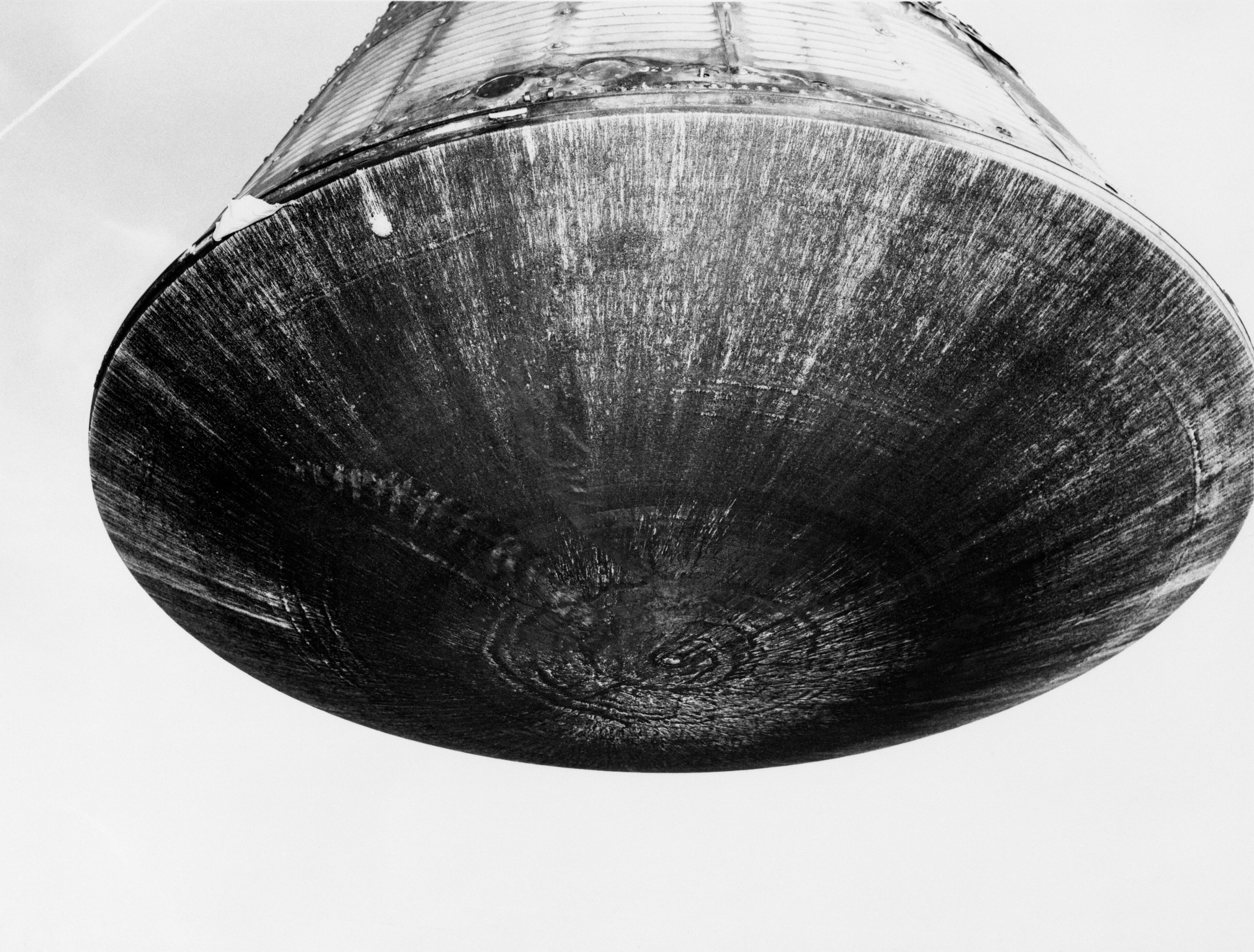
The capsule splashed down and was recovered without incident. Some 55 minutes after launch, inspection aboard the recovery ship indicated that the test objectives had been met: structure and heat protection elements appeared to be in excellent condition after a reentry harsher than anything planned in normal operation. The flight control team obtained satisfactory data, and the complete launch computing and display system, operating for the first time in a flight, performed satisfactorily. NASA's own summary records the mission plainly as successful.
On 2 March 1961, evaluation of the results added the kind of detail engineers value as much as success itself: spacecraft afterbody temperatures had turned out somewhat lower than anticipated. The design case had not merely been survived — the real margin was larger than the calculation.
What MA-2 cleared, and what it left open
On that same 21 February 1961 the Space Task Group selected astronauts John Glenn, Virgil Grissom and Alan Shepard to begin special training for the first crewed Mercury flight. The coincidence of dates is not accidental: with the capsule proven against the critical abort case, the programme could split its attention between crew preparation and the problem that remained.
Because MA-2 did not close the Atlas file; it bounded it. The mission showed that the spacecraft and its escape system were compatible with the Mercury-Atlas combination, that the reinforced adapter held, and that the shield performed in the worst abort case — but the deep structural remedy, the thick-skin configuration, had still not flown. The first flight to carry it, Mercury-Atlas 3, lifted off on 25 April 1961 on an uncrewed orbital mission that was aborted shortly after launch and did not accomplish its objectives, reaching a maximum altitude of only 4.5 statute miles in 7 minutes and 19 seconds. Its spacecraft, number 8, was refitted and flown again in the same configuration as MA-4 on 13 September 1961, this time successfully and with fully orbital objectives: integrity of structure, shield and shingles in a normal reentry from orbital conditions, systems performance for the entire flight, network and ground command operation, and recovery procedures.
Seen from the end of the programme, MA-2 occupies an exact place in the sequence. It is the flight that restored confidence in the capsule-launcher pairing after two failed attempts, the one that turned an uninstrumented structural failure into a measured and bounded problem, and the one that let the Atlas discussion move from "why did it break" to "when will the reinforced version be ready". It is also a fair sample of how the Space Task Group worked in 1960 and 1961: faced with uncertainty, neither a quick patch nor a total redesign, but a flight instrumented to the limit in the most severe condition imaginable, and a five-month delay accepted without argument in order to fly it.
Images
Elsewhere
- WikipediaMercury-Atlas 2 ↗
- Smithsonian National Air and Space MuseumCapsule, Mercury MA-2 ↗
- Flickr — NASA on The CommonsLaunch of Mercury-Atlas 2 ↗
- Next SpaceflightMercury-Atlas 2 (MA-2) ↗
- Space Launch NowAtlas LV-3B | Mercury-Atlas 2 ↗
- Google Arts & CultureMercury-Atlas (MA)-2 — Liftoff, Cape ↗
- WikidataMercury-Atlas 2 ↗