Did you know…
Which Constellation carried a rotating radome like the E-3 Sentry's?
Short answer
The WV-2E, an experimental version of the US Navy's WV-2 Warning Star modified to carry a rotating radar dome similar to the Boeing E-3 Sentry's. It was later redesignated EC-121L, anticipating by decades the typical silhouette of airborne early warning aircraft.
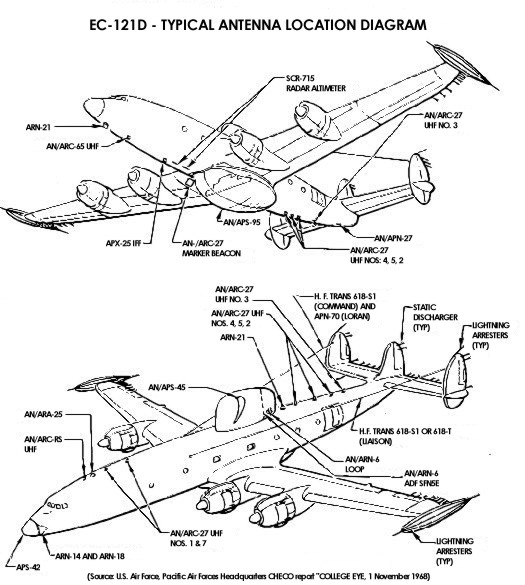
The starting Warning Star
The United States Navy commissioned Lockheed to build a long-range flying radar based on the L-1049 Super Constellation. It was first designated PO-2W and then WV-2 Warning Star, powered by Wright R-3350-34 or R-3350-42 engines rated at 3,400 hp (2,536 kW) each. The WV-2 was later redesignated EC-121K, and numerous specialized versions for the Navy and the Air Force were derived from it.
A dome that rotated
The WV-2E was one of the most unusual. According to the list of Constellation variants, it was an experimental version of the WV-2 modified to carry a rotating radar radome, similar to the one that decades later would make the Boeing E-3 Sentry famous. It's the concept that today identifies almost any airborne early warning aircraft: a large disc mounted on top of the fuselage that rotates with the antenna. The WV-2E was later redesignated EC-121L.
A forerunner in a long-lived family
The WV-2E coexisted with other variants of the same airframe: the WV-2Q, equipped for electronic warfare, later EC-121M; the RC-121D, with fuel tanks on the wingtips, later EC-121D; and the EC-121D itself, the early-warning version of the Big Eye, College Eye, and Disco programs. The Warning Star family served in the United States Navy and Air Force until 1978, more than forty years after work began on the first L-049. That a four-engine piston aircraft born as an airliner, with its characteristic triple tail, should trial the rotating radome gives an idea of just how versatile Lockheed's design turned out to be. That first L-049, the prototype with the civil registration NX 25600, had flown on January 9, 1943, between Burbank and Muroc Field.
More questions
L-Bit (CC BY SA), vía commons Military aviation
How many Anson Mk I were built?
6,688 or 6,742 Avro Anson Mk I were built, according to different sources; History of War, which gives the second figure, places 3,935 at Woodford and the… more…
Military aviation
Which flying boats rescued the crew of the Kensington Court in 1939?
They were two RAF Sunderland flying boats: according to uboat.net, an aircraft of Squadron 228 and L5802 of Squadron 204 landed on the water next to the… more…
Military aviation
How long did Catalina convoy escort flights to the USSR last?
Many of the Catalina flights protecting convoys to the Soviet Union lasted between 15 and 20 hours and ended at Gryaznaya Bay (Murmansk) or at Arkhangelsk… more…
Military aviation
How many aircraft did the Axis lose in Crusader?
Around 332 aircraft destroyed and around 228 abandoned in the operation's tally, which took place between 18 November and 30 December 1941. According to their… more…
Military aviation
How many victories did No. 604 Squadron, the RAF night-fighter squadron, claim?
Around 127 aerial victories over the course of the war, 41 of them since May 1944. No. 604 (County of Middlesex) Squadron RAF spent most of the Second World… more…
Military aviation
Why did the "Torch" P-40Fs carry a flag on the fuselage?
To deter Vichy French forces from shooting them down: aircraft with yellow-outlined roundels sometimes had an American flag added in front of the roundel. The… more…


