Did you know…
What is the Saturn V?
Short answer
The Saturn V was the three-stage rocket NASA used to send astronauts to the Moon during the Apollo program. It stood 110.6 m tall, weighed about 2,900 t, and its five F-1 engines produced 34.5 MN of thrust. It flew 13 times between 1967 and 1973 without losing a single payload, sent nine crews to the Moon, and launched the Skylab space station into orbit.

A rocket for the Apollo program
The Saturn V was designed by NASA's Marshall Center under the direction of Wernher von Braun with a single goal: to meet the commitment of landing a human being on the Moon before 1970. It was a three-stage vehicle. The first stage, S-IC, burned kerosene and liquid oxygen in five F-1 engines, the most powerful single-chamber liquid-propellant engines ever to fly. The second stage, S-II, and the third, S-IVB, used liquid hydrogen and oxygen with J-2 engines; the S-IVB reignited in orbit for trans-lunar injection. Each stage was built by a different contractor: Boeing built the S-IC, North American the S-II, and Douglas the S-IVB. At the top sat the command and service module and the lunar module.
Numbers and flight history
At 110.6 m tall, 10.1 m in diameter, and about 2,900 t on the pad, it could place roughly 140 t into low Earth orbit or send about 48 t toward the Moon. Its first flight, Apollo 4, lifted off on November 9, 1967, uncrewed, from Launch Complex 39A at the Kennedy Space Center. Apollo 8 flew it with astronauts for the first time in December 1968, and Apollo 11 carried Armstrong, Aldrin, and Collins in July 1969. In total, 13 units flew: two test flights, ten crewed Apollo missions, and, in May 1973, a two-stage version that launched the Skylab space station.
Legacy
No rocket exceeded its payload capacity for more than fifty years. Three complete examples survive, at the Kennedy Space Center, the Johnson Space Center in Houston, and the U.S. Space & Rocket Center in Huntsville. Its cryogenic-stage architecture and vertical integration procedures directly inspired the Space Launch System, the Artemis program's lunar rocket, and the F-1 remains a benchmark for high-thrust engines.
More questions
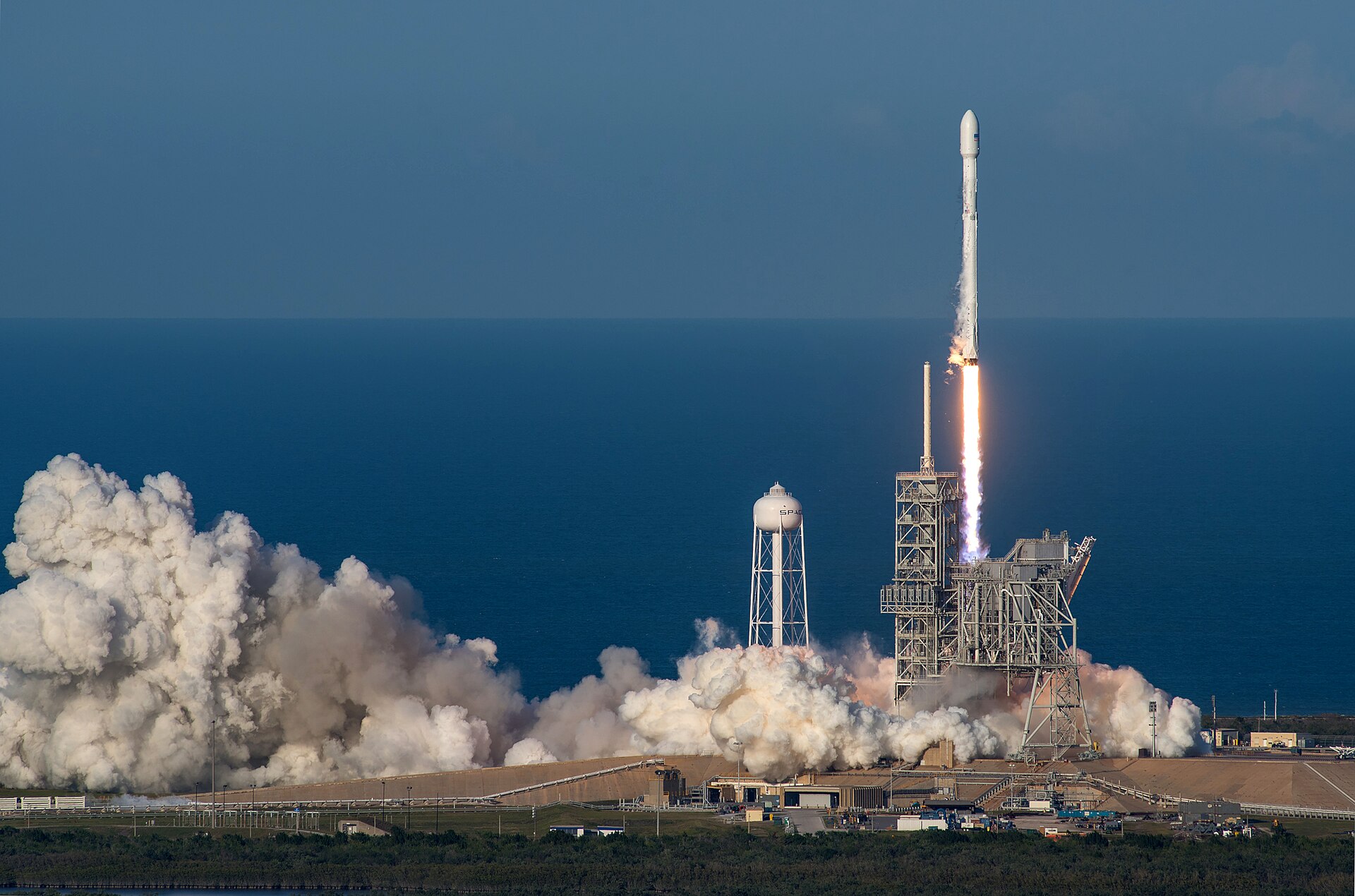
Foto: SpaceX (CC0) Rockets and launches
How many horsepower does the Falcon 9 have?
Rockets aren't measured in horsepower, but in thrust: the Falcon 9's first stage's nine Merlin engines deliver 7,686 kN (1,710,000 lbf) combined at sea level… more…
Foto: SpaceX (CC0) Rockets and launches
How much a rocket weight?
Rockets range from about 13 t for Rocket Lab's Electron to roughly 549 t for Falcon 9, 2,800 t for Saturn V and close to 5,000 t for Starship with its Super… more…

Rockets and launches
What does the saturn v look like?
Saturn V looked like a white needle 110.6 m (363 ft) tall and 10.1 m wide at the base, painted with black roll-pattern stripes, the words UNITED STATES and… more…
Foto: SpaceX (CC0) Rockets and launches
Why do rockets launch from florida?
Rockets launch from Florida because the Cape sits at 28.5 degrees north, low enough to gain about 410 m/s from the Earth's rotation on an eastward launch, and… more…
Foto: SpaceX (CC0) Rockets and launches
How much falcon 9 launch cost?
SpaceX lists a standard Falcon 9 mission at 69.75 million dollars, with the booster recovered (data as of January 2025). Small satellites can share a ride… more…
Rockets and launches
How does the saturn v work?
Saturn V worked by staging: a kerosene first stage with five F-1 engines (about 34,000 kN) lifted the 2,800 t rocket for two and a half minutes, a… more…
