Did you know…
What changed on the Vulcan to turn it into the B.Mk 1A?
Short answer
Mainly its defensive electronics. Between 1959 and 1963 Armstrong Whitworth upgraded 28 surviving Vulcan B.1s, those fitted with Olympus 102/104 engines, with electronic countermeasures, air-to-air refuelling receiver gear, and UHF radio inherited from the B.2; this produced the B.1A.
Extending the B.1's life
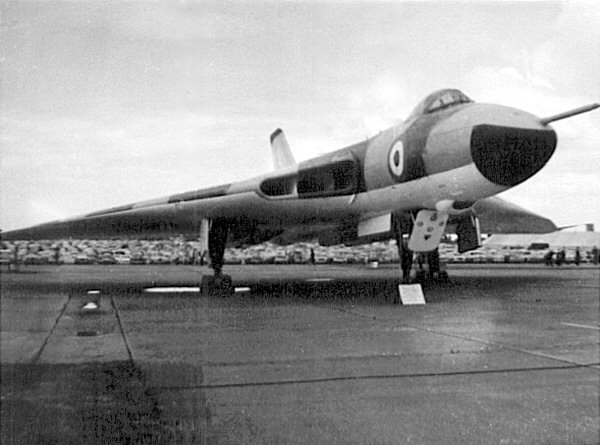
When the Vulcan B.2 entered production, the B.1s already in service risked being left behind. To extend their service life, 28 of them, the surviving B.1s fitted with Olympus 102 and 104 engines, passed through Armstrong Whitworth's workshops between 1959 and 1963 to receive some of the new model's equipment. The result was designated B.1A.
What they received
The upgrades included electronic countermeasures equipment, receiver gear for air-to-air refuelling, and UHF radio. The most visible change was at the tail: the German Wikipedia describes a large bulbous fairing added to the rear end in a 1961 modernisation, which housed the electronic warfare equipment used to jam enemy air defences. The B.1 XA895 had already been used to trial a countermeasures set with jammers in a bulged tail cone and a tail warning radar.
The original electronic equipment of the B.1A and B.2 combined a Green Palm communications jammer, two Blue Diver metric-band jammers, and three Red Shrimp S-band jammers, among other systems.
An early end
What the B.1A did not receive was the structural reinforcement required for low-level flying, the tactic the RAF adopted in the mid-1960s. Without that reinforcement, the B.1As could not follow the new mission profile, and by 1968 all of them had been withdrawn. The last unmodified B.1s, assigned to the 230 OCU conversion unit, had already been withdrawn in 1966.
The aircraft came from the British Ministry of Supply's B.35/46 specification.
More questions

L-Bit (CC BY SA), vía commons Military aviation
How many Anson Mk I were built?
6,688 or 6,742 Avro Anson Mk I were built, according to different sources; History of War, which gives the second figure, places 3,935 at Woodford and the… more…

Military aviation
Which flying boats rescued the crew of the Kensington Court in 1939?
They were two RAF Sunderland flying boats: according to uboat.net, an aircraft of Squadron 228 and L5802 of Squadron 204 landed on the water next to the… more…

Military aviation
How long did Catalina convoy escort flights to the USSR last?
Many of the Catalina flights protecting convoys to the Soviet Union lasted between 15 and 20 hours and ended at Gryaznaya Bay (Murmansk) or at Arkhangelsk… more…

Military aviation
How many aircraft did the Axis lose in Crusader?
Around 332 aircraft destroyed and around 228 abandoned in the operation's tally, which took place between 18 November and 30 December 1941. According to their… more…

Military aviation
How many victories did No. 604 Squadron, the RAF night-fighter squadron, claim?
Around 127 aerial victories over the course of the war, 41 of them since May 1944. No. 604 (County of Middlesex) Squadron RAF spent most of the Second World… more…

Military aviation
Why did the "Torch" P-40Fs carry a flag on the fuselage?
To deter Vichy French forces from shooting them down: aircraft with yellow-outlined roundels sometimes had an American flag added in front of the roundel. The… more…


