Did you know…
What is the Falcon 9?
Short answer
The Falcon 9 is SpaceX's two-stage rocket, 70 m tall and 3.7 m in diameter, powered by nine Merlin engines in its first stage, which lands and is reused. It first flew in June 2010 and is the world's most-used launcher: it carries Starlink satellites, commercial payloads and astronauts to the International Space Station.

Nine engines and one idea
The name comes from its nine Merlin 1D engines, fueled by RP-1 kerosene and liquid oxygen, which produce about 7,600 kN at liftoff. That redundancy lets the mission continue even if one fails, as happened in 2012. The second stage, with a single vacuum-adapted Merlin, places the payload into orbit. The rocket stands 70 m tall and weighs 549 t; it can carry 22,800 kg to low Earth orbit in expendable mode and up to 8,300 kg to geostationary transfer orbit.
From 2010 to reusability
The first Falcon 9 launched on June 4, 2010. In 2012 it carried the first Dragon capsule to the International Space Station, and in 2013 it debuted the 1.1 version, taller and more powerful. On December 21, 2015, a first stage landed back at Cape Canaveral for the first time, and in March 2017 a previously flown booster flew again. The Block 5, from 2018, is the definitive version, designed for dozens of flights per unit with minimal maintenance between missions.
What it does today
The Falcon 9 is the world's most-flown rocket per year: 132 launches in 2024, most of them deploying SpaceX's own Starlink constellation. It is also the only American rocket that regularly carries crews, with the Crew Dragon capsule since the Demo-2 mission in May 2020. Its three-core version, the Falcon Heavy, shares the same first stage. The boosters land on the ground or on barges in the Atlantic and Pacific, and some have surpassed 30 flights (as of December 2025).
More questions
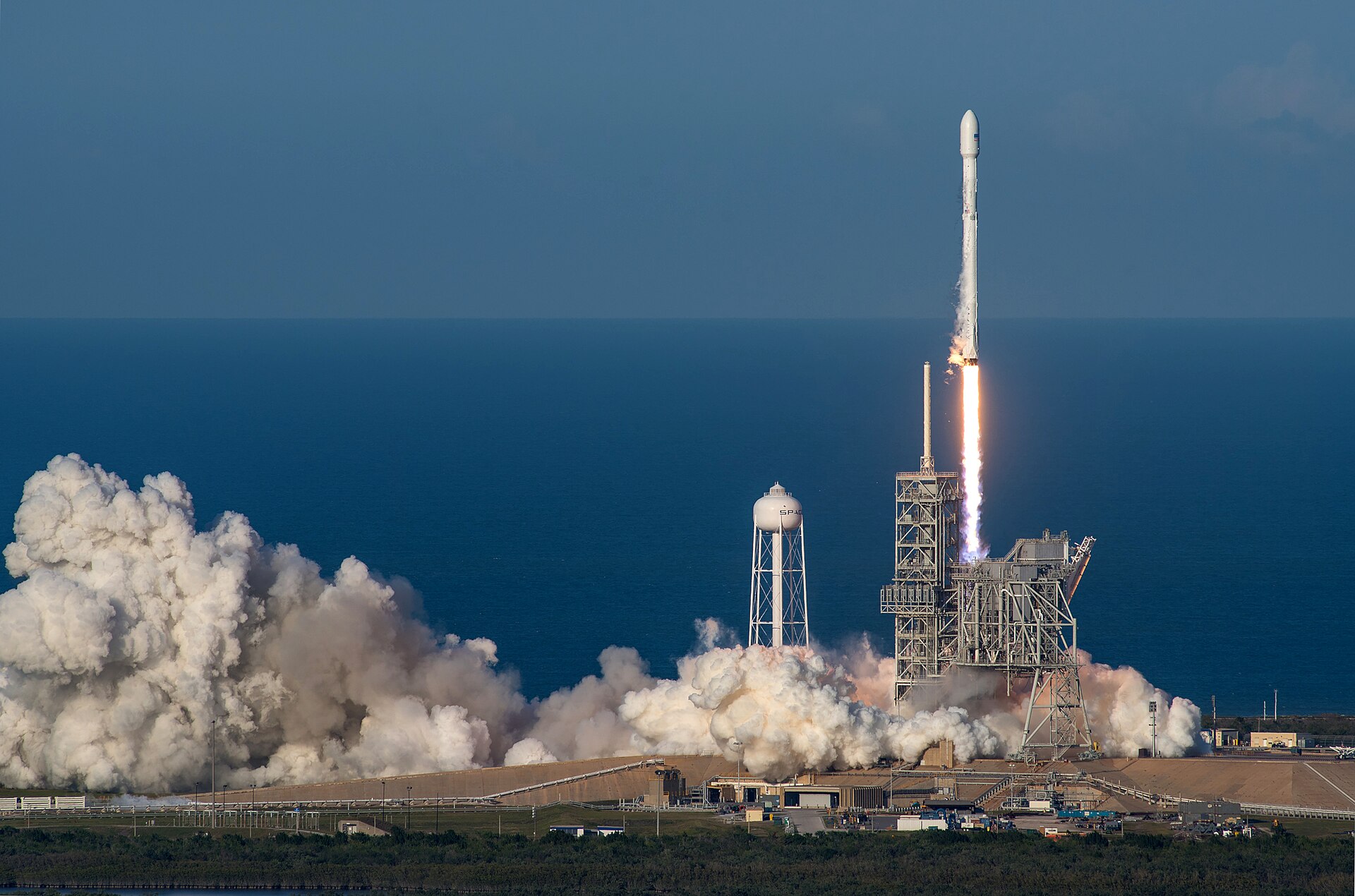
Foto: SpaceX (CC0) Rockets and launches
How many horsepower does the Falcon 9 have?
Rockets aren't measured in horsepower, but in thrust: the Falcon 9's first stage's nine Merlin engines deliver 7,686 kN (1,710,000 lbf) combined at sea level… more…
Foto: SpaceX (CC0) Rockets and launches
How much a rocket weight?
Rockets range from about 13 t for Rocket Lab's Electron to roughly 549 t for Falcon 9, 2,800 t for Saturn V and close to 5,000 t for Starship with its Super… more…

Rockets and launches
What does the saturn v look like?
Saturn V looked like a white needle 110.6 m (363 ft) tall and 10.1 m wide at the base, painted with black roll-pattern stripes, the words UNITED STATES and… more…
Foto: SpaceX (CC0) Rockets and launches
Why do rockets launch from florida?
Rockets launch from Florida because the Cape sits at 28.5 degrees north, low enough to gain about 410 m/s from the Earth's rotation on an eastward launch, and… more…
Foto: SpaceX (CC0) Rockets and launches
How much falcon 9 launch cost?
SpaceX lists a standard Falcon 9 mission at 69.75 million dollars, with the booster recovered (data as of January 2025). Small satellites can share a ride… more…
Rockets and launches
How does the saturn v work?
Saturn V worked by staging: a kerosene first stage with five F-1 engines (about 34,000 kN) lifted the 2,800 t rocket for two and a half minutes, a… more…
