Did you know…
How fast was Apollo 11 going?
Short answer
NASA documents a specific figure: the command module Columbia entered Earth's atmosphere at 39,000 km/h (24,000 mph) on the way back from the Moon. About nine minutes later, the parachutes had slowed it to about 25 miles per hour (mph) for splashdown in the Pacific on July 24, 1969.

A speed that changed every minute
Asking for "the" speed of Apollo 11 is a trick question, because it kept changing throughout the entire trip. After liftoff, the spacecraft was left in a parking orbit around Earth; then the Saturn V's upper stage reignited for 5 minutes and 48 seconds to put the stack on a trans-lunar trajectory. From that moment it kept losing speed as it climbed out of Earth's gravity well, and regained it as it fell toward the Moon.
On arrival, the service module's engine had to do just the opposite: slow down. A retrograde burn of 357.5 seconds left the spacecraft in an elliptical lunar orbit of 69 by 190 miles. The Eagle's descent was another braking exercise, with the engine firing for 756.3 seconds until it touched down in the Sea of Tranquility. Every maneuver of the flight was, in essence, a speed adjustment measured in seconds of burn time.
The documented figure: 39,000 km/h on reentry
The figure NASA states explicitly corresponds to the return trip. The command module Columbia entered Earth's atmosphere at 39,000 km/h (24,000 mph). At that speed the air doesn't have time to move out of the way: it compresses in front of the heat shield, and the surrounding gas exceeds 5,000°F, enough to turn the capsule into a fireball with a trail of glowing plasma.
From fire to splash
The atmospheric braking was as violent as it was brief. About nine minutes after reentry began, the three main parachutes opened, slowing the capsule to about 25 miles per hour (mph), little more than a jog. At that pace it touched down in the Pacific Ocean on July 24, 1969, at 16:50:35 UT. All the energy built up on the way home had been dissipated as heat and disturbed air within a matter of minutes.
More questions
Moon and Mars
How does neil armstrong look like?
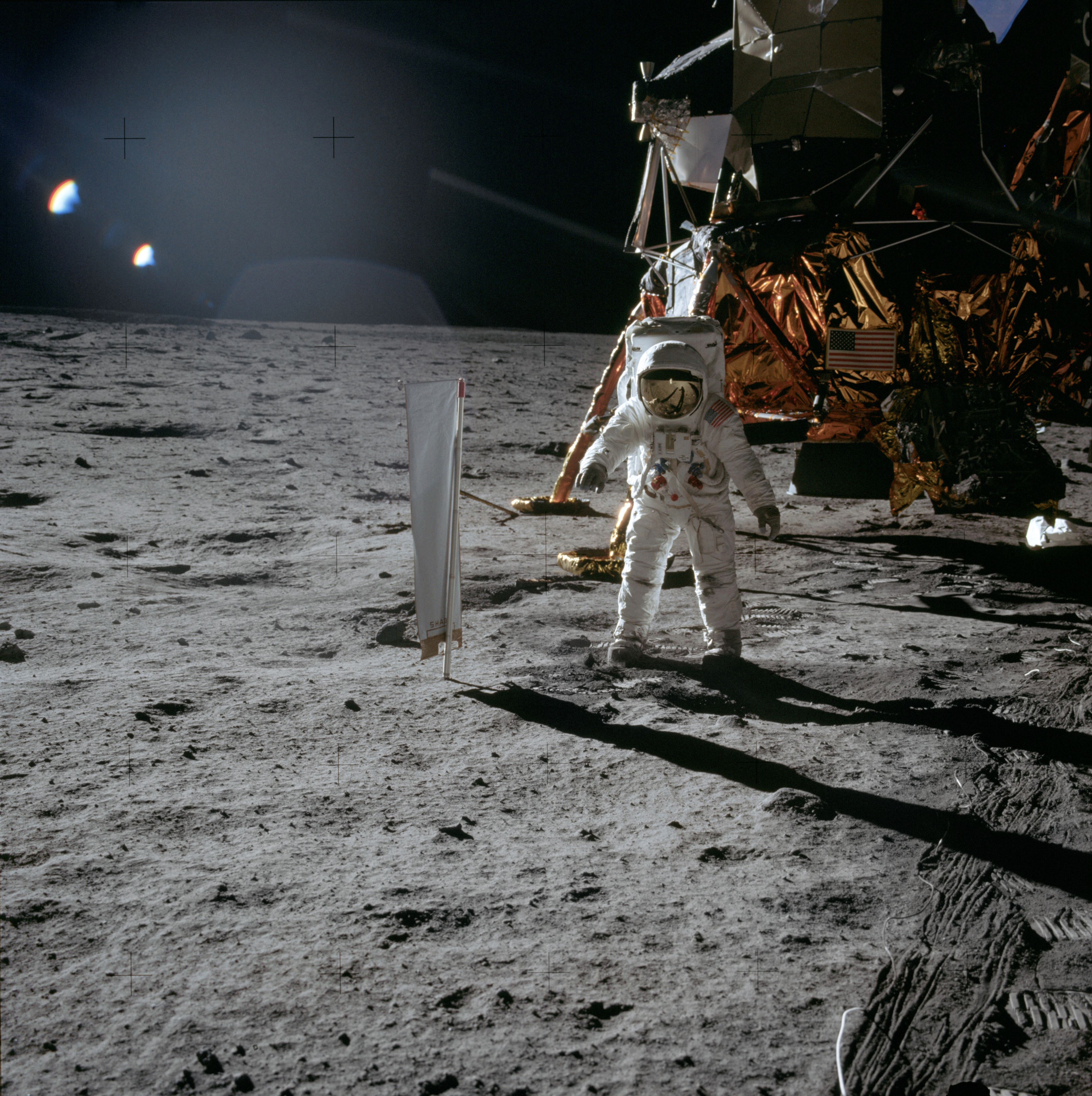
The face most people picture is not his: the gold-visored astronaut in the famous Apollo 11 photograph is Buzz Aldrin, shot by Armstrong. Armstrong himself is… more…

Richard Dorrell (CC BY SA), vía commons Moon and Mars
How does the moon affect the tides?
By pulling unevenly on it. Tidal forces vary inversely as the cube of the distance, so the near side of the Earth is tugged harder than the far side: one… more…
Moon and Mars
Why does neil armstrong have a hollywood star?
Strictly he does not have a star. Armstrong, Aldrin and Collins share four circular monuments resembling the Moon, one at each corner of Hollywood and Vine… more…

Foto: SpaceX (CC0) Moon and Mars
Why did falcon 9 hit the moon?
Because a spent upper stage on a lunar trajectory has no mission and no way to steer. A Falcon 9 upper stage from the January 2025 Firefly Blue Ghost 1 launch… more…
Moon and Mars
How much apollo 11 cost?
NASA never published a price for Apollo 11 on its own; what is documented is the program. The United States spent $25.8 billion on Project Apollo between 1960… more…
Moon and Mars
How much time neil armstrong spent on moon?
Armstrong and Aldrin spent 21 hours, 36 minutes on the Moon's surface, almost all of it inside the lunar module Eagle. Armstrong stepped onto the surface… more…
