Did you know…
How fast does the Moon rotate?
Short answer
The Moon spins on itself very slowly: it takes 655.720 hours, that is 27.3217 days, practically the same time it takes to orbit Earth, which is why it always shows us the same face (synchronous rotation). In its orbit around Earth it moves at an average of 1.022 km/s.

Slow, synchronized rotation
The Moon's rotation on its own axis lasts 655.720 hours, equivalent to 27.3217 days, practically the same time it takes to complete one orbit around Earth. That coincidence is not random: the tides Earth raises on the lunar body have slowed its spin until it became locked to its orbital period. The result is synchronous rotation, which keeps the same hemisphere facing us. Earth and the Moon are tidally locked, and their rotations are so synchronized that from the ground we only ever see one side of the satellite.
How long a day lasts there
For someone standing on the surface, the Sun would not rise every 24 hours. The full lighting cycle matches the synodic period of 29.53 days, the same one that governs the phases we observe from Earth: lunar night stretches on for many consecutive Earth days. That rhythm affects any equipment operating there, because solar panels go entire days without receiving light and temperatures swing dramatically between day and night.
Don't confuse spin with travel
If what you're looking for is how fast the Moon moves, rather than how fast it spins on its axis, the figure is different: an average orbital speed of 1.022 km/s around Earth, at an average distance of 384,400 kilometers (238,855 miles). These are two movements that are in principle independent, spinning on its axis and traveling its orbit, which in the Moon's case have been locked together for a very long time by tidal friction.
More questions
Moon and Mars
How does neil armstrong look like?
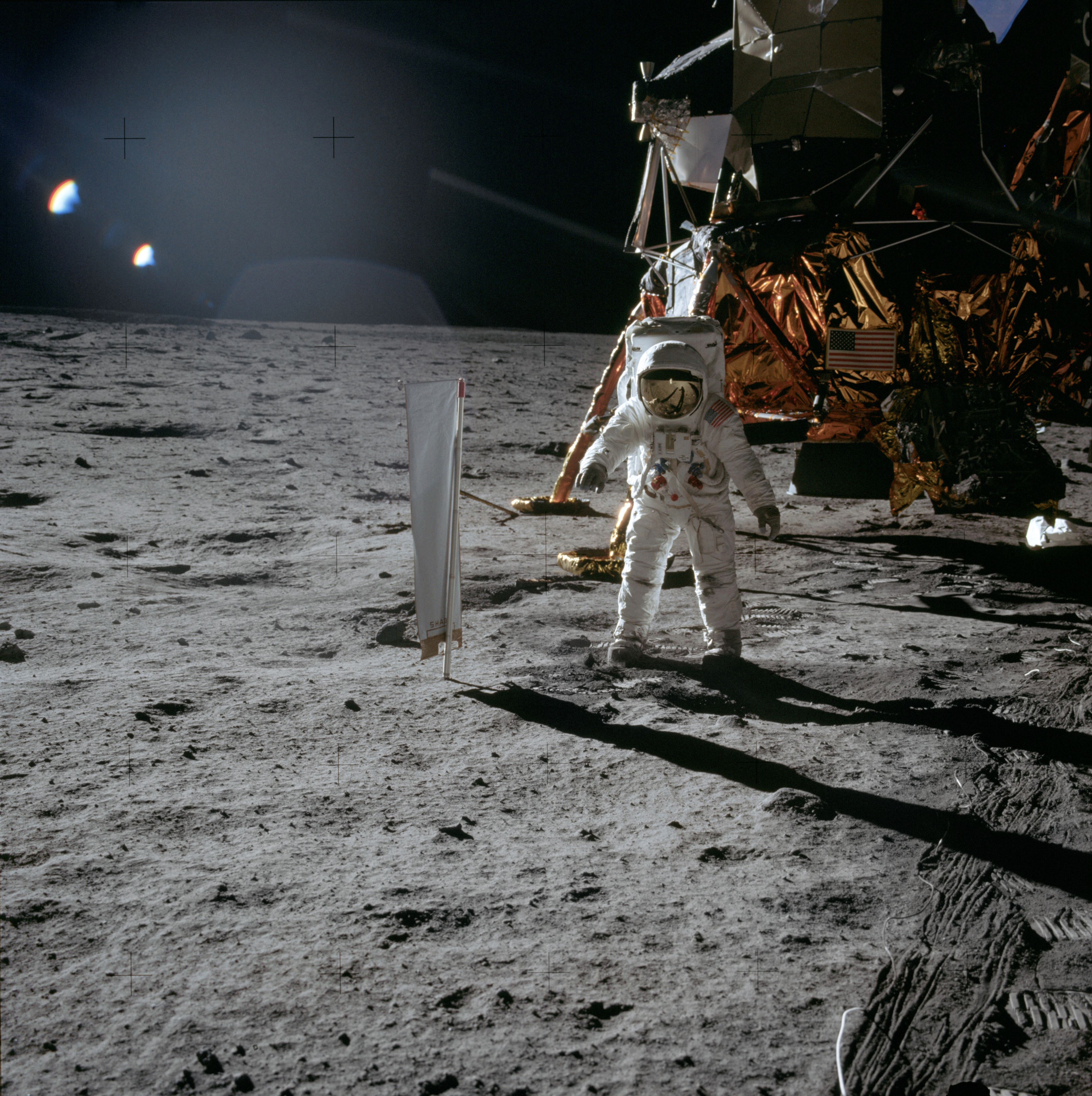
The face most people picture is not his: the gold-visored astronaut in the famous Apollo 11 photograph is Buzz Aldrin, shot by Armstrong. Armstrong himself is… more…

Richard Dorrell (CC BY SA), vía commons Moon and Mars
How does the moon affect the tides?
By pulling unevenly on it. Tidal forces vary inversely as the cube of the distance, so the near side of the Earth is tugged harder than the far side: one… more…
Moon and Mars
Why does neil armstrong have a hollywood star?
Strictly he does not have a star. Armstrong, Aldrin and Collins share four circular monuments resembling the Moon, one at each corner of Hollywood and Vine… more…

Foto: SpaceX (CC0) Moon and Mars
Why did falcon 9 hit the moon?
Because a spent upper stage on a lunar trajectory has no mission and no way to steer. A Falcon 9 upper stage from the January 2025 Firefly Blue Ghost 1 launch… more…
Moon and Mars
How much apollo 11 cost?
NASA never published a price for Apollo 11 on its own; what is documented is the program. The United States spent $25.8 billion on Project Apollo between 1960… more…
Moon and Mars
How much time neil armstrong spent on moon?
Armstrong and Aldrin spent 21 hours, 36 minutes on the Moon's surface, almost all of it inside the lunar module Eagle. Armstrong stepped onto the surface… more…

