Did you know…
How can weightlessness be created on Earth?
Short answer
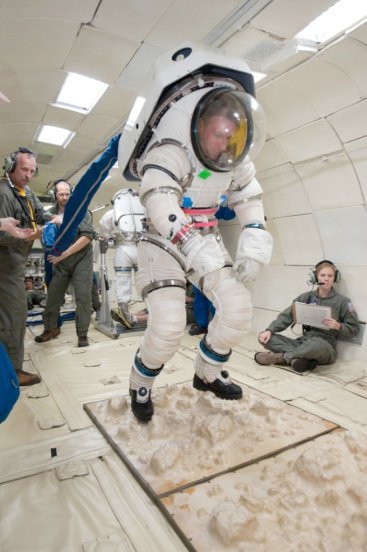
Real weightlessness only occurs in free fall, and on Earth it can only be sustained briefly: about 20 seconds per maneuver in a parabolic flight, barely a few seconds in a drop tower. Water tanks, tilted bed studies, and rotating chairs only imitate partial effects, while gravity keeps acting fully.
Only free fall counts
Weightlessness does not mean gravity disappears; it cannot be switched off. What people experience in orbit is free fall: the spacecraft and its occupants accelerate at the same rate, so there is nothing left to press against the seat or the floor. The technical term microgravity describes exactly that state, along with small residual accelerations. On Earth it is created by dropping something, and that is precisely what limits the duration, because the ground is reached quickly or the air slows the motion down.
Parabolic flight, drop tower, suborbital rocket
The best known is the parabolic flight: a modified commercial aircraft climbs at a steep angle and then, with thrust nearly cut off, follows a parabolic path that provides about 20 seconds of weightlessness before returning to normal flight. A single flight strings together dozens of those parabolas, each separated by phases of higher load. Drop towers, such as the one in Bremen, offer only a few seconds, but with very few disturbances, because the drop tube is emptied of air. Suborbital rockets extend that window to minutes, though only for experiments without a crew.
What only looks like weightlessness
Everything else is an imitation, and that is not a weakness but its purpose. In the water tank, thrust and weight balance each other out, so grips and spacewalk procedures can be trained; but gravity keeps acting, tools fall downward, and water slows every movement. Slightly tilted bed rest studies reproduce the shift of fluids in the body, and rotating chairs reproduce the imbalance of the inner ear. Small samples can be levitated using magnetic fields. For people, free fall remains the only real path.
More questions

Lviatour (CC BY SA), vía commons Astronauts and life in space
What did Neil Armstrong see in the Cueva de los Tayos?
An enormous cave full of life, not an extraterrestrial structure. According to an account by a caver on the team, published in 1979, Armstrong was the guest… more…

Astronauts and life in space
Why do astronauts grow taller in space?
In microgravity, the spine is no longer compressed by body weight: it lengthens and the back's natural curves flatten out. The crew gains a few centimeters… more…

Astronauts and life in space
How do astronauts sleep in space?
Each astronaut on the International Space Station has an individual cabin about the size of a phone booth, with a sleeping bag strapped to the floor, ceiling… more…
Astronauts and life in space
How long do astronauts sleep?
The International Space Station's schedule reserves 8.5 hours of sleep per night for each crew member. In practice, they sleep less: a study published in 2014… more…

Astronauts and life in space
How do astronauts eat in space?
Meals on board are mostly dehydrated foods rehydrated with water from a dispenser, and ready-to-eat thermostabilized dishes warmed in the galley oven, along… more…

Astronauts and life in space
How much money does Alexander Gerst have?
There is no reliable figure for Alexander Gerst's fortune; the amounts on celebrity websites are estimates without basis. What is documented is his… more…


