Did you know…
At what speed does a Boeing 737 land?
Short answer
A Boeing 737 lands at around 130-145 knots (240-270 km/h) indicated airspeed, with flaps 30 or 40 and gear down. The exact figure, the VREF reference speed, is calculated for each flight from the weight: a light 737-800 may approach below 130 kn, while near maximum landing weight it can exceed 145 kn.
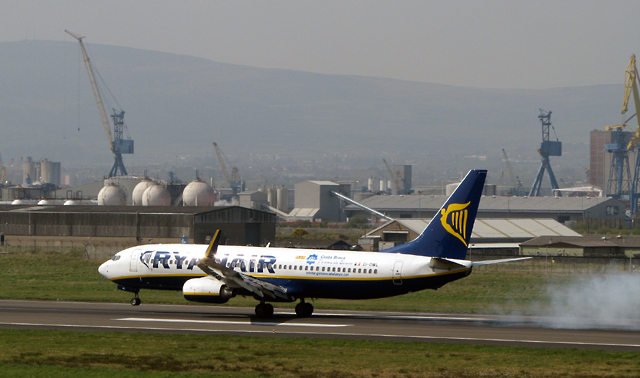
A speed recalculated on every flight
On the 737, as on any transport jet, the crew does not land at a fixed speed but at VREF, the landing reference speed, which the flight management computer derives from the predicted landing weight and the selected flap setting. It is 1.23 times the stall speed in that configuration, a margin required by certification. Half the headwind component plus the full gust value is added to VREF, with a minimum of 5 kn and a maximum of 20, to get the approach speed held until crossing the threshold at about 15 m (50 ft).
Typical figures by variant
A 737-800 at 60 tonnes with flaps 30 has a VREF near 140 kn (260 km/h); with flaps 40 it drops around 5 kn, and near the maximum landing weight of 66 tonnes it is close to 147 kn. The lighter 737-700 approaches between 125 and 135 kn, and the 737 MAX 8 sits at similar values to the -800 at the same weight. In every case, groundspeed at touchdown is lower when there is a headwind, and it determines the landing roll length.
What happens landing faster or slower
Arriving too fast extends the flare, makes the aircraft float and eats up runway: every extra 10 kn can add several hundred metres. Arriving below VREF reduces the margin above the stall and increases the rate of descent, which can cause a hard landing. That is why procedures treat as unstable any approach that deviates more than a few knots from the target speed below 300 m (1,000 ft), in which case the correct action is to go around and try again.
More questions

Foto: 4300streetcar (CC BY 4.0) Commercial aviation
Which 747 carried Enterprise "piggyback"?
The first Shuttle Carrier Aircraft was a Boeing 747-123 registered N905NA, originally built for American Airlines and acquired by NASA in 1974. Boeing… more…

Commercial aviation
Was there an amphibious DC-3?
Yes: the Douglas XC-47C was created by fitting Edo Model 78 floats onto a standard C-47. The single-step metal floats carried retractable wheels that also… more…

OTFW, Berlin (CC BY SA), vía commons Commercial aviation
Was a C-47 converted into a glider?
Yes: the Douglas XCG-17 was an assault glider created by converting a twin-engine C-47 Skytrain during World War II. Its engines were removed and the nacelles… more…
Commercial aviation
What did the USSR build from the DC-3?
The USSR built a version of the DC-3 under a licence granted to its government on 15 July 1936. It was designated PS-84 and, in 1942, renamed Lisunov Li-2… more…
Commercial aviation
What was "Puff, the Magic Dragon"?
It was the nickname of the Douglas AC-47 Spooky, the first in a series of fixed-wing gunships developed by the United States Air Force during the Vietnam War… more…
Commercial aviation
How did the RAF refer to the C-47?
The RAF called it Dakota: the Dakota I was the designation for 53 C-47s received under Lend-Lease. The Dakota III designated 962 C-47A Skytrains. The Dakota… more…


