Airliner · Civil · United Kingdom
Vickers Vanguard
- January 20, 1959
- First flight
- 1960
- Introduced
- 1996
- Retired
- 44
- Units built
-1600.webp)

-1600.webp)
-1600.webp)
_BEA._(9900721695)-1600.webp)
-1600.webp)

-1600.webp)
-1600.webp)
-1600.webp)
-1600.webp)

-1600.webp)
_Vanguard_Air_Bridge_Carriers_MAN_SEP87_(12851425574)-1600.webp)

-1600.webp)
-1600.webp)
-800.webp)
_DHL_Cargo_MAN_APR92_(5646931043)-1600.webp)

-1600.webp)
-1600.webp)
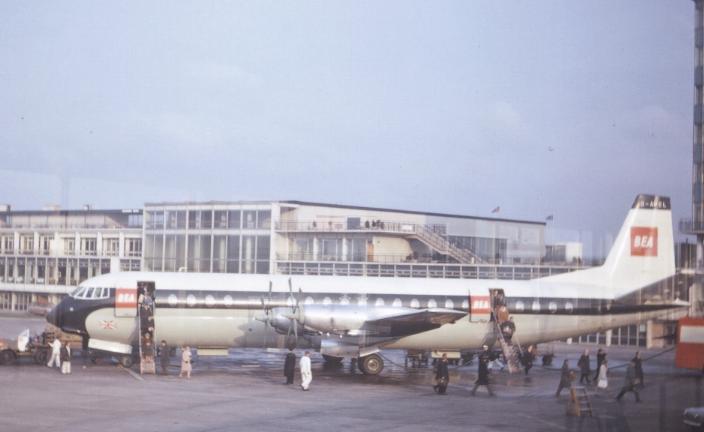
The Vickers Vanguard was a British four-engined turboprop airliner for short and medium-range services, designed and produced by Vickers-Armstrongs as the direct successor to the Viscount. It grew out of discussions the manufacturer had been holding with British European Airways (BEA) since 1953 for an airliner seating up to 100 passengers, together with the parallel requirements of Trans-Canada Air Lines (TCA), which wanted a Viscount-like aircraft for its transcontinental routes. The compromise between the two operators explains the type's two defining features: the low-mounted wing and the double-bubble fuselage, with a long hold beneath the cabin floor for the freight BEA needed to carry. The airframe, far larger and heavier than the Viscount's, called for the new Rolls-Royce Tyne, a turboprop of some 4,000 hp (3,000 kW) against the roughly 1,700 hp (1,300 kW) of the Dart. That leap in power gave the Vanguard a much higher service ceiling and cruising speed and made it one of the fastest turboprop airliners ever built. The Type 950 prototype G-AOYW first flew on 20 January 1959 and the type entered revenue service with TCA on 1 February 1961 and with BEA a month later. It arrived late. Entry into service coincided with the commercial availability of a new generation of jet airliners, which passengers preferred despite their higher operating costs, and the Vanguard was left with a market that never materialised: only 44 were built, all for BEA and TCA. Its second life was freight — the Canadian Cargoliner and, above all, the nine British Merchantman conversions from 1969 — a role in which the type kept flying until 1996.
Related events
Related sheets
Category
History
Origins: a successor to the Viscount
The Vanguard traces back to speculative discussions between Vickers and British European Airways held as early as 1953, the same year the Viscount entered revenue service. Even then both parties envisaged a successor entering service around 1959, with economics roughly ten per cent better than the Viscount's and appreciably faster in every stage of flight. BEA's internal study of the options, covering both turboprop and pure-jet propulsion, made clear that a larger aircraft able to carry bigger payloads was highly desirable.
On 19 April 1953 BEA's chief executive, Peter Masefield, set out the airline's requirements in a letter to Vickers: a cruise speed of 370 knots (430 mph; 690 km/h), a standard range of 1,000 miles (1,600 km) with reserves for a further 305 miles (490 km), accommodation for up to 100 passengers and an explicit preference for a high wing. Coincidentally, Trans-Canada Air Lines approached the manufacturer with its own list, calling for a Viscount-like airliner able to serve its transcontinental routes with up to 60 passengers. Recognising the chance to satisfy both airlines with a single design, Vickers' design team set to work.
The first proposal, the Type 870 — also known as the Viscount Major — could not meet BEA's criteria and was quickly dismissed. A meeting with Rolls-Royce led to the decision to adopt the Tyne, then under development, for the revised proposal. Turbojet propulsion was also considered, but a study carried out in November 1953 found it would perform worse than a turboprop over shorter routes. Around the same time the team discarded a swept wing: it offered little benefit at the intended cruise speed of some 350 knots (400 mph; 640 km/h) and worsened handling on the approach.
From Type 870 to Type 950
Despite BEA's initial preference for a high-mounted wing, the airline settled on a low wing once the double-bubble fuselage was adopted. That cross-section was needed because of the large proportion of freight BEA had to carry: placing it on the same level as the passengers would have demanded an impractically long fuselage, whereas a long hold beneath the main cabin worked well. For TCA the low wing was welcome anyway, making the aircraft easier to refuel, de-ice and service and offering a statistically significant improvement in survivability in a water landing.
By 13 April 1955 the design studies had been shortlisted to five, jointly evaluated by BEA and Vickers. The combination of low wing and double-bubble fuselage was judged the optimum configuration for capacity and versatility. That concept, the Type 870 Scheme 16a, could carry 88 passengers, cruise at 360 knots (420 mph; 680 km/h) at 25,000 ft (7,600 m) and lift a payload of 20,000 lb (9,100 kg). BEA was interested in short, sub-1,000-mile routes, but the fuel tanks were progressively enlarged over several revisions to give a range of 2,600 miles (4,200 km) so the airliner would also be acceptable to TCA.
The Type 900 was a further revision, with payload raised to 21,000 lb (9,500 kg) and up to 93 passengers. After relatively minor changes, largely increasing gross weight to suit customers worldwide, the definitive Type 950 proposal emerged. BEA placed an initial order for twenty aircraft and publicly announced its plan for the new airliner to succeed the Viscount in its fleet; with that order the type became known as the Vanguard.
TCA, though intensely interested, was not yet ready to commit, partly because the basic model did not entirely meet its requirements, air mail capacity among them. Vickers judged that a high-density layout seating up to 139 passengers would appeal to more operators and designed the Type 952 for that market. After a particularly rigorous evaluation, in early January 1957 TCA announced an order for twenty Type 952s. With a follow-on order for three more aircraft it was, in dollar terms, the largest single export deal in postwar Britain's history to that date.
The programme was launched immediately after BEA's order. Because the airliner had grown substantially during the concept phase, Rolls-Royce set about scaling the Tyne up from its initial output of 2,750 hp (2,000 kW) to at least 4,000 hp (3,000 kW). As the production line at Weybridge came online, BEA realised that the typically short length of its routes allowed a higher-density economy layout without hurting performance. On 23 July 1957 Vickers accordingly announced a new model, the Type 953, able to handle payloads of up to 29,000 lb (13,000 kg), which greatly improved BEA's operating costs; the airline converted its order to six Type 951s and fourteen Type 953s.
Design
The Vanguard was a turboprop airliner designed for short and medium-range services. The principal difference from the Viscount lay in the fuselage: the lower portion was similar to its predecessor's, but the upper section had a larger diameter, producing the double-bubble cross-section, somewhat similar to that of the Boeing Stratocruiser. The larger upper portion gave a more spacious interior and, above all, a considerable increase in cargo capacity below the cabin floor. A low-mounted straight wing was adopted after shoulder-mounted and swept alternatives had been considered. Aviation author C. F. Andrews described the design as orthodox in practically every respect.
Construction was entirely conventional except for the wing, which introduced integrally machined light-alloy skins to provide spanwise stiffening at low cost, and three shear webs in place of the Viscount wing's single spar. Tied together by closely spaced ribs, this produced a rigid box structure which, outboard of the centre section, was sealed to form integral fuel tanks.
The larger, heavier fuselage plainly needed a more powerful engine, hence the adoption of the newly developed Rolls-Royce Tyne, capable of a nominal 4,000 hp (3,000 kW) compared with the Viscount's Dart at about 1,700 hp (1,300 kW). The Tyne let the Vanguard operate at a substantially greater service ceiling and cruising speed and made it one of the fastest turboprop airliners ever built, ahead even of much later designs such as the Saab 2000 and the de Havilland Canada Dash 8. One pilot report describes holding 10,000 ft (3,000 m) with three engines at idle and their propellers feathered, sustained by the port outer engine at maximum cruise power.
The flight deck was particularly spacious for the era. The flying controls were designed for manual operation and were aerodynamically balanced. Despite that conservative choice, Andrews considered the onboard electrical systems a major advance over the previous generation of airliners: among other things, the engines could be started without a ground support cart. Stall behaviour was ultimately docile, partly because of the dihedral of the horizontal stabiliser, which kept it clear of the engine efflux and aided longitudinal stability; but that docility came only after a programme of over 2,000 stalls to correct initially very violent tendencies, including rolling inverted.
Testing and entry into service
On 20 January 1959 the first Type 950 prototype, G-AOYW, made its maiden flight, a transfer to Wisley three miles away that had been planned for December and slipped when the engines went back to Rolls-Royce for minor work. Proper flight testing was then carried out from Wisley. Development went relatively smoothly, apart from the more than two thousand flights needed to resolve the unacceptable stalling characteristics, until the final weeks of trials with BEA in early 1960 uncovered engine problems that required the compressor rotor to be modified and imposed a brief delay.
With the issue resolved, the Vanguard entered revenue service with TCA on 1 February 1961 and with BEA a month later. The second prototype, G-APEA, made the type's first public appearance flying London-Hamburg-London, 940 statute miles, in 2 hr 33 min. By then public taste had shifted towards the new bypass jet engines without propellers: passengers preferred the extra speed even at the cost of higher operating costs and dearer tickets. The Vanguard consequently sold poorly, although the examples that did enter service performed well in numerous roles and often had long service lives.
In service with BEA and TCA
BEA flew its first Vanguard schedule on 17 December 1960, from Heathrow to Paris. Once the full fleet of six V951s and fourteen V953s had been delivered by 30 March 1962, the type took over many of BEA's busier European and UK trunk routes. The aircraft were to be named after famous Royal Navy warships — the first, G-APEA, was named Vanguard — but by the time deliveries began BEA had adopted its new red square livery, which ended the practice, and none of the Vanguards ever carried a name. Initial seating was 18 first class at the rear and 108 tourist, later changed to 139 all-tourist, a configuration in which the Vanguard had very low operating costs per seat-mile. On flights of up to 300 miles (480 km), such as London to Paris, Brussels and Amsterdam, the type could match the block times of the pure jets then being introduced. The remaining BEA fleet passed to British Airways on 1 April 1974 and the last BA passenger flight with the type was on 16 June 1974.
TCA began Vanguard schedules on 1 February 1961 with two flights from Toronto and Montreal via intermediate stops to Vancouver. The fleet was also used on services from Toronto and Montreal to New York and Nassau in the Bahamas. Tyne reliability worried the airline in the early 1960s: it kept a Constellation on stand-by at Dorval Airport in Montreal and at Toronto to take Vanguard passengers should an engine fail to start.
Second life: Cargoliner and Merchantman
In 1966 Air Canada stripped the seats from one of its aircraft and refitted it for pure cargo work, in which role it could carry 42,000 lb (19,000 kg) of freight. Known to the airline as the Cargoliner, it was the only such conversion, but it survived to be the last Canadian Vanguard retired, in December 1972.
BEA operated nine Vanguards modified to the V953C Merchantman all-cargo layout from 1969. The first two conversions were designed and carried out by Aviation Traders Engineering Ltd at Southend Airport; BEA modified the remainder at Heathrow using ATEL kits. A large forward cargo door measuring 139 by 80 inches (350 by 200 cm) was incorporated. The Merchantmen stayed in service with British Airways until late 1979, when the remaining five were sold.
Air Bridge Carriers bought several of them and operated them until 1992, when it changed its name to Hunting Cargo Airlines. Hunting Cargo flew its last V953C service on 30 September 1996 and donated the aircraft, registered G-APEP, to Brooklands Museum on 17 October that year.
Variants
The Type 950 was the prototype: one was built and two further fuselages served as static test airframes. The Type 951 was BEA's model, twenty ordered and six delivered, all in a 127-seat mixed-class layout of 18 first and 109 economy. The Type 952 was TCA's, with more powerful engines and a stronger fuselage and wing for higher weights; 23 were delivered. The Type 953 returned to BEA: the same engines as the 951 but the stronger airframe of the 952, mostly operated as a 135-seat all-economy aircraft although some were configured in the 127-seat mixed layout of the 951; fourteen were delivered, replacing an order for 951s. Finally, the Type 953C Merchantman covers the nine cargo conversions from the Type 953.
Type 952 specifications
With data from Vickers Aircraft since 1908, the Type 952 carried a crew of three and up to 139 passengers. It was 122 ft 10 in long (37.45 m), spanned 118 ft (35.97 m) and stood 34 ft 11 in high (10.64 m), with a wing area of 1,527 sq ft (141.9 m2). Empty weight was 85,000 lb (38,555 kg) and gross weight 141,000 lb (63,957 kg). Power came from four Rolls-Royce Tyne RTy.11 Mk 512 turboprops of 5,545 ehp (4,135 kW) each, driving four-blade propellers of 14.5 ft diameter. High-speed cruise was 422 mph (679 km/h) at 15,000 ft (4,600 m), range 1,830 miles (2,950 km) with maximum payload and service ceiling 30,000 ft (9,144 m).
Accidents
On 27 October 1965 BEA Vanguard G-APEE, flying from Edinburgh Airport to London Heathrow, attempted an overshoot while landing in poor visibility and crashed on runway 28R; all 36 on board died, 6 crew and 30 passengers.
On 2 October 1971 British European Airways Flight 706, operated by Vanguard G-APEC, crashed near Aarsele in Belgium after the rear pressure bulkhead failed and the tailplane was consequently destroyed. All 8 crew and 55 passengers were killed.
On 10 April 1973 Invicta International Airlines Flight 435, operated by Vanguard G-AXOP, crashed near Basel-Mulhouse Airport in Switzerland; of the 145 people on board, four crew and 104 passengers died.
On 29 January 1988 Inter Cargo Service Flight 1004, operated by Vanguard F-GEJF, crashed on take-off from Toulouse-Blagnac Airport when take-off was attempted with only three fully operable engines; there were no casualties among the three crew and one passenger. On 6 February 1989 Flight 3132 of the same operator, with Vanguard F-GEJE, crashed on take-off from Marseille-Marignane; three crew died and no passengers were on board.
Survivors and legacy
Three Merchantmen survive, all in the United Kingdom. Type 953C Ajax, formerly G-APEJ, is on static display — nose section only — inside the Stratosphere Chamber at Brooklands Museum, Surrey. The same museum holds Type 953C Superb, formerly G-APEP, the only intact airframe in existence. The third relic is the nose of Type 953C Swiftsure, formerly G-APES, at East Midlands Aeropark.
The Vanguard sums up an industrial crossroads: a technically sound answer to a specification that stopped making commercial sense while the aircraft was being built. Its underfloor hold, conceived for the freight BEA moved alongside its passengers, turned out to be the feature that gave the type a long and profitable second career as a freighter, far outlasting its passenger career. With 44 built against the hundreds of Viscounts, it marked the end of Vickers' line of turboprop airliners and, in practice, the close of a chapter of the British industry that the arrival of the jet airliner had rendered obsolete ahead of time.
Variants
| Vickers Type 950 | Vickers Type 951 | Vickers Type 952 | Vickers Type 953C Merchantman | Cargoliner (Type 952) | Vickers Type 953 | |
|---|---|---|---|---|---|---|
| First flight | January 20, 1959 | April 22, 1959 | May 21, 1960 | October 10, 1969 | — | — |
| Aircraft type | Short/medium-haul airliner (prototype) | Short/medium-haul airliner | Short/medium-haul airliner | Short/medium-haul freighter | Short/medium-haul freighter | Short/medium-haul airliner |
| Powerplant | 4 × Rolls-Royce Tyne RTy.1 Mk 506 turboprops of 3717 kW each | 4 × Rolls-Royce Tyne RTy.1 Mk 506 turboprops of 3717 kW each | 4 × Rolls-Royce Tyne RTy.11 Mk 512 turboprops of 4135 kW each | 4 × Rolls-Royce Tyne RTy.1 Mk 506 turboprops of 3717 kW each | 4 × Rolls-Royce Tyne RTy.11 Mk 512 turboprops of 4135 kW each | 4 × Rolls-Royce Tyne RTy.1 Mk 506 turboprops of 3717 kW each |
| Powerplant | 4 × Rolls-Royce Tyne RTy.1 Mk 506 | 4 × Rolls-Royce Tyne RTy.1 Mk 506 | 4 × Rolls-Royce Tyne RTy.11 Mk 512 | 4 × Rolls-Royce Tyne RTy.1 Mk 506 | 4 × Rolls-Royce Tyne RTy.11 Mk 512 | 4 × Rolls-Royce Tyne RTy.1 Mk 506 |
| Power per engine | 4,985 hp | 4,985 hp | 5,545 hp Best value in this row | 4,985 hp | 5,545 hp Best value in this row | 4,985 hp |
| Length | 37.5 m Best value in this row | 37.5 m Best value in this row | 37.5 m Best value in this row | 37.5 m Best value in this row | 37.5 m Best value in this row | 37.5 m Best value in this row |
| Wingspan | 36 m | 36 m | 36.1 m Best value in this row | 36 m | 36 m | 36 m |
| Height | 10.6 m Best value in this row | 10.6 m Best value in this row | 10.6 m Best value in this row | 10.6 m Best value in this row | — | 10.6 m Best value in this row |
| Wing area | — | — | 142 m² | — | — | — |
| Empty weight | — | — | 37,421 kg | — | — | — |
| MTOW | — | — | 66,448 kg Best value in this row | 63,957 kg | — | 66,448 kg Best value in this row |
| Top speed | — | — | 685 km/h | — | — | — |
| Cruise speed | — | — | 679 km/h | — | — | — |
| Cruise altitude | — | — | 4,600 m | — | — | — |
| Service ceiling | — | — | 9,145 m | — | — | — |
| Range | — | — | 2,945 km | — | — | — |
| Ferry range | — | — | 4,400 km | — | — | — |
| Combat radius | 0 km Best value in this row | 0 km Best value in this row | 0 km Best value in this row | 0 km Best value in this row | 0 km Best value in this row | 0 km Best value in this row |
| Range conditions | — | — | 2945 km with maximum payload | — | — | — |
| Armament | None | None | None | None | None | None |
| Max weapons load | 0 kg Best value in this row | 0 kg Best value in this row | 0 kg Best value in this row | 0 kg Best value in this row | 0 kg Best value in this row | 0 kg Best value in this row |
| Payload | — | — | 16,783 kg Best value in this row | — | — | 13,000 kg |
| Cargo capacity | Prototype; double-bubble fuselage with an underfloor cargo hold beneath the main cabin | 127 seats in a mixed-class layout (18 first, 109 economy) | Up to 139 passengers in a high-density layout; underfloor cargo hold beneath the cabin | Freighter conversion of the Type 953 with a large cargo door; no passenger cabin | Experimental freighter conversion of the Type 952 carried out by TCA | Up to 135 seats in an all-economy layout; strengthened Type 952 airframe |
| Crew | — | 3 Best value in this row | 3 Best value in this row | 3 Best value in this row | — | 3 Best value in this row |
| Passengers | — | 127 | 139 Best value in this row | — | — | 135 |
| Units built | 1 | 6 | 23 Best value in this row | 9 | 1 | 14 |
Images
Elsewhere
- FlightGlobalDespiece numerado (cutaway) del Vickers Vanguard, lámina del archivo de Flight International ↗
- JetPhotosVickers Vanguard G-AXOY, Invicta International Airlines ↗
- JetPhotosVickers Vanguard G-APES, Hunting Cargo Airlines ↗
- JetPhotosVickers Vanguard G-APEP, Air Bridge Cargo ↗
- Planespotters.netVickers Vanguard 953C Merchantman G-APEM, DHL Aviation ↗
- ABPicVickers V952 Vanguard G-AXOY, Invicta International Airlines ↗
- ABPicVickers V951 Vanguard G-APEB, BEA British European Airways ↗
- ABPicVickers V953 Vanguard G-APEN, BEA British European Airways ↗
- AirHistory.netVickers 951 Vanguard, galería de fotos por matrícula ↗
- AirHistory.netVickers 952 Vanguard, galería de fotos por matrícula ↗
- FlickrVickers Vanguard Air Canada CF-TKD, Montreal-Dorval mayo 1966 ↗
- FlickrTrans Canada Air Lines Vickers 952 Vanguard CF-TKH ↗