Supermarine Spitfire variant
Supermarine Spitfire Mk XII
The first production Spitfire powered by the Rolls-Royce Griffon, built as an interim low-altitude fighter to counter Focke-Wulf Fw 190 hit-and-run raids. With clipped wings, a pointed rudder and a single-stage Griffon, only 100 were built, equipping RAF Nos. 41 and 91 Squadrons from 1943 until September 1944.

- April 10, 1942
- First flight
- 100
- Units built
- 793 km
- Range
History
The Mk XII was the first production Spitfire to use the Rolls-Royce Griffon, an engine descended from the "R" sprint unit built for the Supermarine racing seaplanes of the Schneider Trophy in the late 1920s and early 1930s. The Griffon delivered considerably more power than an equivalent Merlin without a comparable increase in size, which made it possible to fit it into a mature fighter airframe, provided that airframe was strengthened to absorb the extra power and torque.
The aeroplane began life as the prototype of the Mk IV project, which first flew in November 1941 using a Mk II airframe whose Merlin had been replaced by a single-stage, two-speed supercharged Griffon of 1,735 hp. To avoid confusion with the photo-reconnaissance PR Mk IV, the machine was redesignated Mk XX, and finally, in April 1942, aircraft DP845 received its third and definitive designation as the Mk XII. Sources date that first flight in Mk XII guise to 10 April 1942, with a Griffon IIB, Mk VC armament and the broad-chord, pointed rudder that became a hallmark of the mark; reduced-span wings and a fixed tailwheel were also tried on it.
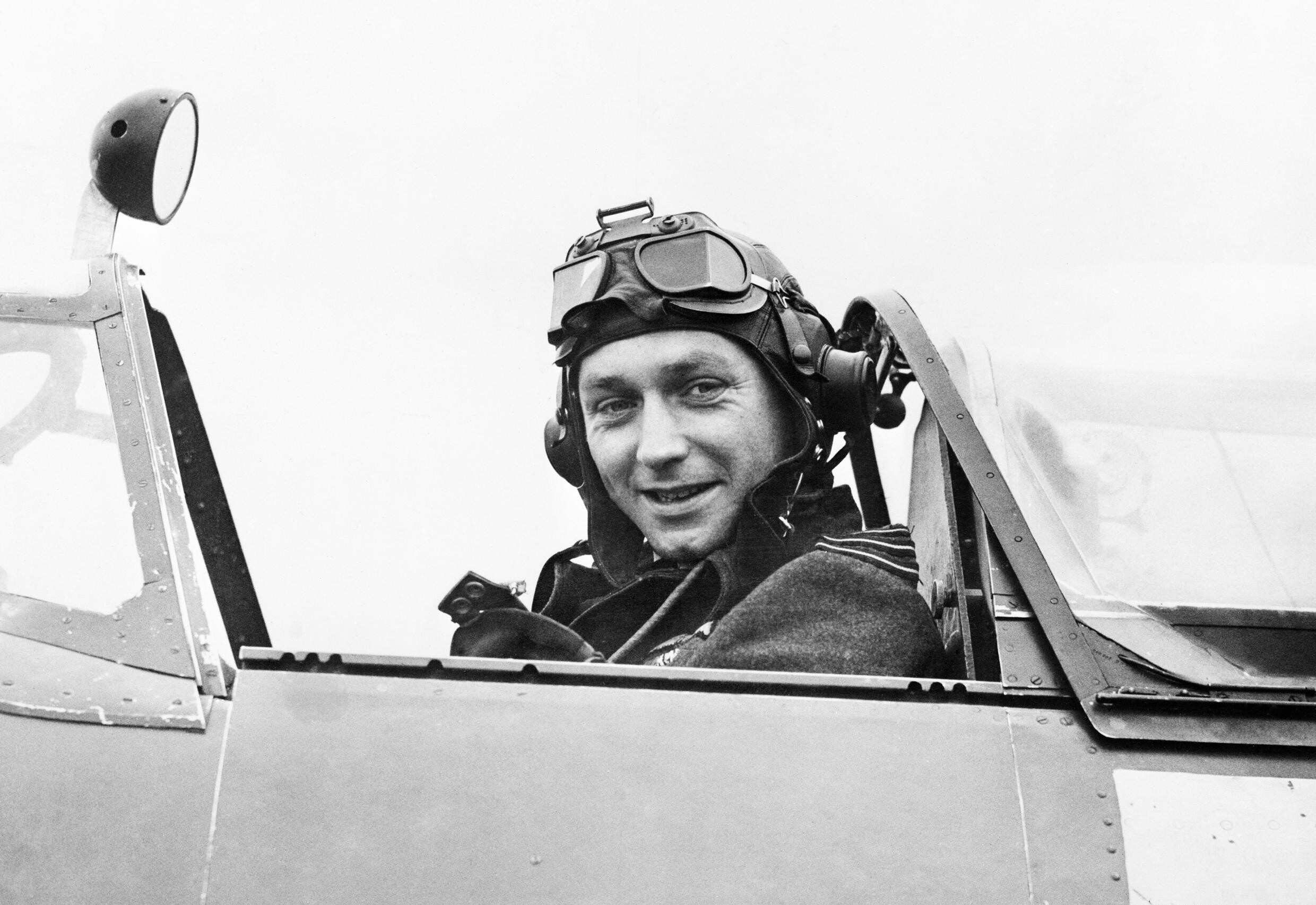
The Mk XII existed for tactical rather than technical reasons. By late 1941 the Fw 190 had upset the balance of the fighting over the Channel and, above all, was punishing the English coast with low-level hit-and-run raids that Merlin-engined Spitfires, optimised for medium and high altitudes, struggled to intercept. The single-stage Griffon offered precisely the opposite quality: superb low and medium level performance that fell away above 6,100 m. For that reason every production aircraft flew with clipped wingtips, a change that also sharpened aileron response and handling; the LF prefix used by low-altitude Merlin Spitfires was never applied to it. In comparative trials against a Mk IX the Mk XII was 23 km/h faster at sea level but slower above the crossover altitude. A speed trial held at Farnborough in July 1942 made the point memorably: flown by Jeffrey Quill, the prototype pulled ahead of a Hawker Typhoon and a captured Fw 190, the exact reverse of what the assembled officials had expected.
Production, designated Supermarine Type 366, was limited to 100 Supermarine-built aircraft, the first of which began appearing in October 1942. There was no mass production as with the Mk V or Mk IX: the Mk XII was always a stopgap pending the Mk XIV. The aircraft were built from Mk Vc and Mk VIII airframes, which explains their two distinct configurations. Early machines retained fixed tailwheels, Dunlop AH2061 five-spoke mainwheels and small elevator balances, with a single 85 gal main tank that gave a short range of little more than 610 km on internal fuel. The last 45 or so, based on Mk VIIIs, added two wing tanks of 14 gal each, larger horn balances, a retractable tailwheel, undercarriage legs with torque links and dished fairings, and the stronger Dunlop AH10019 four-spoke wheels. All carried the pointed rudder, and with the Griffon came the fully flush-riveted finish progressively adopted across the family. Externally the engine lengthened the nose and required two prominent bulges above the exhaust stubs to clear the cylinder blocks, plus a smaller central blister over the magneto. Armament was two 20 mm cannon and four 7.7 mm machine guns.
The Mk XII entered service in February 1943 with No. 41 Squadron, followed by No. 91 Squadron in April of that year; these were the only two RAF units to operate the type. In combat its low-level speed advantage proved hard to exploit, because German pilots were reluctant to be drawn into dogfights with any Spitfire below 6,100 m; when it did get to grips with the enemy, however, it was a formidable fighter, and several Fw 190s and Messerschmitt Bf 109Gs fell to it. That same advantage became useful once more at the end of its front-line career, in the summer of 1944, when its pilots were credited with 82.5 V-1 flying bomb kills. The mark was withdrawn from front-line service in September 1944. The final production Mk XII, MB882, flew with No. 41 Squadron in the hands of Flt. Lt. Donald Smith of the RAAF. The Griffon's full potential in the Spitfire would not be realised until the two-stage Mk XIV, but it was the Mk XII that opened the way.
Multimedia


-1600.webp)

.jpg)
