Fighter · Military · Russia
Mikoyan-Gurevich MiG-21
- February 14, 1955
- First flight
- In service
- Status


_expuesto_en_Monino-1600.webp)


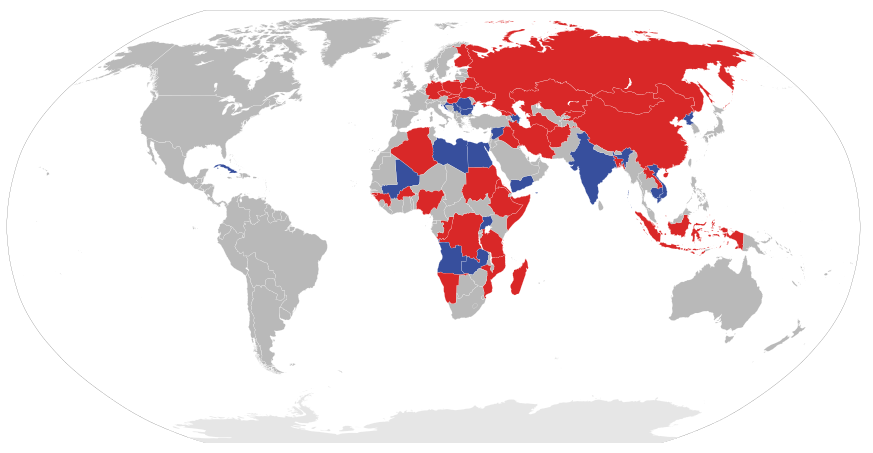


The Mikoyan-Gurevich MiG-21 — NATO reporting name «Fishbed» — is the delta-winged supersonic fighter-interceptor with which the Soviet Union equipped its own fighter arm, and that of much of the world, from 1959 onwards. Aircrews named it after its silhouette: «balalaika» in the USSR, «Ołówek» («pencil») in Poland and «Én Bạc» («silver swallow») in Vietnam. Around sixty countries on four continents have flown it, and seven decades after its maiden flight it remains in service with a handful of them. Its significance is measured in figures few aircraft can match: it is the most-produced supersonic combat aircraft in history and the most-produced combat aircraft since the Korean War, built over a run stretching from 1959 to 1985. Totals differ by source: Soviet official records add up to 10,158 airframes, while the most widely quoted overall figure reaches 11,496 — 10,645 built in the USSR, 657 assembled under licence by Hindustan Aeronautics in India and 194 by Aero Vodochody in Czechoslovakia. Soviet output came from three plants: 5,765 aircraft from Gorky, 3,203 from Moscow and 1,678 from Tbilisi, the last of them specialising in two-seat trainers. The programme began in the early 1950s as a continuation of the MiG-15, MiG-17 and MiG-19 line. The preliminary Ye-1 design study of 1954 was reworked once its intended engine proved underpowered, yielding the still swept-wing Ye-2; the first prototype with the delta wing of the production versions was the Ye-4, which flew on 16 June 1955 and appeared in public at the Tushino display in Moscow in July 1956. The outcome was a lightweight fighter able to reach Mach 2 on a comparatively modest afterburning turbojet, close in philosophy to the F-104 Starfighter, the F-5 and the Mirage III. Its nose intake with a shock cone left very little room for radar and ultimately capped the design's growth potential, while internal tanks placed ahead of the centre of gravity gave it short legs — roughly forty-five minutes of endurance in clean configuration. Armament paired a cannon with the K-13 missile, a reverse-engineered copy of the American AIM-9 Sidewinder based on an example recovered after the 1958 fighting over the Taiwan Strait. In combat it was exactly what it had been designed to be: a ground-controlled interceptor. Over North Vietnam, where the first aircraft arrived by ship in April 1966 for the 921st Fighter Regiment, it practised the single fast firing pass against American formations; thirteen North Vietnamese aces scored their victories in it, and Operation Bolo of 2 January 1967 — F-4 fighters posing as bomb-laden F-105s to draw the MiGs into a turning fight — was, as Vietnamese sources later conceded, one of the worst days of the war for their air arm, with five MiG-21s lost by their own count. In the Middle East it equipped Egypt, Syria and Iraq: in the Six-Day War Egypt lost about a hundred of the hundred and ten MiG-21s it had, almost all of them on the ground, and Syria thirty-five of sixty; during the War of Attrition Soviet pilots arrived to fly them, and it was they who were ambushed by Israel in Operation Rimon 20 on 30 July 1970, which ended with five Soviet-flown MiG-21s shot down and not one Israeli aircraft lost. No air force became as closely identified with the type as India's. India chose it in 1961 over Western contenders and in 1963 it became the first supersonic aircraft in Indian military service; more than 1,200 would eventually be inducted, with a peak of four hundred spread across nineteen squadrons. It fought the subcontinent's first supersonic dogfight in the 1971 war, when a MiG-21FL brought down a Pakistani F-104 with cannon fire. It also built up an accident record that earned it the nickname «flying coffin»: more than a hundred and seventy pilots and forty civilians were killed in MiG-21 accidents from 1970 onwards. Its Indian story closed with the loss of one aircraft in the 2019 border clash with Pakistan, its pilot captured and returned days later, and with the farewell ceremony held at Chandigarh on 26 September 2025, No. 23 Squadron «Panthers» being the last unit to fly it. The Fishbed's lineage continued along two paths. The first was Chinese copying and development: the technology-transfer agreement of 30 March 1962 led to the Chengdu J-7 — production started at Shenyang in March 1964 with incomplete documentation, forcing Chinese engineers to reconstruct much of the design, and only reached true mass production in the 1980s — and to its F-7 export family. The second was modernisation: Romania converted 111 airframes between 1995 and 2002 into the LanceR A, B and C versions, cleared for both Western and Eastern weapons, while India contracted in 1996 for 125 aircraft to be brought to the MiG-21-93 standard, known as the «Bison». On the latest available counts, from 2021 to 2023, the MiG-21 still flies in small numbers with Angola, Cuba, Mali, Mozambique, North Korea, Sudan and Yemen.
Category
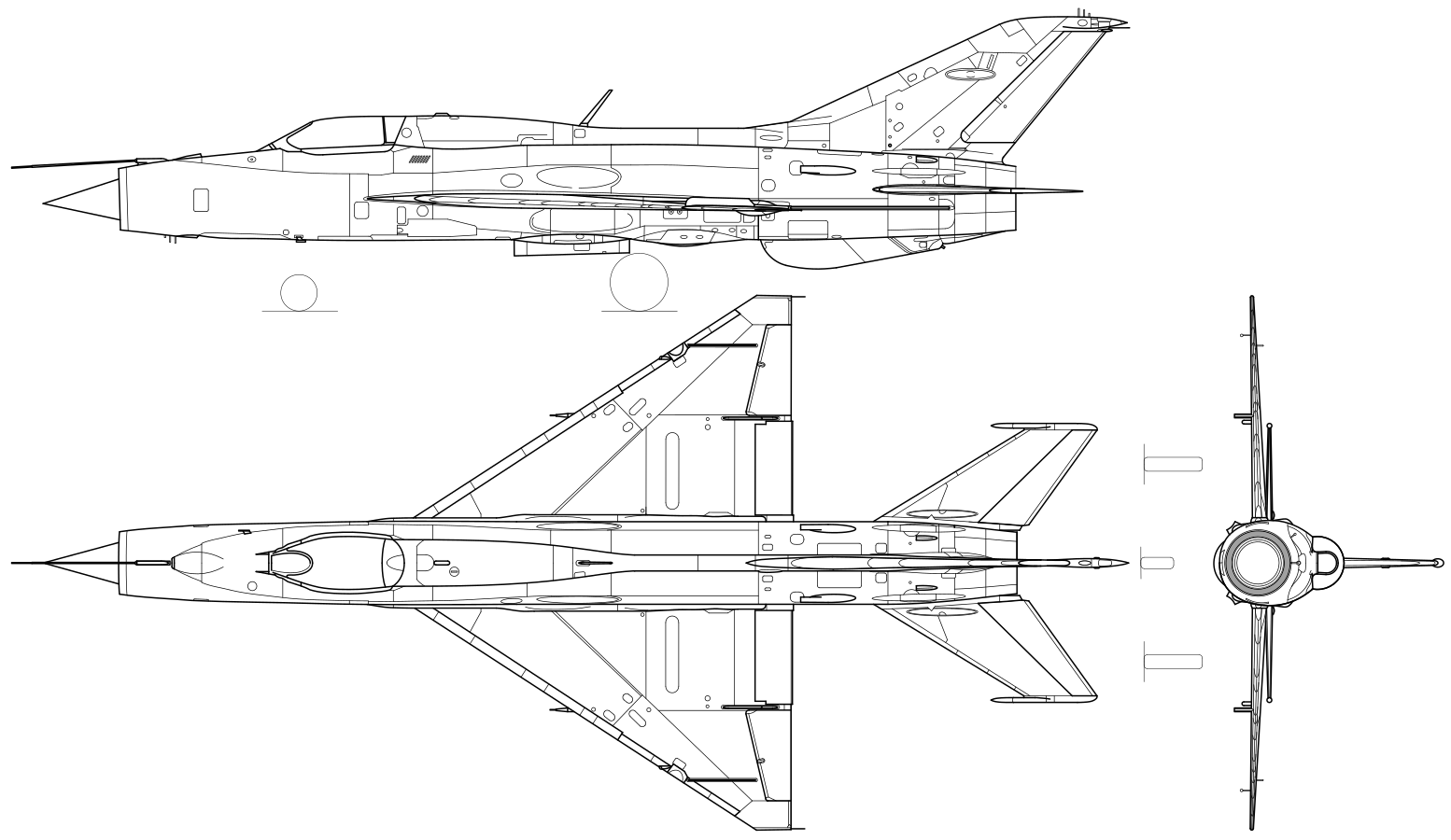
Three-view drawing
.jpg)
.jpg)
.jpg)
.jpg)
.jpg)
.jpg)
History
A 1953 requirement and the last bureau standing
The MiG-21 story begins with the conclusions the Soviet Union and the United States drew from Korea. Pilots on both sides asked for the same thing: more performance in a light, agile fighter able to prevail in a turning fight. The American answer was the Lockheed F-104 Starfighter; the Soviet one started in the autumn of 1953, when a state requirement for a fast, light fighter was handed down in deliberately broad terms — a top speed of Mach 2, cannon armament, a radar gunsight and the ability to carry guided air-to-air missiles later on.
Several design bureaux were given the requirement, but some were too committed to other projects to take it on seriously and others could not produce designs the authorities found acceptable. The OKB led by Artyom Ivanovich Mikoyan — the bureau behind the MiG-15, evenly matched with the F-86 Sabre over Korea, its improved MiG-17 derivative and the twin-engine MiG-19, the first Soviet supersonic jet to enter widespread service — was left as the last man standing, and in January 1954 it received the go-ahead to develop the aircraft.
The project was given the internal code "Ye-1", where "Ye" stood for *Yedinitsa*, "single unit", meaning a one-off experimental prototype. The choice of powerplant took it first to the Mikulin AM-9B, the MiG-19's engine, and from there to the AM-11 then in development and optimised precisely for the fast light fighter requirement; with that change the code became "Ye-2".
The fork in the wing: swept or delta
As was the custom in the Soviet aerospace industry, the aerodynamics were suggested by the state institute TsAGI. The complication was that TsAGI offered two configurations instead of one. Both started from a fuselage related to the MiG-19's — nose intake, conventional swept tail, mid-mounted wings — but slimmer. The difference lay in the wing: one proposal had a strongly swept wing, 55 degrees at 25% chord, along MiG-19 lines; the other a pure delta with 57 degrees of leading-edge sweep.
Rather than settle it on paper, six prototypes were authorised to settle it in the air: one "Ye-2" with the swept wing and the AM-9B, one "Ye-2A" with the swept wing and the AM-11, two "Ye-4" deltas with the AM-9B and two "Ye-5" deltas with the AM-11. Since the AM-11 would not be available immediately, the Ye-2 and Ye-4 were to be completed first. At the same time three further aircraft were authorised, designated "Ye-50", with the swept wing, an AM-9B and an integral liquid-propellant boost rocket engine.
The Ye-2 was rolled out in early 1955 and made its first flight on 14 February 1955 with Georgiy K. Mosolov at the controls. The flight went well enough, though Mosolov found it underpowered — expected with the AM-9B — and it still proved capable of Mach 1.8. The first Ye-4 delta flew on 16 June 1955 with Grigory A. Sedov, and the result shocked the design team: barely Mach 1.2. There was no difference between the two aircraft other than the wing, and TsAGI's analysis said the delta should work; in practice it did not. A series of adjustments to the delta wing followed, and performance gradually began to improve.
The engines held back the rest. The AM-11 was suffering development problems — it was prone to fires and other troubles — and the prototypes meant to use it were delayed. The first Ye-5 delta did not fly until 9 January 1956, with Vladimir A. Nefyedov, on the same day the rocket-boosted Ye-50 took to the air for the first time. The first swept-wing Ye-2A flew on 17 February 1956 with Sedov, and the second on 4 September of that year; the second Ye-5 flew before the year was out.
Trials of the Ye-2A and Ye-5 were promising enough that by early 1956 it was taken for granted that one of them would go into production. Service designations were reserved for both: "MiG-23" for the Ye-2A and "MiG-21" for the Ye-5. Pre-production batches of five aircraft each were ordered. Intensive trials reversed the expectation: despite its disastrous start the Ye-5 turned out better than the Ye-2A — more manoeuvrable, lighter and slightly faster — and it was the one selected. The MiG-23 designation was set aside to be recycled years later on another Mikoyan fighter.
The West had already had its first hint. Swept-wing and delta-wing prototypes flew a pass during the Aviation Day air show at Tushino Airport in Moscow on 24 June 1956 (other sources place that first public appearance in July 1956). The photographs, very poor, were enough to deduce the general configuration, and NATO assigned the reporting name "Faceplate" to the swept-wing machine and "Fishbed" to the delta. It would take a few more years to work out which of the two had actually gone into production.
From prototype to production line: the MiG-21F
The powerplant still had to be settled. The engine bureau, by then under Sergei K. Tumanskiy — Mikulin having been removed in 1955 — had most of the AM-11's problems under control and was offering an improved version besides. With Mikulin's departure the AM-11 became the R-11, from *Reaktivniy*, and the new variant was the R-11F-300, with a considerable jump in afterburning thrust.
Initial deliveries of the production "Ye-6T", or MiG-21F, to the VVS took place in the autumn of 1959. At the factory it was known by the code *Izdeliye 72*, or "I-72"; NATO called it "Fishbed-B" and retroactively relabelled the prototypes "Fishbed-A". Production for the VVS was assigned to State Factory Number 21 at Gorkiy, and later the MMZ Znamya Truda factory — the former State Factory Number 30 — took on export production.
The family put its performance on the record early: a straight-line speed record over a 25-kilometre course at 2,504 km/h (Mach 2.36) and, on 16 September 1960, a record by Konstantin Kokkinaki over a 100-kilometre closed circuit at an average of 2,148.66 km/h.
The Sidewinder that changed sides: the K-13
The armament took a leap by an unplanned route. The Soviet Union had been working on radar-guided air-to-air missiles and paid little attention to heat-seeking ones until September 1958, when Taiwanese F-86 Sabres tangled with Chinese MiGs over the Formosa Straits. The Sidewinder proved effective against the MiGs, but a few of the missiles scored hits, failed to detonate and remained embedded in their targets. They were disarmed and reverse engineered: the result was the K-13, known in service as the R-3S and christened "AA-2 Atoll" by NATO. The surviving second Ye-6 prototype was used in 1960 for trials of the new heat-seeking missile.
From the second half of 1960 production moved on to a slightly enhanced variant, the "MiG-21F-13", with the factory code "I-74". The main improvement was precisely the Atoll, one on a pylon under each wing, at the cost of deleting the left cannon; the SRD-5 radar ranging set was updated to the SRD-5M Kvant. NATO assigned it the reporting name "Fishbed-C". Czechoslovakia obtained a licence to build it as the S-106, effectively a MiG-21F-13 without the transparent panel on the rear cockpit fairing, which had not proved useful in practice and would later be deleted from Soviet production as well; 194 were built, and no other variant of the type.
All-weather interceptors: P, PF, PFS and PFM
The second evolutionary line turned the light day fighter into an all-weather interceptor, with an intercept radar in the nose and a fuselage that grew heavier variant by variant. From the MiG-21P and PF came the MiG-21PFS, of which only a handful were built, and by the end of 1964 production flowed to the "MiG-21PFM", which kept the factory code "I-94". It had the broadest tailfin of the whole family and a new RP-21M radar — "Spin Scan-B" to NATO — which supported radar-guided missiles; the initial standard was the K-5/R-2.
By then the decision to delete the cannon armament had been reconsidered and judged too hasty. The PFM could carry an optional belly pack on the centreline hardpoint with a Gryazev-Shipunov GSh-23 23 mm cannon and 200 rounds. The GSh-23 was an ingenious weapon: twin barrels working in a teeter-totter fashion, the recoil of one throwing it back to actuate and fire the other, supporting a rate of fire of up to 3,600 rounds per minute. An improved PKI gunsight was added to support it, along with a Khrom-Nikel SRO-2M IFF and a Sirena-3M radar warning receiver. Late PFM production introduced a new KM-1 ejection seat: not a modern zero-zero seat, but usable at zero altitude provided the aircraft was moving at a minimum of 130 km/h, a considerable improvement on the previous system.
Second and final generations: R, S, M, SM, SMT, MT and bis
From there the lineage falls into two further steps. The second generation covers the MiG-21R reconnaissance aircraft and the MiG-21S, MiG-21M and MiG-21SM, with successively better radar, avionics and armament. Final production comprises the MiG-21SMT, the MiG-21MT and, closing the series, the MiG-21bis, the last production variant of the family. The technical literature sums the evolution up well: the MiG-21 was built as a lightweight day fighter and acquired new roles over its life — all-weather interceptor, reconnaissance platform — growing more capable and, somewhat unfortunately, heavier at each step.
The weight of each variant in the production run shows in the Gorkiy breakdown: 83 MiG-21F, 513 MiG-21F-13, 525 MiG-21PF, 233 MiG-21PFL, 944 MiG-21PFS/PFM, 448 MiG-21R, 145 MiG-21S/SN, 349 MiG-21SM, 281 MiG-21SMT, 231 MiG-21MF and 2,013 MiG-21bis. The bis alone accounts for more than a third of everything that left that factory.
Industrial scale: three factories and the licences
The figure that defines the MiG-21 is not a performance number but a quantity. A total of 10,645 aircraft were built in the USSR across three factories: AZ 30 in Moscow — the aforementioned MMZ Znamya Truda — with 3,203 aircraft, GAZ 21 at Gorkiy with 5,765 and TAZ 31 at Tbilisi with 1,678. The division of labour had a logic: Gorkiy built single-seaters for the Soviet forces, Moscow single-seaters for export and Tbilisi two-seaters for both export and domestic use, with plenty of exceptions. The MiG-21R and MiG-21bis, for export and for the USSR alike, came out of Gorkiy; 17 single-seaters (MiG-21 and MiG-21F) were built at Tbilisi; the MiG-21MF was first built in Moscow and then at Gorkiy; and the two-seat MiG-21U came from both Moscow and Tbilisi. The Tbilisi trainer line runs as follows: 181 MiG-21U of the *izdeliye* 66-400 and 66-600 series between 1962 and 1966, 347 MiG-21US between 1966 and 1970, and 1,133 MiG-21UM from 1971 to the end.
One discrepancy the source itself carries unresolved is worth flagging: the sum of the three factory totals comes to one aircraft more than the 10,645 quoted as the Soviet total. Both statements are recorded as they stand, without reconciling them.
Outside the USSR there were two licence lines. Czechoslovakia built the 194 S-106s already mentioned. In India, Hindustan Aeronautics Limited built, according to the same source, 657 aircraft between MiG-21FL, MiG-21M and MiG-21bis, of which 225 were bis; another passage of the same article speaks of 840 aircraft built in India between 1966 and 1984 and gives an overall total of 11,496 units produced between 1959 and 1986. The three figures do not fit together, and we have no source of our own from HAL or from Aero Vodochody to settle the matter, so they are recorded as statements of the source rather than as reconciled data.
Vietnam: interception directed from the ground
The MiG-21 was designed for very short ground-controlled interception (GCI) missions, and it was in exactly that role that it became renowned, in the skies over North Vietnam. The first aircraft arrived by ship directly from the Soviet Union in April 1966. Once unloaded and assembled they were handed to the oldest fighter unit of the Vietnam People's Air Force, the 921st Fighter Regiment, created on 3 February 1964 as a MiG-17 unit. The newer and less experienced 923rd continued with MiG-17s; the arrival of Chinese MiG-19s (J-6) in 1969 produced the country's only MiG-19 unit, the 925th; and on 3 February 1972 the fourth and last fighter regiment created during the war was commissioned.
The first shootdown of a piloted aircraft by a Vietnamese MiG-21 was achieved not by a missile but by a salvo of UB-16-57/S-5M unguided rockets; the flight leader was unable to lock another wildly evading F-105 with his R-3S. Thirteen Vietnamese aces reached that status flying the MiG-21, against three who did so on the MiG-17. Even so, many pilots preferred the MiG-17: the MiG-21's high wing loading made it comparatively less manoeuvrable, and the MiG-17's lighter canopy framing gave better visibility.
The tactics followed from the aircraft. The interceptors flew under the guidance of ground controllers who placed them in ambush battle stations for "one pass, then haul ass" attacks. The MiGs came in fast and often accurately against American formations from several directions — the MiG-17s usually attacking head-on — aiming either to down aircraft or to force them to jettison their bomb loads. Armed with two K-13s, the MiG-21 had rapid acceleration, was agile at supersonic speeds and at high altitude, and significantly outperformed its primary target, the F-105 Thunderchief, in all flight regimes; its low wing loading suited air combat manoeuvring and its small size made it hard to spot even when the adversary had been warned.
The available tallies are partial and come from interested parties, and should be read as such. From May to December 1966 the USAF lost 47 aircraft and destroyed only 12 Vietnamese fighters. Between April 1965 and November 1968 more than 268 air battles took place over North Vietnam: North Vietnam claimed 244 American aircraft downed while admitting the loss of 85 MiGs. Of 46 engagements between F-4s and MiG-21s, losses came to 27 Phantoms and 20 MiG-21s.
Operation Bolo, 2 January 1967
The best-remembered American answer grew out of the losses of the Rolling Thunder bombing campaign during 1966, in which Vietnamese fighters evaded the escorts and attacked bombers flying predictable routes. Since October the F-105s had carried QRC-160 radar jamming pods that had virtually ended their own losses to surface-to-air missiles, but that had shifted the SAM attacks onto the F-4s, unprotected because of a shortage of pods. In December, moreover, the rules of engagement had been revised to limit escort penetration to the edge of SAM coverage. Interceptions increased, mainly by MiG-21s using high-speed hit-and-run tactics against bomb-laden F-105 formations: only two bombers had been lost, but the threat was perceived as serious, and bombing North Vietnamese airfields was still forbidden at the start of 1967.
Colonel Robin Olds, commander of the 8th Tactical Fighter Wing and a double ace over Europe in the Second World War, proposed an aerial ambush. His idea was simple: make the agile Phantom look like a cumbersome bomb-laden F-105 and draw the MiGs into a sustained fight that would exhaust their small fuel load. He assigned the planning to four veteran junior officers of the wing — wing tactics officer Captain John B. Stone, 1st Lieutenants Joseph Hicks and Ralph F. Wetterhahn, and Major James D. Covington — under the tightest security: the pilots flying the mission would not be briefed until 30 December. The F-4s would use the same air refuelling tanker tracks and altitudes as the F-105s, their radio jargon, their inflexible line-abreast formations and their QRC-160 pods, so that the electronic signature would be identical.
The plan was presented to General William Momyer, commanding the Seventh Air Force, on 22 December 1966. Momyer approved it under the code name "Bolo", after the Filipino machete that does not look like a weapon until the opponent is already too close. The date was set for 1 January 1967, but bad weather pushed it to the 2nd. The mission launched from Ubon that afternoon, and Olds, leading the first flight, arrived over Phúc Yên Air Base at 15:00 local time. Flying southeast along the ingress route used by the F-105s he drew no reaction, and a thick cloud floor concealed any takeoffs. Unknown to Olds, the North Vietnamese GCI controllers had delayed takeoffs by roughly fifteen minutes because of the overcast. Olds reversed course to the northwest and, just as the second flight reached the area, the first MiGs emerged from the clouds.
The fight followed a pattern all three engaged flights later described alike: the MiGs appeared apparently at random, but had in fact been directed so that the first came up at the flight's six o'clock and the next two, moments later, at its ten o'clock, presenting one MiG with a tail-shooting solution and tactical surprise. The first kill went to Olds 02, flown by mission planner Ralph F. Wetterhahn, with an AIM-7 Sparrow, while Olds fired three missiles that failed either to launch or to guide. Olds then scored the second with a vector roll that put his Phantom above the tighter-turning MiG-21 and let him drop in behind it as it completed its turn; he fired two AIM-9s, one of which tore off the MiG's right wing. At nearly the same moment Captain Walter S. Radeker III, in Olds 04, launched without a consistently good tone at a MiG tracking his element lead; the Sidewinder guided perfectly. Olds flight destroyed three MiG-21s without a loss.
The overall result of the day was several MiG-21 victories credited to the 8th TFW with no losses of its own, although a North Vietnamese source confirms the loss of only five MiG-21s during the operation. The gap between claims and admissions is the rule rather than the exception across the type's entire combat record.
The Middle East: 1967, the War of Attrition and Rimon 20
The MiG-21 was the reference fighter of the Egyptian, Syrian and Iraqi air forces in the Middle Eastern conflicts of the 1960s, 1970s and 1980s. It first encountered Israeli Mirage IIICJs on 14 November 1964, though the first MiG-21 was not shot down until 14 July 1966; on 7 April 1967 another six Syrian MiG-21s fell to Israeli Mirages. It would later face F-4 Phantom IIs and A-4 Skyhawks, and be clearly outclassed by the F-15 Eagles and F-16 Fighting Falcons Israel began acquiring from the mid-1970s.
In the opening attacks of the 1967 Six-Day War the Israeli Air Force struck in four waves. In the first, Israeli pilots claimed eight Egyptian aircraft destroyed in air-to-air combat, seven of them MiG-21s; Egypt for its part claimed five kills scored by MiG-21PFs. In the second wave Israel claimed four more MiG-21s, and the third produced claimed victories over two Syrian and one Iraqi MiG-21. Syria lost 35 of its 60 MiG-21F-13s and MiG-21PFs, in the air and on the ground.
Between the end of the Six-Day War and the start of the War of Attrition, Israeli Mirages scored six confirmed kills of Egyptian MiG-21s, while Egyptian MiG-21s scored two confirmed and three probable kills against Israeli aircraft. Taking the whole period to the end of the War of Attrition, Israel claimed a total of 25 Syrian MiG-21s destroyed; the Syrians claimed three confirmed and four probable kills, which Israel denied.
High losses and continuous bombing led Egypt to ask the Soviet Union for help. President Nasser visited Moscow on 24 and 25 January 1970 and persuaded his hosts to expand Soviet assistance: an entire division of the Soviet Air Defence Forces, the 18th Special Anti-Aircraft Rocket Division, was deployed, including the MiG-21MF-equipped 135th Fighter Aviation Regiment along with the latest versions of the SA-2 and SA-3 SAM batteries, initially tasked with defending Cairo and Alexandria. In March 1970 Soviet pilots and SAM crews arrived with their equipment. On 13 April, in the air battle over the Red Sea coast, Soviet MiG-21MFs shot down, according to some data, two Israeli F-4s; on 18 April an Israeli RF-4E reconnaissance aircraft was damaged by a Soviet MiG-21MF; on 16 May an Israeli aircraft was shot down in air combat, probably by a Soviet MiG-21; and on 22 June 1970 a Soviet pilot flying a MiG-21MF shot down an Israeli A-4E.
Israel decided to respond with a planned ambush that carried an explicit political purpose: to signal that it would no longer tolerate direct Soviet military involvement. On the afternoon of 30 July 1970 four Israeli Mirage IIIs crossed into Egyptian airspace in tight formation so as to appear on radar as a single aircraft. As expected, four Soviet-flown MiG-21s scrambled to intercept what they believed to be a routine reconnaissance flight; they were soon joined by eight more. As they closed on the Mirages they were ambushed by four Israeli F-4 Phantoms and eight Mirage IIIs that had been lurking undetected at low altitude. A further twelve MiG-21 reinforcements arrived. By the end of the close-quarters dogfight five Soviet MiG-21s had been downed with no Israeli losses. Egyptian military leaders were pleased with the outcome, since the Soviets had long criticised Egypt's aerial losses and attributed them to a lack of skill among Egyptian pilots; the Soviets kept quiet to avoid the embarrassment. It was one of the final engagements of the War of Attrition and is widely believed to have contributed to its conclusion.
In the Yom Kippur War, veteran North Korean pilots — many with more than 2,000 flying hours — flew Egyptian and Syrian MiG-21s and engaged Israeli forces on several occasions. North Korean air force pilots continued to fly Syrian MiG-21s throughout the 1970s and into the 1980s.
India: from the HAL licence to the "flying coffin"
India received the type very early. No. 28 Squadron, the "First Supersonics", introduced it at Chandigarh in March 1963, and the first Fishbed in Indian service was the MiG-21F-13, known locally as the Type 74, a fairly basic first-generation iteration; by 1964 the improved MiG-21PF, or Type 76, had been added, bringing an air-intercept radar.
In the Indo-Pakistani war of 1965 the MiG-21's role was limited by small numbers and lack of training, though the Indian Air Force gained valuable experience on defensive sorties. The only known combat engagement took place on 4 September 1965, when a MiG-21FL of No. 28 Squadron damaged an F-86E with two R-3S missiles. The positive feedback from pilots prompted India to place further orders and to invest in maintenance infrastructure for the type.
In the 1971 war the role was central: the MiG-21s served to establish air superiority over vital points and areas, and the conflict saw the first supersonic dogfight in the subcontinent, when an Indian MiG-21FL shot down a Pakistan Air Force F-104 Starfighter. They are also credited, among other Pakistani aircraft, with an F-86F Sabre and a C-130E Hercules.
During the Kargil war in 1999 Indian MiG-21s were pressed into combat air patrols and reconnaissance duties at high altitude in Kashmir. As part of Operation Safed Sagar they flew multiple sorties against Pakistani positions and supported Indian Army units, but operating at those altitudes proved extremely demanding for the aircraft and limited its effectiveness as a fighter. On 27 May 1999 a MiG-21 was shot down by Pakistani ground fire at Kargil; its pilot was captured and later killed. Shortly afterwards, on 10 August 1999, two Indian MiG-21s (FLs in some sources, bis of No. 45 Squadron in others) intercepted and shot down a Pakistani Bréguet 1150 Atlantic maritime patrol aircraft with an R-60 missile after it had, according to the Indian side, entered Indian airspace.
The other side of that longevity is its accident record. Since 1970 more than 170 Indian Air Force pilots and 40 civilians were killed in MiG-21 accidents, which earned the aircraft the nickname "flying coffin"; over half of the 840 aircraft built in India between 1966 and 1984 were lost to crashes. Among the technical causes cited is that in afterburner the engine operates very close to its surge line, so ingesting a small object could cause a compressor surge or seizure and a flame-out; poor maintenance and the quality of replacement parts were also blamed. It should be stressed that these figures come from the general documentation consulted and not from an Indian official source of our own.
The end came in stages. The Indian Air Force announced that it would replace its remaining fleet of MiG-21 Bison aircraft with the indigenous HAL Tejas in 2023; in October of that year the aircraft made its final public appearance at the Air Force Day flypast held at Prayagraj. The retirement ceremony took place on 26 September 2025 at Air Force Station Chandigarh with the last unit operating the type, No. 23 Squadron "Panthers"; Indian Defence Minister Rajnath Singh described the aircraft as "family members" of India and of the Indian Air Force, reflecting on the "courage, sacrifice, and excellence" of its crews.
The Chinese lineage: J-7 and F-7
On 30 March 1962 the Soviet Union and China signed a technology transfer arrangement covering the MiG-21. The cooperation came after a tense period: the withdrawal of Soviet advisers had left the project in China at a standstill. According to the available accounts, various kits, components, complete aircraft and associated documents were delivered to the Shenyang Aircraft Factory, but the design documentation was incomplete and Chinese designers had to fall back on reverse engineering. The two aircraft are greatly similar, but differ in areas such as the hydraulic systems and the internal fuel arrangements.
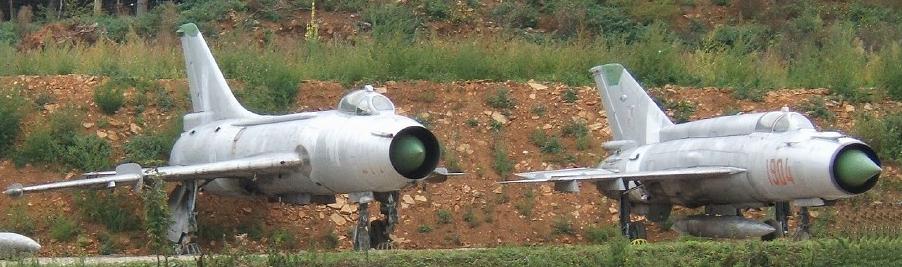
Domestic production of the J-7 reportedly began in March 1964 at Shenyang, though for various reasons — the Cultural Revolution among them — genuine mass production was only achieved during the 1980s. Numerous models were developed with improvements in armament, avionics and wing design. The largest export operator is the Pakistan Air Force, and several countries, including Zimbabwe, Tanzania and Sri Lanka, deployed the type in offensive roles. Lessons from the J-7 programme fed later aircraft such as the Shenyang J-8 interceptor. Production ended in 2013 with the delivery of 16 F-7BGIs to the Bangladesh Air Force; in the export market it was succeeded by the JF-17 Thunder, the Chengdu J-10 and the Shenyang J-35A, and the retirement of the Chinese J-7 fleet, begun in 2018, was set for 2023.
Upgrades: LanceR, Bison and the packages that found no buyer
An abundance of airframes and a shortage of budgets made the MiG-21 an ideal candidate for upgrade programmes, many of them run outside Russia.
The most thorough was the Romanian one. In 1993 Elbit Systems of Israel and Aerostar of Romania began a joint effort to update 100 MiG-21MF fighters and 10 MiG-21UM trainers of the Romanian Air Force to the "Lancer" standard. The upgrade included a new cockpit with twin colour multifunction displays and HOTAS controls, compatibility with Elbit's Display And Sight Helmet (DASH), an EL/M-2032 multimode radar from the Elta division of Israel Aircraft Industries for the air-superiority configuration or an EL/M-2001B ranging radar for the ground-attack one, a Litton inertial navigation system with a GPS receiver, new IFF, dual jam-resistant radios and a modern countermeasures suite with radar warning receiver, chaff and flare dispensers and integration with an external pod. The airframes also received a service life extension programme. Weapons carriage covered AA-11 Archer and Rafael Python 3 air-to-air missiles, the Elbit Opher infrared-guided bomb, the IAI Lizard laser-guided bomb and unguided munitions, with the Rafael Litening designation pod for directing the laser-guided bombs. The single-seat "Lancer I" prototype flew in 1995 and the two-seat "Lancer II" in 1996; in Romanian service the ground-attack single-seaters were designated Lancer A, the two-seaters Lancer B and the air-superiority machines Lancer C.
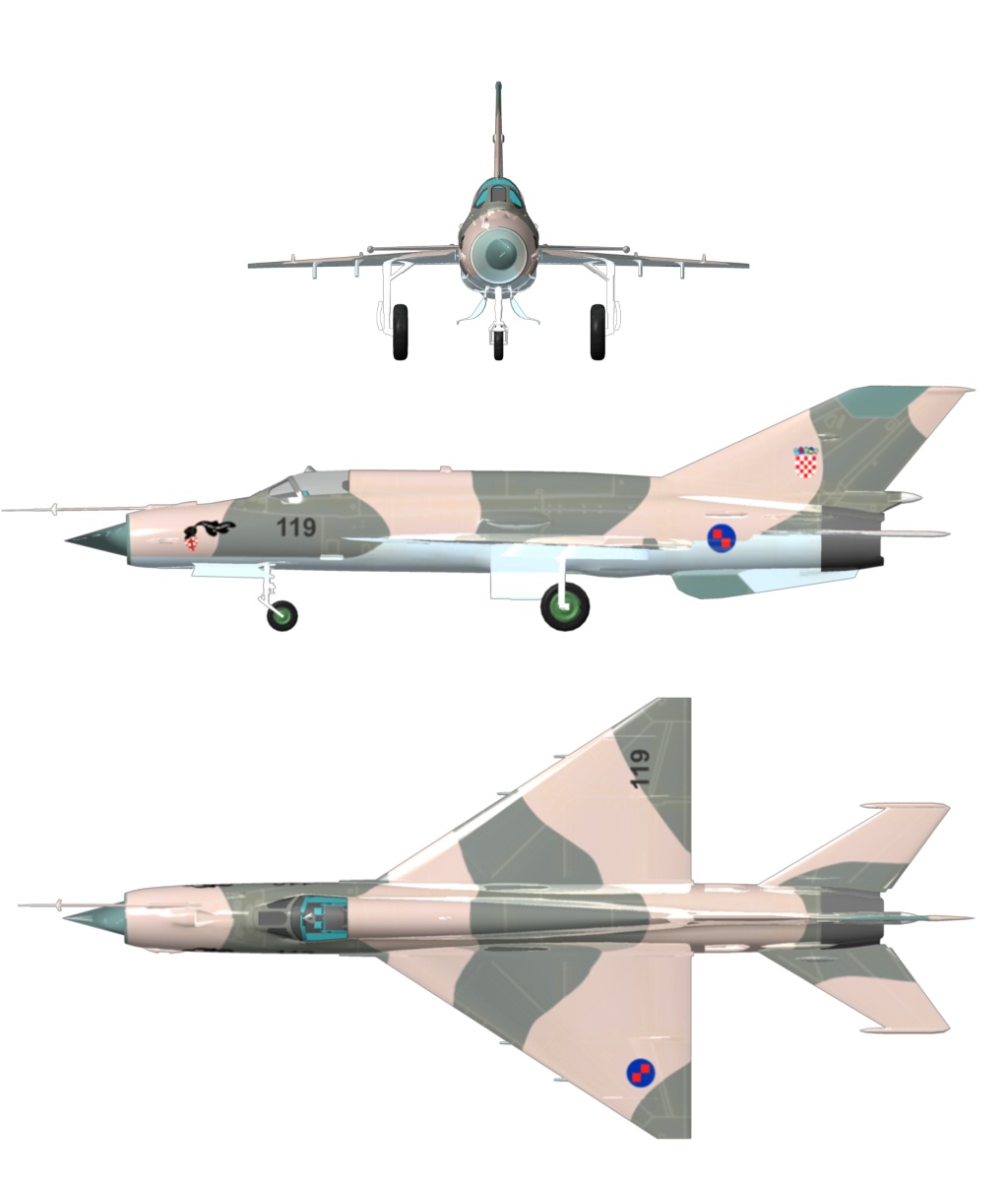
Aerostar later carried out a far more modest programme for 12 Croatian MiG-21s — eight single-seat bis and four UM trainers — under a deal signed in 2002: despite initial reports it was not a Lancer-class upgrade but a refurbishment of airframes bought as surplus from an unspecified Eastern European nation, plus a simple avionics update with a beacon navigation receiver, GPS, and NATO-compatible IFF and radios, leaving cockpit instrumentation untouched. A decade later Croatia put another batch through refurbishment in Ukraine, including some of those already refurbished in the first cycle.
In India, two MiG-21bis fighters were upgraded at Gorkiy by the MiG organisation to the MiG-21UPG configuration and delivered back to India in December 2000; HAL then converted the rest of the fleet using Russian-supplied kits, with the first HAL upgrade publicly displayed in October 2001. This is the version known in India as the Bison. The upgrade did not include a modification evaluated by the Kiev Military Aviation Institute involving a new engine intake that looked like a vented ring installed around the old one and which, according to its designers, finally eliminated the MiG-21's long-standing tendency to suffer engine stalls when the aircraft's longitudinal axis veered off the line of flight; the modification attracted little interest.
Some proposals found no customer. IAI promoted a "MiG-21-2000" package with Elta EL/M-2032 radar, a HUD and colour multifunction displays, HOTAS controls, the Elbit DASH sight, a GPS receiver, a mission computer, a modern countermeasures suite, a one-piece windscreen and the potential to carry Israeli munitions; a prototype flew in 1998, but there were no takers. As the airframes have aged, interest in upgrades has largely faded, except perhaps for the more advanced Chinese J-7/F-7 variants.
The long epilogue
The retirement of the MiG-21 from its principal operators was concentrated into very few years. Romania suspended all LanceR flights on 15 April 2022 because of the high accident rate and announced that it would speed up the acquisition of ex-Norwegian F-16s; the LanceRs resumed flying on 23 May for a period of one year, until 15 May 2023, when a retirement ceremony was held at the 71st and 86th Air Bases. That same year the Chinese J-7 fleet was due to complete its retirement, and India announced the Tejas replacement before closing the chapter in September 2025.
Even so, the type and its Chinese derivatives still appear on the inventories of a small number of air forces, above all in Africa and Asia. The operator listings we consulted were captured some years ago and do not support a statement about the exact situation today; the cut-off is recorded precisely so as not to project onto the present a status we have not verified.
Documentary gaps in this pass
These are set down because a recorded absence is information while a silent one is an oversight:
- We have no source of our own from Hindustan Aeronautics Limited or from Aero Vodochody on the licence production figures; the three quantities quoted (657, 840 and the overall total of 11,496) come from the same secondary source and do not fit together. - The sum of the three Soviet factory totals exceeds by one aircraft the total of 10,645 that the same source gives; both statements are recorded without reconciling them. - We have not located a source of our own on the MiG-21I "Analog" research aircraft, so nothing is asserted about it in this pass. - The Indian accident figures come from the general documentation consulted rather than from an Indian official statistic, and should be treated with that caution. - The Vietnam and Middle East shootdown tallies are claims by the parties involved, frequently contradictory, and are presented as such. - The listing of active operators reflects material captured some years ago and has not been updated to the date of writing.
Variants
| Ye-2 | Ye-5 | Ye-6 | MiG-21 | MiG-21-93 | MiG-21bis | MiG-21F | MiG-21F-13 | MiG-21FL | MiG-21I | MiG-21M | MiG-21MF | MiG-21MT | MiG-21P-13 | MiG-21PD | MiG-21PF | MiG-21PFM | MiG-21PFS | MiG-21R | MiG-21S | MiG-21SM | MiG-21SMT | MiG-21U | MiG-21UM | MiG-21US | Ye-2A | Ye-4 | Ye-50 | |
|---|---|---|---|---|---|---|---|---|---|---|---|---|---|---|---|---|---|---|---|---|---|---|---|---|---|---|---|---|
| First flight | February 14, 1955 | January 9, 1956 | May 20, 1958 | — | — | — | — | — | — | — | — | — | — | — | — | — | — | — | — | — | — | — | — | — | — | — | — | — |
| Aircraft type | — | — | — | — | — | Single-seat supersonic multirole fighter | — | Single-seat supersonic day fighter | — | — | — | — | — | — | — | — | — | — | — | — | — | — | — | — | — | — | — | — |
| Powerplant | — | — | — | — | — | One Tumansky R-25-300 afterburning turbojet rated at 69.58 kN with afterburner. | — | — | — | — | — | — | — | — | — | — | — | — | — | — | — | — | — | — | — | — | — | — |
| Powerplant | 1 × turbojet | 1 × turbojet | 1 × turbojet | 1 × turbojet | 1 × turbojet | 1 × Tumansky R-25-300 | 1 × turbojet | 1 × turbojet | 1 × turbojet | 1 × turbojet | 1 × turbojet | 1 × turbojet | 1 × turbojet | 1 × turbojet | — | 1 × turbojet | 1 × turbojet | 1 × turbojet | 1 × turbojet | 1 × turbojet | 1 × turbojet | 1 × turbojet | 1 × turbojet | 1 × turbojet | 1 × turbojet | 1 × turbojet | 1 × turbojet | — |
| Thrust per engine | — | — | — | — | — | 69.6 kN | — | — | — | — | — | — | — | — | — | — | — | — | — | — | — | — | — | — | — | — | — | — |
| Length | — | — | — | — | — | 14.7 m | — | — | — | — | — | — | — | — | — | — | — | — | — | — | — | — | — | — | — | — | — | — |
| Wingspan | — | — | — | — | — | 7.2 m Best value in this row | — | 7.2 m Best value in this row | — | — | — | — | — | — | — | — | — | — | — | — | — | — | — | — | — | — | — | — |
| Height | — | — | — | — | — | 4.1 m Best value in this row | — | 4.1 m Best value in this row | — | — | — | — | — | — | — | — | — | — | — | — | — | — | — | — | — | — | — | — |
| Wing area | — | — | — | — | — | 23 m² Best value in this row | — | 23 m² Best value in this row | — | — | — | — | — | — | — | — | — | — | — | — | — | — | — | — | — | — | — | — |
| Empty weight | — | — | — | — | — | — | — | 4,871 kg | — | — | — | — | — | — | — | — | — | — | — | — | — | — | — | — | — | — | — | — |
| MTOW | — | — | — | — | — | 10,400 kg Best value in this row | — | 8,625 kg | — | — | — | — | — | — | — | — | — | — | — | — | — | — | — | — | — | — | — | — |
| Top speed | — | — | — | — | — | 2,175 km/h Best value in this row | — | 2,175 km/h Best value in this row | — | — | — | — | — | — | — | — | — | — | — | — | — | — | — | — | — | — | — | — |
| Max speed altitude | — | — | — | — | — | 13,000 m | — | — | — | — | — | — | — | — | — | — | — | — | — | — | — | — | — | — | — | — | — | — |
| Cruise speed | — | — | — | — | — | 1,000 km/h | — | — | — | — | — | — | — | — | — | — | — | — | — | — | — | — | — | — | — | — | — | — |
| Service ceiling | — | — | — | — | — | 17,500 m | — | 19,000 m Best value in this row | — | — | — | — | — | — | — | — | — | — | — | — | — | — | — | — | — | — | — | — |
| Initial climb rate | — | — | — | — | — | 235 m/s | — | — | — | — | — | — | — | — | — | — | — | — | — | — | — | — | — | — | — | — | — | — |
| Range | — | — | — | — | — | 1,225 km | — | 1,420 km Best value in this row | — | — | — | — | — | — | — | — | — | — | — | — | — | — | — | — | — | — | — | — |
| Range conditions | — | — | — | — | — | Range of 1225 km without external tanks and 1470 km with drop tanks (Russian Wikipedia). Jane's all the world's aircraft 1992-93 gives more restrictive figures: 660 km clean at 11,000 m, 604 km with two R-3S and 793 km with two R-3S plus an 800 l drop tank at 10,000 m. | — | — | — | — | — | — | — | — | — | — | — | — | — | — | — | — | — | — | — | — | — | — |
| Armament | — | — | — | — | — | One internal 23 mm GSh-23L cannon with 200 rounds and five hardpoints (four underwing, one ventral) for R-3S, R-3R, R-13M and R-60 air-to-air missiles, Kh-66 air-to-surface missiles, 57 mm and 240 mm rockets and free-fall bombs. Maximum external stores mass: 1300 kg. | — | — | — | — | — | — | — | — | — | — | — | — | — | — | — | — | — | — | — | — | — | — |
| Max weapons load | — | — | — | — | — | 1,300 kg | — | — | — | — | — | — | — | — | — | — | — | — | — | — | — | — | — | — | — | — | — | — |
| Payload | — | — | — | — | — | 0 kg | — | — | — | — | — | — | — | — | — | — | — | — | — | — | — | — | — | — | — | — | — | — |
| Cargo capacity | — | — | — | — | — | No cargo capability: single-seat fighter with neither a hold nor a passenger cabin. Everything carried under the wings and fuselage is ordnance or jettisonable fuel tanks. | — | — | — | — | — | — | — | — | — | — | — | — | — | — | — | — | — | — | — | — | — | — |
| Crew | — | — | — | — | — | 1 Best value in this row | — | 1 Best value in this row | — | — | — | — | — | — | — | — | — | — | — | — | — | — | — | — | — | — | — | — |
| Passengers | — | — | — | — | — | 0 Best value in this row | — | 0 Best value in this row | — | — | — | — | — | — | — | — | — | — | — | — | — | — | — | — | — | — | — | — |
| Units built | — | — | — | — | — | 2,030 | — | — | — | — | — | — | — | — | — | — | — | — | — | — | — | — | — | — | — | — | — | — |
Images