Fighter · Military · Germany
Messerschmitt Me 262
- In service
- Status
-1600.webp)
-1600.webp)


-1600.webp)
_(2)-1600.webp)
_und_Junkers_Jumo_004_(33365846093)-1600.webp)

-1600.webp)

-1600.webp)


-1600.webp)
-1600.webp)
_und_Junkers_Jumo_004_(33792441760)-1600.webp)
-1600.webp)

-1600.webp)
_-_262-1600.webp)
_und_Junkers_Jumo_004_(34046048961)-1600.webp)
-1600.webp)

-1600.webp)

_(2)-1600.webp)


The Messerschmitt Me 262 — nicknamed Schwalbe ("swallow") in its fighter versions and Sturmvogel ("storm bird") in its fighter-bomber versions — was the world's first operational jet fighter and one of only two jet fighter types to see air-to-air combat in the Second World War, the other being the Heinkel He 162. It flew at around 900 km/h (871 km/h as a maximum operating speed in other sources), carried four 30 mm MK 108 cannon in the nose and, in the best-equipped units, up to twenty-four 55 mm R4M rockets: it was faster and more heavily armed than any Allied fighter, including Britain's Gloster Meteor. Its wing, with the outer section swept 18.5° — a change adopted to accommodate the shift in the centre of gravity and to position the centre of lift correctly, not for reasons of compressibility — foreshadowed the shape of postwar aviation. Design work began in April 1939, before the war started, and from the outset the programme was hostage to engine availability. The V1 prototype flew on 18 April 1941 with a Junkers Jumo 210 piston engine mounted in the nose, because the intended BMW 003 turbojets were not ready; the first flight on jet power alone did not come until 18 July 1942. Engine and metallurgy troubles were compounded by interference from Hermann Göring and Adolf Hitler, who demanded that an aircraft conceived as a defensive interceptor be turned into a ground-attack and bomber type; that decree produced the Sturmvogel variant. The Me 262 did not become operational with the Luftwaffe until mid-1944. On 26 July 1944, over Munich, Leutnant Alfred Schreiber intercepted an RAF reconnaissance Mosquito in an Me 262 A-1a — the first air-to-air use of a jet fighter in history; the British pilot evaded three attack runs and landed safely at Fermo. The first fighter unit, Kommando Nowotny (Walter Nowotny took command on 25 September 1944), was essentially a trials formation, yet from 3 October 1944 it mounted the world's first jet fighter operations; Jagdgeschwader 7, which made the R4M rocket attack on bomber formations standard practice, and Jagdverband 44 followed. The aircraft also served as a light bomber, a reconnaissance platform and an experimental night fighter, and proved effective even in close combat against Allied fighters: German pilots claimed 542 aircraft shot down — around 509 by other counts — although higher claims have sometimes been made. Its limits were industrial rather than aerodynamic. Shortages of strategic materials forced the axial-flow Junkers Jumo 004B to be built with low-quality steels: the engine required an overhaul after just 25 hours so that the turbine could undergo a metallurgical test, and in practice some had to be scrapped after as little as ten hours of flying. Allied attacks on fuel supplies cut back combat and training sorties, German armament production concentrated on aircraft that were easier to manufacture, and the Allies learned to strike the jet where it was vulnerable: on the ground and during take-off and landing. Some 1,433 examples were built between 1943 and 1945 and about 800 were delivered to the Luftwaffe, but only around 300 entered combat; it arrived too late and in numbers too small to change the course of the war. Its influence outlived the regime that built it. Captured examples were studied and flight-tested by the major powers, and their mark can be seen in prototypes such as the Sukhoi Su-9 (1946) and the Nakajima Kikka, and in production aircraft such as the North American F-86 Sabre, the MiG-15 and the Boeing B-47 Stratojet. The Czechoslovak Air Force kept a handful of Avia-built machines flying until 1951, and it has been suggested that Israel may have received between two and eight, without official confirmation. Several Me 262s survive on static display in museums, and some privately built flying reproductions remain airworthy, usually powered by modern General Electric CJ610 engines.
Category
Three-view drawing
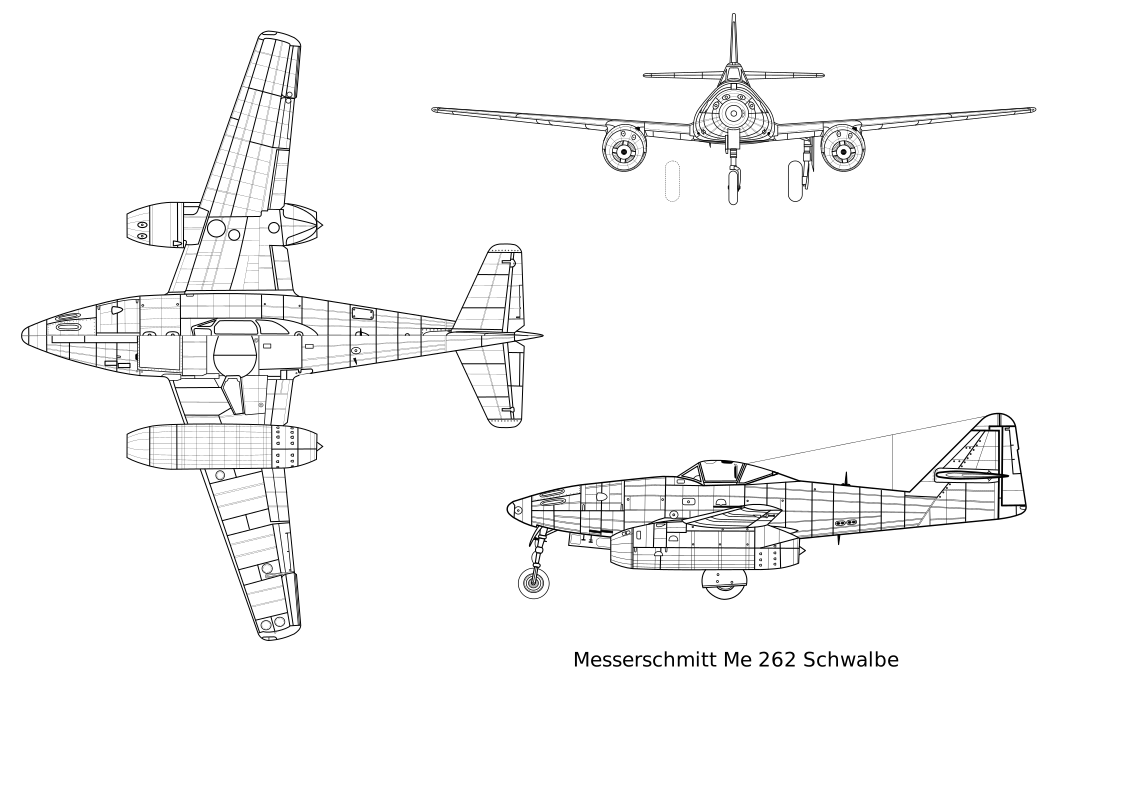
History
A fighter without a propeller
The Me 262 begins not with a drawing board in Augsburg but with a ceiling that late-1930s aerodynamics could already see coming. Piston engines and propellers had carried the fighter aircraft to a limit that was becoming visible: above roughly 700 km/h the propeller loses efficiency, the blade tips enter the transonic regime and additional power dissipates into drag. The gas turbine promised to break that ceiling, and in Germany the promise had two independent parents. One was Hans von Ohain, whose work with Ernst Heinkel produced the He 178, the world's first turbojet-powered aircraft, flown on 27 August 1939. The other was the Reich Air Ministry (Reichsluftfahrtministerium, RLM), which had quietly started a jet propulsion programme of its own in parallel, unknown to Heinkel.
It was the official programme that generated the requirement from which the Me 262 grew. The RLM asked for a jet-powered combat aircraft with one hour of endurance and a speed of at least 850 km/h. That figure defines the ambition, because it sat some 150 km/h above any Allied fighter that would operate over Europe. Messerschmitt AG of Augsburg answered with an in-house study begun in April 1939, before the war started, under the designation Projekt 1065 or P.1065. Woldemar Voigt led the design team; Robert Lusser, the company's head of development, supervised it.
The paradox that would define the next six years was present from the first week: the airframe was ready long before its engines. Structural development ran at a pace the turbines never matched, and that asymmetry — not politics, not Hitler's interventions, not the bombing — is the thread running through the entire story of the aeroplane.
Projekt 1065: from straight wing to eighteen and a half degrees
The original P.1065 was a straight-winged aircraft with the engines buried in the wing roots. When it became clear that the intended BMW 003 turbojets would be far heavier than advertised, a balance problem appeared. On 1 March 1940 the decision was taken to sweep the outer wing panels rearwards by 18.5 degrees rather than move the whole wing on its mounting, so as to accommodate the shifted centre of gravity and place the centre of lift correctly with respect to the centre of mass. The point deserves emphasis because it feeds one of the most widespread misconceptions about the aircraft: the Me 262's sweep was not a high-speed aerodynamic decision but a trim fix. Adolf Busemann — the German theorist of the swept wing — had originally proposed 35 degrees of sweep, and that proposal was not adopted.
The compromise nonetheless carried an unintended benefit. The 18.5 degrees of leading-edge sweep may have raised the wing's critical Mach number slightly. The effect was modest: the usable tactical Mach number remained around 0.82, and both German and, later, British test pilots met severe control problems as they approached Mach 0.86. On the basis of AVA Göttingen data and wind-tunnel results, the leading edge of the inboard section between the engine nacelle and the wing root was subsequently swept at the same angle as the outer panels, a change incorporated from the sixth prototype, V6, onwards and retained throughout series production.
The rest of the airframe was soberly modern rather than revolutionary. The fuselage had a distinctive triangular cross-section, with tanks shaped to fit it: one ahead of and two behind the cockpit. The wing was a cantilever single-spar structure with stressed skin whose thickness varied from 3 mm at the root to thinner gauges outboard, and NACA profiles were used on the tail surfaces. The high-lift devices carried over the company's tradition: leading-edge slots of the same type as the original Bf 109's ran along the outer wing and could raise total wing lift by as much as 35 per cent in tight turns or at low speed. And one particular feature would prove decisive in the Mach controversy: the Me 262 was not restricted to a hinged elevator but could vary the incidence angle of the entire horizontal tailplane.
The engines that never arrived: Jumo 004 and BMW 003
The real technical history of the Me 262 is the history of two turbojets.
The Junkers Jumo 004 was the world's first production turbojet in operational use and the first successful axial-flow turbojet engine. It was the work of Anselm Franz, who ran turbocharger and supercharger development at Junkers when the RLM's Helmut Schelp identified him as the right man for the job. Franz chose a design that was simultaneously radical and conservative: radical because he adopted the axial-flow compressor newly developed by the Aerodynamische Versuchsanstalt at Göttingen, which allowed a continuous straight-through airflow instead of von Ohain's reverse-flow centrifugal arrangement; conservative because he deliberately renounced sophistication everywhere else in order to reach production sooner. A full-scale bench engine was running by November 1940.
The first prototype, the 004A, was tested in October 1940 burning diesel fuel and without an exhaust nozzle. By the end of January 1941 it produced a maximum of 430 kgf (4,200 N; 950 lbf) on the bench, well short of the 600 kgf (5,900 N; 1,300 lbf) minimum written into the RLM contract. Vibration in the compressor stator blades, originally cantilevered inwards from the casing, held the programme back; Max Bentele, an Air Ministry consultant with experience of turbocharger blade vibration, helped to solve it. The aluminium stators were replaced with steel and in that form the engine gave 5.9 kN in August and passed a ten-hour endurance run at 9.8 kN in December. The first flight test came on 15 March 1942, with a 004A carried aloft under a Messerschmitt Bf 110 and started in the air. The 004 used an eight-stage axial compressor, six straight-through combustion chambers fabricated from sheet steel and a single-stage turbine with hollow blades.
Here is the bottleneck that governed the Me 262's career. The early 004As had been built without material restrictions, using nickel, cobalt and molybdenum in quantities Germany could not sustain. The 004A proved unsuited to mass production precisely because of its weight and its appetite for scarce strategic metals. The 004B was redesigned accordingly: parts such as the combustion chamber went over to mild steel protected by an aluminium coating, and the hollow turbine blades were folded and welded from Cromadur alloy — 12 per cent chromium, 18 per cent manganese and 70 per cent iron — developed by Krupp and air-cooled with compressor bleed. The engine became easier to build and its working life became shorter.
Those service-life figures are the single most important datum in the aircraft's history. By 1943 the production 004B, a hundred kilograms lighter than the 004A, had passed several 100-hour tests and a 50-hour time between overhauls had been reached. Later in 1943 turbine blade failures appeared which the Junkers team could not explain; Bentele was recalled in December and determined that one of the blades' natural frequencies lay inside the engine's operating range. The fix was to raise that frequency by increasing the blade taper and shortening the blade by one millimetre, and to reduce the operating speed. But with the lower-grade steels of the 004B, real service life fell to between 10 and 25 hours, perhaps twice that in the hands of a careful pilot. Even in the spring of 1945 the Jumo 004 required an overhaul at 25 hours for a metallurgical inspection of the turbine; if it passed, it was reassembled for another 10 hours, with 35 hours as the absolute limit. The earliest engines were so short-lived that they frequently had to be replaced after a single flight. The comparison is cruel: engines built with the proper alloys eventually ran for up to 150 hours in flight testing and up to 500 hours on the bench.
The BMW 003 — full designation 109-003 — was the other German turbojet to reach production, and its story is that of the competitor which lost narrowly. It had begun at Brandenburgische Motorenwerke (Bramo) under Hermann Östrich; BMW bought Bramo in 1939 and inherited the project. It first ran in August 1940 and delivered only 150 kg of thrust, half what was wanted, against the 690 kg the RLM had asked of both Junkers and BMW. Technically it was more advanced than the 004 but slightly less powerful in its initial production form, 7.83 kN (1,760 lbf). An improved version was flight-tested under a Junkers Ju 88 in October 1943 and was not ready for mass production until August 1944, by which time it had a reputation for unreliability. For the Me 262 the BMW 003 was ruled out except in three experimental aircraft designated Me 262 A-1b. Its descendants, however, were long-lived: mass-produced in the Soviet Union from 1947 as the RD-20, and in France the basis of SNECMA's Atar, which would power the Dassault Ouragan and the Mirage.
Tailwheel to tricycle: prototypes V1 to V6
Flight testing began on 18 April 1941 with the Me 262 V1, carrying the radio code PC+UA. Because the intended BMW 003s were not ready to install, a conventional Junkers Jumo 210 piston engine — a 210G of roughly 700 hp (520 kW) — was mounted in the nose driving a propeller so that the airframe could be evaluated. Forty-seven test flights were made in that configuration. Handling proved very good and only minor changes to the elevator system were called for.
When the BMW 003s were finally fitted, on 25 November 1941, the nose Jumo was retained as insurance. The decision was a fortunate one: both 003s failed in flight and the pilot had to land on the nose engine alone. Prototypes V1 to V4 shared a feature that would soon look distinctly odd on a jet: a fully retractable conventional undercarriage with a retracting tailwheel. The contrast with the competition is telling — the Heinkel He 280, the first German jet fighter design to fly, used a retractable tricycle undercarriage from the outset and had already flown under jet power alone by late March 1941.
The third prototype, V3, coded PC+UC, became a true jet aircraft on 18 July 1942 at Leipheim near Günzburg, flown by Fritz Wendel, the company's chief test pilot. It carried two pre-production Jumo 004As of 8.24 kN (840 kgp; 1,850 lbf) each. The date falls almost nine months after the He 280's first pure-jet flight, and the take-off was not straightforward: the tailwheel left the horizontal stabiliser sitting inside the wing's turbulent wake, the elevators lost authority and the engine efflux deflected off the runway. The first take-off attempt was abandoned. On the second, Wendel solved the problem by tapping the brakes at take-off speed — a little over 180 km/h — to lift the tail out of the wing's wake. Wendel found the aircraft extraordinarily impressive; V3 was destroyed on its second test flight three weeks later.
The definitive remedy was the tricycle gear: the fifth prototype, V5 (coded PC+UE), carried it in fixed form, and V6 (coded VI+AA, from a new block) introduced the fully retractable nosewheel arrangement that went into production. Testing continued through the following year, but the engine problems never left the programme: the Jumo 004 was only marginally more reliable than the lower-thrust BMW 003.
The He 280 and the Ar 234: rivals and context
The Me 262 was not Germany's only wartime jet, and its story is badly understood without its two neighbours.
The Heinkel He 280 — initially the He 180 — capitalised on von Ohain's gas-turbine work and on Heinkel's own He 178. Its first airframe was complete in the summer of 1940 but could not fly under its own power because of difficulties with the intended HeS 8 engine. Fritz Schäfer flew the second prototype under power on 30 March 1941. The He 280 introduced an absolute first: a compressed-air ejection seat, the earliest fitted to any aircraft, and pilot Helmut Schenk became the first person to use one in an emergency. Even so, engines sank the programme. In 1942 the RLM ordered Heinkel to abandon both the HeS 8 and the HeS 30 in favour of the HeS 011, which was not expected soon; Heinkel then chose the BMW 003, also delayed, and finally re-engined the second prototype with Jumo 004s that were too large and heavy for an airframe not designed around them. On 27 March 1943 Erhard Milch, the Luftwaffe's inspector general, ordered Heinkel to abandon the He 280. The cancellation had several causes: competition from the Jumo 004-powered Me 262, which appeared to combine nearly every advantage, and — as authors including Tim Heath and Robert Dorr have noted — a political element, since Heinkel had become unpopular with influential Nazis while Willy Messerschmitt was a favoured figure.
The Arado Ar 234 Blitz was the other German jet to see operational service, and the world's first operational turbojet-powered bomber. It grew from a ministry requirement of late 1940 for a high-speed reconnaissance aircraft with a range of 2,156 km; Arado was the only company to respond, with its E.370 project led by Walter Blume. Its first two prototypes were nearly finished before the end of 1941, but Jumo 004s did not arrive until February 1943 and the Ar 234 V1's first flight slipped to 30 July 1943. The Ar 234 shares the Me 262's bottleneck — engines — and its industrial fate: it was produced in small numbers despite plans for 500 a month by late 1945. One detail shows how directly the two programmes competed for the same scarce resource: the switch of the Ar 234 C series to four BMW 003s was made partly to free Jumo 004s for the Me 262.
The industrial decision: Milch, the Me 209 and Galland's flight
For almost four years the Me 262 was a technically promising and politically orphaned programme. Willy Messerschmitt, aeronautical engineer and owner of the firm, wanted to keep the piston-engined Bf 109 — a 1935 design — and the projected Me 209 in mass production. Erhard Milch, at the head of the RLM, was conservative and preferred the Me 209 to the far more radical Me 262. The RLM had ordered three prototypes with BMW 003s, ordered five more in July 1941, and ordered fifteen pre-production Me 262s in May 1942 with a further thirty that October, all without committing to full-scale production.
The logjam broke by the least bureaucratic route available: an influential fighter pilot flew the aircraft. Adolf Galland, General of the Fighter Arm, had supported Messerschmitt through the early development years and flew the Me 262 himself on 22 April 1943 — prototype V4, still in tailwheel configuration. His reaction has been quoted ever since: flying the jet was "as if an angel were pushing". Galland recommended halting Bf 109 production so that Messerschmitt could concentrate on the new fighter, and suggested cancelling the Me 209. His influence produced a measurable acceleration: within days the RLM placed an order for a hundred production Me 262s. The day after Galland's flight a demonstration was staged for Hermann Göring, who received the fighter enthusiastically. Even so, the bureaucratic machinery did not clear entirely: Messerschmitt continued to press for producing the Me 209 and the Me 262 simultaneously, partly as internal empire-building, and the Me 209 was not finally dropped until November 1943.
By then the problem was unchanged. Airframe modifications were complete as early as 1942, but the shortage of engines kept series production from starting until 1944, and deliveries were meagre: 28 Me 262s in June, 59 in July and only 20 in August. By April 1943 thirteen Me 262A-0 pre-production aircraft had been completed, out of 23 eventually built from the 45 ordered. The Luftwaffe accepted its first sixteen pre-production Me 262A-0s — long-since-built airframes that had been waiting for engines — between 18 and 29 April 1944, and production proper began in May 1944.
The Führer's order and the myth of the delay
No aspect of the Me 262 has generated more literature than Hitler's intervention, and none holds up worse against the dates.
By mid-1943 Hitler conceived of the Me 262 as a ground-attack and bombing aircraft rather than a defensive interceptor. The Schnellbomber configuration — a fast, lightly loaded high-speed bomber — was conceived to force its way through defended airspace over France once the Allied landings came. According to the memoirs of Albert Speer, then Minister of Armaments and War Production, Hitler had at first refused to release the Me 262 for mass production and relented only in early 1944; he believed its speed advantage over any contemporary fighter made it immune to attack, which is why he preferred to reserve it for high-altitude missions and retaliatory strikes. The Allied landings in North Africa in November 1942, in Sicily in July 1943 and in Italy that September fed his fear of an invasion of France.
The scenes are well documented. When Göring asked about a bomb load, Messerschmitt replied at once that from the drawing board onwards the Me 262 had been meant to lift 500 kilograms of bombs, that double that figure was probably within reach, and that turning it into a Jabo (fighter-bomber) would present no difficulty. Hitler saw the aircraft for himself at Insterburg on 26 November 1943, asked the same thing and received the same reply. Hitler ordered it built as a fighter-bomber. At a meeting in Berchtesgaden on 23 May 1944 with Göring, Milch, Galland and Speer, on learning that production was going ahead purely as a fighter, Hitler lost his temper: "I wanted only one 250-kilogram bomb", and complained that nobody paid the least attention to the orders he gave. His confidence in Milch was destroyed. On 8 July 1944 came the famous Führer-Befehl limiting initial production to bomber aircraft, and it was not until 4 November 1944 that Hitler relented and allowed it to be built as a fighter, on condition that it could carry at least one 250 kg bomb.
And yet the claim that Hitler's edict delayed the aircraft's operational deployment by months is incorrect. What his edict delayed was the Me 262's combat debut with Kommando Nowotny, the first fighter unit to receive it, and by less than three weeks. Far more decisive was the Jumo 004's short service life. Specialist sources agree that the delay-by-Führer's-whim story is exactly that: a myth concealing a metallurgical problem. Humouring Hitler with a fighter-bomber version cost the Luftwaffe time — perhaps six months of bomber-oriented production — but the crucial factor remained the engine. The edict's real and lasting consequence lay elsewhere: the development of, and concentration on, the Sturmvogel variant.
The Jägerstab, dispersed production and forced labour
Between 20 and 25 February 1944, some 10,000 American and British aircraft, of which roughly 6,000 were bombers, struck strategic targets across Germany in the operation known as Big Week. The attacks severely damaged the German aircraft industry and production rates fell sharply. The response was the Jägerstab — Fighter Staff — a task force created in March 1944 and composed of government and SS personnel together with manufacturers' representatives. Albert Speer established it with the support of Erhard Milch of the Air Ministry, and its day-to-day director of operations was Karl Saur, previously head of the Technical Office in the Armaments Ministry. The Jägerstab received extraordinary powers over labour, production and transport, with priority over repairing the homes of bombed-out civilians and over restoring basic urban services. Factories under its control saw the working week extended to 72 hours.
The plan for protecting the aircraft industry — and Me 262 jet manufacture in particular — required moving assembly plants into underground bunkers. And here the aircraft's history becomes inseparable from a crime. The task force immediately began expanding the use of slave labour in the aircraft industry: on 9 March 1944 Heinrich Himmler informed Göring that the SS would supply 100,000 prisoners to move aircraft production underground, prisoners to be obtained by deporting Hungarian Jews to Auschwitz under Operation Höss. The demand for labour to raise fighter output served as the argument put to the Hungarian government in favour of the deportations; of the 437,000 Hungarian Jews deported, those judged fit for work were set aside for aircraft production. At the height of the Jägerstab building programme the SS had, the records show, handed over 64,000 prisoners spread across 20 projects. In strictly productive terms the German authorities judged the Jägerstab a success: from February to July 1944 production of Fw 190 and Bf 109 fighters rose by 150 per cent. Speer recast the task force as the Rüstungsstab on 1 August 1944, and it inherited the underground relocation projects.
As Germany came under heavy bombardment, Me 262 production was scattered among inconspicuous sites, a few of them barely more than cleared ground among the trees of Germany and the occupied countries. The resulting industrial geography reads like a map of collapse: fuselages were built from January 1944 at the Obertraubling plant and subassemblies from the summer of 1944 at the Waldwerk Staufen near Obertraubling; wings were produced between April 1944 and April 1945 by prisoners of the Leonberg concentration subcamp inside the tubes of the Engelberg tunnel west of Stuttgart, Germany's oldest motorway tunnel; there were plants at Leipheim, Burgau and Horgau, and in Dachau subcamps as well. At B8 Bergkristall-Esche II, a vast tunnel network dug beneath St. Georgen/Gusen in Austria, slave labourers from the Gusen II concentration camp produced fully equipped Me 262 fuselages on large assembly lines at a monthly rate of 450 units from early 1945. Gusen II was reputed to be among the harshest of the camps: six months was the usual life expectancy there. Somewhere between 35,000 and 50,000 people are thought to have died on Me 262 forced-labour details.
Dispersal did not save production. Between late February and late March 1945 raids on Obertraubling wrecked some sixty Me 262s, with another thirty lost at Leipheim; Neuburg's jet engine plant was bombed on 19 March 1945. Shortages of light metals prompted a study of wooden structures: several Me 262s received a wooden tail unit designed and built by Jacobs-Schweyer in Darmstadt, and of the wooden fuselages only three test articles were ever built.
Walpersberg and REIMAHG: the factory inside the hill
Of all the dispersed sites, the Walpersberg deserves a section of its own, because it distils both the logic and the failure of the whole programme.
The Walpersberg is a sandstone plateau in Thuringia, rising west of the Saale close to Kahla. In the late nineteenth century the porcelain industry flourished at Kahla and kaolin sand was found in the Walpersberg; excavation began in 1897 under Kahlaer Porzellanwerke AG and created a tunnel system that eventually extended for 20 km. In 1944 Nazi Germany undertook the conversion of those old sand mines into a bomb-proof underground factory for the Me 262. To that end the existing tunnel system was extended to 30 km using more than 12,000 forced labourers from Italy and Eastern Europe, together with another 3,000 skilled workers. The conversion included building a runway on the summit of the Walpersberg and an inclined railway set into the hillside to raise finished aircraft from the ground-level tunnel exit to the runway. The first Me 262 took off from there on 21 February 1945. The stated target for the REIMAHG plants at the Walpersberg was up to 1,200 aircraft per month. The reality was that only some 20 to 30 complete aircraft ever left the facility before American troops liberated it: the underground factory was overrun before reaching any meaningful output.
The human cost stayed in local memory. Every year around 8 May, the villages beneath the Walpersberg hold ceremonies in memory of the 2,000 forced labourers who lost their lives there, and former REIMAHG forced labourers have traditionally travelled from abroad to attend. Two permanent museum sites document the factory's history: an exhibition in the Kahla town museum and the Documentation Center run by the Geschichts- und Forschungsverein Walpersberg association at Großeutersdorf, which cover the construction and function of the underground factory, the camp system, forced labour and the liberation of 1945.
The numbers: how many were built and how many flew
The Me 262's figures are an exercise in perspective. Between 1943 and 1945, 1,433 examples were built — English-language sources usually round this to about 1,400 — of which around 800 were delivered to the Luftwaffe during the war. But the number that really explains its impact is a different one: rarely were more than a hundred aircraft combat-ready at any one time. The reasons have already appeared: massive Allied bombing, material shortages, the extremely short engine life and, in the final phase, Allied attacks on fuel supplies that cut availability for both combat missions and training. Armament production inside Germany also concentrated on aircraft that were easier to build.
The unit cost of an Me 262 airframe without engines, armament or electronics was 87,400 Reichsmark, and building one airframe required about 6,400 man-hours. A late-war stock balance gives the measure of attrition: 232 aircraft lost to enemy action, with 264 still on inventory of which 134 were with operational units.
On the other side of the ledger, sources credit Me 262s with destroying between 300 and 450 enemy aircraft, while the Allies destroyed around a hundred Me 262s in the air. German pilots claimed 542 Allied aircraft on the type, and higher figures have occasionally been advanced. With those numbers the historiographical conclusion is unanimous: the Me 262 did not change the course of the war, and its low impact stemmed from its late introduction and from the small number of aircraft that entered service.
Armament: the pneumatic hammer and its alternatives
The standard armament of the Me 262A-1a was four 30 mm MK 108 cannon in the nose. The MK 108, built by Rheinmetall-Borsig, only makes sense as a deliberate wager: it was tuned to fire fast and took poor ballistics as the price. Its ammunition, the purpose-developed 30×90RB — 30 mm calibre, 90 mm case, rebated rim — came in steel cases rather than the customary brass. Its signature round was the Minengeschoss mine shell, drawn from steel rather than forged and machined, which gave a thin but strong wall and a much larger cavity for explosive filling. With 85 g of RDX in a 330 g shell and a highly destructive blast effect, about four hits sufficed to bring down a heavy bomber such as a B-17 or B-24, and a single "devastating" hit would finish a fighter. The comparison with the excellent 20 mm MG 151/20 — 18 g of explosive in a 92 g shell, requiring between 15 and 20 hits to down a B-17 — explains why the Luftwaffe accepted the trade. Allied crews nicknamed the MK 108 the "pneumatic hammer" for its characteristic sound and rate of fire, and feared its destructive power.
The price of the trade was ballistics. Muzzle velocity reached just 500 m/s where the MG 151/20 managed 720-790 m/s, and the gun fired between 600 and 850 rounds per minute according to the variant. Its short barrel and low muzzle velocity made it inaccurate beyond 600 m; shell drop exceeded 41 metres at a range of 1,000 metres. Closing far enough to guarantee hits took the fighter inside the reach of the dozens of defensive Browning AN/M2 machine guns that a USAAF heavy bomber combat box could bring to bear from almost any approach direction.
Every alternative was explored. The more powerful MK 103 offered higher muzzle velocity and greater range at a considerable cost in weight and bulk. A single Me 262A-1a/U1 was built with nose armament expanded to two 20 mm MG 151s, two 30 mm MK 103s and two 30 mm MK 108s. The Me 262A-1a/U5 was a heavy-fighter prototype with six MK 108s in the nose. Two Me 262A-1a/U4 bomber-destroyer prototypes carried a single 50 mm cannon; the MK 214A did reach the /U4 in February 1945, though production approval never followed. A scaled-up version of the MK 108's mechanism became the MK 112 cannon, chambered for a 55×175RB cartridge and meant to sit in pairs in the Me 262's nose with 25 rounds per gun: of the ten examples delivered for trials, seven were an early 300 kg model and three a lighter 275 kg version, both far below the 50 mm BK 5 with its 21 rounds, which weighed around 540 kg. The MK 112's projectile was to weigh 1.5 kg, of which 420 g was explosive. The Americans captured some of these prototypes and the knowledge gained was fed into the experimental 57 mm T78 cannon, which never reached production.
The R4M Orkan and the salvo attack
The Me 262's tactical problem was not firepower but time. Its speed forced German pilots to invent new ways of attacking bombers. In a head-on pass, the combined closing speed of some 320 m/s was too high for accurate aiming with a relatively slow-firing cannon: at roughly 650 rounds per minute the four MK 108s put out on the order of 44 projectiles per second, but the window was minimal. Even from astern the closing speed was too great to make the most of a short-range gun. A "roller-coaster" attack was devised in which the Me 262s approached from behind and about 1,800 m (5,900 ft) above the bombers, then from around five kilometres out began a dive that turned into a climb into the formation. One pilot described it bluntly: you dived, opened fire on the B-17 at about 550 m because the 30 mm gun was not accurate beyond 600 metres, and since you had to break away at 200 metres to avoid collision, that left roughly two seconds of useful firing.
The solution was to replace the underwing gun pods and large-calibre rocket tubes, which produced excessive drag, with a small-diameter self-propelled projectile carrying a warhead similar to a cannon shell's. The large-calibre BR 21 rockets, fired from tubes under the Me 262A's nose, one on each side of the nosewheel bay, were only as fast as MK 108 projectiles, and their tubes had to be angled some 15 degrees above the line of flight to compensate for shell drop, adding drag to an already dirty five-strut mounting.
The R4M Orkan solved the equation. Each rocket weighed 3.2 kg and carried a 55 mm warhead with 520 g of the HTA 41 explosive mixture — 40 per cent hexogen (RDX), 45 per cent TNT and 15 per cent aluminium — inside walls only 0.8 mm thick; the same brisant filling used in MK 103 and MK 108 shells. A single hit all but guaranteed the destruction of a fighter, and these rockets could bring down even the famously rugged Boeing B-17 Flying Fortress through the sheer blast effect of the charge. The rocket body was a simple steel tube with eight base-hinged flip-out fins — an Edgar Brandt patent of 1930, also used in the American M8 rocket — that deployed immediately after launch. A typical battery consisted of two groups of 12 rockets, twelve on each of two underwing racks outboard of the engine nacelles: 24 in all. Although each "cartridge" weighed more than the equivalent gun-fired shell, the absence of the gun reduced total weight so much that a much larger, longer-ranged rocket still came out lighter than the cannon it replaced, even if the number of shots fell from 65 rounds of 30 mm to just 24 rockets.
Effectiveness came from density. Salvoed as a single volley, the 24 rockets covered an area of about 15 by 30 m at 1,000 m range, a density that made a hit nearly certain. They were usually fired in four salvos of six at 7-millisecond intervals from 600 m, and flew at roughly 1,890 km/h, some sixty per cent faster than the Wfr. Gr. 21 rocket, whose projectile travelled at about 1,150 km/h after launch. Maximum range was 1,500 m and effective range 600 to 1,000 m, just outside the reach of the bombers' defensive guns. The R4M also accepted shaped-charge warheads for air-to-ground work, then designated R4HL or Panzerblitz: the PB 2 with an 88 mm Panzerschreck warhead and ballistic cap, and the PB 3 with the original 55 mm mine warhead reworked as a shaped charge. The Panzerblitz III, fitted with a huge 210 mm shaped-charge head, shows how far the basic Orkan could be pushed.
Effective as it was, the salvo tactic came too late to have any real effect on the war, and only a small number of Me 262s carried the rocket racks; most remained standard-armament Me 262A-1as. Allied unease, however, predated it: on 1 September 1944 USAAF General Carl Spaatz expressed his fear of what would happen if the number of German jets grew.
Aerodynamics, the Mach limit and the Mutke case
In a series of carefully controlled flight tests, Messerschmitt established with the production Me 262 that control was lost in a dive once Mach 0.86 was reached, and that beyond that figure a nose-down trim appeared which the pilot could not overcome with the stick. The resulting steepening of the dive led to still higher speeds and to airframe disintegration from excessive negative G loading. Post-war British tests corroborated Messerschmitt's results, although neither party actually exceeded Mach 0.86.
Against that background the Hans Guido Mutke controversy comes into focus. On 9 April 1945, Fähnrich Mutke of the conversion unit Ergänzungs-Jagdgeschwader 2 (EJG 2) took off from Lagerlechfeld in his Me 262 marked "Weiße 9". He entered a 40-degree dive at full power; passing 12,000 metres (39,000 ft) the aircraft began to shake and to swing from side to side, and the airspeed indicator stuck at its 1,100 km/h limit, at a time when the Me 262's maximum speed is given as 870 km/h and the speed of sound at that altitude as 1,062 km/h. With the needle still off the scale, Mutke tried to recover from the uncontrollable dive by adjusting the incidence angle of the entire horizontal tailplane, precisely the technique Chuck Yeager would use in the Bell X-1 to counter what became known as Mach tuck. Mutke claimed to have overcome the ever-steepening dive that way, and his observation of briefly regaining control while still accelerating is consistent with later accounts of supersonic flight.
The question remains open, and precision matters here: mainstream opinion still credits Chuck Yeager as the first man to break the sound barrier, and Mutke's claim is unverified. Mutke never in fact claimed to have been first; his argument was that the flight showed the Me 262 could reach Mach 1 and go past it. The factors against are substantial: compressibility in the pitot tubes of the period routinely inflated airspeed indications close to the speed of sound, and German instruments — themselves in short supply — were especially prone to it; and the Me 262's pre-area-rule fuselage would have added wave drag. On the other side, a computer performance analysis run in 1999 at the Technical University of Munich came down in favour of the aircraft being able to pass Mach 1, and post-war American test pilots wrote reports on it that entertained the possibility of Mach 1. The damaging effects Mutke experienced are believed to have resulted from local supersonic airflow and shock waves over parts of the airframe — the phenomenon known as buffeting, which appears at speeds approaching Mach 1 and ceases above it. Several other Me 262s suffered similarly strange accidents or broke up in the air from that buffeting and from the different aerodynamics near the sound barrier. Allied pilots documented the same phenomenon: machines whose dive limits fell short of Mach 0.85 — one Spitfire, measured at Mach 0.92, was the exception — showed visible shock waves and popped rivets in dives, because the air flowing over the wing exceeded Mach 1 even when the aircraft's forward speed was well below it.
Mutke also has a place in the aircraft's material history: on 25 April 1945 he landed at Dübendorf in Switzerland with the Me 262A-1a "White 3" of 9. Staffel, Jagdgeschwader 7, claiming to have become lost on a combat mission. That aircraft survived, and in 1957 Mutke unsuccessfully sued the post-war German government for its return on the grounds that it was his property.
Erprobungskommando 262 and Kommando Nowotny
Erprobungskommando 262 stood up at Lechfeld, a little to the south of Augsburg, on 19 April 1944; the test unit was also known as Jäger Erprobungskommando Thierfelder after its commander, Hauptmann Werner Thierfelder. Its task was to bring the Me 262 into service and to build a cadre of pilots capable of flying it; as its pilots gained experience they wrote the operational manual for the Me 262A-1a Schwalbe.
The first air combat between a jet and an enemy aircraft occurred on 26 July 1944, when Leutnant Alfred Schreiber, flying an Me 262 A-1a, attacked an unarmed De Havilland Mosquito PR Mk XVI photo-reconnaissance aircraft of No. 540 Squadron RAF over the Alps. Some sources consider that episode the first aerial victory by a jet-fighter pilot. The first confirmed kill by an Me 262 pilot came on 8 August 1944, when Leutnant Joachim Weber of EKdo 262 shot down a Mosquito PR XVI of No. 540 Squadron over Ohlstadt near Munich, killing the pilot. Schreiber would soon down four more British aircraft.
Thierfelder was killed on 18 July 1944 when his Me 262 caught fire and crashed. After his death, command was assigned on 25 September 1944 to Major Walter Nowotny and the unit was redesignated Kommando Nowotny. Formally the Kommando was established on 26 September 1944 following the disbandment of Erprobungskommando 262 at Lechfeld, and reached operational status on 3 October at the airfields of Achmer and Hesepe. Its Stab was created from the Stab of III. Gruppe, Zerstörergeschwader 26; 9. and 10. Staffel of JG 6 became the Kommando's 1. and 2. Staffel. On 5 November a third Staffel was ordered, to be complete by 30 November, and on 12 November a fourth that was never implemented. The purpose was to evaluate and establish tactics for the new jet fighter against USAAF numerical superiority. Nowotny, who had previously commanded I. Gruppe of Jagdgeschwader 54, asked on taking command for as many former JG 54 pilots as possible, and replaced Oberleutnant Hans-Günter Müller at the head of the Hesepe Staffel with Oberleutnant Alfred Teumer, who had trained on the Me 262 at Rechlin; Teumer flew from Rechlin to Hesepe on 4 October and crashed on the approach.
The Kommando's balance sheet sums up the difficulties of a pioneering unit: by 24 November it had claimed 24 enemy aircraft against 28 Me 262s damaged or destroyed. Nowotny was killed on 8 November 1944; Galland, visiting Hesepe that day, left an account of the scene. After Nowotny's death the Kommando came off operations and its pilots went to Ergänzungs-Jagdgeschwader 2, the replacement training unit at Lechfeld, to finish their conversion. On 19 November the remnants of Kommando Nowotny were redesignated at Lechfeld as III. Gruppe of JG 7 and ordered to move to Brandenburg-Briest; the Kommando's 1., 2. and 3. Staffel became 9., 10. and 11. Staffel of that III. Gruppe, under Major Erich Hohagen. Kommando Nowotny was formally dissolved on 24 November.
Jagdgeschwader 7: the world's first jet fighter wing
Jagdgeschwader 7 "Nowotny" was the world's first operational jet fighter wing. It was created in late 1944 and served to the end of the war. Its gestation was tortuous: in August 1944 the Oberkommando der Luftwaffe ordered JG 7 to be formed, initially planned with radial-engined Focke-Wulf Fw 190s and with training and preparation at Königsberg in der Neumark — present-day Chojna in north-western Poland; shortages of pilots and aircraft forced a change of plan. On 24 November the order came to form JG 7 with three Gruppen, all equipped with the Me 262. On 1 December Oberstleutnant Johannes Steinhoff was given command.
The way the three groups came together illustrates the disorder of the Luftwaffe's final year. Formation of I. Gruppe began on 25 August 1944 by re-equipping the former II. Gruppe of Kampfgeschwader 1 "Hindenburg" with Fw 190s, a plan cancelled for lack of resources; the OKL then ordered the group detached and subordinated to Jagdgeschwader 3 "Udet", becoming the new II. Gruppe of JG 3, while JG 3's old II. Gruppe was renumbered as I. Gruppe of JG 7, commanded by Hauptmann Theodor Weissenberger from Kaltenkirchen. The formation of a II. Gruppe of JG 7, also ordered on 25 August, went the same way: the group ended up as IV. Gruppe of Jagdgeschwader 301, and a second attempt had to be made on 12 January 1945 under Major Hermann Staiger. III. Gruppe emerged, as described, from the remnants of Kommando Nowotny on 24 November at Lechfeld under Hohagen.
By January 1945 JG 7 was constituted as a pure jet fighter wing, partly based at Parchim, but several weeks would pass before it was operational. Technical problems and material shortages meant that the first tentative sorties were flown only in flight strength, usually no more than four or six aircraft. Flying from Brandenburg-Briest, Oranienburg and Parchim, the wing operated intermittently against USAAF bomber formations. On 3 February JG 7 intercepted American formations and claimed five bombers. By the end of February 1945 it had claimed some 45 four-engined bombers and 15 fighters, a success rate that at that stage of the war had no effect whatever on the Allied air offensive.
March 1945 was the month when Me 262 units first managed attacks on a large scale against Allied bomber formations. On 3 March, 29 sorties yielded eight claims for one jet lost. On 18 March III./JG 7 flew its largest attack: thirty-seven Me 262s went up against 1,221 bombers with 632 fighters escorting them — other sources put the formation at about 1,330 heavy bombers and more than 700 fighters of the Eighth Air Force bound for Berlin, "Mission 894", bombing by H2X radar because of the weather. It was the first time the Me 262s carried the new complement of 24 R4M rockets. Twelve bombers and a single fighter fell to them, against three Me 262s lost. That four-to-one ratio was precisely what the Luftwaffe needed to make a difference, but with a hundred-odd jets facing a thousand bombers the arithmetic did not work.
The following days repeated the pattern. On 21 March JG 7 claimed thirteen B-17s destroyed — the Eighth Air Force lost six heavy bombers to all causes — for the loss of four Me 262s. On 22 March, twenty-seven Me 262s of II./JG 7 under Major Weissenberger went after B-17s in the Leipzig area; of the twelve B-17s the unit reported, one each was claimed by Weissenberger and by Oberfeldwebel Heinz Arnold, while the Fifteenth Air Force formation lost ten. On 23 March, fourteen jet fighters responded to the Fifteenth Air Force's attack on the Ruhland refineries — where fuel production ceased entirely after the raid — and claimed two confirmed victories and one probable in eleven engagements over Chemnitz, with two B-24s destroyed credited to Major Heinrich Ehrler. American sources confirm those Me 262 attacks in the operational area. The total number of aircraft shot down by JG 7 is hard to quantify because Luftwaffe records were lost: it may have claimed between 136 and 420 Allied aircraft.
Jagdverband 44: Galland's circus
Jagdverband 44 was a special-operations unit formed in the last months of the war to operate the Me 262. It was commanded by General Adolf Galland, the former General der Jagdflieger, who had just been removed from his staff post by Hermann Göring for criticising the operational policies, strategic doctrine and tactics dictated by the Luftwaffe high command in what became known as the "Fighter Pilots' Revolt". Göring tasked Galland with putting together a small Me 262 unit to demonstrate the jet fighter's capabilities, challenging him with the words "prove what you've always said about the 262's great potential"; he also saw in it a way of getting rid of Galland and others involved in the revolt without having to force their resignation.
In size JG 44 was a Staffel-strength unit, given the small number of personnel available, but its roster had no equal in the war. Galland assembled a core of Experten drawn from his former staff or recruited from disbanded or re-equipping units: Heinrich Bär as his deputy, who wore the Knight's Cross with Oak Leaves, Swords and Diamonds and had 208 victories to his name; Johannes Steinhoff as operations officer, a future Bundesluftwaffe general, with 176 victories; Günther Lützow as Galland's adjutant, with 110. Galland himself had 104. Not without irony, the Germans called the unit "Galland's circus".
JV 44 performed well in its short existence. A wound put Galland out of action on 26 April, sustained in an attack on B-26 bombers, and Heinrich Bär succeeded him in command. As the German surrender approached, Galland disbanded the unit, released any pilots who wished to leave and led the remainder into the American occupation zone: an unusual "whole-unit" defection. Many JV 44 pilots later flew for the Bundesluftwaffe and formed the backbone of the new Bundeswehr air force.
Night fighting: Welter, 10./NJG 11 and the Me 262 B
The least known facet of the Me 262 is the nocturnal one, and it produced the most successful jet pilot in history.
The problem behind it was British and very specific: the De Havilland Mosquito. Radar-equipped versions of Bomber Command's No. 100 Group were exacting a growing toll on German night fighters, and the Oboe-equipped target-marking and light-bombing versions proved hard to intercept. Through 1944 JG 300 and NJGr 10 were tasked with countering that threat with Fw 190 A-8s and A-9s carrying FuG 217 or FuG 218 Neptun V radar and with some Bf 109 G-6s, G-10s and G-14s. In November, Nachtjagdgeschwader 11 — formed on 20 August 1944 with one Gruppe of two Staffeln — took over specialised high-speed, high-altitude interception operations against the Mosquitos, concentrating over the Ruhr and Berlin and creating "light horizons" with searchlight boxes to allow visual contact. Results were poor: two Mosquitos claimed over Berlin, and no more. NJG 11's piston-engined component gave up sustained anti-Mosquito work in December 1944.
The jet took over. 10./NJG 11, commanded by Hauptmann Kurt Welter — a veteran ace of the Wilde Sau operations — began operating a handful of single-seat Me 262s in December 1944; the Staffel was officially formed on 28 January 1945 at Burg near Magdeburg out of Sonderkommando Welter. By April 1945 seven Me 262B-1a/U1 two-seat night-fighter conversions were available. Fitting the radar operator in cost fuselage fuel capacity, and two hardpoints appeared under the nose, one either side of the nosewheel well, for a pair of standard 300-litre (79 US gallon) drop tanks. After trialling the radar in a single-seater, the two-seaters were fitted with mid-VHF-band FuG 218 Neptun V, whose prominent Hirschgeweih ("stag's antlers") array of eight nose dipoles cost about 30 mph off the top speed.
Welter's figures are simultaneously extraordinary and disputed. He claimed a total of 63 aerial victories in 93 combat missions, 56 of them at night including 33 Mosquitos, and scored more aerial victories flying a jet fighter than any other pilot of the Second World War and possibly in the history of aviation. On the Me 262 he is credited with 25 victories. His night career had begun in September 1943 with 5. Staffel of JG 301, a squadron experimenting with single-seat Fw 190 A-5s and A-6s essentially without radar, often carrying the FuG 350 Naxos detector; on the night of 22-23 September 1943 he claimed two four-engined bombers in the Hannover area, and on the night of 3-4 October two Halifaxes near Kassel. By early April 1944 he had 17 victories in only 15 missions, and on 10 May he received the German Cross in Gold. In July he claimed two B-17s and three P-51s, two of the latter on 19 July between Munich and Memmingen, in daylight. From 25 July 1944 he served with 1. Staffel of NJGr 10; on the night of 25-26 August he claimed his first Mosquito. He transferred to 10./JG 300 on 4 September 1944, a unit created to check the Mosquito raids with speed-optimised Bf 109 G-6/AS fighters, and claimed seven Mosquitos that September, one of them by ramming: on 13 September he collided with — or deliberately rammed — Mosquito serial MM280 near Salzwedel. He received the Knight's Cross on 18 October 1944 after 40 missions and the Oak Leaves on 11 March 1945 for 48 victories. He survived the war and died in an accident.
His record is nonetheless contested. Research into actual RAF losses suggests that Welter considerably overclaimed against Mosquitos; the usual counter-argument is that Luftwaffe claims were strictly assessed and required confirmation and witness evidence, with verifiable wreckage on the ground in the claimed sector. One case illustrates the difficulty: on the night of 25-26 August 1944 the RAF recorded no Mosquito lost over Germany, although the No. 692 Squadron combat report shows that Mosquito MM140, on a mission to Berlin, was attacked by a Bf 109 that hit its starboard wing and burst a tyre; the aircraft returned to England but crash-landed at RAF Woodbridge damaged beyond repair. Another celebrated attribution — that Welter may have shot down Wing Commander Guy Gibson on the night of 19 September 1944, whose Mosquito crashed near Steenbergen in the Netherlands — is considered unlikely, among other reasons because Welter filed his claim north of Wittenberg, to the east.
For the unit as a whole, some sources credit the Me 262s of 10./NJG 11 with around 43 Mosquitos shot down at night and five P-38 and Mosquito photo-reconnaissance aircraft by day between January 1945 and the end of the war, although these figures do not tally with known Allied losses. Among them are six Mosquitos that Feldwebel Karl-Heinz Becker and his radio operator claimed inside a fortnight, two of them within three minutes. Most of Welter's night kills were achieved visually, despite his having tested a radar-equipped Me 262 prototype.
The Sturmvogel: the Me 262 as fighter-bomber
The practical consequence of Hitler's edict was the Me 262A-2a Sturmvogel ("storm bird"), the definitive fighter-bomber version. It derived from the Jäger u. Jabo proposal in Messerschmitt's September 1943 report. Similar to the A-1a, it carried racks for two 250 kg or 500 kg bombs under the fuselage, with the upper pair of cannon deleted for balance reasons and much of the cockpit armour removed. One aircraft received the TSA bombsight as the Me 262A-2a/U1, and a pair of Me 262A-2a/U2 prototypes appeared with a glazed nose to accommodate a bomb-aimer. With bombs fitted, speed fell by about 193 km/h, which left the aircraft inside the reach of Allied piston fighters until it released its load.
Operationally the result was poor, and the dates explain why. A detachment of Kampfgeschwader 51 — Einsatzkommando Schenk — moved to Châteaudun in France on 20 July 1944, the same day as the failed attempt on Hitler's life at his East Prussian headquarters. The Sturmvogel pilots achieved little as they joined the retreat towards Chièvres in Belgium. On 28 August the unit suffered its only combat loss: the first Me 262 claimed by an Allied pilot, near Brussels, when the German pilot ran from the aircraft and the rest of Joseph Myers' flight destroyed the jet on the ground. 1./KG 54, redesignated KG(J) 54 on 1 October 1944 when it re-equipped with the Me 262A-2a for ground attack, lost twelve jets in action in two weeks for minimal returns; the wing claimed fifty Allied aircraft by war's end but, between air combat, accidents and attacks on its bases, lost 70 per cent of the more than 150 Me 262A-2as assigned to it.
Against the Me 262: what worked and what remains undocumented
The Me 262 was hard to counter because its speed and rate of climb made it difficult to intercept. Too fast for Allied escort fighters, it was almost impossible to cut off; the aviation historian Mike Spick reckoned that neutralising one jet could take eight Mustangs. Bomber gunners had trouble tracking it: the jet entered gun range very quickly and remained in a firing position for very little time.
Its vulnerabilities, on the other hand, were catalogued. Like other early turbojets, the Me 262's engines did not develop enough thrust at low airspeed and responded slowly to the throttle, so take-off and landing turned the aircraft into a vulnerable target. It also had, by the standards of the day, a high wing loading — 294.0 kg/m², 60.2 lb/ft² — which demanded higher take-off and landing speeds. Poor throttle response and an engine tendency towards flow interruption and compressor stall were ubiquitous. And its high speed created problems in engaging enemy aircraft: rapid convergence left extremely short firing windows. Fuel consumption was double that of a typical contemporary twin-engined piston fighter, which prompted the fitting of a low-fuel warning device; the aircraft burned J-2, a synthetic fuel derived from brown coal, with diesel or a mixture of oil and high-octane B4 aviation petrol as options.
Much of the effective Allied counter-effort was therefore surface-based or opportunistic, and here a limit of the available material must be declared. The jet airfields were protected by as many as 500 anti-aircraft gun barrels, which shows that the Germans understood perfectly where the weak point lay. Accounts of Allied gun kills are vivid but fragmentary and mutually contradictory: some versions place the first confirmed kill on a Sturmvogel, an Me 262A-2a of III. Gruppe, KG 51 "Edelweiß" flying from Rheine-Hopsten, brought down on 26 November 1944 by a Bofors gun of B.11 Detachment, 2875 Squadron RAF Regiment at the forward airfield of Helmond near Eindhoven; another credits the first confirmed kill to the 71st Light Anti-Aircraft Regiment, then part of 100th Anti-Aircraft Brigade, operating on the outskirts of Antwerp in September 1944. Another Me 262 fell over Volkel airfield in February 1945, shot down by the guns of B.6 Detachment, 2809 Squadron RAF Regiment.
What the consulted material does not support is a systematic account of Allied countermeasures — standing patrols over the jet fields, ambush tactics in the landing circuit, modified escort doctrine — beyond these isolated episodes. The German "Rat Scramble" tactic, the alert take-off procedures and the Allied response to them remain to be documented from a dedicated source. This sheet declares that as a gap rather than filling it by inference.
The last weeks: the Eastern Front and the end
In the final days of the conflict, Me 262s of JG 7 and other units were used on ground-attack missions in support of German troops fighting the Red Army. Just south of Berlin, halfway between Spremberg and the capital, the Wehrmacht's Ninth Army, with elements of the Twelfth Army and Fourth Panzer Army, was attacking the Soviet 1st Ukrainian Front. In support of that attack, thirty-one Me 262s of JG 7 flew a strafing sortie over the Cottbus-Bautzen area on 24 April: the pilots claimed six lorries and seven Soviet aircraft, and three jets were lost. On the afternoon of 27 April, thirty-six Me 262s of JG 7, III./KG(J) 6 and KG(J) 54 were launched against Soviet forces attacking German troops in the woods north-east of Baruth; they successfully strafed 65 Soviet lorries and then intercepted Il-2 Sturmoviks flying low in search of German tanks, claiming six Sturmoviks for the loss of three Messerschmitts. Soviet fighters and anti-aircraft fire accounted for at least ten more Me 262s of JG 7 between 28 April and 1 May.
JG 7 managed to keep its jets flying to the end. On 8 May, around four in the afternoon, Oberleutnant Fritz Stehle of 2./JG 7, flying an Me 262 over the Ore Mountains, attacked a formation of Soviet aircraft and claimed a Yakovlev Yak-9; the aircraft he shot down was probably a P-39 Airacobra, and Soviet records show two Airacobras lost that day.
As for the type's aces, the most successful Me 262 pilot was probably Hauptmann Franz Schall with 17 kills, including six four-engined bombers and ten P-51 Mustangs, although Kurt Welter claimed 25 on the jet. Highly decorated pilots flew the Me 262: Walter Nowotny and Adolf Galland, both holders of the Diamonds, and Heinz Bär, Erich Rudorffer, Walter Schuck, Theodor Weißenberger, Heinrich Ehrler and Franz Schall. The distance between those records and the effect on the war is the best summary of the Me 262: the Luftwaffe's best pilots in the world's best fighter, to strategically irrelevant effect.
The variant census: A through E, and the HG studies
The Me 262 spawned a range of variants out of all proportion to its short operational life, largely because Messerschmitt issued a report on 11 September 1943 with drawings of multiple proposals and derivatives of the production aircraft, some of which were later built as prototypes.
The first production variant was the Me 262A-1a, in service from July 1944, nicknamed Schwalbe ("swallow"), powered by two Jumo 004B-1s of 8.8 kN (1,980 lbf) and armed with four MK 108s. From it came the Umrüst-Bausätze (/U) conversions: the A-1a/U1 with expanded mixed armament, the A-1a/U2 night-fighter prototype with 90 MHz FuG 220 Lichtenstein SN-2 radar and Hirschgeweih antennas, the A-1a/U3 reconnaissance version built in small numbers with Rb 20/30 cameras or with one Rb 20/20 and one Rb 75/30, the A-1a/U4 bomber destroyer with a single 50 mm cannon, and the A-1a/U5 with six MK 108s in the nose. Besides the /U conversions there were Rüstsätze field modification kits, designated with /R numbers, which unlike the /U kits could be installed at unit level; the best known is the A-1a/R7 with the R4M rocket racks. The Me 262A-1b was the modification with BMW 003As in place of the Jumos: only three aircraft.
The A-2a Sturmvogel has already been described, with its /U1 and /U2 sub-variants. The Me 262A-3a would have been a ground-attack version with increased armour for pilot, ammunition, air intakes and fuel at the cost of range and performance; no prototype was built before the war ended. The A-4a was an interim unarmed reconnaissance variant, superseded by the armed A-5a with two MK 108s and drop tanks.
The need for a jet trainer led to the dual-control Me 262B-1a, similar to the A-1a but with a second seat in place of the rear fuel tank and provision for external tanks to recover endurance. Only 15 B-1a trainers were built, some of them modified into B-1a/U1 night fighters with FuG 218 Neptun radar and two MK 108s plus two MG 151s. In service the radar antenna cost drag, yet the B-1a/U1 remained faster than the Mosquito. The relative success of the B-1a/U1 led to the Me 262B-2a, a dedicated night fighter with a lengthened fuselage and more fuel, planned with internally mounted FuG 240 Berlin radar and an armament that, in the six-MK 108 version, would have made it a formidable jet; only one prototype was built before the war's end.
The C series, the "Heimatschützer" (homeland protector), came out of the Interzeptor proposals in the September 1943 report. The Me 262C-1a or Heimatschützer I derived from Interzeptor I: similar to the A-1a but with a Walter HWK 109-509A-1 rocket motor in the tail; a single prototype was converted from an A-1a. Interzeptor II became the Me 262C-2, with BMW 003R combined-thrust engines incorporating BMW 109-718 rockets — a configuration adding some 1,250 kg of thrust per engine for three to five minutes to aid take-off and short dashes, with serious reliability problems. There was also the Me 262 V8, a prototype with Jumo 004As and four nose MK 108s, later modified for high-speed research as the Hochgeschwindigkeit I (HG I), together with the HG II and HG III studies with greater wing sweep, of which scale models survive in museums. The more distant variants — Lorin ramjet projects, the D and E series — never left paper or mock-up form. The fastest variant actually measured was the specially streamlined pre-production V12, which reached 1,004 km/h (624 mph).
Operation Lusty and the post-war evaluations
When the war ended, the Soviets, the British and the Americans all wanted to evaluate German technology, and the engines above all. Many Me 262s were found in easily repairable condition and were confiscated.
On the American side, collection was organised as Operation Lusty, the precursor of Paperclip and centred on Wright Field in Dayton, Ohio. Air Technical Intelligence teams, trained at the Technical Intelligence School at Wright Field, gathered enemy equipment to learn about German technology. The operation had two teams: enemy aircraft and weapons were the business of the first, led by Colonel Harold E. Watson, who had been a test pilot at Wright Field; the second, under Colonel Howard M. McCoy, recruited scientists, gathered documents and investigated facilities. By 1944 the intelligence experts at Wright Field had compiled lists of the advanced aeronautical equipment they wanted to examine, and Watson and his crews — nicknamed "Watson's Whizzers" and made up of pilots, engineers and mechanics — used those "Black Lists" to collect aircraft, organised into two sections: one for jet aircraft and one for piston aircraft and non-flyable jet and rocket equipment.
The human detail of the operation is notable. The Whizzers took on Luftwaffe test pilots: Hauptmann Heinz Braur, who on 8 May 1945 had flown 70 women, children and wounded soldiers to Munich-Riem airport, was approached after landing by one of Watson's men and offered a choice between a prisoner-of-war camp and a flying job with the Whizzers; Braur preferred to fly. Three men from Messerschmitt signed on as well: Karl Baur, chief test pilot for experimental types, the test pilot Ludwig Hoffman, and Gerhard Coulis, engineering superintendent. When the Whizzers located nine Me 262s at Lechfeld airfield near Augsburg, those German pilots had the experience needed to fly them.
Moving the haul was a logistical operation in itself. In Operation Sea Horse the British lent the escort carrier HMS Reaper, American-built and originally commissioned into the US Navy as USS Winjah. The most workable port for berthing the carrier and loading the aircraft was Cherbourg. From Lechfeld the Whizzers ferried the Me 262s and other machines — an Arado Ar 234 among them — to St. Dizier, on to Melun and finally to Querqueville airfield at Cherbourg. All the aircraft were cocooned against salt air and weather, put aboard the carrier and shipped to the United States; unloading took place at Newark Army Air Field, after which they were studied at the respective USAAF and Navy flight test centres. One Me 262 was named "Marge" by the mechanics and later renamed "Lady Jess IV". In total the Operation Lusty collectors acquired 16,280 items (6,200 tons), of which intelligence staff selected 2,398 for technical analysis.
The first Me 262 to reach Allied hands arrived earlier, and by defection: Messerschmitt test pilot Hans Fay went over to the Allies on 30 March 1945 with his aircraft, which was subsequently lost in August 1946 when its USAAF test pilot parachuted to safety.
Among the Allied evaluations, one stands out: Captain Eric Brown, Britain's chief naval test pilot and commanding officer of the Royal Aircraft Establishment's Captured Enemy Aircraft Flight, flew a captured Me 262 as well as other German wartime jets, and over his career piloted 487 different aircraft types. A limit must be stated explicitly here: the consulted material provides no primary source giving performance figures measured by Allied tests on the Me 262, so this sheet asserts no Allied test-measured performance. What is documented is that post-war British testing corroborated the Mach 0.86 limit established by Messerschmitt without exceeding it, and that American pilots' reports speculated about the possibility of Mach 1.
Avia S-92 and CS-92: the jet's Czechoslovak life
The Czechoslovak aircraft industry went on producing the Me 262 after the war, in single-seat (Avia S-92) and two-seat (Avia CS-92) form. It was the first Czechoslovak jet aircraft, and it was born from a parts hunt: no complete airframe remained, the Allies having confiscated them, but a great many components did, and Czech engineers set about development. The first prototype flew on 27 August 1946, piloted by Antonín Kraus. The work was divided between Letecké opravny Malešice, responsible for preparing and testing the Jumo 004-B1 engines designated M-04 — an eight-stage axial-compressor engine with a single-stage turbine, giving 8.7 kN at sea level — and Avia Letňany, responsible for assembling the aircraft.
The first S-92 was officially handed over to the Czechoslovak military air force on 24 June 1948. From August 1946 a total of nine single-seat S-92s — the Me 262A equivalent — and three two-seat CS-92 combat trainers — the Me 262B equivalent — were completed and flight-tested. The aircraft equipped the 5th Fighter Squadron and were the first jets in the Czechoslovak fighter inventory; they entered service in 1947 and were supplied to that unit in 1950. They served until replaced by Yak-17s and Yak-23s and by licence-built MiG-15s.
There was also a little-known Yugoslav episode. A delegation of senior defence ministry representatives, the air force commander, pilots and technicians from Yugoslavia attended a demonstration of the S-92 and CS-92 at Žatec airfield on 23 May 1947; during the display Major Ilija Zelenika became, aboard the CS-92, the first member of the Yugoslav air force to fly a jet. The delegation was satisfied and a contract was signed for the supply of two S-92s and six spare engines. Four members of the delegation remained in Czechoslovakia until the following summer, but the aircraft were never delivered; the availability of the MiG-15 made the Yugoslav plans to acquire the S/CS-92 unnecessary. Both versions, S-92 and CS-92, are preserved on display at the Kbely Aviation Museum in Prague.
Finally there is a side story that deserves the caution it warrants: according to Egyptian and British intelligence sources, the Israeli air force is said to have secretly received eight crated S-92s, supposedly built by Avia and covertly supplied. There is no official confirmation of their use.
Legacy: what the Me 262 left to post-war aviation
For all its deficiencies, the Me 262 marked the beginning of the end for the piston-engined aircraft as an effective combat machine. Once airborne it could accelerate past 850 km/h, some 150 km/h faster than any Allied fighter operational in the European theatre, and that difference alone was enough to reorder the priorities of every air force in the world.
Its influence on specific designs is documentable. The aircraft notably influenced several prototypes, among them the 1946 Sukhoi Su-9 and the Japanese Nakajima Kikka, and the major powers examined and flew the many captured Me 262s, with effects on production aircraft including the North American F-86 Sabre, the MiG-15 and the Boeing B-47 Stratojet. The engines' footprint was just as long: some 8,000 Jumo 004s were built at Junkers, and variants of the engine were produced in Eastern Europe and in the Soviet Union for several years after the war, while the BMW 003 was mass-produced in the Soviet Union from 1947 as the RD-20 and formed the basis in France of SNECMA's Atar, which powered the Ouragan and the Mirage.
There is a legacy in its designer's personal history too. Willy Messerschmitt was classified in 1945 as a Nazi "fellow traveller" and tried by a denazification court over the use of forced labour in the production of his aircraft; in 1948 he was convicted of collaborating with the Nazi regime and released after two years in prison, later resuming the direction of his firm. Since Germany was forbidden to build aircraft, he exported his talent to Franco's Spain, where the Hispano HA-200 jet trainer came from his drawing board for Hispano Aviación in 1952, before returning to Germany in 1955 and to licensed aircraft manufacture. During the war, Hitler's interest in the Me 262 had won him some favour and shielded him from Milch's attacks, though he was forcibly removed from the management of his company and confined to development and design.
Survivors and flying replicas
Several Me 262s survive on static display in museums. Collections holding examples include the National Museum of the United States Air Force at Wright-Patterson AFB in Dayton, Ohio; the Royal Air Force Museum at Cosford in the United Kingdom; the National Museum of Naval Aviation at Pensacola, Florida; the South African National Museum of Military History in Johannesburg, which displays a radar-equipped Me 262B-1a/U1; the Luftwaffenmuseum der Bundeswehr in Germany, which exhibits an aircraft rebuilt from parts of crashed and incomplete Me 262s; the Prague Aviation Museum at Kbely; and the Deutsches Museum in Munich, which holds Hans Guido Mutke's Me 262 A-1a/R7. One example comes from the collection of the Planes of Fame Air Museum at Chino, California. The Flying Heritage & Combat Armor Museum at Everett, Washington, holds Me 262 A-1a/U3 Werknummer 500453, converted back to A-1a configuration, under restoration to flying condition with rebuilt Jumo 004 engines. Another limit of the material should be declared here: no dedicated source on the survivor census was consulted, so this list is indicative rather than exhaustive, and individual serial numbers and conservation states remain to be verified against a specific source.
As for replicas, the Me 262 Project is an enterprise formed to build flyable reproductions of the world's first operational jet fighter, initiated by the Texas Airplane Factory with the approval of the German Messerschmitt Foundation; the reproductions' Werknummer continue the series where the last wartime-built Me 262 left off, in a continuous airframe numbering. In January 2003 the project completed the flight testing that allowed delivery of partially updated-specification reproductions of several Me 262 versions; the first replica flew on 20 December 2002. The four known airframes are W.Nr. 501241 (registration N262AZ) of the Collings Foundation in Houston, Texas, in flying condition and the first to fly; W.Nr. 501242, on static display at the Evergreen Aviation Museum in McMinnville, Oregon, in the markings of an aircraft of 11./JG 7 based at Brandenburg-Briest; W.Nr. 501243 (registration N262MF) at the Military Aviation Museum in Virginia Beach, Virginia, airworthy; and W.Nr. 501244 (registration D-IMTT), delivered to the Messerschmitt Stiftung at Manching in Germany, airworthy and publicly displayed at the Berlin ILA. These reproductions are usually powered by modern General Electric CJ610 engines. The available material on the replicas is thin — barely four thousand characters — and this sheet confines itself to what that material supports: a detailed census of airframes, engines and flight hours for each reproduction awaits a dedicated source.
Assessment: what the Me 262 was and was not
The Me 262 was the world's first operational jet fighter and one of only two jet fighter types to see air-to-air combat in the Second World War. Post-war assessments rated it broadly superior to anything in Allied hands, and it pointed the way for post-war aeronautical development.
And yet it won nothing. Its low impact on the course of the war stemmed from its late introduction and the small number of aircraft that reached service: of the 1,433 built, around 800 delivered and rarely more than a hundred combat-ready at once. The root cause was not Hitler's whim — whose edict delayed operational introduction by less than three weeks — but metallurgy: an engine requiring overhaul at 25 hours, lasting 10 to 25 in practice, and in the early days needing replacement after a single flight. To that were added the bombing of the plants, the forced industrial dispersal, the collapse of fuel supplies that limited even training flights, and a shortage of trained pilots that no production figure could offset.
There remains, finally, the reckoning no technical sheet should omit. The Me 262 was made possible by an organisation, the Jägerstab, that deliberately expanded slave labour in the aircraft industry; it was assembled in tunnels dug by concentration camp prisoners, and an estimated 35,000 to 50,000 people died on forced-labour details tied to its production. The engineering that opened the jet age and the crime that sustained it are part of the same story, and telling one without the other would be telling the aeroplane wrong.
Variants
| Me 262 A-0 | Me 262 A-1a | Me 262 A-1a/U1 | Me 262 A-1a/U2 | Me 262 A-1a/U3 | Me 262 A-1a/U4 | Me 262 A-1a/U5 | Me 262 A-1b | Me 262 A-2a | Me 262 A-3a | Me 262 A-4a / A-5a | Me 262 B-1a | Me 262 B-1a/U1 | Me 262 B-2a | Me 262 C-1a | Me 262 C-2b | Me 262 CS-92 | Me 262 S-92 | |
|---|---|---|---|---|---|---|---|---|---|---|---|---|---|---|---|---|---|---|
| Aircraft type | — | Jet fighter | — | Night fighter (prototype) | Photo-reconnaissance | Bomber destroyer (prototype) | Heavy fighter (prototype) | — | Fighter-bomber | Ground-attack (project) | Reconnaissance | Two-seat trainer | Two-seat night fighter | Dedicated night fighter | Mixed-power interceptor (turbojet + rocket) | Mixed-power interceptor (Heimatschützer II) | Two-seat trainer (post-war Czech production) | Jet fighter (post-war Czech production) |
| Powerplant | — | 2 × Junkers Jumo 004B-1 turbojets, 8.8 kN thrust each | — | — | — | — | — | 2 × BMW 003A turbojets in place of the Jumo 004 | — | — | — | — | — | — | 2 Jumo 004 turbojets plus 1 Walter HWK 109-509A-1 rocket engine in the tail | — | — | 2 × Avia M-04 turbojets, a locally-produced Jumo 004 |
| Powerplant | 2 × Junkers Jumo 004B | 2 × Junkers Jumo 004B-1 | 2 × Junkers Jumo 004B-1 | 2 × turbojet | 2 × turbojet | 2 × turbojet | 2 × turbojet | 2 × BMW 003A | 2 × Junkers Jumo 004B-1 | 2 × turbojet | 2 × turbojet | 2 × Junkers Jumo 004B-1 | 2 × turbojet | 2 × turbojet | 2 × Junkers Jumo 004; 1 × Walter HWK 109-509A-1 (cohete auxiliar en cola) | 2 × BMW 003R (turborreactor BMW 003A + cohete BMW 109-718 integrado) | 2 × Avia M-04 | 2 × Avia M-04 (Jumo 004 de producción local) |
| Thrust per engine | — | 8.8 kN | — | — | — | — | — | — | — | — | — | — | — | — | — | — | — | — |
| Length | — | 10.6 m | — | — | — | — | — | — | — | — | — | — | — | — | — | — | — | — |
| Wingspan | — | 12.6 m | — | — | — | — | — | — | — | — | — | — | — | — | — | — | — | — |
| Height | — | 3.5 m | — | — | — | — | — | — | — | — | — | — | — | — | — | — | — | — |
| Wing area | — | 21.7 m² | — | — | — | — | — | — | — | — | — | — | — | — | — | — | — | — |
| Empty weight | — | 3,795 kg | — | — | — | — | — | — | — | — | — | — | — | — | — | — | — | — |
| MTOW | — | 7,130 kg | — | — | — | — | — | — | — | — | — | — | — | — | — | — | — | — |
| Top speed | — | 900 km/h | — | — | — | — | — | — | — | — | — | — | — | — | — | — | — | — |
| Service ceiling | — | 11,450 m | — | — | — | — | — | — | — | — | — | — | — | — | — | — | — | — |
| Initial climb rate | — | 20 m/s | — | — | — | — | — | — | — | — | — | — | — | — | — | — | — | — |
| Range | — | 1,050 km | — | — | — | — | — | — | — | — | — | — | — | — | — | — | — | — |
| Range conditions | — | 1,050 km normal range, no external tanks | — | — | — | — | — | — | — | — | — | — | — | — | — | — | — | — |
| Armament | — | 4 × 30 mm MK 108 cannon in the nose; field kits added up to 24 × 55 mm R4M rockets or 2 × 250 kg bombs | 2 × 20 mm MG 151, 2 × 30 mm MK 103, 2 × 30 mm MK 108 cannon | — | None (guns replaced by Rb 20/30 cameras, or one Rb 20/20 and one Rb 75/30) | 1 × 50 mm nose cannon (Rheinmetall BK-5, replaced in 1945 by the MK 214A) | 6 × 30 mm MK 108 nose cannon | — | Upper cannon pair deleted at the factory; underfuselage racks for 250 kg or 500 kg bombs | — | A-4a unarmed; A-5a with 2 × 30 mm MK 108 cannon and drop tanks | — | 2 × 30 mm MK 108 and 2 × 20 mm MG 151 cannon; FuG 218 Neptun radar | 2 × upward-firing 30 mm MK 108 cannon (Schräge Musik); FuG 218 Neptun or FuG 240 Berlin radar | — | — | — | — |
| Max weapons load | — | 500 kg Best value in this row | — | — | 0 kg | — | — | — | 500 kg Best value in this row | — | 0 kg | — | — | — | — | — | — | — |
| Payload | — | 0 kg | — | — | — | — | — | — | — | — | — | — | — | — | — | — | — | — |
| Cargo capacity | — | Single-seat interceptor: no hold and no payload capacity. The only station is the pilot's, and the offensive load is limited to the fixed cannon armament. | — | — | — | — | — | — | Up to 500 kg of ordnance under the fuselage | — | — | No civil payload; rear fuel tank replaced by the second seat | — | — | — | — | — | — |
| Crew | — | 1 Best value in this row | — | — | — | — | — | — | — | — | — | 2 | 2 | 2 | — | — | 2 | 1 Best value in this row |
| Passengers | — | 0 | — | — | — | — | — | — | — | — | — | — | — | — | — | — | — | — |
| Units built | 23 Best value in this row | — | 1 | 1 | — | 2 | — | 3 | — | 0 | — | 15 | — | 1 | 1 | 1 | 3 | 9 |
Images
Elsewhere
- Imperial War MuseumsMe 262 capturado en el aeródromo de Giebelstadt, sobrevolado por un Piper Cub (1945) ↗
- Imperial War MuseumsMesserschmitt Me 262 A-1 «Schwalbe» en las colecciones del IWM ↗
- Library of Congress«Loading of ME 262»: fuselaje embarcado en un vehículo de la USAAF (5-10-1945) ↗
- Australian War MemorialMe 262 A-2 del KG 51, la variante de bombardeo ↗
- Australian War MemorialDos Me 262 en el centro de pruebas de Rechlin/Lärz, octubre de 1944 ↗
- Australian War MemorialMe 262 alemán: uno de los primeros cazas a reacción operativos ↗
- National Air and Space MuseumMe 262 A-1a «Schwalbe» del NASM (NASM2018-10311) ↗
- National Air and Space MuseumMesserschmitt Me 262 en la galería multimedia del NASM ↗
- National Air and Space MuseumCabina del Me 262 A-1a del NASM ↗
- National Air and Space MuseumMe 262: fotografía de archivo del Smithsonian (SI-79-4069) ↗
- National Museum of the United States Air ForceMe 262 A expuesto en el Museo Nacional de la USAF (Dayton) ↗
- National Museum of the United States Air ForceCabina del Me 262 A conservada en el Museo Nacional de la USAF ↗
Show the 9 more
- National Museum of the United States Air ForceFicha del Me 262 A «Schwalbe» del Museo Nacional de la USAF ↗
- FlightGlobal ImagesMe 262 en evaluación en Farnborough, 1945 (archivo de Flight) ↗
- Media StorehouseDespiece del Me 262: diagrama de construcción y planta motriz (1945) ↗
- Media StorehouseMe 262 H-4 capturado con marcas de evaluación de la RAF ↗
- Media StorehouseMe 262 A «White 9» (T2-4012) restaurado ↗
- Airliners.netRéplica volante Me 262 A-1c del Flugmuseum Messerschmitt (foto 7642177) ↗
- Airliners.netRéplica volante Me 262 A-1c de la Messerschmitt Stiftung (foto 6200079) ↗
- Airliners.netRéplica Me 262 A-1c D-IMTT (foto 1748675) ↗
- Airliners.netRéplica Me 262 A-1c D-IMTT (foto 1035944) ↗