Lockheed SR-71 Blackbird Fastest Jet in the World Full Documentary
Video from the channel te darea about Lockheed SR-71 Blackbird, linked on its Above Ten Thousand entry. Duration: 47:23. Language: English. Video type: Documentary.
What it's about
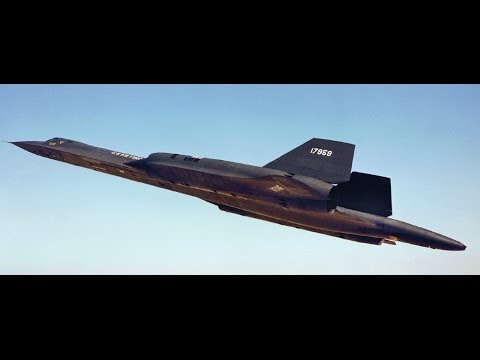
English-language documentary about the Lockheed SR-71 Blackbird that combines archive footage, color reconstructions and testimonies from pilots, reconnaissance officers, mechanics and engineers. It covers the aircraft's design, the selection and training of crews, and several operational missions up to its retirement.
Historical background
In the depths of the Cold War, the United States needed intelligence on the Soviet Union. Skunk Works, Lockheed's advanced development division led by Kelly Johnson, had produced the U-2 in 1955, which had been flying over Soviet territory since 1956, but Soviet radars tracked it from its very first mission. On 1 May 1960 a U-2 piloted by Francis Gary Powers was shot down by an SA-2 missile, and the project for a supersonic reconnaissance aircraft became a priority. To withstand Mach 3 temperatures it was built in titanium, a material for which tools had to be designed from scratch, and it was given a shape designed to reduce the radar signature, with chines, canted fins and edges of radar-absorbent composite material. President Lyndon B. Johnson revealed its existence on 24 July 1964 and test pilot Robert Gilliland made the first flight, lasting a little over an hour. In 1966 the first example arrived at Beale Air Force Base in California, whose crews came from the B-58 and the U-2 program.
Highlights
Each aircraft carried a pilot and a reconnaissance systems officer, wearing pressure suits, and the J58 engines were started with triethylborane. The first operational sortie departed from Kadena, on Okinawa, on 21 March 1968, during the Vietnam War. In the October 1973 war, Jim Shelton's Giant Reach mission flew from Griffiss, New York, to the Middle East and back in 11 hours and 20 minutes, with six in-flight refuelings; eight more missions followed until the ceasefire of 24 October. In 1974 it linked New York and London in 1h 55min 42s and, on 13 September, London and Los Angeles in 3h 47min 39s. In April 1986, from Mildenhall, it photographed the results of the F-111 strikes against Tripoli and Benghazi; pilot Brian Shul recounts how he accelerated to outrun a missile. In the late 1980s the program was ended due to its cost, and on 20 December 1989 it made a final pass over Burbank in front of Kelly Johnson. On the delivery flight to the National Air and Space Museum it set four speed records. According to the documentary, it served six presidents and no aircraft was lost to enemy fire.