360° SR-71 Cockpit Tour & Discussion
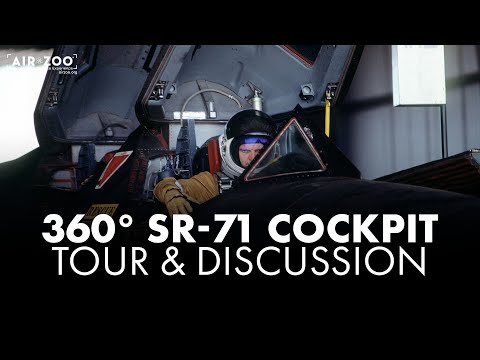
Video from the channel Air Zoo about Lockheed SR-71 Blackbird, linked on its Above Ten Thousand entry. Duration: 52:59. Language: English. Video type: Onboard.
What's toured
Two former SR-71 Blackbird crew members, instructor pilot Jerry Glasser and reconnaissance systems officer (RSO) Doug, take a museum audience through the two cockpits of the operational A model. They first show the rear seat using slides, because the aircraft on display is missing parts from that cockpit, and then the front seat with a 360-degree view that expands panel by panel, from left to right. They compare both to the two-seat B training variant, of which only one example existed and which carried no sensors.
Details shown
The RSO combined the roles of copilot, flight engineer, navigator and sensor operator. His station included UHF, HF and VHF radios, a projected moving map, a downward-looking viewfinder, TACAN and IFF, a center-of-gravity indicator, and Northrop's astro-inertial navigation system, which tracked three stars: losing it on an operational mission meant turning back. The nose-mounted optical bar camera (OBC) was the only manually operated sensor. In the front seat, notable items include the throttles with triethylborane charge counters (16 per engine) for starting and afterburner lighting, manual controls for the inlet spikes and doors, the triple display indicator (TDI) for equivalent airspeed, altitude and Mach, the inlet recovery pressure indicator, the 49 warning lights, the six fuel tanks, and the DAFICS system, which did not automatically hold pitch. All the instruments are analog: according to Glasser, a glass cockpit would not have withstood the heat.
Context
The speakers stress that the crew did not perform the preflight inspection, which was left to maintenance personnel, and that the aircraft depended entirely on KC-135 tankers. They recall the windshield reaching about 620°F at Mach 3.2, the cockpit pressurized to 26,000 feet, the liquid nitrogen used to inert the tanks, without which the aircraft could not exceed Mach 2.6, and a fuel capacity of about 81,000 pounds. Doug describes the selection process, a week of testing at Beale Air Force Base, the year of training, and an 11.2-hour mission with five refuelings from Kadena to the Strait of Hormuz in the summer of 1987.