Attack · Military · United States
Lockheed F-117 Nighthawk
- June 18, 1981
- First flight
- In service
- Status


_con_el_esquema_gris_de_pruebas_previo_al_negro_definitivo-1600.webp)


-1600.webp)


%2C_escoltado_por_un_A-7D-800.webp)


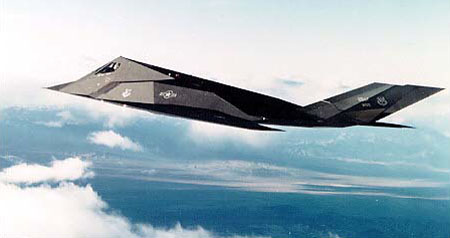
The Lockheed F-117 Nighthawk was the world's first operational aircraft designed from the outset around low observability: a single-seat, subsonic, twin-engined attack aircraft built by Lockheed's Skunk Works division and flown exclusively by the United States Air Force. Its significance lies not in its performance, which was modest, but in proving that an aeroplane could cross dense air defences without being seen, a demonstration that reshaped late twentieth-century air doctrine. The idea reached Burbank by an improbable route. In 1962 the Soviet mathematician Pyotr Ufimtsev published "Method of Edge Waves in the Physical Theory of Diffraction", showing that the strength of a radar return depends on an object's edge configuration rather than on its size, extending earlier theoretical work by the German physicist Arnold Sommerfeld. The logical conclusion, that even a large aircraft could shrink its signature by exploiting the principle, was unusable in the 1960s, because the resulting shape would be aerodynamically unstable and no flight computer then existed to tame it. When the Lockheed analyst Denys Overholser came across the paper in the 1970s, computing had caught up. Skunk Works modelled the "Hopeless Diamond" in 1975, and in 1976 DARPA contracted two demonstrators under the code name Have Blue, assembled from T-38A engines, F-16 fly-by-wire systems, A-10 landing gear and C-130 environmental systems for 35 million dollars for the pair. They first flew on 1 December 1977 and both were lost in crashes, but the test data validated the concept. The operational programme, Senior Trend, was approved on 1 November 1978 and awarded to Lockheed Advanced Development Projects in Burbank, led by Ben Rich with Alan Brown as project manager. Against Kelly Johnson's rounded proposal, Rich argued for flat surfaces, or facets, arranged by an in-house program called "Echo" so as to scatter over 99% of the radar energy painting the aircraft. The first YF-117A, serial 79-10780, flew from Groom Lake on 18 June 1981, only 31 months after the full-scale development decision; initial operating capability followed in October 1983. Five full-scale development aircraft and 59 production machines were built, the last delivered on 3 July 1990. (The Spanish-language Wikipedia dates the first prototype flight to 1982.) Faceting came at a cost. The aircraft is unstable about all three principal axes and depends on quadruple-redundant fly-by-wire controls; it has no afterburners and carries no radar of its own, is clad in almost a ton of radar-absorbent material supplied as flat sheets, and vents its exhaust through a slit-shaped, non-circular tail pipe that mixes hot gas with cool ambient air. Its radar cross-section is around 0.001 m². In exchange it is confined to subsonic speeds and to manoeuvrability far below that of any fighter, irrelevant in a dedicated attack aircraft, which makes its "F" designation all the more striking. It had no air-to-air capability; project manager Alan Brown attributed the letter to General Robert J. Dixon, who believed the top-notch fighter pilots the aircraft required would be more easily attracted to a fighter designation than to a bomber or attack one. The entire fleet operated in secret from Tonopah Test Range Airport, initially under the 4450th Tactical Group. The USAF denied the aircraft's existence until 10 November 1988, when Assistant Secretary of Defense J. Daniel Howard produced a grainy photograph at a Pentagon press conference. Its combat debut came in the 1989 invasion of Panama; its reputation was made in the 1991 Gulf War, with roughly 1,300 sorties against what the US military described as 1,600 high-value targets, and 42 aircraft dropping 2,077 bombs. On 27 March 1999 over Serbia, an S-125 Neva battery of the 3rd Battalion, 250th Air Defence Missile Brigade under Colonel Zoltán Dani downed F-117 82-0806, callsign "Vega 31"; the pilot ejected and was recovered hours later, and the wreckage was left where it fell. It remains the type's only combat loss. Retirement, brought forward to 2008 to fund more F-22s, did not end the story: most airframes went into recallable storage at Tonopah and several still fly on training and test work.
Related events
Category
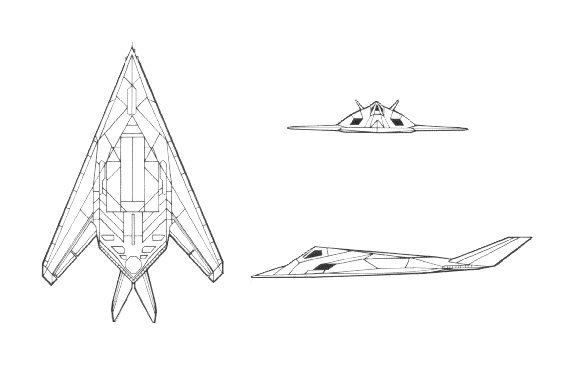
Three-view drawing
History
The F-117 did not begin as an idea for an aeroplane. It began as a survival problem. Over Vietnam, radar-guided surface-to-air missiles and anti-aircraft artillery brought down so many American aircraft that planners were forced to surround every strike package with an escort of supporting aircraft: combat air patrols, electronic warfare platforms and dedicated missions to suppress enemy air defences. Every bomb delivered on target required half a dozen additional sorties simply to open the way. The lesson repeated itself, in harsher terms, in October 1973: during the Yom Kippur War the Israeli Air Force lost 109 aircraft in eighteen days against an integrated network of Soviet-built surveillance radars, mobile launchers and anti-aircraft guns. The arithmetic that followed from that figure was devastating. If NATO were to suffer in Central Europe the same loss rate Israel had suffered over Sinai and the Golan, its tactical air arm would be exhausted within two weeks. A 1974 Defense Science Board assessment stated the conclusion plainly: in the event of a conflict in Central Europe, Warsaw Pact air defences would in all likelihood prevent NATO air strikes against targets in Eastern Europe.
That diagnosis arrived with a painful and very specific precedent for the company that would eventually build the aircraft. In 1955 Lockheed's advanced projects division, the Skunk Works, had received a CIA contract to build the U-2, a reconnaissance aircraft intended to overfly the Soviet Union and photograph sites of strategic interest; it was tested at Groom Lake in the Nevada desert and made its first overflight on 4 July 1956. Those overflights ended on 1 May 1960, when Francis Gary Powers was shot down on a mission over Russia. Altitude had ceased to be a sanctuary. The Skunk Works' answer was speed: in late 1959 it received a $96 million contract for five A-12s, a Mach 3-plus aircraft built of titanium whose manufacturing difficulties delayed the first flight until 1962, and from which the SR-71 Blackbird would derive, flying from 1966 and remaining in service until 1998. The same family produced the D-21 drone and the M-21 that launched it. But speed and altitude were finite resources against missiles that improved every year. A third avenue remained, until then never seriously explored: not to fly higher or faster, but not to appear on the screen at all.
The theoretical basis for that third avenue had existed for decades, and it was not American. As early as 1936 the British radar pioneer Robert Watson Watt had observed that measures to reduce an object's radar cross-section could be used to evade radar detection. The mathematical tool that turned the intuition into engineering was published by a Soviet. Pyotr Yakovlevich Ufimtsev, born on 8 July 1931 in Ust-Charyshskaya Pristan, in the Siberian Altai region, to a peasant family, earned a doctorate in electrical engineering in 1959 from the Central Research Radio Engineering Institute of the Defence Ministry in Moscow and, in 1970, a Doctor of Science degree in theoretical and mathematical physics from Leningrad State University. His biography bore the mark of Stalinist terror: his father was repressed when Ufimtsev was three years old and later died in the gulag. In 1962, as chief scientist of the Moscow Institute for Radio Engineering, he published through Soviet Radio the book Method of Edge Waves in the Physical Theory of Diffraction, whose results also appeared in the institute's journal. Extending earlier theoretical work by the German physicist Arnold Sommerfeld, he demonstrated that the strength of an object's radar return depends on the configuration of its edges rather than on its size, and that the radar cross-section could be calculated across a wing's surface and along its edge. The conclusion, obvious once stated, was that even a large aircraft could drastically reduce its signature if given the right geometry.
Ufimtsev was granted permission to publish internationally because his superiors judged the work to have no significant military or economic value. In 1971 the Foreign Technology Division of the US Air Force Systems Command, at Wright-Patterson AFB in Ohio, translated the book into English and filed it with the Defense Technical Information Center in Alexandria, Virginia, as Technical Report AD 733203. There it sat, available to anyone who knew what to look for, until a Lockheed analyst named Denys Overholser found it and understood what he was holding: not a speculation, but the mathematical apparatus that made finite element analysis of radar reflection possible, meaning that the energy returned by a given surface could be calculated in advance. Sources differ on the exact date of the discovery: the Spanish-language Wikipedia places it in 1970 and states that Lockheed began developing the stealth aircraft at that point, while the English-language account dates it generically to the 1970s, with the DARPA competition already under way. What no source disputes is why it had not happened earlier. In the 1960s the theoretical result was unusable. An aircraft designed to those criteria would be aerodynamically unstable, and the electronics of the day could not provide the flight computers that would later keep the F-117 and the B-2 in the air. Without computing there was no invisible aeroplane.
The institutional impulse came from the Defense Advanced Research Projects Agency. In 1974 the agency quietly put two questions to five aircraft manufacturers: what were the signature thresholds below which an aircraft became virtually undetectable, and could the company design and manufacture such an aircraft. Fairchild and Grumman declined to take part. General Dynamics insisted that the solution lay in electronic countermeasures and left the discussion. McDonnell Douglas and Northrop remained, each awarded $100,000 for further research. Lockheed was not approached: it had been absent from the fighter business for ten years. It learned of the programme sideways. Ed Martin, director of science and engineering at the Lockheed California Company, became aware of the stealth research through his work at the Pentagon and at Wright-Patterson, and together with Ben Rich — who had recently become president of the Skunk Works following Clarence "Kelly" Johnson's retirement in 1975 — briefed Johnson himself. The CIA gave the Skunk Works permission to discuss with DARPA the low-observable characteristics of the A-12, the M-21 and the D-21, which were its credentials for entering the contest. Rich and Martin formally requested permission to participate; the agency initially refused on the grounds of insufficient funds and, after much debate, admitted Lockheed to the programme without a government contract, that is, at the company's own risk.
The work began in-house. Preliminary designer Dick Scherrer asked for shapes on which he could base a low radar cross-section design and was introduced to Overholser, who recommended flat surfaces. Overholser later recounted the conversation: "When Dick Scherrer asked me ... I said 'Well, it's simple, you just make it out of flat surfaces, and tilt those flat surfaces over, sweeping the edges away from the radar view angle, and that way you basically cause the energy to reflect away from the radar.'" Scherrer duly drew a preliminary faceted aircraft. Overholser hired the mathematician Bill Schroeder, who years earlier had trained him in precisely the mathematics the problem required, and Kenneth Watson was appointed senior lead aircraft designer. Within a few weeks the team wrote a program capable of evaluating the radar cross-section of candidate shapes: it was called ECHO 1. The first results were wrong at the edges, precisely because of diffraction, and it was then that Overholser incorporated Ufimtsev's research into the code. With that correction ECHO 1 allowed the team to sift rapidly through some twenty possible configurations before settling on a faceted delta-wing design.
The resulting shape convinced nobody inside the division. It was given the derisive name "Hopeless Diamond" — a pun on the Hope Diamond — for its appearance and for the doubts about its viability, and Kelly Johnson summed up the general scepticism with a line that entered the record: "Our old D-21 drone has a lower radar cross-section than that goddamn diamond." The underlying argument was not anecdotal but the programme's technical fork in the road. An internal Skunk Works report of May 1975 titled "Progress Report No. 2, High Stealth Conceptual Studies" contained a concept study called "Little Harvey", including Johnson's drawing of an aircraft with smoothly blended shapes. Johnson argued that the best combination of speed and stealth came from continuous curved surfaces; Ben Rich argued that flat faceted angles would cut the signature far more, and that the necessary aerodynamic control could be delegated to computer units. Rich won the argument with Johnson, a rare occurrence. The F-117's faceted geometry was therefore not an aesthetic preference: it was the only shape whose reflection the computers of the 1970s could calculate. As the programme's own literature would later acknowledge, later supercomputers made stealth possible with curved surfaces — the B-2 is the result — because they could afford the enormous additional volume of calculation that curvature demands.
Before any metal was cut there were wooden models. A 24-inch balsa model was used to study the placement of internal structure and access doors, and it delivered an early warning: the model shop found it nearly impossible to make all the flat surfaces come to a single point in one corner, exactly the difficulty engineers would later encounter fabricating the prototype on the factory floor. Two one-third-scale wooden mock-ups were built, one coated in metal foil to verify ECHO 1's calculations and the other earmarked for wind tunnel testing. The first was taken to the Grey Butte radar-testing range in the Mojave Desert near Palmdale, where the measurements confirmed the program's predictions. Rich collected the quarter Johnson had wagered on his conviction that the D-21 had a lower signature than the diamond.
In the summer of 1975 DARPA informally invited Lockheed, Northrop and McDonnell Douglas to develop an aircraft under the name Experimental Survivable Testbed (XST). McDonnell Douglas, having successfully identified the thresholds of undetectability, proved unable to design and produce an aircraft that met them and dropped out. Phase 1 required Lockheed and Northrop to build full-scale mock-ups for radar cross-section measurement, to design flyable vehicles and to test their designs in the wind tunnel; after Phase 1 a single contractor would proceed to Phase 2, the construction and flight testing of two demonstrators. The two companies' designs were broadly similar, though Northrop's featured even more angular and flat surfaces; Northrop computed its signatures with an in-house program called GENSCAT, analogous to ECHO 1. On 1 November 1975 both companies received $1.5 million contracts for Phase 1. Over four months they were to build full-scale wooden mock-ups to be evaluated at the Air Force's Radar Target Scatter (RATSCAT) facility at White Sands, New Mexico. Lockheed erected there a specially built pole costing $187,000 on which its model would be perched. The Lockheed mock-up reached the range in March 1976 and the following month Lockheed was pronounced the winner, because the Northrop XST had a much higher side-hemisphere radar cross-section. DARPA, aware of how much had been learned, urged the Northrop team to stay together: from it would come the Battlefield Surveillance Aircraft-Experimental programme, then Tacit Blue and, ultimately, the B-2 bomber.
Phase 2 received the code name Have Blue. In 1976 DARPA contracted the Skunk Works to build and test two stealth strike fighters, and Ben Rich had to extract $10.4 million of company money from Lockheed management, secured by June. The programme's three objectives were set down in writing: validating reduced visibility in the radio-wave, infrared and visual spectrums along with reduced acoustic observability; demonstrating acceptable flying qualities; and verifying the modelling capabilities that accurately predict the low-observable characteristics of an aircraft in flight. It was not enough for the aircraft to be invisible: the software had to be proved right. The two aircraft cost $35 million in total, under budget and in record time — eighteen months of fabrication in Building 82 at Burbank — an achievement made possible by borrowing existing technology wholesale. William J. Perry, Undersecretary of Defense for Research and Engineering, was instrumental in shepherding the project.
The demonstrators were subscale aircraft, roughly a quarter of the weight of the future F-117, with 72.5 degrees of wing sweep and inward-canted vertical tails forming an inverted V. Gross weight ranged from 9,200 to 12,500 lb (4,200 to 5,700 kg). Power came from two General Electric J85s of 2,950 lb thrust (13.1 kN) each; here the sources disagree about the donor aircraft for the engines, some attributing them to the Northrop T-38A trainer and others to the T-2C Buckeye. They differ likewise on the origin of the landing gear, which is credited both to the A-10 and to the Northrop F-5. On everything else they agree: the fly-by-wire flight control system came from the F-16 and the environmental systems from the C-130. The engine inlet, mounted above the wing, was covered by a low-observable grid, and blow-in doors were built into the upper fuselage to admit the additional airflow needed on take-off, when the engine demands more than the grid will pass. Radar-absorbent material developed in a Lockheed laboratory was applied to the flat surfaces, and the windscreen received special coatings to give it metallic characteristics so that radar would not see into the cockpit. Because stealth took precedence over everything else the aircraft was inherently unstable, and it required a quadruple-redundant fly-by-wire system to behave normally.
Construction used leftover tooling from the C-5 programme. Final assembly of the first aircraft, HB1001, was scheduled for completion in August 1977, with ground testing until mid-October and a secret roll-out on 23 October, after which the aircraft would be dismantled for transport to the test area. On 1 September, with the aircraft partly complete, Lockheed machinists went on a four-month strike; a group of managers took over the assembly and finished it in six weeks, so that ground tests began on 17 October. Secrecy was maintained by almost domestic means: for outdoor engine runs two semi-trailers were parked in parallel outside Building 82 and a camouflage net thrown over the top; a local resident complained about the noise, but nobody connected the dots. HB1001 received a coat of iron-based paint and, over the weekend of 12-13 November, a camouflage scheme devised by Alan Brown, Have Blue's chief technical engineer, in three colours of three tones each whose sole purpose was to prevent a casual onlooker from recognising the faceting. On 16 November the aircraft, disassembled and loaded into a C-5, was flown from Burbank Airport to Groom Lake, reassembled there and, after four taxi tests, declared ready.
HB1001 first flew on 1 December 1977 with Lockheed test pilot Bill Park at the controls. Park also flew the next four sorties, chased by a T-38 flown by then-Major Ken Dyson, an F-15 pilot whom the Air Force had approached about the project in 1976. Dyson first flew HB1001 on 17 January 1978, with Park in the chase aircraft. The two were the programme's only test pilots and alternated between the demonstrator and the chase plane. The flights allowed engineers to refine the fly-by-wire system and confirmed the predictions the aerodynamicists had made about the aircraft's behaviour. Everything proceeded reasonably smoothly until 4 May 1978, on the 36th flight. The aircraft pitched up just as it made contact with the runway, and the impact was hard enough to jam the landing gear in a semi-retracted position; Park aborted the landing and climbed away, and when attempts to lower the gear failed and the fuel ran out he was forced to eject. The aircraft was destroyed in the vicinity of Groom Lake. Park survived with a concussion that ended his test-flying career. Dyson, in the chase aircraft, recalled it this way: "Just before touchdown the airplane pitched up... It seemed it slammed down on the ground real hard... He raised the gear on the go around, and when he tried to extend it on approach, only one of the mains and the nose wheel came down. All this time, gas was being consumed... I suggested he climb up to 10,000 feet for ejection... He started climbing, but the engine started flaming out, from the lack of fuel, so he ejected."
The second aircraft, HB1002, was nearly complete when the first was lost, and the lessons learned were incorporated into it, including a rebuilt aft fuselage. It was distinguished by a grey paint coat and by the absence of the flight-test instrumentation boom HB1001 carried on its nose. Since its purpose was to measure radar returns, the unstealthy spin-recovery chute was removed and the aircraft was covered in radar-absorbent material. It first flew on 20 July 1978 with Dyson at the controls, and he remained its only pilot. It was lost on 11 July 1979 on its 52nd flight: a hydraulic leak caused an engine fire, the consequent loss of hydraulic pressure produced severe pitch oscillations, and the pilot ejected safely. The investigation determined that an engine exhaust clamp had loosened, allowing hot exhaust gas to migrate into the right engine compartment until the accumulated heat caused the hydraulic lines to fail. The debris from both aircraft was secretly buried somewhere within the Nellis Air Force Base complex. Despite the loss of both demonstrators, Have Blue was judged a success: the test data gathered proved positive and validated both the shape and the method of calculation. The government accordingly increased funding for stealth technology, and much of that increase was allocated to producing an operational stealth aircraft. The Spanish-language Wikipedia calls the first demonstrator "XST-1" and the second "HB-1002", and agrees on the figures of 36 and 52 flights.
The move to a production aircraft began before the flight tests were over. In October 1977, just prior to Phase 2 of the XST competition, Lockheed was tasked with exploring possible operational aircraft, and the sources disagree about when the corresponding contract was signed and with what scope. One account places the award of the Senior Trend programme in November 1977, on the same day HB1001 was transported to Groom Lake, with Tactical Air Command ordering five full-scale development aircraft and twenty production aircraft. Another — given both in the F-117's own record and in the history of the Skunk Works — dates the decision to produce the aircraft to 1 November 1978, with the contract awarded to Lockheed Advanced Development Projects in Burbank. A third, the Spanish-language Wikipedia, brings the production decision forward to 1973, a date incompatible with the rest of the narrative. The programme was led by Ben Rich with Alan Brown as project manager; Rich called on the Lockheed mathematician Bill Schroeder and on Overholser, a mathematician and radar specialist, to exploit Ufimtsev's work, and the three developed a computer program called "Echo" that made it possible to design an aircraft of flat panels — facets — arranged so as to scatter over 99 per cent of the energy of a radar signal painting the aircraft.
The production aircraft was not an enlarged Have Blue. Wing sweep was reduced to resolve a centre-of-gravity problem found during testing; the forward fuselage was shortened to improve the pilot's view; the vertical stabilisers, instead of canting inward, were canted outward from the centreline; and two internal weapons bays were provided, each able to accommodate a single 2,000 lb (910 kg) laser-guided bomb or a B61 tactical nuclear weapon. Power came from two non-afterburning General Electric F404 turbofans, extensively modified to run cooler, to the point of resembling turbojets; they were redesigned to produce a minimum of mass thrust, which eased the task of designing a compatible inlet and nozzle. The intake was covered by a conductive metal mesh grill that hid the compressor from radar, and exhaust gases were deliberately mixed with cool ambient air to lower the thermal signature. The tail pipe was not circular but a slit, a geometry that minimises the exhaust cross-section and maximises mixing with ambient air. The aircraft was air-refuelable and carried a V-tail.
The price of all this was paid in performance, and paid in full. The F-117 was confined to subsonic flight: without afterburners there was no thrust for more, breaking the sound barrier would have produced an obvious sonic boom, and skin heating would have driven up the infrared footprint. Heat at the inlet and outlet also ruled out certain thrusting manoeuvres. The wing had a very low aspect ratio and a 50-degree sweep angle, needed to deflect incoming radar waves to the sides. Maximum speed settled at 623 mph (1,003 km/h; 541 kn) at high altitude, maximum rate of climb at 2,820 feet (860 m) per minute, and service ceiling between 43,000 and 45,000 feet (13,000 to 14,000 m). Aerodynamically the aircraft was unstable in all three principal axes and depended entirely on a quadruple-redundant fly-by-wire system correcting its attitude without pause; without that computing the aeroplane would not stay in the air. Its air combat manoeuvring could never match that of a dedicated fighter, which troubled nobody because it was not a fighter. The cockpit proved quite spacious, with ergonomic displays and controls, but the field of view was somewhat obstructed, with a large blind spot to the rear.
The resulting radar cross-section is around 0.001 m² (0.0108 sq ft). That figure was achieved by combining shape and materials: the aircraft was covered with almost one ton of radio-wave absorbing material manufactured as flat sheets, held in place with glue, the gaps between them filled with a putty the programme called "butter". It was also achieved by subtraction: the F-117 carried no radar. Not only would an active radar betray the aircraft through its own emissions, but an inactive radar antenna would itself act as a reflector of incoming energy. Whether it carried any radar detection equipment remained classified as of 2008. An aircraft with no radar and no emissions had to navigate and attack by other means: the F-117 integrated its navigation and attack systems into a digital avionics suite, with high-accuracy inertial navigation and an automated mission-planning system able to carry out every aspect of an attack mission on its own, weapons release included. Target acquisition was handled by a thermal imaging infrared system paired with a laser rangefinder and designator that found the range and marked the target for laser-guided bombs. The split internal bay carried 5,000 lb (2,300 kg) of ordnance, typically a pair of GBU-10, GBU-12 or GBU-27 laser-guided bombs, or two BLU-109 penetration bombs. To lower development costs, the avionics, the fly-by-wire system and other components were derived from the F-16, the B-52, the F/A-18 and the F-15E.
Secrecy shaped even the procurement of parts. To leave no trail, components were rerouted from other aircraft programmes and ordered using falsified addresses and other details, and $3 million worth of equipment was removed from Air Force storage without disclosing its purpose. The aircraft was also designed with the capability to deliver nuclear weapons — two gravity bombs, the B57 and the B61, with a dedicated cockpit panel for interfacing with the weapons' permissive action links — though it never served in a standardised nuclear role, being held instead at a latent or reserve level of nuclear readiness. On paper it was an ideal aircraft for a strategic nuclear strike against the Soviet Union, not only for its shape and paint but for flight-planning software that could route it so as to minimise exposure to the Warsaw Pact's dense anti-aircraft forces. Forward deployments to the United Kingdom and South Korea were considered but abandoned out of concern for the aircraft's sensitive technology. In 1985, during a test drop of a dummy B61 at Groom Lake, the aircraft suffered a shaking problem. Pilots trained for specific conventional GBU-27 attack missions against Warsaw Pact targets from airfields in the United Kingdom, in what would theoretically be the opening non-nuclear phases of a third world war; one pilot was assigned a target in Rostock, East Germany.
The aircraft's designation is one of the more discussed anomalies in American military nomenclature. In the post-1962 system the letter "F" generally denotes an air-to-air fighter, "B" a bomber and "A" a ground-attack aircraft. The F-117 is primarily an attack aircraft, so its "F" is inconsistent with the Department of Defense system. It was not the first time: the Air Force had done the same since the late 1950s with attack aircraft such as the Republic F-105 Thunderchief and the General Dynamics F-111 Aardvark. A televised documentary quoted project manager Alan Brown attributing the decision to General Robert J. Dixon, the four-star head of Tactical Air Command, who felt that the top-notch fighter pilots the new aircraft demanded would be more easily attracted to an aircraft carrying a fighter designation than to one designated as a bomber or an attack machine. Early on, one air-to-air mission was considered for the F-117: hunting down the Soviet A-50 "Mainstay" airborne warning and control aircraft. It was not deemed effective and the task passed to the nascent Advanced Tactical Fighter, which eventually became the F-22 Raptor.
The number does not fit either. A "117" suggests a designation predating the 1962 Tri-Service system and would place the aircraft numerically within the old Century Series of fighters, when the logical allocation would have been F-19, a number that was free and that no other aircraft was to receive after the F-111. The documented explanation is prosaic: exotic aircraft flying in southern Nevada, captured Soviet fighters among them, were given arbitrary radio calls, and aircraft obtained by the United States through various means under the Constant Peg programme received F-series numbers for evaluation by US pilots. The "117" call had already been used by the enigmatic 4477th Test and Evaluation Squadron, the "Red Hats" or "Red Eagles", who flew expatriated MiG fighters in the area, with no relationship between that call and the formal F-19 designation then under consideration. Use of "117" over the radio became commonplace, and when Lockheed released the aircraft's first flight manual — the Air Force "dash one" — the cover read F-117A. The aircraft's official name is "Night Hawk", also used in the form "Nighthawk".
The first YF-117A, serial number 79-10780, was transferred to Groom Lake in May 1981 inside a C-5, and fuel leaks delayed its first flight further. It took off on 18 June 1981 with Harold Farley at the controls, eleven months after the originally envisaged date of July 1980 and only 31 months after the full-scale development decision. The Spanish-language Wikipedia dates that first flight of a genuine F-117 prototype to 1982, in disagreement with the remaining sources, which converge on 18 June 1981. The first production F-117A was delivered in 1982 and operational capability was achieved in October 1983. Five full-scale development aircraft were built, designated "YF-117A", and the last of 59 production F-117s was delivered on 3 July 1990. The Air Force's official assessment stressed the method above the product: "Streamlined management by Aeronautical Systems Center, Wright-Patterson AFB, Ohio, combined breakthrough stealth technology with concurrent development and production to rapidly field the aircraft... The F-117A program demonstrates that a stealth aircraft can be designed for reliability and maintainability."
The shape unsettled the pilots themselves. A Royal Air Force pilot who flew it as an exchange officer recounted that on first seeing a photograph of the still-secret F-117 he "promptly giggled and thought [to himself] 'this clearly can't fly'". From those early years the aircraft carried the nickname "Wobblin' Goblin" for its alleged instability at low speeds; F-117 pilots have stated the nickname is undeserved and that it is most likely a holdover from the Have Blue and early Senior Trend development days, when instability genuinely was a problem. Within the Air Force plain "Goblin" persisted, on account of the aircraft's appearance, and some pilots called it the "Stinkbug".
The aircraft needed a home where nobody would see it. In the summer of 1979 Tonopah Test Range Airport was selected — Senior Trend project site PS-66 — located 27 nautical miles (50 km) south-east of Tonopah, Nevada, and 140 miles (230 km) north-west of Las Vegas. The airfield had existed since 1957 in support of Atomic Energy Commission nuclear weapons programmes. From October 1979 it was rebuilt and expanded in phases, with a care that reveals the nature of the incoming tenant: it was immediately staffed with Air Force security police; the flight line was walled off with a double fence whose only access to the runway was through controlled gates, the space between the fences lit at night and fitted with intruder detectors; security checkpoints were placed on the sole public access road leading to the test range. At first the facilities amounted to a few buildings, a small mess hall and sixteen winterised trailers. The 6,000 ft (1,829 m) runway was lengthened to 10,000 ft (3,048 m), and taxiways, a concrete apron, a large maintenance hangar and a propane storage tank were added. Phase II brought an extra taxiway, a new control tower, a 42,000 sq ft (3,900 m²) hangar, a parts warehouse, a dining hall, a water storage tank and extensive fuel storage. Phase III extended the runway a further 2,000 ft (610 m) to a total of 12,000 ft (3,658 m), lengthened taxiways and ramp, added arrestor gear and installed new navigation aids. The end result was an airfield with a 12,000 by 150 ft (3,658 × 46 m) runway, instrument approach facilities, night illumination and over fifty hangars.
The unit charged with operational development was the 4450th Tactical Group, initially based at Nellis, with the mission of bringing the classified F-117A to initial operating capability. Between 1981 — before the first aircraft even arrived — and 1989, the group flew LTV A-7 Corsair IIs, first to bring all its pilots to a common flight-training baseline and later as chase planes for F-117A tests. The A-7 also served a purpose written in no manual: it was the cover story. A unit flying Corsair IIs in daylight justified the existence of pilots, mechanics and air movements without requiring any further explanation. The 4450th's move from Groom Lake to Tonopah was initiated on 17 May 1982 and completed in early 1983; Tactical Air Command's "R"-Unit, known as the "Baja Scorpions", remained at Groom Lake until the last production F-117 was delivered by Lockheed in July 1990, and throughout the aircraft's operational life personnel from Tonopah and later Holloman continued to deploy temporarily to Groom Lake for checkout flights of the aircraft's classified elements.
The lives of those people were, quite literally, double. Nearly all Air Force personnel and their families lived in Las Vegas. Every Monday morning they boarded a Key Airlines Boeing 727-100 under contract at Nellis — there were around fifteen daily flights between the two bases — and flew to Tonopah, where they lived in dormitories at a compound called "Mancamp" during the working week, returning on Thursday afternoon or Friday morning. The rooms had private bathrooms and showers, televisions with about thirty cable channels, a telephone with unrestricted local service to Las Vegas, laundry rooms and access to twenty-four-hour recreational and dining facilities. It was a comfortable life in exchange for being unable to say at home what one did for a living.
Routine F-117A operations began in late 1982 and were governed by the sun. Before each night's sorties there was a mass briefing of the pilots, followed by individual target and route study. Hangar doors were not opened until one hour after sunset, which put the first take-off at around 7:00 p.m. in winter and 9:30 p.m. in summer. In time two waves were flown each night, with eight primary aircraft and two spares, totalling eighteen sorties: the first wave, the "early-go", returned to Tonopah and the aircraft were serviced while a second group of pilots prepared for the "late-go". Flights were conducted under radio silence and without air traffic control contact. Training simulated real missions, normally with two targets and several turn points; on some nights a "turkey shoot" was organised with as many as fourteen targets, pilots scoring points that were added up at the end of the night to see who had won. The missions ranged across the south-west and the targets were changed each time so that the exercise never became comfortable.
Secrecy held through most of the 1980s and carried a human cost that was not made public at the time. When an F-117 crashed in Sequoia National Forest in July 1986, killing the pilot and starting a fire, the Air Force immediately established restricted airspace; armed guards prohibited entry to the site, firefighters included, while a helicopter gunship circled overhead. All F-117 debris was removed and replaced with the remains of an F-101A Voodoo crash stored at Area 51, so that anyone arriving later would find the wreckage of a different aeroplane. When another fatal crash occurred in October 1987, this time inside the Nellis boundaries, the military again gave the press very little information. Meanwhile the specialist press was writing about a supposed "F-19" stealth fighter, of which the Testor Corporation went so far as to market a wholly inaccurate scale model, and rumours circulated about a virtually radar-invisible SR-71 successor named "Aurora". The disinformation worked: the public was arguing about the wrong shape under the wrong name. It is nevertheless believed that the Soviet Union knew of the aircraft's existence some years before it was made public.
From 1984 until the middle of 1992 the F-117 fleet was based at Tonopah Test Range Airport in Nevada, assigned to the 4450th Tactical Group, Air Combat Command's only F-117A unit. The group's administrative headquarters sat at Nellis Air Force Base, more than two hundred kilometres away, a deliberate separation that helped sustain the fiction that no such combat formation existed. The 4450th was organised into three squadrons: the 4450th Tactical Squadron and the 4451st Tactical Squadron, both active from 1981 to 1989, and the 4453rd Test and Evaluation Squadron, added in 1985 and disbanded on the same date. For daytime training and for accumulating flying hours without exposing the black jet, the unit operated LTV A-7 Corsair II aircraft, a plausible cover that also gave the pilots a conventional attack platform on which to keep basic skills current. Initial operating capability was achieved in October 1983, barely two years after the prototype's first flight.
The unit's clandestine life imposed a routine with no parallel elsewhere in the United States Air Force. Most personnel and their families lived in Las Vegas, so commercial air transport and trucking had to be arranged every week to move people and equipment back and forth between Las Vegas and Tonopah: the crews worked in the desert during the week and went home at weekends under standing instructions never to say where they had been. The aircraft flew in total secrecy and only at night, a practice maintained until November 1988. Pilots told friends and relatives that they flew the Northrop F-5 with aggressor squadrons against Tactical Air Command, an alibi that fitted both the nocturnal flying schedule and the known presence of aggressor aircraft in Nevada. Among themselves they called each other "Bandits", and each of the 558 USAF pilots who eventually flew the F-117 was given a Bandit number — "Bandit 52", for example — reflecting the sequential order of his first flight in the type. That numbering became the programme's internal memory and, in effect, the only public roster of who had passed through it.
Maintaining the fleet was from the outset the most demanding aspect of the system. The F-117 was almost entirely covered in radar-absorbent material, a coating that was laborious and expensive to keep in condition: after every mission specialists examined the special covering closely to identify the repairs required and, where needed, reapplied the layers, allowed them to cure and inspected them again. Any badly sealed panel, any damaged serrated edge, degraded the radar signature that was the aircraft's whole reason for existing. The programme nevertheless argued that a stealth aircraft could be designed to be reliable and maintainable: the F-117A's maintenance statistics were comparable to those of other tactical fighters of similar complexity. Logistic support was provided by the Sacramento Air Logistics Center at McClellan Air Force Base in California, while weapon-system improvements were carried out under a planned programme at USAF Plant 42 in Palmdale. The other singular element was the automated mission planning system developed specifically to exploit the capabilities of the F-117A: penetrating densely defended airspace demanded detailed advance computation of routes, detection thresholds and attack windows that no pilot could improvise in flight.
The secret years also brought losses, and with them the problem of concealing an accident without concealing the dead. The Aviation Safety Network database records eight losses of the type, seven in the United States and one in Serbia. The first, on 20 April 1982, involved 79-0785 operated by Lockheed Corporation itself and caused no casualties. On 11 July 1986 the USAF lost 80-0792 with the death of the pilot, at a point some fifteen nautical miles north-east of Bakersfield, California; the material describes that accident as a crash in Sequoia National Forest in July 1986 which killed the pilot and started a fire, after which the Air Force established restricted airspace, armed guards prohibited entry to the site including that of firefighters, and a helicopter gunship circled overhead. All F-117 debris was removed and replaced with the remains of an F-101A Voodoo so that the official investigation could be attributed to a different aircraft. On 14 October 1987, 85-0815 was lost, again with the death of the pilot, in the immediate vicinity of the Tonopah Test Range itself.
Official silence ended on 10 November 1988. Until that date the Air Force had denied the aircraft's existence; that day Assistant Secretary of Defense J. Daniel Howard displayed a grainy photograph of it, and the Pentagon formally acknowledged the programme while the fleet was still stationed at Tonopah. The sources do not agree entirely on the date: most of the material places the public acknowledgement in November 1988, but the GlobalSecurity.org entry states that the aircraft "was finally unveiled in 1989". A further eighteen months passed before the type was shown to the public and the press: the F-117A was first displayed publicly at Nellis in April 1990. Production closed the same year, with the last of the 59 production F-117s delivered on 3 July 1990, and in 1989 the programme had received the Collier Trophy, one of the most prestigious aeronautical awards in the world. The sequence is revealing of how carefully the revelation was rationed: first the photograph, then the trophy, and only at the end the aircraft itself.
In October 1989 the command structure was normalised. The 4450th Tactical Group was deactivated and its assets reactivated as the 37th Tactical Fighter Wing, still at Tonopah, with three conventionally numbered squadrons: the 415th Tactical Fighter Squadron, the 416th Tactical Fighter Squadron and the 417th Tactical Fighter Training Squadron, all three active between 1989 and 1992. The change altered neither the location nor the routine, but it did alter the status: the F-117 ceased to be a camouflaged experimental group and became a fighter wing with an ordinary designation within the order of battle. Over its life the type also flew under other unit designations: the 57th Fighter Weapons Wing at Nellis, the 410th Flight Test Squadron — later the 410th Test Squadron — at Palmdale, and Detachment 1 of the Test Evaluation Group at Holloman, reporting to the 53rd Wing at Eglin.
The combat debut came two months after the reorganisation, during the United States invasion of Panama. Operation Just Cause involved 27,684 troops and more than three hundred aircraft, among them C-130 Hercules tactical transports of the 317th and 314th Tactical Airlift Wings — the former equipped with the Adverse Weather Aerial Delivery System — AC-130 Spectre gunships, OA-37B Dragonfly observation and attack aircraft, C-141 Starlifter and C-5 Galaxy strategic transports, AH-64 Apache attack helicopters and F-117As of the 37th Tactical Fighter Wing. It was the first combat deployment of the AH-64, of the HMMWV vehicle and of the F-117A itself. Panamanian radars were jammed by two EF-111A electronic warfare aircraft of the 390th Electronic Combat Squadron, part of the 366th Tactical Fighter Wing. The sources differ on the exact date of the F-117 strike: the National Museum of the USAF dates the type's first combat to 19 December 1989, when two F-117As of the 37th TFW attacked military targets in Panama, whereas the operational account places the start of the invasion at 00:46 local time on 20 December 1989. The offensive opened with assaults on strategic installations, among them the civil airport at Punta Paitilla in Panama City and the Panamanian Defence Forces garrison and airfield at Río Hato, where Noriega also kept a beachside residence. The entire 75th Ranger Regiment parachuted onto Río Hato in two elements, Team Black and Team Gold, comprising half of the headquarters command and control element, the whole of the 2nd Battalion and two companies of the 3rd Battalion, with the mission of neutralising the Panamanian units and the "Macho de Montes" troops, seizing the runway and securing Noriega's facility.
At least two F-117s dropped bombs on the Río Hato airfield immediately before the jump. The purpose was not to destroy the barracks but to stun and disorganise the Panamanian troops quartered there, and that is precisely where the aircraft's debut became controversial: the material records that the bombs fell farther from the barracks than intended. The public argument that followed — over whether the weapon had failed, whether the aiming point had been badly defined, or whether the intended stunning effect had been achieved anyway — left an ambiguous impression of the operational debut of the most expensive and most secret system in the inventory. The available documentation describes the episode in those sober terms and permits nothing more; it gives neither the miss distance nor the conclusions of any subsequent inquiry.
The real test came in the Gulf. During Operations Desert Shield and Desert Storm in 1990 and 1991 the 415th and 416th squadrons of the 37th Tactical Fighter Wing moved to a base in Saudi Arabia from which they would operate against Iraq. The sources differ on the number of aircraft committed: some state that only 36 stealth fighters were deployed in Desert Storm, while others record that 42 F-117s dropped bombs during the campaign. The figure of 36 is the one used to calculate the type's relative contribution: of the 229 coalition tactical aircraft capable of delivering and designating laser-guided bombs, the 36 F-117s represented 15.7 per cent; and since only the United States Air Force possessed the I-2000 bombs designed for hardened targets, the F-117 amounted to 32 per cent of all coalition aircraft able to deliver that class of munition.
On the first night of the campaign, 17 January 1991, the F-117 opened the war over Baghdad. The Iraqi capital was protected by sixty surface-to-air missile batteries and a very large number of anti-aircraft guns, and allied planners judged that the F-117 was the only aircraft that could penetrate that belt: it was the only coalition jet permitted to strike targets inside Baghdad's city limits. According to GlobalSecurity.org, the type was responsible for hitting more than 31 per cent of the targets struck on the first day of the war. Its normal load was two 2,000-pound GBU-27 laser-guided bombs, carried in the twin internal weapons bays and employed in conjunction with the forward-looking infrared sensor and the downward-looking infrared sensor with laser designator mounted in the lower right fuselage. With these weapons it destroyed or crippled Iraqi electrical power stations, military headquarters, communications sites, air defence operations centres, airfields, ammunition bunkers and chemical, biological and nuclear weapons plants. Outside Baghdad, the F-117's effort was directed principally at destroying airfields, in combination with other air-delivered munitions.
The overall figures for the campaign remain subject to qualification. The material records that the F-117 flew approximately 1,300 sorties and achieved direct hits on what the American command described as 1,600 high-value targets in Iraq, over 6,905 flight hours; the National Museum of the USAF, for its part, gives 1,271 sorties flown during Desert Storm. In total, 42 F-117s dropped 2,077 bombs, roughly a third of all guided bombing carried out by the United States Air Force in the war. Post-war records show that the F-117 struck eighteen times more targets per aircraft than its non-stealth counterparts. Above all, not a single aircraft was lost and not a single item of battle damage was recorded throughout the campaign, a result that allied propaganda exploited to the full. Leaflets dropped on Iraqi forces showed the F-117 destroying ground targets with the warning "Escape now and save yourselves".
Not everything was clean. Two stealth aircraft bombed the Amiriyah shelter in Baghdad, killing at least 408 Iraqi civilians. Images of the burnt and mutilated bodies were broadcast on television and provoked immediate controversy over the nature of the building: some maintained that it was a civilian shelter, others that it was an Iraqi military operations centre into which civilians had been deliberately introduced to serve as human shields. The episode formed part of a wider propaganda battle. The bombing of Baghdad's telecommunications, water supply and transport infrastructure received enormous media attention, and coverage constantly set civilian deaths against the American claim that stealth bombing was highly effective in destroying military targets. It was the first war broadcast live from the front, nicknamed the "Video Game War" because of the daily release of footage taken from the cameras of American aircraft, and the F-117 became permanently associated with those black-and-white recordings of crosshairs settling on buildings.
The debate over real effectiveness came later, and was considerably less flattering. Early claims about the F-117's performance proved exaggerated: initial reports of an 80 per cent target hit rate — a figure the National Museum of the USAF still records as an "80 per cent mission success rate" — were subsequently scaled back to a range of 41 to 60 per cent. On the first night the F-117s failed to hit 40 per cent of their assigned air defence targets, including the Baghdad Air Defense Operations Center, and of the ten such targets that could be assessed, eight remained operational after the attack. The USAF's Desert Storm white paper asserted that "the F-117 was the only airplane that the planners dared risk over downtown Baghdad" and that the area was especially well defended; later review qualified both claims, noting that dozens of F-16s were routinely tasked against Baghdad during the first days of the war, that most anti-aircraft defences were on the city's outskirts rather than in the centre, and that many other aircraft struck downtown targets with minimal casualties when they attacked at night, as the F-117 did, thereby avoiding optically aimed anti-aircraft guns and infrared-guided missiles, which were the greatest threat to coalition aircraft. The material consulted documents this revision of the figures but does not attribute it to any specific report, and it is therefore recorded here without being ascribed to any particular body.
With the war over, the programme finally left the Nevada desert. In 1992 the whole fleet moved to Holloman Air Force Base in New Mexico under the 49th Fighter Wing; the official ceremony marking the F-117's arrival at Holloman was held on 9 May 1992. The 49th Fighter Wing became the type's sole home base, and its 49th Operations Group took over operating and maintaining the aircraft. The 7th Fighter Squadron, nicknamed the "Screamin' Demons", served as the transition unit, preparing experienced Air Force pilots for assignment to the F-117A, while the 8th Fighter Squadron "Black Sheep" and the 9th Fighter Squadron "Flying Knights" were designated to employ the aircraft in combat; the 7th was active with the type from 1992 to 2006, the 8th from 1992 to 2008 and the 9th from 1993 to 2008. In parallel, the 410th Flight Test Squadron, part of the 412th Test Wing at Edwards, sustained test work from Palmdale between 1993 and 2008. Integration with the rest of the Air Force, however, proceeded slowly. The aircraft had operated in secret out of Tonopah for nearly a decade, and its assimilation alongside the non-stealth "iron jets" advanced only gradually; as a senior F-117 pilot later summarised it, "because of ongoing secrecy, others continued to see the aircraft as none of their business, a stand-alone system."
The 1990s were for the F-117 a period of repeated deployments and quiet modernisation. The wing and its aircraft were sent to South-West Asia on several occasions; on the first of those deployments, and with the help of air-to-air refuelling, the pilots flew non-stop from Holloman to Kuwait, some 18.5 hours of continuous flight in a single-seat cockpit. The material documents that F-117s deployed to the Gulf several times during the late 1990s to support American attacks against Iraq designed to deprive Saddam Hussein of his weapons of mass destruction programmes and to force his compliance with the United Nations monitoring regime; the sources consulted do not name the specific operations of that period, so they are described here by their purpose rather than by their designation. In August 1998 the type passed 150,000 accumulated flight hours. As for improvements, the internal armament came to include two units of each of the following: Mk 84 2,000-pound bombs, GBU-10 Paveway II, GBU-12 Paveway II and GBU-27 Paveway III laser-guided weapons, BLU-109 penetrators, Wind Corrected Munitions Dispensers and Mk 61 weapons. Alongside this ran the IRRCA project — the integration of real-time information into and out of the cockpit for combat aircraft — whose first phase, completed in October 1998, allowed a pilot to receive live threat information and manually replan a mission from the cockpit, and whose second phase, flown with operational aircraft drawn from Holloman, demonstrated the transmission of real-time mission and target data out of the cockpit to command and control authorities on the ground. The fleet continued to suffer peacetime losses: on 4 August 1992, 82-0801 was lost about eight miles north-east of Holloman with no fatalities; on 10 May 1995, 85-822 of the 9th Fighter Squadron crashed roughly seven miles south of Zuni, New Mexico, killing the pilot; on 1 May 1997, 82-0803 suffered substantial damage at Holloman itself; and on 14 September 1997, 81-10793 was lost at Baltimore-Martin State Airport in Maryland, an accident on which Air Combat Command released the investigation report on 12 December of that year.
The Kosovo campaign changed the aircraft's image irreversibly. In the spring of 1999, during Operation Allied Force, the F-117 again operated as the spearhead of NATO's air campaign, and it met an adversary who had spent years preparing for that specific moment. The 3rd Battalion of the 250th Air Defence Missile Brigade of the Yugoslav Army was commanded by Lieutenant Colonel — later Colonel — Zoltán Dani, a Serbian officer of Hungarian descent born in 1956 who operated during the war under the alias Gvozden Đukić and revealed his identity only on retirement. It should be noted that the sources designate his unit in different ways: some speak of the 3rd Battalion of the 250th Air Defence Missile Brigade, others of the 3rd battery of the 250th Missile Brigade, and others of the 3rd missile detachment of the 250th Yugoslav Air Defense Battalion. The unit was equipped with the Yugoslav version of the Soviet Isayev S-125 "Neva" system — NATO designation SA-3 "Goa" — a 1960s-generation weapon that allied commanders regarded as obsolete.
Dani had drawn his conclusions from the 1982 Lebanon War, where the Syrian air defences were annihilated for failing to move, and he made constant mobility the key to survival. Although the S-125 is not by design a mobile system, its solid-fuel missiles can be transported in conditions close to launch readiness, and Dani trained his unit to break down the equipment in ninety minutes with minimal lighting — an hour better than the standard time — and to do so with the best available camouflage. He also reduced the number of active 5P73 launchers and V-601M missiles from the original four-by-four configuration to just two by two: a deliberate reduction in capability, justified on the grounds that the firing windows available against NATO's Wild Weasel capability would be very few and very brief if the battery was to survive at all. The economy also became a necessity, because the allied air strike of 24 March 1999 at 20:20 destroyed eighty ready V-601M reload missiles stored in two concrete vaults at the Jakovo missile base. Dani imposed as a strict field rule that the SA-3's UNV fire control radar could remain switched on for a maximum of two twenty-second periods in combat, after which the equipment had to be broken down immediately and moved by truck to a prepared alternative launch position, whether or not a missile had been fired. The rule proved decisive: other Yugoslav air defence units that emitted for longer periods, or that neglected to relocate, were struck by AGM-88 HARM anti-radiation missiles and lost radar equipment and personnel.
The rest of his procedures pointed in the same direction. To train his crews under that pressure, Dani obtained access to an "Accord" electronic signal simulator that allowed radar and guidance operators to practise combat scenarios with simulated engagements; several soldiers were removed from their posts, both during pre-war exercises and during watch duty in the field, when it became clear that they could not withstand the psychological stress of being the target of enemy aircraft. It was decided to launch two missiles almost simultaneously against any target in order to maximise the probability of a hit. Unusually, launches were reserved for NATO aircraft that had already completed their ground attack missions and were leaving Yugoslav airspace: their northerly heading took them away from the powerful allied airborne jamming sources, which allowed the SA-3's unmodernised UNV radar to work with less interference. The unit's trucks relocated ceaselessly throughout the 78 days of the war, shuttling missiles, radars and equipment among a dozen alternative positions, most of them embankments inherited from SA-2 batteries already withdrawn from service. Around the positions, radar sets removed from confiscated Iraqi MiG-21 fighters were planted as active emitting decoys to divert part of the anti-radiation missile effort: dozens of Iraqi MiG-21s and MiG-23s sent to Yugoslavia for industrial overhaul had been impounded in 1991 after the Iraqi invasion of Kuwait.
On the night of 27 March 1999 that accumulation of precautions produced the first shootdown of a stealth aircraft in history. F-117A serial number 82-0806, named "Something Wicked" and with 39 Desert Storm sorties to its credit, was flying under the callsign "Vega 31" with Lieutenant Colonel Darrell Patrick "Dale" Zelko at the controls, born on 30 November 1963 and a veteran of the Gulf War. At about 20:15 local time several missiles with a range of roughly thirteen kilometres were launched. The aircraft was hit at a distance of 13 kilometres and an altitude of 26,000 feet, some 8,000 metres, in the vicinity of the village of Buđanovci. On how the interception was achieved, the material records a version that contradicts the one circulated by the Serbian command: the F-117 was not acquired on radar, despite claims by the Serbian military, but tracked visually from its take-off base in Italy after flying repeatedly on the same track for several days, and the SA-3 missiles were launched at the expected crossover point through which the aircraft was going to pass, so that warhead fragmentation caused the loss. The discrepancy is declared here because it goes to the heart of the episode: whether the shootdown is explained by emission discipline and prior knowledge of repeated routes, or by the radar's own ability to detect the F-117.
Zelko saw the two missiles climb through the low cloud cover and come straight at him. The first passed overhead, close enough to buffet the aircraft, but did not detonate. The second exploded nearby, and its shrapnel and shock wave caused significant damage that sent the aircraft tumbling out of control. The explosion was large enough to be seen from a NATO KC-135 Stratotanker flying over Bosnia. Subjected to intense g-forces as the aircraft spun, Zelko had great difficulty assuming the correct posture for ejection. Once his parachute had deployed, and contrary to his training, he used his survival radio while still descending, reasoning that the altitude would give his signal the greatest possible range; with it he transmitted a distress call and managed to contact the same KC-135 that had witnessed the shootdown.
He landed in a field south of Ruma, approximately one kilometre south of a four-lane highway now part of European route E70, and barely a kilometre from the point where his aircraft had crashed. He immediately concealed himself in a drainage ditch that he had identified from the air as a hiding place while descending; from there he felt the shock waves of NATO bombs falling on targets on the outskirts of Belgrade. Yugoslav soldiers, police and villagers combed the area intensively, and at one point the searchers came within a few hundred metres of the ditch in which he was hiding; according to Zelko himself, he learned later that he had been minutes away from capture. The rescue was carried out by a United States Air Force combat search and rescue team — including Staff Sergeant Eric Giacchino and Senior Airman John M. Jordan — flying two Sikorsky MH-53 helicopters and a Sikorsky HH-60 Pave Hawk, operated according to one source by the 20th Special Operations Squadron, in the early hours of the following morning. The sources differ on the elapsed time: the principal material speaks of a rescue six hours after the shootdown, while the monograph on the episode places it approximately eight hours later. The first press reports misidentified the pilot as "Captain Ken 'Wiz' Dwelle", because that was the name painted on the aircraft's canopy.
The fate of the wreckage caused more concern than that of the pilot. Photographs show that the aircraft struck the ground at low speed and inverted, and that the airframe remained relatively intact. F-15E Strike Eagle fighter-bombers armed with AGM-130 missiles were placed on immediate alert to destroy the wreck, but by the time the impact site could be positively located a CNN crew and other civilians had already arrived, and the strike was aborted. The capture of the wreckage by Yugoslav forces surprised analysts and pilots alike. Paul G. Kaminski, who had played a leading role in the F-117's development, argued that even though the aircraft had been in service for fifteen years, "there are things in that airplane, while they may not be leading technologies today in the United States, are certainly ahead of what some potential adversaries have", adding that he feared foreign stealth aircraft development more than counter-stealth technology. The American government, by contrast, played the matter down, noting that the F-117 was based on 1970s technology, that the aircraft's existence had been revealed in 1988 and that it appeared regularly at air shows; General Bruce A. Carlson stated that if Serbia handed the wreckage to Russia the result would be minimal. On 2 April the Yugoslav government announced its intention to hand pieces of the downed F-117 to the Russian authorities. A Russian trade delegation visited the site and salvaged materials and system components; Russian officials later confirmed that they had examined the wreckage, which according to the material contributed to the development of the Sukhoi Su-57 fighter and the Tupolev PAK DA bomber. China is said to have purchased parts of the wreck, contributing to the Chengdu J-20 fighter. It is speculated that Chinese-Yugoslav military and intelligence collaboration, including that concerning these remains, played a part in the American bombing of the Chinese embassy in Belgrade on 7 May 1999. In 2011 the Croatian admiral Davor Domazet-Lošo, chief of the military staff in 1999, told the BBC that Chinese agents had scoured the area where the F-117 disintegrated, buying up recovered components from local farmers; the BBC also quoted an anonymous senior Serbian military officer according to whom some components were collected by "souvenir collectors" and subsequently transferred to "foreign military attachés". Part of the wreckage is displayed today at the Museum of Aviation in Belgrade, and during the campaign itself the Serbian paramilitary leader Arkan showed Western journalists a small rubber fragment of the aircraft as a "souvenir".
The shootdown was not the only damage the type suffered in the campaign. American sources state that a second F-117A was targeted and hit on 30 April 1999; the aircraft is said to have returned damaged to Spangdahlem Air Base in Germany and never to have flown again. Another F-117A pilot corroborated the episode in 2020, but the incident remains classified and only limited details have been made public. Despite the loss, the Air Force continued to employ the F-117 throughout Operation Allied Force. On 2 May the same 250th brigade shot down an American F-16CJ flown by Lieutenant Colonel David L. Goldfein, commander of the 555th Fighter Squadron and a future Chief of Staff of the Air Force, who was rescued; Dani claimed that kill as well, and NATO initially attributed the loss to mechanical failure until the pilot himself recounted having been hit by a missile. In a campaign during which Yugoslav air defences may have fired as many as seven hundred missiles, only two NATO manned aircraft were shot down: one F-16 and one F-117A. The loss of 82-0806 remains the first and, as of 2024, the only occasion on which a stealth aircraft has been brought down by hostile ground fire in combat. In Serbia the type earned the nickname "Nevidljivi", the Invisible.
The consequences were more tactical than technical. The loss of the F-117 in Serbia led the Air Force to create a subsection within its existing weapons school to improve the type's tactics; joint training with other units was increased, and the F-117 began taking part in Red Flag exercises, finally breaking the operational isolation it had carried with it from Tonopah. The myth of invulnerability, however, was never repaired: a missile battery of 1960s Soviet design, commanded with discipline and patience, had demonstrated that low observability reduced risk but did not eliminate it, particularly if the attacker repeated routes and timings. Years later, in 2011, Zoltán Dani — by then a baker and the owner of a family restaurant in his native Skorenovac — and Dale Zelko, retired from the Air Force, met in person and formed a friendship that travelled around the world.
The F-117 was used again in Operation Enduring Freedom in 2001, though its role was limited. The Taliban had no modern air force and, after the initial bombing campaign of October, the targets that justified employing so expensive and so specialised an aircraft were few, and its use was correspondingly restricted. The type's last war came two years later. The first bombs dropped in Operation Iraqi Freedom in 2003 came from two F-117s. In the early hours of 19 March, American forces abandoned the planned decapitation strikes against 55 senior Iraqi officials on receiving reports that Saddam Hussein was visiting Uday and Qusay at Dora Farms, in the Dora farming district south of Baghdad. At about 04:42 Baghdad time, two F-117 Nighthawks of the 8th Expeditionary Fighter Squadron dropped four satellite-guided 2,000-pound bunker-busting bombs on the compound; the sources designate the weapon in two different ways, some identifying it as an enhanced, satellite-guided GBU-27 "Bunker Buster" and others as the EGBU-27 Advanced Paveway III, described as an unusual payload for the F-117. The air attack was complemented by nearly forty Tomahawk cruise missiles fired from several ships, among them the Ticonderoga-class cruiser USS Cowpens — credited with the first strike — the Arleigh Burke-class destroyers USS Donald Cook and USS Porter, and two submarines in the Red Sea and the Persian Gulf. The F-117 was chosen to deliver the bunker-busting weapons because nearby Baghdad was heavily fortified with anti-aircraft weaponry and because American intelligence indicated that Saddam Hussein's bunker was too heavily reinforced for missiles. Subsequent intelligence showed that Saddam Hussein had indeed been at Dora Farms but had left several hours before the bombing. For that period the Air Force estimated the operational cost at 35,000 dollars for each JDAM-type bomb delivered by the F-117.
That opening mission was in practice the Nighthawk's last great moment in combat. In the following years the aircraft was reserved for very specific missions: by 2005 it was used mainly when a pilot was needed to verify that the correct target had been struck, or when minimising collateral damage was vital. Its faceted airframe, advanced for its time, demanded a considerable amount of maintenance and was being overtaken by the smoother shapes achievable through computer-aided design, while other weapon systems — the B-2 Spirit, and an F-22 Raptor progressively acquiring the ability to deliver guided bombs — took over the roles that had justified its existence.
By 2005 the Nighthawk had ceased to be the opening instrument it had been in 1991 and had become a niche tool. The Air Force reserved it only for particular missions: those in which a pilot needed to verify personally that the correct target had been struck, or those in which keeping collateral damage to a minimum was vital. Its other tasks had steadily migrated to other platforms. The F-22 Raptor acquired the ability to drop guided bombs, and the B-2 Spirit, in service since 1997, represented a generational leap over the F-117 in range, payload and in the treatment of the radar signature itself. At the same time the faceted airframe that had made the aircraft possible in the 1970s had turned into a burden: though advanced for its time, it required a large amount of maintenance and had been superseded by the streamlined shapes made possible by computer-aided design. Radar-absorbent material covered nearly the whole aircraft, was laborious and expensive to keep in condition, and required that after every mission maintenance specialists closely examine the special coating to identify any needed repairs; when repairs were required, coatings had to be reapplied, allowed to cure and re-inspected. No other American combat aircraft of its generation imposed a comparable servitude.
The formal decision came through the budget. The Air Force had at one point planned to retire the F-117 in 2011, but Program Budget Decision 720 (PBD 720), dated 28 December 2005, proposed retiring it by October 2008 to free up an estimated $1.07 billion with which to buy more F-22s. The document set out the schedule with accounting precision: ten F-117s were to be retired in fiscal year 2007 and the remaining forty-two in fiscal year 2008. The technical argument accompanying the figure was that other USAF aircraft and missiles could already deliver precision ordnance stealthily — the B-2 Spirit, the F-22 and the JASSM cruise missile were named explicitly — so that the unique capability which justified keeping a small, expensive, single-mission fleet had ceased to be unique. The planned introduction of the multirole F-35 Lightning II also contributed to the decision, promising to spread low observability across far more airframes at far lower operating cost. In the summary formulation that circulated at the time, the Air Force retired the F-117 because a new generation of stealth aircraft — the B-2 Spirit, the F-22 Raptor and the soon-to-be-fielded F-35 Joint Strike Fighter — had better capabilities, and because the F-117 was expensive to fly and maintain.
In late 2006 the Air Force closed the F-117 formal training unit and announced the retirement of the aircraft. The decision carried with it the fate of Holloman AFB, New Mexico, which had been the Nighthawk's home since the move from Tonopah: in 2006 it was announced that Holloman would cease to be the home of the F-117A, coinciding with the announcement that the aircraft was set to be retired from service by 2008. The base was not emptied but prepared for its successor. On 2 June 2008 the first two F-22s flew into Holloman, and on 6 June the fifth-generation fighter was officially welcomed at a Total Force Integration Announcement Ceremony. The same airfield that had watched Nighthawks depart into the dark for a decade and a half began operating the aircraft whose purchase had funded their retirement.
The farewell was staged as a succession of events. On 12 March 2007, after a ceremony at Holloman to commemorate the aircraft's career, the first six F-117s to be retired flew their last flight. Brigadier General David L. Goldfein, commander of the 49th Fighter Wing, said at the ceremony that with the launch of those aircraft "the circle comes to a close — their service to our nation's defense fulfilled, their mission accomplished, and a job well done", and that they were being sent "to their final resting place — a home they are intimately familiar with — their first, and only, home outside of Holloman". The line was not merely rhetorical: they were being sent back to Tonopah, the secret Nevada desert airfield where the type had spent its first years of clandestine operation.
The decommissioning was carried out in eight phases, with the operational aircraft retired to Tonopah in seven waves running from 13 March 2007 to the arrival of the last on 22 April 2008. The closing stretch is documented with some variation between sources: according to the GlobalSecurity account, Holloman's pilot and maintenance teams launched their last four-ship of stealth fighters on 21 April 2008, making a brief overnight stop at the F-117 logistics support centre at Palmdale, California, for a final ceremony before retiring to Tonopah; the account placing the last wave's arrival on 22 April 2008 is consistent with a departure the previous day, and Air & Space Forces Magazine dates the fleet's official retirement to 22 April 2008. Four aircraft were kept flying beyond April by the 410th Flight Test Squadron at Palmdale for flight tests. By August two remained. The last F-117 left Palmdale to fly to Tonopah on 11 August 2008; the 410th itself had been inactivated in a ceremony on 1 August 2008, that is, before the final aircraft left the field. Sources disagree on that last airframe's serial: the programme closeout account identifies it as AF Serial No. 86-0831, while the inventory of preserved aircraft records an 85-0831 with the same history as a test aircraft at Air Force Plant 42 in Palmdale from 1987 to 2008.
What was genuinely unusual was not the schedule but the aircraft's destination. Unlike most USAF aircraft, which are retired to Davis-Monthan AFB for scrapping or for dispersal to museums, most of the F-117s were placed in "Type 1000" storage in their original hangars at the Tonopah Test Range Airport. There their wings were removed — the GlobalSecurity version adds the tails as well — and the aircraft were stored in the same climate-controlled hangars that had housed them when the programme was black. The reason they did not go to the usual boneyard is explicit: since the aircraft still contained classified material, the Air Force was not able to mothball them in normal facilities and used the Tonopah hangars instead, a compound of more than fifty hangars with extensive support infrastructure, a double fence and a security control point, built in its day precisely to hide the Nighthawk from passing satellites. In 2008 the surviving fleet of fifty-two production F-117As was stored that way, wings removed, in its original hangars. "Type 1000" storage was not a retirement but a hibernation: a portion of the fleet remained rapidly recallable to fly again if it were ever needed.
That condition was not a discretionary Air Force choice but a congressional order. The 2007 National Defense Authorization Act required that all F-117s mothballed from 30 September 2006 onwards be maintained "in a condition that would allow recall of that aircraft to future service". Congress distrusted an accelerated retirement that might leave a capability gap before the F-22 and F-35 were available in sufficient numbers, and bound the Air Force to keep the entire fleet recoverable. The practical consequence is that the F-117 was never destroyed; it was put away. Only one airframe was scrapped in those years. AF Serial No. 79-0784 was scrapped at the Palmdale test facility on 26 April 2008; it was the last F-117 at Palmdale and it was scrapped precisely in order to test an effective method for destroying these aircraft, a detail that says a great deal about how far from routine it was to dispose of an airframe coated in classified materials. Five aircraft went to museums, among them the first four YF-117As and some remains of the F-117 shot down over Serbia.
Demilitarisation did eventually come, but at a deliberately slow pace. As of 2022 the USAF plans to demilitarise three F-117s each year until 2034, when they should all be demilitarised. That trickle — two to three units a year — is also the mechanism by which the programme's life has been stretched: by slowing the retirement of the existing inventory, the Air Force has extended the F-117's existence more than a quarter of a century past its official retirement. Figures for the surviving fleet vary by source and by year, and the variation is worth declaring. The postretirement service account speaks of an inventory of about 45 F-117s; a crew member interviewed in 2022 during exercise Savannah Sentry stated that about 48 flyable F-117s were in USAF inventory; Simple Flying estimates that between 40 and 45 examples were kept flying; and the Air & Space Forces Magazine data sheet records approximately 39 airframes in "Type 1000" storage and a combined 45 aircraft in flying or regeneratable stored condition in 2023, with roughly three airframes undergoing demilitarisation and disposal each year. The same source notes that the USAF contracted to maintain the type for test and training support through at least 2034.
For more than a decade everything that happened to those aircraft happened without official acknowledgement. The first crack came in March 2019, when it was reported that four F-117s had been secretly deployed to the Middle East in 2016 and that one of them had had to make an emergency landing at Ali Al Salem, Kuwait, sometime late that year. There are also unconfirmed reports — carried by Sandboxx News and cited by Simple Flying — that the type flew strike missions in Syria in 2017; the rationale offered is that the threat environment was relatively benign, so that even an aircraft as old as the F-117 would be survivable, while the importance of the mission did not justify risking a B-2, whose loss to malfunction or interception would have handed over far more sensitive technology. The United States has never acknowledged such a strike mission, and the item should be treated as what it is: an unconfirmed report.
Formal acknowledgement came in 2021. On 13 September of that year a pair of F-117s landed at Fresno Yosemite International Airport, California, scheduled to train with the F-15C/D Eagles of the California Air National Guard's 144th Fighter Wing over the following days. Observers noted revealing details: one aircraft carried red letters on its tail and the other white, and one of the two was seen to be flying without radar reflectors fitted — the devices installed in peacetime precisely so that the aircraft is visible to air traffic control and to radar. That same year the Air Force published photographs on DVIDS, its official imagery distribution service, the first acknowledgement by the service that the aircraft continued to fly after its official retirement.
From that point the sightings came in sequence. In January 2022 two F-117s were observed in flight in the Saline Military Operating Area; one had portions of its exterior covered in a "mirror-like coating" believed to be an experimental treatment to reduce the aircraft's infrared signature — a line of work entirely consistent with the fact that the F-117, with no afterburners and with flattened exhausts, was always a natural testbed for thermal signature management. In May 2022 an F-117 took part in exercise Savannah Sentry at the Air Dominance Center in Savannah, Georgia, a joint exercise with both active USAF and Air National Guard units; in a video documenting the exercise, an off-screen crew member stated that the F-117 is sometimes used in aggressor-type training roles and had been brought to Savannah Sentry to participate in an "unclassified capacity". In May 2023 two F-117s participated in exercise Northern Edge 23-1, marking the first time they were officially spotted operating outside the continental United States after their retirement. On 1 February 2024 two were seen at testing range R-2508 in the Mojave Desert. And in September 2025 two F-117s were spotted above Los Angeles being refuelled by a USAF KC-46 Pegasus tanker, the first time the two types had been seen transferring fuel to one another; the Air Force had previously acknowledged plans to certify the KC-46 to refuel the F-117, so the sighting confirmed an already declared intention.
The role the Nighthawk plays today is described in consistent terms across the sources: the USAF uses the aircraft in aggressor squadron and cruise missile training, and in research and development. In recent years a portion of the remaining fleet, flown by Air Force test pilots, has been very actively used for research and development, test and evaluation, and training purposes. F-117s have reemerged supporting several exercises and operating more frequently and more openly alongside Aggressor aircraft at Nellis and at MCAS Miramar. The context is the Air Force's acknowledged need for more advanced, threat-representative training: in the same vein it reactivated the 65th Aggressor Squadron at Nellis with early F-35As to enhance fifth-generation combat training. An aircraft built to be invisible to enemy radar now serves, in its second life, to teach American aircrew and sensor operators how a low-observable target is found and fought. It is a complete inversion of the original task, and probably the most solid reason the type survives at all.
Alongside the career the aircraft actually had there is a career it never had, and it helps define the limits of the concept. The United States Navy tested the F-117 in 1984 but determined it was unsuitable for carrier use. In the early 1990s, with the A/F-X programme cancelled, Lockheed proposed to the Navy an upgraded, carrier-capable variant dubbed the "Seahawk" — the name also appears as "Sea Hawk". It was an unsolicited proposal and was received poorly by the Department of Defense, which lacked interest in the single-mission capabilities on offer, particularly as the money would have come out of the Joint Advanced Strike Technology programme, which evolved into the Joint Strike Fighter. Technically the F-117N would have differed considerably from the land-based aircraft: elevators, a bubble canopy, a less sharply swept wing and a reconfigured tail, plus a re-engining with General Electric F414 turbofans in place of the F404s. It would have been optionally fitted with hardpoints allowing an additional 8,000 lb (3,600 kg) of payload, and a new ground-attack radar with air-to-air capability that would have let it carry AIM-120 AMRAAM missiles. The proposal, in other words, dismantled much of the Nighthawk's original logic — internal carriage only, no emitting radar, a single night-attack mission — in order to make it saleable.
Rebuffed by the Navy, Lockheed returned with an updated proposal that included afterburning capability and placed a much greater emphasis on the F-117N as a multimission aircraft rather than purely an attack aircraft. This renewed proposal was also known as the A/F-117X. To broaden interest, Lockheed additionally proposed an F-117B land-based variant sharing most of the F-117N's capabilities, and offered it to the USAF and to the RAF. The British connection ran back some way: two RAF pilots formally evaluated the aircraft in 1986 as a reward for British help with the American bombing of Libya that year, and RAF exchange officers began flying the F-117 in 1987, but the British declined an offer during the Reagan administration to purchase the aircraft. Neither the F-117N nor the F-117B was ordered. The Nighthawk ended its history as a single-customer, single-production-model aircraft.
The census of preserved examples is unusually large for an aircraft that spent half its life classified, and it explains why the F-117 remains familiar to the public. Among the prototypes, YF-117A 79-10780 "Scorpion 1" is on pedestal display on Nellis Boulevard at the entrance to Nellis Air Force Base, Nevada; it was put in place on 16 May 1992 and was the first F-117 to be made a gate guardian. 79-10781 "Scorpion 2" is at the National Museum of the United States Air Force at Wright-Patterson AFB outside Dayton, Ohio, delivered to the museum on 17 July 1991, retired there once its test programme was complete. 79-10782 "Scorpion 3", at Holloman AFB, New Mexico, was repainted to resemble the first F-117A used to drop weapons in combat; it had been used for acoustics and navigation-system testing and it was this aircraft, wearing a flag painted on its bottom surface, that revealed the type's existence to high-ranking officials at Groom Lake on 14 December 1983, the first semipublic unveiling of the aircraft. It was placed on display at Holloman on 5 April 2008. 79-10783 "Scorpion 4" had been on display at the Blackbird Airpark Museum at Air Force Plant 42, Palmdale, California; in June 2012 it was transported from there to Edwards AFB for restoration work, with the intention of displaying it at the Air Force Flight Test Museum.
Among the production airframes, 80-0785 is pole-mounted outside the Skunk Works facility at Air Force Plant 42 in Palmdale; it is in fact a hybrid airframe comprising the wreckage of 80-0785, the first production F-117A, together with static test articles 778 and 779, fixed to a pedestal as a monument. 81-0794 "Delta Dawn" arrived at the Museum of Aviation at Warner Robins on 18 May 2023, to be partially restored and put on display. 82-0799 "Midnight Rider" arrived at the Hill Aerospace Museum on 5 August 2020, to be prepared and painted for display. 82-0803 "Unexpected Guest" is displayed outside the Ronald Reagan Presidential Library in Simi Valley, California, likewise fixed to a pedestal as a monument. 84-0810 "Dark Angel" was reported on social media on 13 November 2022 to be under delivery from the Tonopah Test Range to the Pima Air & Space Museum, and as of November 2024 was visible outside the restoration and maintenance hangar. 85-0813 "The Toxic Avenger" was delivered to the Castle Air Museum in Atwater, California, on 29 July 2022 for restoration and subsequent display; restoration was expected to take about a year and to cost around $75,000. 85-0816 "Lone Wolf", at the Evergreen Aviation & Space Museum in McMinnville, Oregon, is undergoing restoration; it was the first F-117 to drop a bomb during Operation Desert Storm. 85-0817 "Shaba" arrived at the Kalamazoo Air Zoo on 11 December 2020; restoration was completed and it went on display in July 2022. 85-0819 "Raven Beauty" arrived at the Stafford Air & Space Museum on 11 July 2024 for preservation, and was to be available for public display on 24 July 2024. 85-0831 is at the Strategic Air Command & Aerospace Museum in Ashland, Nebraska, where it has been restored and is on display; it had served as a test aircraft at Air Force Plant 42 in Palmdale from 1987 to 2008. 85-0833 "Black Devil" was unveiled at the Palm Springs Air Museum on 3 October 2020 and is on display following a period of restoration. There is also an anomaly in the census: 84-0827, a stripped fuselage, was listed as "scrap" on a government-surplus website in early 2020, and its fate is unknown.
Outside the United States only one F-117 survives, and not as a museum aircraft but as a trophy. The remains of 82-0806 "Something Wicked", shot down over Serbia, are displayed at the Museum of Aviation in Belgrade, close to Belgrade Nikola Tesla Airport. That fragment of faceted airframe is probably the most eloquent object in the F-117's legacy: physical proof that low observability drastically lowers the chances of interception without eliminating them. The effects of that shootdown reached far beyond the lost aircraft. Besides the propaganda victory for Serbia there was a genuine technological compromise: Russian officials confirmed they had examined the wreckage, work that contributed to the development of the Sukhoi Su-57 fighter and the Tupolev PAK DA bomber then under development, and China is alleged to have purchased wreckage parts, contributing to the Chengdu J-20 fighter programme. The United States returned to the site intending to bomb and destroy the wreckage, but by that time Serbian civilians were guarding it with their bodies and the strikes were aborted. In Serbia the Nighthawk remains a major source of national pride within the memory of a historically traumatic period.
The programme's technical legacy is measured better by what it made possible than by what the aircraft itself became. The F-117 was the first operational aircraft designed to exploit stealth technology, and with it industry and the Air Force learned how to build, maintain, plan for and employ a low-observable fleet: not merely how to shape an airframe, but how to manage absorbent coatings, how to plan missions with an automated system developed specifically to take advantage of the aircraft's unique capabilities, how to operate at night, and how to build stealth into the architecture of a strike package. That body of knowledge passed directly into the B-2, the F-22, the F-35 and later the B-21: the Nighthawk was the first of a far more capable stealthy lineage. The very documents that justified its retirement acknowledged as much when they listed who was inheriting its role.
What aged badly was the faceted approach. Flat facets were the only practical solution in the 1970s, when the available computing power could reliably predict reflection only from flat surfaces, but they exacted a severe aerodynamic price. Early stealth aircraft were designed with a focus on minimal radar cross-section rather than aerodynamic performance, and highly stealthy aircraft such as the F-117 are aerodynamically unstable in all three axes and require constant flight corrections from a fly-by-wire system to maintain controlled flight; the Nighthawk carried quadruple-redundant fly-by-wire flight controls for precisely that reason. Nor did it have afterburners, because hot exhaust would have increased its infrared footprint, and flying faster than sound would have produced a sonic boom as well as skin heating that also raises that footprint. The consequence is that its performance in the air combat manoeuvring required in a dogfight would never match that of a dedicated fighter — irrelevant in its case, since it was in fact a bomber. There was a structural logistical dependency as well: all F-117 sorties in Iraq had to be refuelled, tying the stealthy aircraft to tankers that are anything but. Later design techniques allowed stealthy shapes without that sacrifice: the F-22, F-35 and Su-57 have performance characteristics meeting or exceeding those of front-line fighters thanks to advances in flight control systems, engines, airframe construction and materials. The F-117 was, in that sense, a necessary evolutionary specimen with no direct descendants: nobody built facets again.
The other inheritance of the programme is the impetus it gave to counter-stealth. If the F-117 proved that dense defences could be penetrated, it also forced those defences to change. The most cited avenue is long-wavelength radar: VHF systems have wavelengths comparable to aircraft feature sizes and should exhibit scattering in the resonance region rather than the optical region, which allows most stealth aircraft to be detected. That logic prompted the Nizhny Novgorod Research Institute of Radio Engineering (NNIIRT) to develop VHF AESAs such as the NEBO SVU, capable of performing target acquisition for surface-to-air missile batteries; the P-18 is an example of a ground-based VHF radar with counter-stealth capability. The limitation is just as real: the longer wavelengths give poor resolution compared with a comparably sized X-band array, so such systems must be very large before they have the resolution to support an engagement. At sea, the Dutch company Thales Nederland, formerly Holland Signaal, developed the SMART-L naval phased-array radar, which operates in L band and has counter-stealth capability and is carried by all ships of the Royal Netherlands Navy's De Zeven Provinciën class. And at the far end of the spectrum, over-the-horizon radar: it is claimed that the Australian JORN (Jindalee Operational Radar Network), through its HF frequency and its bouncing of radar off the ionosphere, overcomes the stealth characteristics of the F-117A. The general formulation that sums up this vulnerability is that stealth aircraft are optimised for defeating much higher-frequency radar from front-on rather than low-frequency radars looking down from above.
The 1999 shootdown left a doctrinal lesson that outlives the aircraft. Stealth is not an invisibility cloak: it dramatically lowers the chances of interception but does not eliminate them. And stealth resides not only in the airframe but in how a strike package is put together and executed — routing, repetition, escort, defence suppression, timing. The Air Force drew that conclusion immediately: the loss in Serbia caused it to create a subsection of its existing weapons school to improve tactics, more training was done with other units, and the F-117 began to participate in Red Flag exercises, coming out of the operational isolation in which it had lived. That the same aircraft is now flown as an aggressor and as a training target for one's own defences closes that arc with a certain irony.
In collective memory the Nighthawk occupies a place out of all proportion to its numbers. The aircraft's official name is "Night Hawk", though the alternative form "Nighthawk" is the one in common use. Because it prioritised stealth over aerodynamics it earned the nickname "Wobblin' Goblin" for its alleged instability at low speeds, a name F-117 pilots consider undeserved and which is likely a holdover from the Have Blue and Senior Trend full-scale development days, when instability really was a problem. Within the USAF, "Goblin" without the wobble persists as a nickname because of the aircraft's appearance. During Operation Desert Storm the Saudis dubbed it "Shaba", Arabic for "ghost", a name one of the preserved airframes still carries painted on it. Some pilots also called it the "Stinkbug". And during the NATO bombing of Yugoslavia in 1999 it picked up the Serbian nickname "Nevidljivi", "the invisible", which became ironic after the shootdown near Buđanovci and gave rise to the phrase "we didn't know it was invisible". Outside the military sphere its silhouette has even served as a sporting emblem: the Omaha Nighthawks professional American football team used the F-117 Nighthawk as its logo.
So the aircraft whose existence USAF officials denied until 10 November 1988, and which flew its first combat mission the following year, has ended up as two things at once: a museum piece distributed across a dozen American institutions and a trophy in Belgrade, and a ghost fleet that still takes off from Tonopah to teach others how to find what is not supposed to be seen. The Air Force retired it officially in 2008 but never disposed of it; the congressional timetable and the trickle of three demilitarisations a year set 2034 as the date on which the Nighthawk will genuinely cease to exist. Counting from the first flight in 1981, it will by then have been an aircraft with fifty-three years of useful life, of which barely twenty-five were declared operational service. The rest has been spent in the desert, between secrecy and instruction, which is more or less where it began.
Variants
| Have Blue | F-117A | YF-117A | A/F-117X | F-117B | F-117N «Sea Hawk» | |
|---|---|---|---|---|---|---|
| First flight | December 1, 1977 | June 18, 1981 | June 18, 1981 | — | — | — |
| Aircraft type | — | Single-seat, subsonic, low-observable (stealth) tactical attack aircraft. | — | — | — | — |
| Powerplant | — | Powered by two non-afterburning General Electric F404-F1D2 turbofans, rated at 40.2 kN (9,040 lbf) unitary thrust each, per Wikipedia's USAF National Museum-sourced specifications table and Air & Space Forces Magazine's technical data. A National Museum of the USAF fact sheet (captured via Wayback Machine) instead lists 10,600 lbf per engine — a source conflict left unresolved here; the majority figure of 9,040 lbf / 40.2 kN is used. The faceted airframe and slit-shaped, non-circular exhaust minimize radar and infrared signature; the lack of an afterburner restricts the aircraft to subsonic flight. | — | — | — | — |
| Powerplant | — | 2 × General Electric F404-F1D2 | — | — | 2 × turbofan | 2 × turbofan |
| Thrust per engine | — | 40.2 kN | — | — | — | — |
| Length | — | 20.1 m | — | — | — | — |
| Wingspan | — | 13.2 m | — | — | — | — |
| Height | — | 3.8 m | — | — | — | — |
| Wing area | — | 72 m² | — | — | — | — |
| Empty weight | — | 13,381 kg | — | — | — | — |
| MTOW | — | 23,814 kg | — | — | — | — |
| Top speed | — | 1,100 km/h | — | — | — | — |
| Service ceiling | — | 13,716 m | — | — | — | — |
| Initial climb rate | — | 14.3 m/s | — | — | — | — |
| Range | — | 1,720 km | — | — | — | — |
| Combat radius | — | 1,056 km | — | — | — | — |
| Range conditions | — | The USAF Museum-sourced specifications table gives a range of 930 nmi / 1,720 km without stating an associated weapons load. Air & Space Forces Magazine separately states an unrefueled mission radius of 656 mi (1,056 km) with a 5,000 lb weapons load. Both FAS and the National Museum of the USAF describe range as "unlimited with aerial refueling", without a numeric ferry figure. Service ceiling is 45,000 ft / 13,716 m per Wikipedia and the National Museum fact sheet, against a discrepant 35,000 ft in Air & Space Forces Magazine's table, likely an error there and not used. No consulted material gives climb rate, endurance in minutes, cruise speed/altitude or a distinct ferry-range figure for the F-117A — these fields are left unfilled rather than invented; some of this data may remain classified. | — | — | — | — |
| Armament | — | Two internal weapons bays, one hardpoint each, for a maximum of two guided munitions: GBU-10, GBU-12 or GBU-27 Paveway laser-guided bombs, the GBU-31 JDAM, or the B61 nuclear bomb. The Federation of American Scientists also lists Mk84 general-purpose bombs, BLU-109 penetrators and WCMD-kitted weapons among typical loads. No gun and no external stores are carried. | — | — | — | — |
| Max weapons load | — | 2,268 kg | — | — | — | — |
| Payload | — | 2,268 kg | — | — | — | — |
| Cargo capacity | — | Maximum ordnance load is approximately 5,000 lb (2,268 kg), per Simple Flying and Air & Space Forces Magazine. Air & Space Forces Magazine separately lists a maximum takeoff weight of 70,000 lb alongside a 52,500 lb gross weight; the 70,000 lb figure could not be corroborated against the 52,500 lb shared by Wikipedia, the National Museum of the USAF and FAS, so 52,500 lb / 23,814 kg is used as MTOW. There is no cargo or passenger capacity: it is a single-seat, pure attack aircraft (passengersMax: 0). | — | — | — | — |
| Crew | — | 1 | — | — | — | — |
| Passengers | — | 0 | — | — | — | — |
| Units built | 2 | 59 Best value in this row | 5 | 0 | 0 | 0 |
Images
Elsewhere
- FlickrF-117A Nighthawk en el Pima Air and Space Museum Restoration Yard ↗
- National Museum of the U.S. Air ForceF-117A Nighthawk en el National Museum of the USAF ↗
- National Museum of the U.S. Air ForceLockheed F-117A Nighthawk — ficha del museo ↗
- National Museum of the U.S. Air ForceF-117A Nighthawk, vista de detalle ↗
- Vintage Aviation NewsF-117A Nighthawk expuesto en el Strategic Air Command and Aerospace Museum ↗
- Vintage Aviation NewsF-117A Nighthawk llega al Stafford Air & Space Museum ↗
- TripadvisorF-117 Nighthawk Stealth Fighter, National Museum of the US Air Force ↗
- TripadvisorF-117 Nighthawk, National Museum of the US Air Force ↗
- The AviationistReportaje: 25 años del derribo del F-117 sobre Serbia ↗
- Simple FlyingPor qué el F-117 Nighthawk vuelve a volar ↗
- Air & Space Forces MagazineFicha del F-117 ↗
- Simple FlyingLa única vez que un F-117 fue derribado ↗