Lockheed F-117 Nighthawk variant
Lockheed F-117 Nighthawk Have Blue
Have Blue was the technology demonstrator with which Lockheed Skunk Works proved in flight, between 1977 and 1979, that an aircraft could be made almost invisible to radar. Born of the DARPA/USAF XST programme, it was the first fixed-wing aircraft whose external shape was defined by radar engineering rather than aerodynamics: flat faceted surfaces that deflect radar waves away from the emitter, a 72.5° swept wing and inward-canted tails, a look that earned it the nickname "Hopeless Diamond". Two aircraft were built, much smaller than the later F-117 and using parts from other types: HB1001, for flying qualities, first flew on 1 December 1977 at Groom Lake, and HB1002, for radar signature measurements, on 20 July 1978. Both were lost to mechanical failures, but their data validated the concept and opened the way to the Senior Trend programme that produced the F-117 Nighthawk.
Lockheed F-117 Nighthawk sheet
-800.webp)
- December 1, 1977
- First flight
- 2
- Units built
History
Origins: the radar problem
In the 1970s US planners feared that, in a clash with the Warsaw Pact, NATO air power would suffer heavy losses to Soviet networks of surveillance radars, radar-guided surface-to-air missiles and anti-aircraft artillery. The Vietnam War had already forced strike aircraft to be escorted by combat air patrol and air-defence suppression aircraft, and the 1973 Yom Kippur War drove the point home: the Israeli Air Force lost 109 aircraft in 18 days. At that loss rate, NATO's air forces would have been depleted within two weeks.
In 1974 DARPA secretly asked five manufacturers two questions: at what signature thresholds an aircraft becomes virtually undetectable, and whether they could design and build such an aircraft. Fairchild and Grumman declined; General Dynamics insisted on electronic countermeasures and dropped out; McDonnell Douglas and Northrop were each awarded $100,000 for further research. Lockheed, absent from the fighter business for ten years, was not even approached.
Lockheed joins without a contract
Ed Martin, director of science and engineering at the Lockheed California Companies, learned of the study through his work at the Pentagon and Wright-Patterson AFB. With Ben Rich, newly appointed president of the Skunk Works, he briefed Kelly Johnson, and the CIA allowed the company to discuss the stealth characteristics of the A-12, M-21 and D-21 with DARPA. The agency initially refused for lack of funds, but after much debate Lockheed was admitted, albeit without a government contract.
From the "Hopeless Diamond" to ECHO 1
Preliminary designer Dick Scherrer asked for candidate shapes for a low radar cross-section (RCS) aircraft, and Denys Overholser proposed tilted flat surfaces with their edges swept away from the radar's line of sight, so that energy would be reflected away from the emitter. Overholser hired mathematician Bill Schroeder, and Kenneth Watson joined as senior lead designer. Within weeks the team wrote ECHO 1, a program that predicted the RCS of each design. When it became clear that its edge calculations were wrong because of diffraction, Overholser incorporated the work of the Soviet scientist Pyotr Ufimtsev, who in 1962, as chief scientist of the Moscow Institute for Radio Engineering, had published "Method of Edge Waves in the Physical Theory of Diffraction", translated by the Foreign Technology Division of USAF Air Force Systems Command. With ECHO 1 the team chose the faceted delta-wing design from 20 possible candidates.
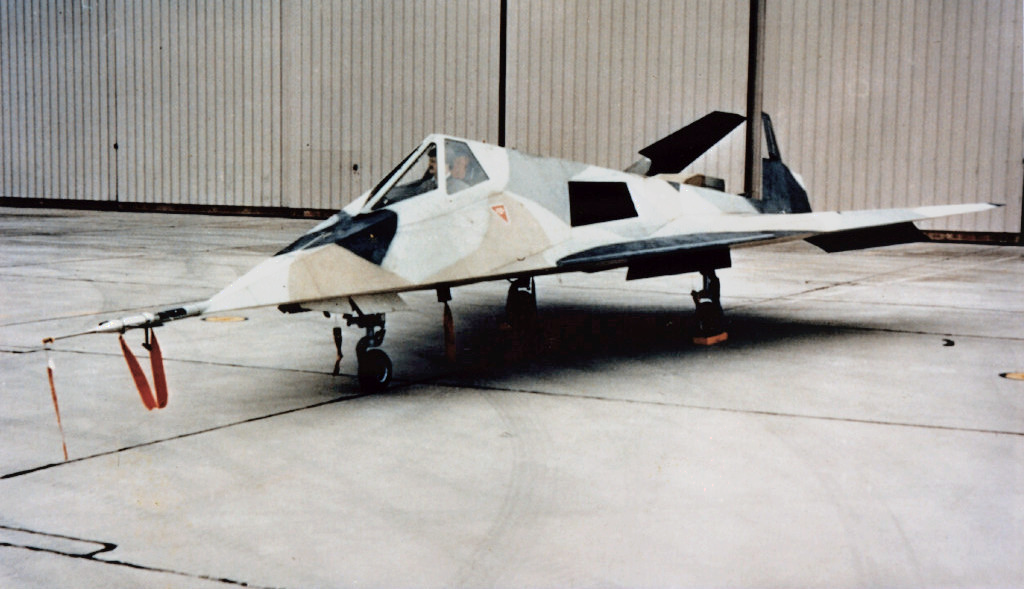
The shape met with scepticism inside the company and earned the nickname "Hopeless Diamond", a pun on the Hope Diamond; Johnson told Rich that the old D-21 drone had a lower radar cross-section than "that goddamn diamond". In May 1975 an internal Skunk Works report included the "Little Harvey" study, with Johnson's drawing of an aircraft with smoothly blended shapes; Rich argued for facets and, unusually, won. Wooden models followed: a balsa model about 61 cm long to show internal structure and access doors, and two one-third-scale mock-ups, one covered in metal foil to check ECHO 1's RCS calculations and the other for wind-tunnel tests. At the Grey Butte radar range in the Mojave Desert the measured RCS confirmed the predictions, and Rich won a quarter from Johnson.
The XST competition
In the summer of 1975 DARPA invited Lockheed, Northrop and McDonnell Douglas to the Experimental Survivable Testbed (XST) programme; McDonnell Douglas was unable to produce a design. Phase 1 required full-scale models for RCS measurement and wind-tunnel testing; Phase 2, with a single contractor, would cover the construction and flight testing of two demonstrators. On 1 November 1975 Lockheed and Northrop each received $1.5-million contracts. The wooden mock-ups were evaluated at the USAF's RATSCAT range at White Sands, New Mexico, where Lockheed erected a specially built $187,000 pole to carry its model. Lockheed's mock-up arrived in March 1976 and the following month the company was declared the winner, because Northrop's even more angular design had a much higher side-hemisphere RCS. DARPA kept the Northrop team together, and it went on to the BSAX programme, which led to Tacit Blue and later the B-2.
Building the demonstrator
Phase 2 was named Have Blue. Rich had to raise $10.4 million from Lockheed management, secured by June. The objectives were to validate low observability in the radar, infrared, visual and acoustic domains, acceptable flying qualities, and the ability of models to predict an aircraft's signature in flight. Both aircraft were assembled in Building 82 at Burbank using tooling left over from the C-5 programme; according to the Skunk Works, they were built in only 18 months. On 1 September 1977, with HB1001 partially complete, Lockheed's machinists began a four-month strike; a group of managers finished the assembly in six weeks and ground tests began on 17 October.
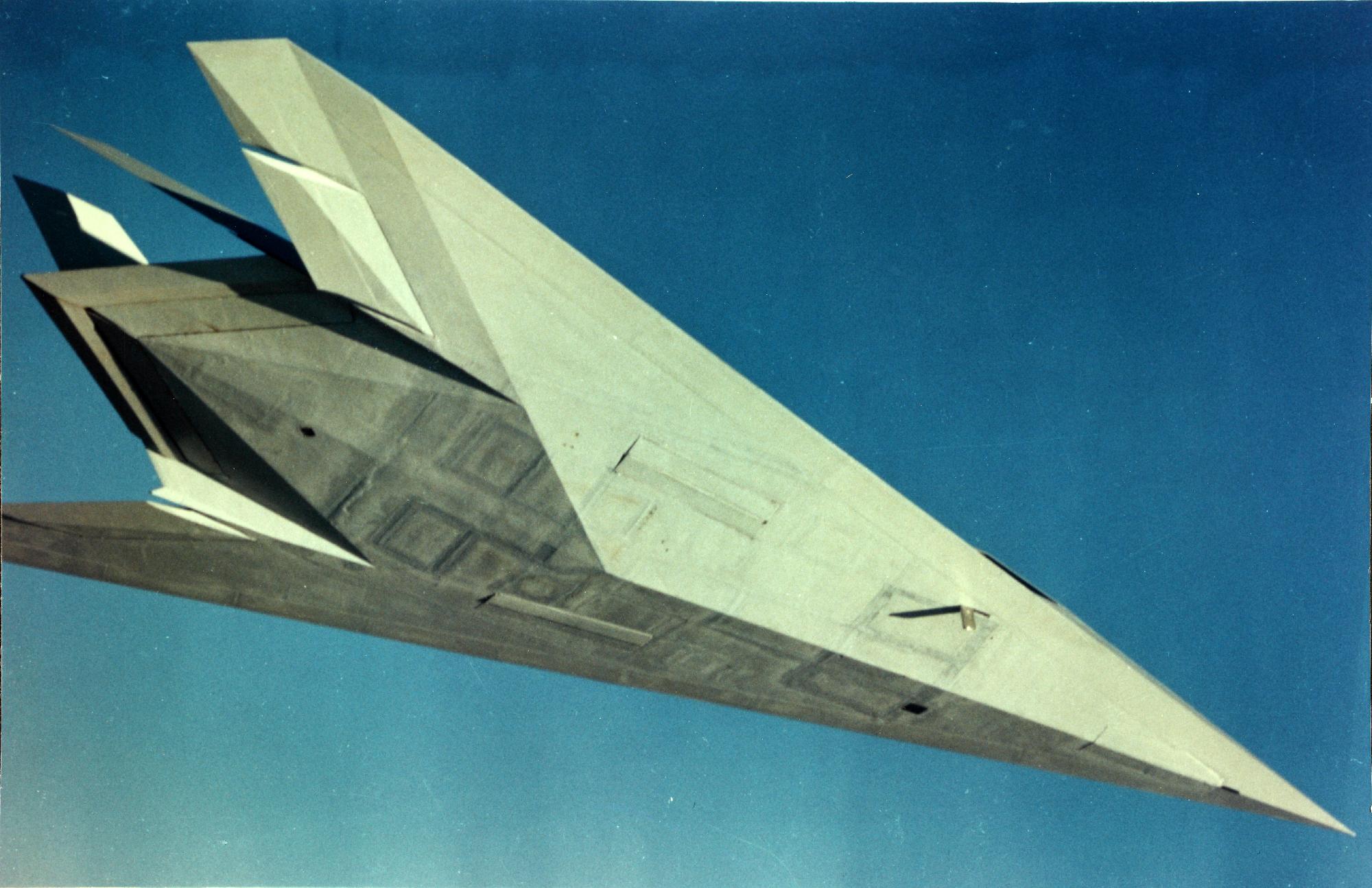
Although it resembled the later F-117, Have Blue was a much smaller aircraft, about one quarter of its weight, with a 72.5° wing sweep and inward-canted vertical tails. According to the data compiled in its dedicated article, it was 14.40 m long, with a 6.86 m span, a height of 2.29 m and 35.9 m² of wing area; empty weight was 4,060 kg and maximum take-off weight 5,670 kg, and it reached 965 km/h. Its gross weight of 4,200–5,700 kg allowed it to use the landing gear of the Northrop F-5. Power came from two General Electric J85-GE-4A turbojets of 13.1 kN (2,950 lbf) each, taken from the T-2C Buckeye. Because stealth took precedence over everything else, the aircraft was inherently unstable and used a quadruple-redundant fly-by-wire flight control system borrowed from the F-16. The overwing inlet was covered by a low-RCS grid, with blow-in doors on the upper fuselage to admit extra air on take-off; the flat surfaces carried radar-absorbent material developed in a Lockheed laboratory, and the canopy received coatings that gave it metallic characteristics.
HB1001: flying qualities
In early November 1977 the engines were run outdoors under a camouflage net thrown over two semi-trailers parked outside Building 82; a local resident complained about the noise, but secrecy held. Over the weekend of 12–13 November HB1001 received a three-colour scheme, each colour in three tones, devised by chief technical engineer Alan Brown so that casual onlookers would not recognise the faceting. Disassembled and loaded into a C-5, it was flown on 16 November from Burbank to Groom Lake (Area 51), Nevada, where it was reassembled and tested again.
After four taxi tests, Lockheed test pilot Bill Park took it up for the first time on 1 December 1977, chased by a T-38 flown by Major Ken Dyson, an F-15 Eagle pilot who made his own first flight in the demonstrator on 17 January 1978. They were Have Blue's only two test pilots, alternating between the demonstrator and the chase aircraft. The flights allowed engineers to refine the fly-by-wire system and confirmed earlier aerodynamic predictions. On 4 May 1978, on its 36th flight, the aircraft pitched up just as it touched down; Park went around, but the impact had jammed the landing gear in a semi-retracted position. Unable to lower it, Park climbed again and ejected as the engines flamed out for lack of fuel. The aircraft was destroyed near Groom Lake, and Park, who suffered a concussion, retired from test flying.
HB1002: radar signature
The second aircraft was almost complete and incorporated the lessons of the first, including a rebuilt aft fuselage. Painted grey, without HB1001's nose instrumentation boom or the unstealthy spin-recovery chute, and covered in radar-absorbent material, it was dedicated to measuring radar returns in flight. It first flew on 20 July 1978 with Dyson, its only pilot. It was lost on 11 July 1979 on its 52nd flight: a hydraulic leak caused an engine fire, and the loss of hydraulic pressure led to severe pitch oscillations; the pilot ejected safely. It was later found that a loosened engine exhaust clamp had let hot exhaust into the right engine compartment, where the heat caused the hydraulic lines to fail. The wreckage of both aircraft was secretly buried within the Nellis Air Force Base Complex.
Legacy
Despite the loss of both aircraft, Have Blue was judged a success: its flight data validated the concept, and the government increased funding for stealth technology. In October 1977 Lockheed was tasked with exploring an operational aircraft; according to the dedicated article, the Air Force awarded the Senior Trend contract on the day HB1001 was flown to Groom Lake, while other sources date Lockheed's decision to develop the F-117 to 1 November 1978. The production aircraft applied what the demonstrator had taught: less wing sweep to solve a centre-of-gravity problem, a shorter nose for better pilot visibility, and tails canted outwards. The Have Blue configuration also formed the basis of Senior Prom, a stealthy cruise missile prototype also flown at Groom Lake.
.jpg)
Multimedia

-800.webp)
.png)