Attack · Military · United Kingdom
Hawker Siddeley Harrier
- December 28, 1967
- First flight
- In service
- Status


-800.webp)

_c1972.jpg)
-1600.webp)

-800.webp)




-1600.webp)

-800.webp)




-800.webp)



_c1972-800.webp)

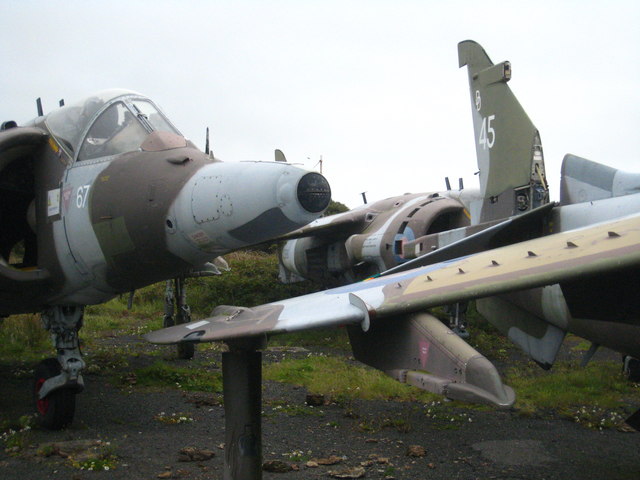
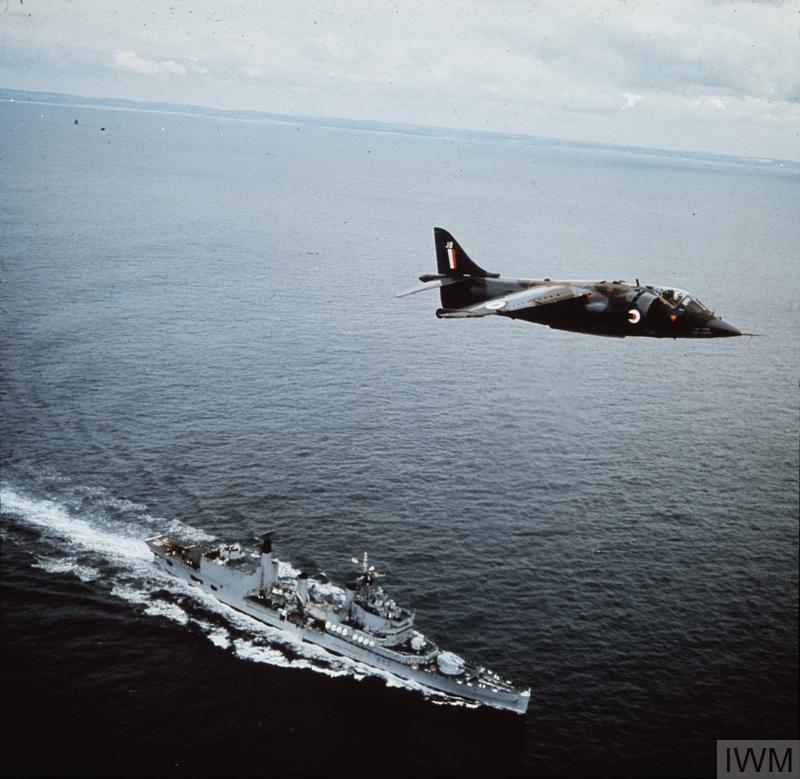
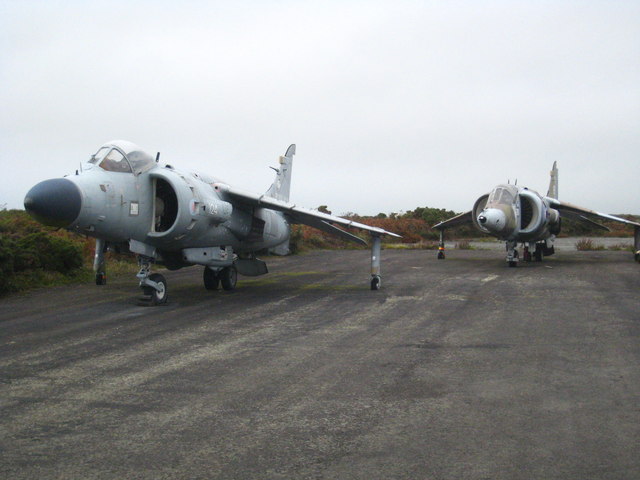
The Hawker Siddeley Harrier was the first attack and reconnaissance aircraft with vertical or short take-off and landing (V/STOL) capability to reach genuine operational service, and the only design of its kind to survive the wave of vertical-flight projects of the 1950s and 1960s. It was neither the fastest nor the best armed aircraft of its generation: it was the only one that could land where there was no runway. That singularity turned it into a cult machine and, at the same time, into a demanding aircraft, expensive to maintain and unforgiving of pilot error. Its origin lies not in a military requirement but in an engine idea. In the mid-1950s the French aviation consultant Michel Wibault proposed directing a jet engine's thrust through swivelling nozzles; the Bristol Engine Company took up the concept, slimmed it down and turned it into the Pegasus, a turbofan with four rotating nozzles venting cold fan air at the front and hot exhaust at the rear. In 1957, with the P.1121 fighter cancelled by the British Defence White Paper, Hawker Aircraft found itself with spare capacity and a revolutionary engine within reach. Sydney Camm, Ralph Hooper and Stanley Hooker launched the P.1127 project, funded at first by the company itself and sustained thereafter in large part by American money and testing, channelled through NATO's mutual weapons development programme and NASA's Langley research centre. The British Treasury had refused to pay for it. The first prototype, XP831, made its tethered hover at Dunsfold in October 1960 and flew free a month later; the full transition between jet-borne and wing-borne flight came in September 1961. In 1963 one of the prototypes landed on the deck of the aircraft carrier HMS Ark Royal, and that same year another crashed in public at the Paris Air Show. Out of those six experimental machines came the Kestrel FGA.1, nine aircraft paid for jointly by Britain, the United States and West Germany and evaluated in 1964-65 by a tripartite squadron at RAF West Raynham. The cancellation of the supersonic P.1154 in 1965 left the RAF without an ambitious vertical successor and with a single realistic option: to produce a combat version of the Kestrel. That aircraft was named Harrier GR.1, flew on 28 December 1967 and entered service in 1969. The RAF used it for close air support, ground attack and tactical reconnaissance, and deployed it above all in West Germany. There the Harrier made complete sense: if the Warsaw Pact attacked, conventional air bases would be the first targets, so the squadrons would disperse into forest clearings and camouflaged sites from which to strike advancing armoured columns. The GR.3, with a more powerful Pegasus and a laser rangefinder in the nose, was the definitive version of the British first generation. The United States joined early: the Marine Corps, won over by the idea of forward bases twenty miles from the front line and of operations from amphibious ships, received its first AV-8A in January 1971 and bought 102 single-seaters and eight TAV-8A trainers by 1976. The Spanish Navy acquired the AV-8S Matador — sold with the United States acting as intermediary to work around political friction with London — and operated it from the carrier Dédalo; Spain would resell the type to the Royal Thai Navy in 1998. The 1982 Falklands War was its trial by fire. The GR.3s of No. 1 Squadron RAF, hurriedly modified for deck operations and carried to the South Atlantic aboard the container ship Atlantic Conveyor, flew from HMS Hermes and from an improvised strip at Port San Carlos, while the Royal Navy's Sea Harriers — a separate aircraft, belonging to the fleet — handled air defence. The GR.3s flew close air support, photographic reconnaissance and strikes against Stanley airfield; at Goose Green their cluster bombs unstuck the advance of 2 PARA, and in the final days of the conflict the RAF used laser-guided bombs in combat for the first time. Four GR.3s were lost, all to fire from the ground. That campaign also produced the legend of VIFFing: moving the nozzles in forward flight to force an abrupt nose-up pitch and unsettle a pursuer. The manoeuvre was first explored by Marine Corps pilots in mock combats against F-4 Phantom IIs, and it worked, but at a steep price in energy and stability, with limits imposed by the Pegasus's high-pressure air ducts. The first-generation Harrier was retired by the Marine Corps by 1987 and replaced in the RAF by the Harrier II, a deep redesign by McDonnell Douglas and British Aerospace that is already another machine. Barely a hundred-odd airframes survive, almost all of them in museums: XP831 at the Science Museum in London, Kestrels and XV-6As spread between Cosford and several American collections, and Falklands veteran GR.3s preserved in the United Kingdom.
Related sheets
Category
History
The race for vertical take-off
With the Korean War over, half a dozen manufacturers on both sides of the Atlantic set about studying the same thing: how to do without the runway. The logic was simple and bleak. An airfield is a flat, long, immobile and perfectly mapped surface — in other words, the easiest target there is; in a high-intensity conflict, and in the 1950s that meant a nuclear one, NATO's runways would last hours. An aircraft able to take off and land vertically could disperse, hide and keep flying once the bases had been wiped off the map. There was considerable civil interest in the idea too, but almost nobody believed a vertical machine could also deliver real combat performance.
The solutions attempted were many and nearly all of them bad: rotors, extra lift engines that were dead weight in cruise, aircraft that took off sitting on their tails. The answer that finally worked came from elsewhere. In the mid-1950s the French aviation consultant Michel Wibault put forward the idea of deflecting a jet engine's thrust through swivelling nozzles, so that a single engine could both lift and propel. The Bristol Engine Company took up the concept and reworked it thoroughly, cutting size and weight, until it became a turbofan with four rotating nozzles: two forward ones for cold fan air and two at the rear, fed by a bifurcated exhaust, for the hot jet. The engine was named Pegasus.
In 1957 Bristol's engine chief, Stanley Hooker, described it to Hawker Aircraft's chief designer, Sydney Camm. The timing could not have been more favourable or more humiliating: that same year the British Defence White Paper had backed missiles over crewed aircraft and cancelled, among many other programmes, the P.1121 fighter with which Hawker intended to replace the Hunter. The company found itself with an idle project team and with the chance to fit the Pegasus to a live NATO specification, for a light tactical support aircraft that would take over from the Fiat G.91. Historians still argue over how much weight British official requirements carried in that decision, but not over the central fact: the aircraft grew around the engine, not the other way round.
Hooper, Camm and the P.1127
The job of turning the idea into a shape fell to Ralph Hooper, a senior project engineer at Hawker, working from data supplied by Bristol. In July 1957 he introduced the decisive change: splitting the exhaust to feed the hot jet into two rotating rear nozzles instead of a single tailpipe. That did away with the tailwheel undercarriage and let the aircraft adopt a conventional layout. Design work ran through 1958 paid for entirely by Hawker, while the company negotiated at NATO headquarters over exactly what tactical requirement was wanted, caught between those who asked for a lightly armed supersonic fighter and those who preferred a simple subsonic multipurpose one.
Camm hammered away at simplicity with a line that became famous in the firm: sophistication means complication, complication means escalation, escalation means cancellation, and cancellation means ruination. The team worked with physical models and blowing trials that directed mixtures of hot and cold air onto ground platforms to simulate ground effect, an area in which there was essentially no prior knowledge. The most serious problem was control: in the hover there is no flow over ailerons, rudder or tailplane, so a reaction system had to be invented that bled air from the compressor and vented it through reaction nozzles — the so-called puffers — at the nose, tail and wingtips. By the end of 1958, barely eighteen months in, the design was settled apart from that system, which was completed in April 1959.
Money was the other obstacle. Bristol was in financial difficulty, the Pegasus had no foreseeable commercial application and the British Treasury refused to fund it, so engine development ended up sustained by American money channelled through NATO institutions. The United States also provided research help: NASA's Langley centre ran wind-tunnel campaigns with sub-scale models that confirmed acceptable behaviour, and Hawker test pilot Hugh Merewether flew the Bell X-14 in the United States at NASA's invitation. In March 1959 the Hawker Siddeley board decided to fund two prototypes privately; between 1959 and 1960 the Ministry of Supply formalised contracts, first for that pair and then for four more development aircraft. Project engineer Gordon Lewis always credited the close collaboration between airframe and engine makers with the programme's survival through technical obstacles and political reversals.
The Pegasus: an engine with four exits
The Pegasus was not a conventional jet with an attachment bolted on. Bristol Siddeley built it around an Orpheus core with Olympus compressor blades for the fan, and the whole assembly was conceived from the start so that thrust would leave through four steerable mouths at once. Cold fan air was discharged through two fibreglass nozzles on the sides of the fuselage, just behind the intakes; hot exhaust left through two steel nozzles slightly further aft. All four rotated together, driven by a lever beside the throttle, between horizontal for cruise and a little over ninety degrees, angled slightly forward, for braking.
The problems that had to be solved measure the size of the leap. The first was reconciling fuel consumption with thrust: an engine powerful enough to lift the aircraft vertically is oversized and thirsty in cruise. The solution was to size an engine of normal thrust and force it briefly through water injection, allowing peaks above the nominal rating for the few seconds a vertical landing lasts, particularly with a heavy load or in hot conditions. The water injection idea is credited to the input of US Colonel Bill Chapman of the mutual weapons development team. The second problem was gyroscopic: the rotating mass of the engine, with the enormous airflow passing through it, would have produced a rolling tendency in the hover that was impossible to counter. The fix was to make the fan and low-pressure turbine spin in the opposite direction to the high-pressure compressor, cancelling the effects out.
The third problem was the interface between engine and airframe. The reaction system was fed by compressor bleed air and phased in proportionally: as the pilot moved the nozzle lever towards the short and vertical take-off settings, the hydraulics progressively brought in the reaction controls, so that the transition from aerodynamic to jet-borne flight felt seamless. The result was an aircraft flown in the same way at high speed and in the hover, apart from that extra lever. The Pegasus 1 gave 9,000 lbf (about 40 kN) and first ran in September 1959; the Kestrel's Pegasus 5 reached 15,000 lbf (67 kN), short of the 18,200 projected because development was trimmed to save money. The family kept growing for decades, and for many years a joint Anglo-American Pegasus support programme, with an annual budget of around three million pounds, worked on reliability and engine life.
From the Ark Royal to the Kestrel: the Tripartite squadron
On 15 July 1960 the first prototype, serial XP831, arrived at Dunsfold to begin static engine testing; on 31 August the Pegasus ran for the first time inside the airframe. On 21 October came the first tethered hover, with the aircraft stripped of everything expendable and the engine restricted to two and a half minutes at full power. On 19 November XP831 held its first free hover. On 13 February 1961 Bill Bedford flew it conventionally for twenty-two minutes, and in September of that year the full cycle was finally closed: take off vertically, transition to wing-borne flight and come back.
Of the six aircraft in that experimental series, the first three were lost. The most notorious was XP831's public crash at the 1963 Paris Air Show, traced to a particle of grit in the air supply to the motor that drove the nozzles, which jammed them; the aircraft was fully repaired and returned to flying. No pilot died in those three accidents. XP980, fifth of the series, brought in the taller fin and the anhedral tailplane that production Harriers would carry; the last, XP984, brought in the swept wing and the Pegasus 5 and served as the Kestrel prototype. In 1963 one of the prototypes made the first vertical landing on the deck of an aircraft carrier, HMS Ark Royal — a demonstration read at the time as a curiosity, and which twenty years later would prove prophetic.
Official support finally appeared in early 1962. The Ministry of Aviation's operational requirements branch asked the Treasury to sanction nine production-standard aircraft for an evaluation unit, and the British government offered the United States and West Germany a share in the project and its cost. All three accepted, and in May 1962 Hawker received an instruction to proceed. Those nine aircraft were the Kestrel FGA.1: fully swept wing, larger tail, fuselage adapted to the Pegasus 5 and genuine operational equipment. The first flew on 7 March 1964, again with Bedford at the controls.
The Tri-partite Evaluation Squadron stood up at RAF West Raynham on 15 October 1964 with ten test pilots: four British, four American and two West German. Each received a week of ground instruction at Bristol, another at Dunsfold and a three-hour conversion with Bedford. The squadron's job was to find out whether a V/STOL aircraft was usable in the field, compare take-off and landing methods, establish procedures, assess instrument and night flying and explore manoeuvring in the jet-borne regime. The practical conclusion shaped the type's whole career: the optimum was not to take off vertically but to make a short rolling take-off and land vertically — abbreviated to STOVL — because that saved fuel and allowed far more ordnance. Operations from boggy ground and temporary surfaces were also trialled at Bircham Newton. By November 1965, when the evaluation ended, 960 sorties had been flown with 1,366 take-offs and landings; one aircraft was lost when a pilot began a rolling take-off without releasing the parking brake. Six of the eight survivors crossed the Atlantic as XV-6As and were evaluated by the US Army, Navy and Air Force, passing afterwards to the USAF at Edwards and two of them to NASA.
From the P.1154 to the Harrier GR.1: RAF service and Manhattan in six hours
While the Kestrel was flying, Hawker was chasing something more ambitious. NATO had issued a requirement, NBMR-3, for a vertical aircraft with supersonic performance comparable to a Phantom's, and to meet it the company designed the P.1154, with a four-nozzle Bristol Siddeley BS100 and plenum chamber burning. The P.1154 won the competition against Dassault's Mirage IIIV; France rejected the outcome and withdrew, and the NATO requirement was cancelled in 1965. The RAF and the Royal Navy tried to carry it forward on their own, but they wanted incompatible aircraft — a low-level supersonic striker for one, a twin-engined air defence fighter for the other — the Navy was already buying Phantoms and the RAF had staked its chips on the TSR-2. The Labour government elected in 1964 cancelled the P.1154. A few strands of work survived, among them a supersonic Pegasus with plenum chamber burning.
With no supersonic vertical aircraft, the RAF was left with the modest option: turning the Kestrel into a combat machine. It issued requirement ASR 384, ordered six pre-production aircraft designated P.1127 (RAF) in late 1965 — the first flew on 31 August 1966 — and in early 1967 placed a formal order for sixty production aircraft. The aeroplane then took the name of a bird of prey, Harrier, which had originally been reserved for the P.1154. Although Kestrel and Harrier looked much alike from outside, around ninety per cent of the airframe was redesigned: a Pegasus 6, new intakes with auxiliary blow-in doors to guarantee airflow at low speed, a larger-area wing, strengthened landing gear, seven hardpoints — four under the wings and three on the fuselage — provision for two 30 mm ADEN gun pods beneath the fuselage and, above all, a navigation and attack system with an inertial platform inherited from the P.1154, a head-up display and a moving map. Production was split between Kingston upon Thames and Dunsfold, where testing was done.
The GR.1 flew on 28 December 1967 and officially entered RAF service in 1969; No. 1 Squadron, at Wittering, was the first unit to convert. Barely a month later the aircraft became world famous. The Daily Mail organised a transatlantic race between 4 and 11 May 1969 to mark the fiftieth anniversary of Alcock and Brown's flight; it was not a race of aircraft but of people, between the Post Office Tower in London and the Empire State Building in New York, with competitors free to combine whatever transport they liked. The RAF saw the perfect chance to show off the one card nobody else held: landing in the middle of a city. A coal yard beside St Pancras station was pressed into service and christened RAF St Pancras, while in New York the Marine Corps laid out a twenty-nine-metre-square pad at Bristol Basin on the East River, on the site earmarked for the United Nations International School. The intended pilot, Mike Adams, was injured when the nosewheel of a Harrier collapsed under him during testing, and the westbound flight fell to Squadron Leader Tom Lecky-Thompson, with Graham Williams — until then the reserve — as the only other qualified pilot available. With ferry wingtips to improve cruise performance and air-to-air refuelling from Victor tankers, Lecky-Thompson covered the tower-to-skyscraper journey in 6 hours 11 minutes, of which 5 hours 57 were flying time. It was the fastest westbound time of the whole event.
Germany: the GR.3 and the dispersed sites
The Harrier was conceived for a war that never came, and its main deployment says everything. In 1970 two squadrons formed at the RAF base at Wildenrath in North Rhine-Westphalia, and a third two years later; in 1977 the survivors of that reorganisation moved forward to Gütersloh, closer to the inner German border. The doctrine was explicit: if the Warsaw Pact attacked, fixed bases would be destroyed within hours, so the Harriers would leave the airfield and operate from dispersed sites — forest clearings, stretches of road, improvised platforms — camouflaged and spread over tens of kilometres, from which they would strike the armoured columns advancing from the east. That dispersal, rather than vertical lift itself, was what strategists prized; the manufacturer itself insisted that short take-off paid better than vertical, because it saved fuel and allowed more ordnance.
Setting such a thing up was not free. The Harrier Field Force concept had a difficult birth, in the words of Air Vice-Marshal George Black, who took over Wildenrath in January 1972 on the very day a Harrier flew into a German village and killed its pilot. The learning was expensive and took years, but it eventually produced a capability with no equivalent in any other air force. No. 3 (Fighter) Squadron is a fair example of the typical set-up: on 1 January 1972 it traded its Canberras for Harrier GR.1As at Wildenrath, sharing the base with No. IV (Army Co-operation) and No. 20 Squadrons; it had twelve aircraft and sixteen pilots, and two primary missions, battlefield interdiction and tactical reconnaissance.
The aircraft evolved alongside the doctrine. The GR.1A carried a Pegasus 10 (Mk.102) of 20,500 lb thrust against the original GR.1; the GR.3, which began replacing it in the mid-1970s, had the 21,500 lb Pegasus 11 (Mk.103) and added a laser ranger and marked-target seeker in a distinctive extended nose, along with improved attack sensors and electronic countermeasures. The RAF ordered 118 aircraft of the GR.1/GR.3 series and took delivery of the last in December 1986; total production of the sub-type is credited at 122 airframes. Pilot conversion was done on two-seaters with a stretched fuselage and taller fin, the T.2 and T.4, of which twenty-five were built.
Germany was not the only posting. No. 1 Squadron was specifically earmarked for operations in Norway under Allied Forces Northern Europe, and Harriers were also deployed to Belize, where they were the only RAF combat aircraft able to operate safely from the airport's short runway; British forces stayed there until 1993, two years after Guatemala recognised Belizean independence.
The Marine Corps, the AV-8A and export
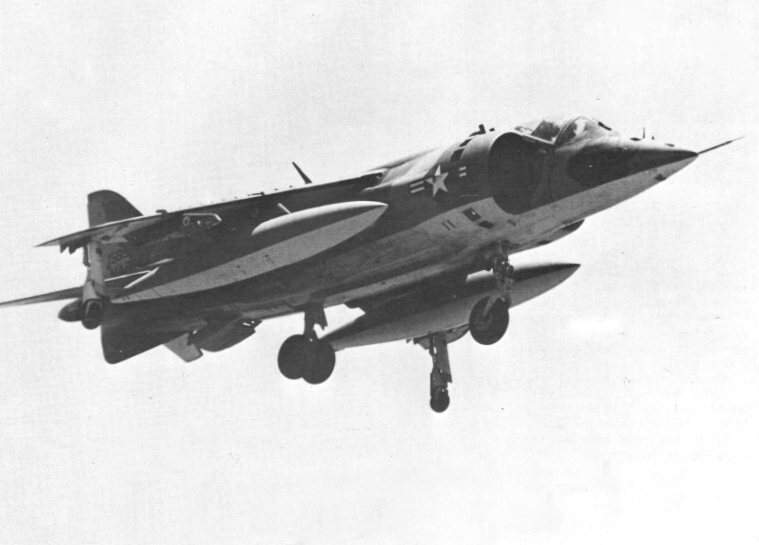
The United States Marine Corps became interested in the Harrier almost as soon as the first RAF squadron stood up in 1969, and for a very Marine reason: the infantry needed close air support parked next to the beachhead, not hundreds of miles away. There was resistance in Congress, where the overlap of several close-support programmes rankled, but the Marines got their way. In 1969 Hawker Siddeley and McDonnell Douglas set up a joint arrangement with American production in mind; Congressman Mendel Rivers and the House Appropriations Committee concluded it was cheaper to build the aircraft on the existing British lines, so every AV-8A was bought from Hawker Siddeley. The first was accepted on 6 January 1971 at Dunsfold and began testing on 26 January at Patuxent River. Between 1971 and 1976 the Corps received 102 AV-8As and eight TAV-8A two-seaters.
The Marines pushed the concept in two directions. Ashore, their expeditionary doctrine called for forward bases and light maintenance facilities to be set up in under twenty-four hours: sites holding one to four aircraft some twenty miles from the forward edge of the battle area, with a more established base around fifty miles back, which multiplied the sortie rate and cut fuel burn. At sea, the Harrier fed a whole family of naval ideas. Admiral Elmo Zumwalt promoted the Sea Control Ship: a light carrier of 15,000 tons, carrying Harriers and helicopters, to supplement the big decks; the amphibious assault ship USS Guam served as the testbed for the concept between 1971 and 1973. In 1976, fourteen Harriers spent six months embarked in USS Franklin D. Roosevelt and showed they could operate in weather that grounded conventional carrier aircraft. Arapaho was also studied, a modular system to convert civilian cargo ships into platforms able to operate and maintain a handful of Harriers, and even a battleship-carrier hybrid that would have replaced an Iowa-class ship's after turret with a flight deck, hangar and two ski jumps; the idea was dropped on cost, and because the Corps preferred to keep the naval gunfire. From 1979 the AV-8As began to be rebuilt to AV-8C standard, focused on extending service life and improving vertical performance; by 1987 the type was retired.
Exports were few and peculiar. After the demonstrations from small ships, the Spanish Navy bought the aircraft as its principal carrier-borne fighter. The deal was politically delicate — relations between London and Madrid were tense at the time — so although the aircraft were built in the United Kingdom, they were sold with the United States acting as intermediary. In November 1972 British test pilot John Farley demonstrated that the wooden deck of the carrier Dédalo could withstand the temperature of the Harrier's efflux. From 1976 the Spanish Navy operated the AV-8S, designated VA.1 Matador in Spain, providing both air defence and strike for the fleet; five further airframes came later, bought straight from the British government to make good attrition. Ten AV-8S were built. In 1998, having replaced them with Harrier IIs, Spain sold seven single-seaters and two two-seaters to the Royal Thai Navy, which received them together with its new light carrier HTMS Chakri Naruebet and its 12-degree ski jump. Thailand, new to both carrier aviation and the Harrier, never managed to sustain them: a shortage of funds for spares and engines left almost none serviceable, and in 1999 only one airframe was airworthy. Around 2003 replacing them with second-hand British Sea Harriers was examined, but no purchase followed.
There was also a long list of customers who came close. Argentina, Australia, Brazil, China, Switzerland and Japan all took the idea far enough for British Aerospace to open talks. The Argentine Navy looked at six to twelve GR.1s in 1969 and even watched a demonstration aboard its new carrier, but bought A-4Q Skyhawks instead. Australia came near to acquiring HMS Invincible with Harriers and helicopters to replace HMAS Melbourne, until the Falklands War led the Royal Navy to withdraw the offer. China negotiated from 1972 for up to two hundred aircraft and the deal was almost closed in 1979, when the Sino-Vietnamese War killed it. Switzerland, whose doctrine was precisely to operate from hidden and dispersed sites, received a demonstration from John Farley with XV742 in 1971.
The Falklands, 1982
When the British task force was assembled in April 1982, the Royal Navy had only twenty-eight Sea Harriers for its two carriers, and it soon became clear that was too few. The answer was to reach for the RAF's Harriers. No. 1 Squadron was the only Harrier unit qualified in air-to-air refuelling and was trained to operate from bare bases, so it was told to prepare for carrier operations as attrition replacements for Sea Harrier losses. The trouble was that neither its aircraft nor its pilots were built for that. In three weeks, working round the clock and through the weekends, the GR.3s were given nosewheel steering, changes to the fuel control units, Sidewinder capability, a special transponder for finding the ship at night, tie-down shackles, drain holes and anti-corrosion treatment; flare and chaff dispensers, an active electronic jammer and the ability to fire American anti-radar missiles came later. The initial plan was to modify twelve aircraft; more than twenty went through the shop. The pilots went to the naval air station at Yeovilton to practise deck landings and ski-jump take-offs, trained in air combat against French Mirages and Étendards and tried out the Sidewinders and laser-guided bombs.
Getting there was a demonstration in itself. The Harriers flew the four thousand miles to Wideawake airfield on Ascension Island in a nine-hour air-refuelled flight that was a new milestone for a single-engined RAF jet, and there embarked on the Atlantic Conveyor, a requisitioned container ship fitted with an aircraft hide built between walls of containers; the aircraft were bagged against salt water. Between 10 and 24 May, in addition, a detachment of three GR.3s provided air defence for Ascension until three Phantoms arrived. On 18 May the aircraft transferred to the carriers and every GR.3 went to HMS Hermes. After a single day of work-up, its first operational sortie went out on 20 May.
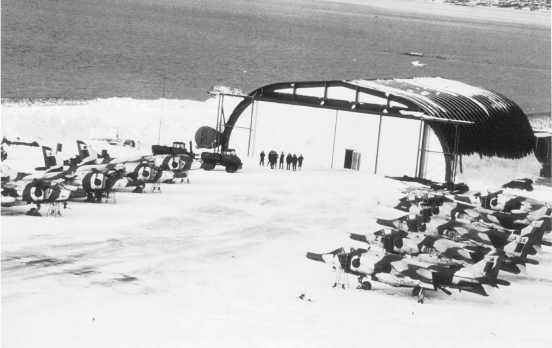
With the Sea Harrier force having suffered no losses in air combat, the GR.3s served not as replacements but as reinforcements, and were given over entirely to attack: close air support, armed reconnaissance and strikes against Stanley airfield and the outlying strips. On 23 May the squadron's commanding officer, Wing Commander Peter Squire, led a four-aircraft formation in XZ997 to bomb the Dunnose Head strip on West Falkland. The GR.3 also carried a reconnaissance pod with five cameras giving 360-degree coverage, and with Hermes's photographic facilities the squadron located troop concentrations and defensive positions, though the Argentines went to some lengths to fool the interpreters by making Stanley's runway look cratered and setting out decoys. The weapons were cluster bombs, two-inch rockets, thousand-pound bombs and, at the end, laser-guided bombs. The cluster bombs had a marked effect on dug-in troops: at Goose Green, with 2 PARA pinned on a forward slope under 35 mm gunfire at two thousand metres, three Harriers silenced the guns and turned the battle. The guided bombs could not be used properly until the day before the ceasefire, when laser markers and targets finally coincided: four bombs delivered from a loft profile scored two direct hits. It was the RAF's first combat use of smart weapons.
Shortly after the landings a strip and a forward operating base were built near Port San Carlos, with refuelling and parking for up to four aircraft, protected by eight Rapier systems, six of them airlifted to the surrounding hills. Two GR.3s were detached there daily to respond immediately to calls from the ground forces. The real threat never came from the air but from the ground: the Argentine Roland and Tigercat missiles scored nothing because pilots were told to keep away from them, the man-portable Blowpipe and SAM-7 were largely defeated by flying very low and very fast — one loss is credited to a Blowpipe — and most hits came from 20 to 35 mm anti-aircraft artillery and small arms. In the campaign's later stages one in four aircraft launched came back with holes in it. Four GR.3s were lost in all. Bob Iveson was shot down on 27 May supporting the paratroopers at Goose Green and evaded capture for three days; Jerry Pook was hit by small arms on 30 May, lost fuel, suffered a flame-out and ejected thirty-five miles from Hermes, to be picked up within ten minutes. Between Harriers and Sea Harriers, more than two thousand sorties were flown, an average of six per aircraft per day.
After the ceasefire on 14 June a shore base was established at Stanley and on 4 July the GR.3 detachment moved ashore to stand air defence duty with Sidewinders. As a deterrent against a further Argentine attempt, No. 1453 Flight remained in the islands from August 1983 to June 1985. The first-generation Harrier never saw combat with the RAF again after the Falklands. The war also left a curious epilogue: British Aerospace proposed Skyhook, a crane system to launch and recover Harriers from small ships without a flight deck, with secondary cranes for rapid rearming; it was marketed abroad and interested nobody.
VIFFing and what the aircraft demanded of its pilot
The Harrier had two controls that do not exist on a conventional aircraft: vectored thrust and the reaction control system. The first is worked with the nozzle lever beside the throttle and swings the efflux from horizontal to a little over ninety degrees; the second behaves like a helicopter's cyclic and takes over as the aerodynamic surfaces stop biting. The practical consequence is that flying a Harrier meant mastering two different crafts, the aeroplane and the helicopter, which is why most services demanded high aptitude and long training, and often drew on experienced helicopter pilots. The aircraft also punished mistakes: the AV-8A and AV-8C fleets lost around forty aircraft and some thirty pilots during the 1970s and 1980s, and the accident rate was a recurring criticism, though it has to be set beside that of other single-engined attack aircraft of the era, such as the A-4 Skyhawk and the A-7 Corsair II, which come off worse in some analyses. Maintenance was another weak point: almost any work on the engine required removing the wing, which drove up man-hours per flying hour. It was, as squadron commanders themselves acknowledged, the unavoidable price of a V/STOL aircraft.
That extra control produced the manoeuvre that made the type famous: VIFFing, from vectoring in forward flight. Marine Corps pilots explored it systematically in mock combats against F-4 Phantom IIs, and it showed that the Harrier could hold its own at close range against nominally superior fighters. Physically, lowering the nozzles in forward flight partly unloads the wing: some of the thrust goes to opposing weight, so the aircraft pitches up faster than its lift alone would allow. Aerodynamicists were already asking in 1961 whether vectored thrust could unload the wing; pilots found that it could, and that the effect was instantaneous. Early recommendations spoke of around 20 degrees of nozzle for sustained turns and up to 60 for instantaneous ones.
The price is high, which explains why VIFFing never stopped being an occasional resort. What is gained in instantaneous pitch is paid for in energy: the aircraft decelerates, and with less speed the maximum attainable g falls away. It also destabilises, because it displaces one of the principal vectors in the force diagram. At best it is a one-shot play: if it is not made to count, what follows is an aircraft with no speed and no control authority. There was also a very specific structural limit: the high-pressure ducts carrying Pegasus bleed air to the reaction control valves are charged when the nozzles come down, and they had been designed for very low speeds, not to take that load at high speed and high power. Hence the manuals imposed limits on altitude, airspeed and engine setting for vectoring, and urged pilots to keep things simple until experience was gained. Its real utility lies above all in close-in gun combat, where an abrupt nose movement can break an attacker's tracking or hand him an angle-and-closure problem he cannot solve in time.
Succession: the Harrier II and the survivors
The first-generation Harrier aged quickly because its own success created an appetite for something better. The structural limitation had been known from the beginning: with the original wing and engine, an aircraft that took off vertically could barely carry weapons, and one that carried weapons had to roll for take-off and accept a short radius of action. McDonnell Douglas and British Aerospace jointly undertook a deep redesign — a new composite wing of greater area, digital avionics, a more powerful engine — that produced the Harrier II, a different aircraft known in the Marine Corps as the AV-8B, in service from 1985, and in the RAF as the GR.5 from the mid-1980s. The AV-8As and AV-8Cs were retired by 1987; the British GR.3s gave ground through the 1980s and 1990s. The first generation never reached the later conflicts: Bosnia, Iraq, Kosovo and Afghanistan were Harrier II wars.
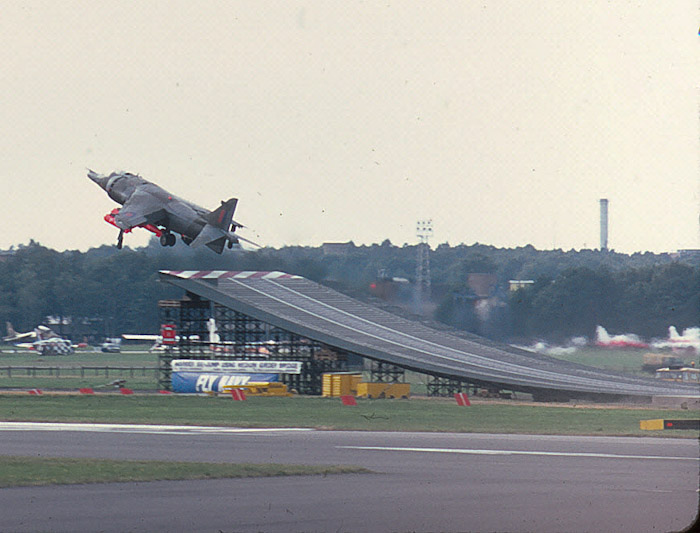
The ski jump deserves a paragraph of its own, because it was born in this period and extended the concept's life far beyond the first generation. With the British conventional carrier project cancelled in 1966, the Royal Navy was left with small ships and no catapult; launching a Harrier with a full war load needed a run of nearly three hundred metres and the available decks barely reached two hundred. In 1973 Lieutenant Commander Doug Taylor, studying at Southampton University, proposed the solution in his thesis: a curved ramp at the end of the deck. The idea met scepticism, but Hawker Siddeley at Kingston and the Ministry of Defence verified it with simulation and modelling, and on 5 August 1977 the first ski-ramp trial took place ashore. Within a year angles between 6.5 and 20 degrees had been tried: the aircraft got airborne with far heavier loads and, if the engine failed on launch, the pilot had roughly three times as long to eject as from a flat deck. HMS Hermes received her 12-degree ramp in her 1979 refit, in time for the Falklands.
Of the two hundred and fifty-odd first-generation airframes built across all versions, a scattered sample survives around the world. The first prototype, XP831, is preserved at the Science Museum in London; XP980 is at the Fleet Air Arm Museum at Yeovilton and XP984 at Brooklands. A Kestrel FGA.1, XS695, is displayed at the RAF Museum at Cosford, and the surviving XV-6As are spread between the National Museum of the US Air Force, the Virginia Air and Space Center, the Pima Air & Space Museum and Air Power Park. GR.1s and GR.3s can be seen at the National Museum of Flight at East Fortune, at Brooklands, at Duxford, at Hendon, in several German museums — including the one at Gütersloh, where they were once based — and as far afield as Estonia, Poland, New Zealand, Belize and Beijing. Among them is XZ997, the aircraft Peter Squire took over Dunnose Head and in which Jerry Pook flew, preserved by the RAF Museum. The American AV-8As and AV-8Cs survive at the San Diego Air and Space Museum, at Pima, at the Museum of Flight in Seattle and several others; AV-8C BuNo 158977, built in 1973 and flown for years by VMA-542 at Cherry Point, went from the Davis-Monthan boneyard to Pima and from there to Seattle, restored in its original markings. It is a fair summary of the type's fate: an aircraft that was never the best at anything except the one thing nobody else could do, and which is remembered for exactly that.
Variants
| Harrier GR.1 | AV-8C Harrier | AV-8A Harrier | AV-8S Matador | Harrier GR.1A | Harrier GR.3 | Harrier T.2 | Harrier T.2A | Harrier T.4 | Harrier T.4A | Harrier T.4N | Harrier T.60 | Harrier T.8 | TAV-8A Harrier | TAV-8S Matador | |
|---|---|---|---|---|---|---|---|---|---|---|---|---|---|---|---|
| First flight | December 28, 1967 | May 5, 1979 | — | — | — | — | — | — | — | — | — | — | — | — | — |
| Aircraft type | — | — | — | — | — | Single-seat V/STOL ground-attack and reconnaissance aircraft | — | — | — | — | — | — | — | — | — |
| Powerplant | — | — | — | — | — | One Rolls-Royce Pegasus Mk 103 vectored-thrust high-bypass turbofan rated at 96 kN with water injection, exhausting through four swivelling nozzles. | — | — | — | — | — | — | — | — | — |
| Powerplant | 1 × Rolls-Royce Pegasus Mk 101 | 1 × Rolls-Royce Pegasus Mk 103 | 1 × Rolls-Royce Pegasus Mk 103 | 1 × Rolls-Royce Pegasus Mk 103 | 1 × Rolls-Royce Pegasus Mk 102 | 1 × Rolls-Royce Pegasus Mk 103 | 1 × turbofan | 1 × Rolls-Royce Pegasus Mk 102 | 1 × turbofan | 1 × turbofan | 1 × turbofan | 1 × Rolls-Royce Pegasus Mk 104 | 1 × turbofan | 1 × Rolls-Royce Pegasus Mk 103 | 1 × Rolls-Royce Pegasus Mk 103 |
| Thrust per engine | 84.5 kN | 96 kN Best value in this row | 96 kN Best value in this row | 96 kN Best value in this row | 89 kN | 96 kN Best value in this row | — | 89 kN | — | — | — | 95.6 kN | — | 96 kN Best value in this row | 96 kN Best value in this row |
| Length | 13.9 m | 14 m | 13.9 m | 13.9 m | 13.9 m | 14.3 m Best value in this row | — | — | — | — | — | — | — | — | — |
| Wingspan | 7.7 m | 7.7 m | 7.7 m | 7.7 m | 7.7 m | 7.8 m Best value in this row | — | — | — | — | — | — | — | — | — |
| Height | 3.5 m | 3.4 m | 3.5 m | 3.5 m | 3.5 m | 3.6 m Best value in this row | — | — | — | — | — | — | — | — | — |
| Wing area | 18.7 m² Best value in this row | 18.7 m² Best value in this row | 18.7 m² Best value in this row | 18.7 m² Best value in this row | 18.7 m² Best value in this row | 18.7 m² Best value in this row | — | — | — | — | — | — | — | — | — |
| Empty weight | 5,530 kg Best value in this row | 5,897 kg | 5,530 kg Best value in this row | 5,530 kg Best value in this row | 5,530 kg Best value in this row | 6,139 kg | — | — | — | — | — | — | — | — | — |
| MTOW | 11,500 kg Best value in this row | 11,340 kg | 11,500 kg Best value in this row | 11,500 kg Best value in this row | 11,500 kg Best value in this row | 11,431 kg | — | — | — | — | — | — | — | — | — |
| Top speed | 1,185 km/h Best value in this row | 1,185 km/h Best value in this row | 1,185 km/h Best value in this row | 1,185 km/h Best value in this row | 1,185 km/h Best value in this row | 1,176 km/h | — | — | — | — | — | — | — | — | — |
| Service ceiling | 15,000 m | 15,000 m | 15,000 m | 15,000 m | 15,000 m | 15,600 m Best value in this row | — | — | — | — | — | — | — | — | — |
| Range | 1,900 km Best value in this row | — | 1,900 km Best value in this row | 1,900 km Best value in this row | 1,900 km Best value in this row | — | — | — | — | — | — | — | — | — | — |
| Ferry range | — | — | — | — | — | 3,430 km | — | — | — | — | — | — | — | — | — |
| Combat radius | — | — | — | — | — | 670 km | — | — | — | — | — | — | — | — | — |
| Endurance | — | — | — | — | — | 90 min | — | — | — | — | — | — | — | — | — |
| Range conditions | — | — | — | — | — | Combat range is 670 km (360 nmi) on a hi-lo-hi profile with a 1,996 kg payload, falling to 370 km (200 nmi) lo-lo with the same load. Ferry range reaches 3,430 km (1,850 nmi) with the 1,500 L drop tanks and rises to 5,600 km (3,000 nmi) with one air-to-air refuelling. On combat air patrol 190 km from base endurance is one hour thirty minutes, and over seven hours with one refuelling. | — | — | — | — | — | — | — | — | — |
| Armament | — | — | — | — | — | Two 30 mm ADEN cannon in under-fuselage pods. Five hardpoints — four under the wings and one under the fuselage — with a total capacity of 5,000 lb (2,268 kg), carrying combinations of four Matra pods with 18 SNEB 68 mm rockets each, two AIM-9 Sidewinder air-to-air missiles, unguided iron bombs, BL755 cluster bombs or laser-guided bombs. A reconnaissance pod can be carried on the same stations. | — | — | — | — | — | — | — | — | — |
| Max weapons load | 2,268 kg Best value in this row | 2,268 kg Best value in this row | 2,268 kg Best value in this row | 2,268 kg Best value in this row | 2,268 kg Best value in this row | 2,268 kg Best value in this row | — | — | — | — | — | — | — | — | — |
| Payload | 0 kg Best value in this row | 0 kg Best value in this row | 0 kg Best value in this row | 0 kg Best value in this row | 0 kg Best value in this row | 0 kg Best value in this row | 0 kg Best value in this row | 0 kg Best value in this row | 0 kg Best value in this row | 0 kg Best value in this row | 0 kg Best value in this row | 0 kg Best value in this row | 0 kg Best value in this row | 0 kg Best value in this row | 0 kg Best value in this row |
| Cargo capacity | — | — | — | — | — | As a single-seat attack aircraft it carries no passengers and no internal cargo. The five pylons are shared between weapons, the reconnaissance pod and drop tanks — 450 L for combat or 1,500 L for ferrying — so every station given over to fuel comes out of the 2,268 kg weapons load. | — | — | — | — | — | — | — | — | — |
| Crew | 1 Best value in this row | 1 Best value in this row | 1 Best value in this row | 1 Best value in this row | 1 Best value in this row | 1 Best value in this row | 2 | 2 | 2 | 2 | 2 | 2 | 2 | 2 | 2 |
| Passengers | 0 Best value in this row | 0 Best value in this row | 0 Best value in this row | 0 Best value in this row | 0 Best value in this row | 0 Best value in this row | 0 Best value in this row | 0 Best value in this row | 0 Best value in this row | 0 Best value in this row | 0 Best value in this row | 0 Best value in this row | 0 Best value in this row | 0 Best value in this row | 0 Best value in this row |
| Units built | — | — | 102 Best value in this row | 10 | 17 | — | — | — | — | — | — | — | — | 8 | — |
Images
Elsewhere
- Wikimedia CommonsCategoría Commons: Hawker Siddeley Harrier ↗
- Wikimedia CommonsCategoría Commons: Harrier GR.1 ↗
- Wikimedia CommonsCategoría Commons: Harrier GR.3 ↗
- Wikimedia CommonsCategoría Commons: Harrier T.2 ↗
- Wikimedia CommonsCategoría Commons: Harrier T.4 ↗
- Wikimedia CommonsCategoría Commons: Harrier T.8 ↗
- Wikimedia CommonsCategoría Commons: AV-8S Matador ↗
- Wikimedia CommonsCategoría Commons: TAV-8A Harrier (USMC) ↗
- Wikimedia CommonsCategoría Commons: TAV-8S Matador ↗
- Wikimedia CommonsCategoría Commons: Harrier en vuelo ↗
- Wikimedia CommonsCategoría Commons: Harrier por ubicación ↗
- Wikimedia CommonsCategoría Commons: ejemplares de museo (Harrier I) ↗
Show the 15 more
- Imperial War MuseumsBAe Harrier GR.3 ↗
- Imperial War MuseumsThe Falklands Conflict, April-June 1982 ↗
- IWM PrintsHarrier GR.3 del No. 3 Squadron en RAF Gütersloh ↗
- RAF MuseumRAF Museum — Photographic Collection ↗
- RAF Museum CollectionsRAF Museum Collections (búsqueda Harrier) ↗
- Pima Air & Space MuseumHawker Siddeley Harrier GR.3 — ejemplar conservado ↗
- The Museum of FlightMcDonnell Douglas AV-8C Harrier — ejemplar conservado ↗
- National Naval Aviation MuseumAV-8C Harrier — ejemplar conservado ↗
- Fort Worth Aviation MuseumAV-8A Harrier — ejemplar conservado ↗
- Wikimedia CommonsPrecursor: Hawker P.1127 y Kestrel FGA.1, categoría en Wikimedia Commons ↗
- Wikimedia CommonsPrecursor: Hawker P.1127 XP831 en el Science Museum, categoría en Commons ↗
- Science Museum Group CollectionPrecursor: Hawker P.1127 XP831, primer prototipo, Science Museum Group ↗
- RAF MuseumPrecursor: Hawker Siddeley Kestrel FGA.1 XS695, RAF Museum ↗
- National Air and Space MuseumPrecursor: Hawker Siddeley XV-6A Kestrel FGA Mk.1, Smithsonian NASM ↗
- Pima Air & Space MuseumPrecursor: Hawker Kestrel FGA.1 (XV-6A), Pima Air & Space Museum ↗