German Pilots Tested A Captured Hawker Hurricane... Their Verdict Stunned The Luftwaffe
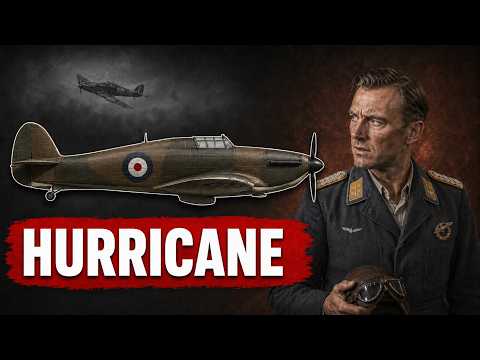
Video from the channel British Bastion about Hawker Hurricane, linked on its Above Ten Thousand entry. Duration: 26:10. Language: English. Video type: Documentary.
What it's about
Narrated documentary that contrasts the Luftwaffe's technical assessment of the Hawker Hurricane with its performance in the Battle of Britain. It starts from the comparative trials at Rechlin in August 1940, in which Werner Mölders flew a Hurricane captured in France against his Bf 109. His conclusion was that it was a docile aircraft, but clearly inferior.
Historical context
The video explains that Josef "Beppo" Schmid's intelligence assessment of 16 July 1940 judged the RAF inferior and estimated British production at about 250 fighters a month, when 496 were actually built in July. It also failed to mention the Chain Home coastal radar. It places Sydney Camm's design within the 1934 specification: steel-tube structure, linen covering and components meant to be repaired in the field with hand tools. The prototype flew at Brooklands on 6 November 1935 with George Bulman at the controls. 178 Hurricanes were left abandoned in France, and at least three ended up at Rechlin.
Key facts
According to the video's figures, a Hurricane required 10,300 man-hours against the Spitfire's 15,200, and could be rearmed and refuelled in 9 minutes against 26. In July 1940 there were 396 operational Hurricanes against 228 Spitfires. It is credited with 656 kills against the Spitfire's 529, around 60% of Fighter Command's victories.
The video recounts the action of James Brindley Nicolson, of 249 Squadron, who on 16 August 1940 shot down a German fighter from his burning cockpit and received the Victoria Cross. It also highlights the Polish 303 Squadron, with 126 kills in 42 days, and the Czech sergeant Josef František, with 17. Finally, it covers the aircraft's weaknesses: it was slower and climbed worse than the Bf 109, the carburettor cut out under negative g, and the fabric fuselage carried a fire risk.