Fighter · Military · United Kingdom
Hawker Hurricane
- In service
- Status


-1600.webp)


-1600.webp)


-1600.webp)


-1600.webp)


-1600.webp)

-1600.webp)


-1600.webp)
-1600.webp)
-1600.webp)


_1260-800.webp)


-1600.webp)
-1600.webp)
_Squadron%3B_in_t-1600.webp)


_(16997750987)-1600.webp)

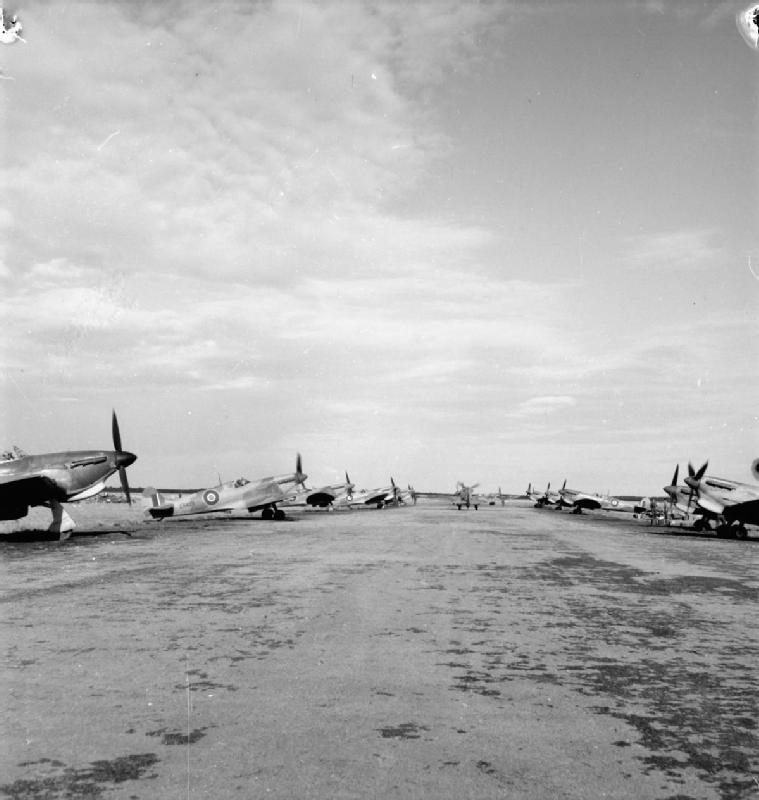
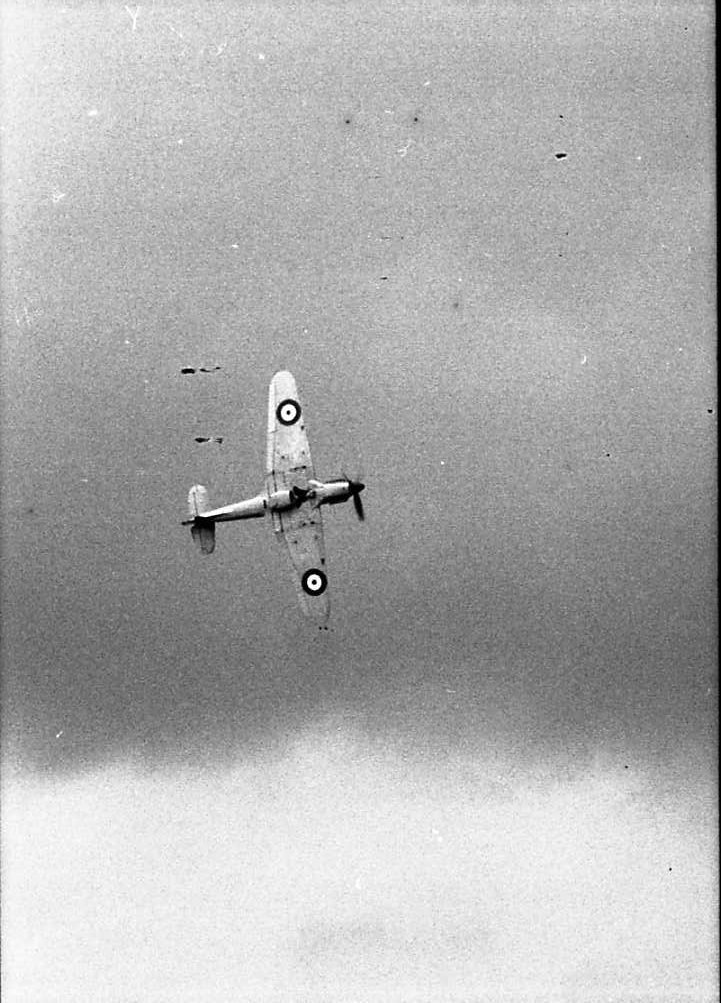
The Hawker Hurricane was the single-seat fighter with which the Royal Air Force went to war in 1939, and the first British fighter monoplane to combine a retractable undercarriage with eight machine guns buried in the wings. Designed by Sydney Camm for Hawker Aircraft Ltd., it has always been overshadowed in popular memory by the Supermarine Spitfire, yet it was the Hurricane that inflicted 60% of the losses suffered by the Luftwaffe during the Battle of Britain, and the Hurricane that fought in every major theatre of the Second World War, from northern France to Burma and from the Arctic to the Libyan desert. The design grew out of conversations Camm held in 1933 with the Air Ministry's Directorate of Technical Development about a monoplane derived from the Hawker Fury biplane, at a time when the Air Staff was still institutionally suspicious of monoplane fighters. The four-gun 'Fury Monoplane' gave way to an 'Interceptor Monoplane' laid out around the new PV.12 engine — the future Rolls-Royce Merlin — presented to the Air Ministry in September 1934 and ordered as a prototype later that year. K5083 first flew on 6 November 1935 in the hands of Hawker's chief test pilot, Flight Lieutenant George Bulman, reaching 315 mph at 16,200 feet: a performance the Messerschmitt Bf 109 would not match until the E series of 1939. Production began in 1936 under an initial contract for 600 aircraft placed on 2 June, and the first production Hurricane I, powered by a Merlin II, flew on 12 October 1937 with Philip Lucas at the controls. That December the first four aircraft reached No. 111 Squadron at RAF Northolt, which had sixteen by February 1938. The airframe was deliberately conventional: a braced metal-tube fuselage with fabric covering over formers, and wings fabric-covered at first and metal-skinned later. The choice cost speed against the stressed-skin Spitfire, but it made the aircraft quick to build and, more importantly, let squadrons carry out major repairs without outside support — a decisive advantage in the summer of 1940. By the outbreak of war in September 1939 more than 550 Hurricanes had been produced and eighteen squadrons flew them. Four of those squadrons — Nos. 1, 73, 85 and 87 — went to France, with three more rushed across after the German offensive of 1940. In the Battle of Britain the Hurricane carried the bulk of the work against the bomber formations: its lower wing loading let it turn inside a Bf 109, even though it lost out in speed and rate of climb. The action of 16 August 1940, in which James Brindley Nicolson of No. 249 Squadron pressed his attack with the cockpit ablaze, earned him the Victoria Cross; the highest-scoring Hurricane of the battle was P3308, flown by Archie McKellar of 605 Squadron. Malta, North Africa — nine Hurricane squadrons took part in Operation Crusader at the end of 1941 — and ground attack came next, and it was in that last role that an outclassed fighter found a second life. The Mk II 'universal wing' could take two 250 or 500 lb bombs, 40 mm cannon, small bomb containers, drop tanks or eight RP-3 rockets; the anti-tank Mk IID mounted two 40 mm Vickers S guns with fifteen rounds each, plus extra armour for pilot, radiator and engine. At El Alamein six squadrons claimed 39 tanks, 212 lorries and armoured troop carriers, 26 bowsers and 42 guns. The Sea Hurricane, fitted with an arrestor hook, became operational in mid-1941 and scored its first kill from HMS Furious on 31 July; the catapult-launched examples carried by CAM merchant ships were fired off operationally on eight occasions, downing six enemy aircraft for one pilot killed. A total of 2,776 Hurricane Mk IIs were shipped to the Soviet Union, and RAF Nos. 81 and 134 Squadrons took the first of them to Murmansk in September 1941. Production ended in July 1944 with 14,487 aircraft completed in Britain and Canada — Canadian Car and Foundry finished its first in February 1940 and built 915 Mk II airframes between November 1941 and May 1943 — alongside others assembled in Belgium and Yugoslavia and small export batches for operators such as Belgium, Romania, Turkey, Iran and Yugoslavia. The Hurricane was neither the fastest fighter of its generation nor the most elegant, but it was the one available in quantity when quantity mattered, and the one that accepted without complaint the guns, armour and missions it had never been designed for. A handful still fly, among them PZ865 and LF363 of the RAF's Battle of Britain Memorial Flight.
Category
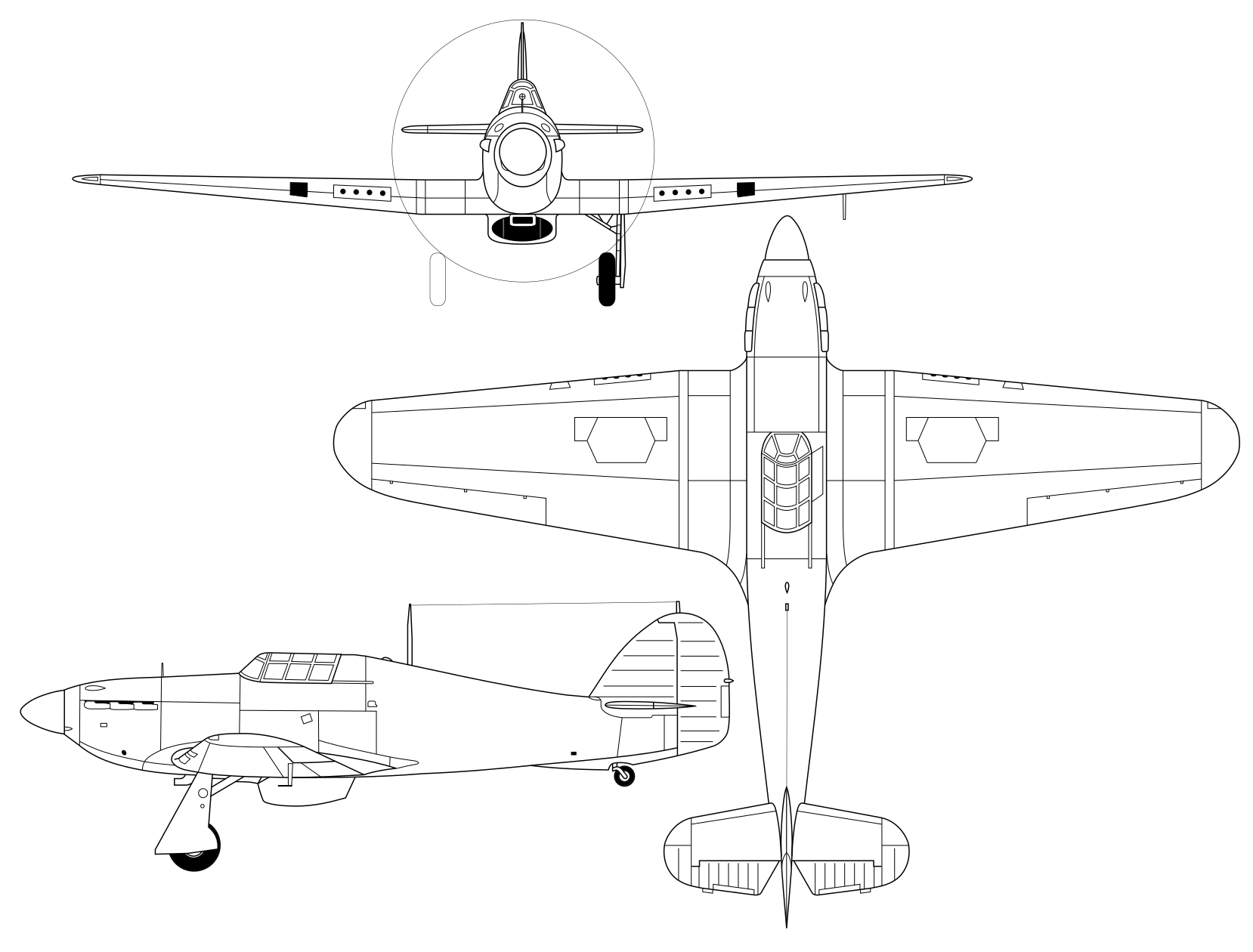
Three-view drawing
History
A fighter nobody had ordered
In the early 1930s RAF Fighter Command had thirteen squadrons, equipped with Hawker Fury, Hawker Demon and Bristol Bulldog biplanes: wooden fixed-pitch propellers, fixed undercarriages, open thinking about the future of air fighting only in places. Resistance to change within the Air Staff was institutional. Some senior figures held a declared prejudice against the monoplane fighter; officers of middle rank tended to be more open-minded. In that climate the aircraft that would carry the weight of Britain's air defence in 1940 was born, and it was born largely on its own manufacturer's initiative.
The origin was not an official requirement but a conversation. During 1933 the designer Sydney Camm held meetings with Major John Buchanan of the Directorate of Technical Development about a monoplane derived from the Fury already in service. The historian Francis K. Mason credits these discussions between Camm and RAF figures — among them Squadron Leader Ralph Sorley — with having prompted the later specification and some of its details, in particular the preference for mounting the armament in the wings rather than in the nose.
A scheme for the "Fury Monoplane" was drawn up in December 1933 — Goshawk power from Rolls-Royce, a pair of guns carried in the wings and a second pair in the nose — and taken to Roger Liptrot at the Air Ministry for discussion. The design was reworked around the PV.12 engine and in May 1934 detailed working drawings of what was then called the Interceptor Monoplane began. On 4 September 1934 the finished design went before the Air Ministry.
Before that there had been a rejection. Camm's initial response to the F.7/30 fighter specification had been the Hawker P.V.3, a development of the Fury; the P.V.3 was not among the proposals selected for prototype construction under official contract. After that rebuff Camm started over: a cantilever monoplane, undercarriage fixed, Goshawk power and four machine guns — a pair in the wings, a pair in the fuselage timed to shoot through the turning propeller as the Gloster Gladiator's did. By January 1934 the detail drawings were finished, and they did not impress the Ministry enough for a prototype to be ordered.
Camm's reaction to that second refusal is what changed the project: a retractable undercarriage and, in place of the unsatisfactory Goshawk, a fresh Rolls-Royce design carrying the initial designation PV-12 — the engine later celebrated as the Merlin. A one-tenth scale model followed in August 1934, going to Teddington for wind-tunnel work at the National Physical Laboratory; the runs there showed the aerodynamics to be satisfactory. In September 1934 Camm went back to the Air Ministry. This time the response was favourable and a prototype of the Interceptor Monoplane was ordered without delay.
Eight guns: the decision that saved the summer of 1940
The decisive meeting came in July 1934 under the chairmanship of Air Commodore Arthur Tedder, at that time Director of Training, where the Air Ministry scientific officer Captain F. W. "Gunner" Hill laid out his arithmetic: no future fighter should go up with fewer than eight machine guns, every one of them able to put out 1,000 rounds per minute. The person who helped him make those calculations was his thirteen-year-old daughter Hazel.
The decision was not uncontested. Claude Hilton Keith, at the time Deputy Director of Research and Development of Armament, remembered it this way: "The battle was brisk and was carried to very high quarters before authority was given to implement it. My department had built up a strong case in favour of the eight-gun fighters and if that recommendation had not been accepted and we had been content with half-measures we might indeed have fared badly during the late summer of 1940." Also present at the meeting was Squadron Leader Ralph Sorley of the Operational Requirements branch, who played an important part in the decision.
In November 1934 the Ministry issued specification F.5/34, which demanded eight guns for new fighters. By then work on the Hurricane was too far advanced for the planned four-gun installation to be altered immediately. A wooden mock-up was finished in January 1935 and inspected by Ministry staff at Kingston on the 10th of that month; the conference produced detail suggestions but cleared the prototype for construction, and a specification written around the design, F.36/34, followed. The prototype order was placed on 21 February 1935. In July 1935 the specification was amended to include the eight-gun installation.
That chronology shows where the armament actually stood in 1935: a pair of Vickers Mark V guns in the fuselage, with a single Browning in either wing. In July 1935 work started on stress-skinned outer wings to replace the fabric-covered ones, and in August the contract was altered to include another set of wings with eight guns housed in them, either Vickers or Browning. That set of wings was delivered in June 1936, with production already under way.
K5083: the prototype, the first flight and the trials
By the end of August 1935 the airframe was complete at Hawker's premises in Kingston upon Thames. The components were moved to Brooklands, in Surrey, where Hawker had an assembly shed, and the prototype was fully reassembled on 23 October 1935. Two weeks of ground testing and taxiing runs followed. On 6 November 1935 prototype K5083 flew for the first time in the hands of Hawker's chief test pilot, Flight Lieutenant George Bulman. Two further pilots assisted in the subsequent test programme: Philip Lucas flew some of the experimental test flights and John Hindmarsh conducted the company's production flight trials. As completed, the prototype carried ballast instead of armament, pending acceptance of the definitive gun-wing configuration.
By March 1936 the prototype had accumulated ten flying hours and covered all the important portions of the envelope. The early trials had gone reasonably well, particularly given the test status of the Merlin, which had not yet achieved full flight certification and was subject to severe usage restrictions. In early 1936 the aircraft moved to RAF Martlesham Heath, in Suffolk, where the first service trials were run under Squadron Leader D. F. Anderson. The RAF test pilot was Sammy Wroath, who years later would be the first commanding officer of the Empire Test Pilots' School: his report was favourable and left a phrase quoted ever since — "The aircraft is simple and easy to fly and has no apparent vices" — while also praising the controls.
Despite the Merlin's problems, which caused numerous breakdowns and forced several engine changes, the reports coming out of the trials were enthusiastic. Testing credited the aircraft with 315 mph (507 km/h) in level flight at 16,200 ft (4,900 m), 5.7 minutes to reach 15,000 ft (4,600 m), and a flaps-down stall at 57 mph (92 km/h) — barely above the figure for the Gladiator biplane. That last figure explains much of the aircraft's acceptance among pilots trained on biplanes: the new monoplane landed almost as slowly as the old one.
The trials also exposed a serious flaw: spin recovery was poor, and all rudder authority could be lost through blanking. Hawker's response was to request that spinning trials be waived, and the Air Ministry refused. The solution came from the Royal Aircraft Establishment, which established that the aerodynamic problem was caused by flow separation over the lower fuselage and could be cured by adding a small ventral fairing and extending the lower edge of the rudder. The finding came too late to incorporate into the earliest production aircraft: the modifications were introduced on the sixty-first machine built and all subsequent ones.
A steel bridge covered in fabric
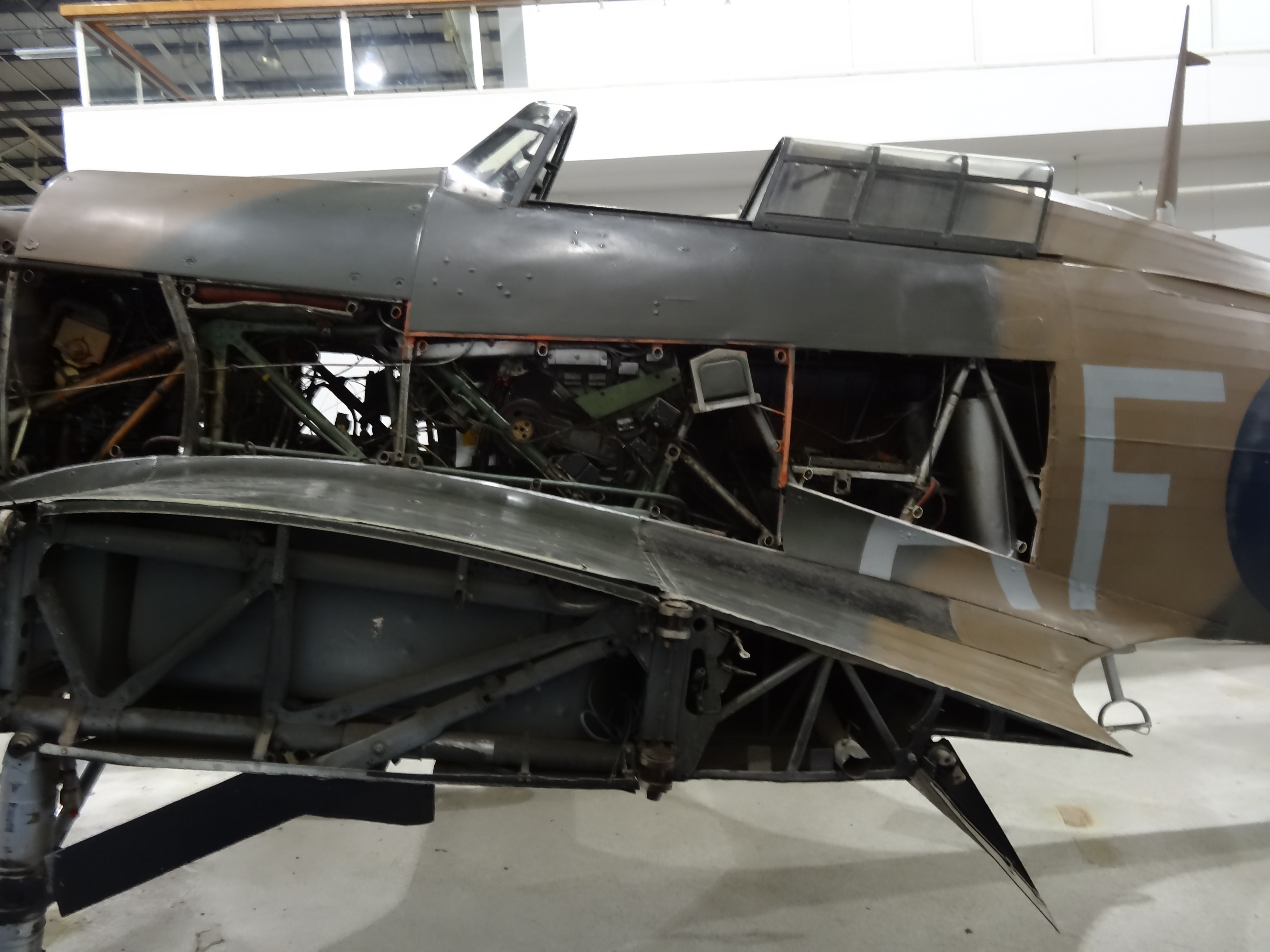
The Hurricane was a low-wing cantilever monoplane with a retractable undercarriage and an enclosed cockpit, and its structure was deliberately conservative. At the heart of the fuselage sat a Warren-truss box girder: longerons of high-tensile steel, cross-bracing in duralumin, the joints made mechanically instead of welded. Over that framework a secondary structure of wooden formers and stringers covered in doped linen gave the fuselage its rounded section. Linen covered most of the outside, the exception being the stretch running from the cockpit forward to the engine cowling, panelled in light metal. Camm chose the firm's traditional techniques over more advanced alternatives such as metal stressed-skin construction; that method of building resembled that of the earlier biplanes and was already considered somewhat dated when the Hurricane entered service.
The dated method turned out, in war, to be an operational advantage of the first order. One consequence of the steel-tube framework was that cannon shells could pass through the wood and fabric without detonating. And a damaged tube was no great matter: the repair was straightforward and ground crew could do it on the airfield. A stressed-skin airframe like the Spitfire's called for more specialised equipment when hit. The same architecture let Hurricanes be put together in the field with rudimentary means: machines arriving in crates were erected at Takoradi, in West Africa, then flown over the Sahara to reach the Middle East theatre, while some Royal Navy carriers kept their spare Sea Hurricanes broken down into major assemblies, slung from hangar bulkheads and the deckhead until they were wanted.
The wing was built around two steel spars of considerable strength and rigidity. *Flight* magazine judged it fairly simple to build: plain vertical jigs brought the two spars together, and the ribs then went on with horizontal bolts, each becoming a separate unit spanning front spar to rear. Split flaps on the trailing edge, worked by hydraulics, occupied the inboard end of each wing. This first wing was mostly fabric-covered, like the fuselage, with some light metal sheeting on the inner wing and leading edge. Most of the control surfaces — including the Frise-type ailerons — were likewise fabric-covered.
The undercarriage retracted inwards and the mainwheel legs sat in wells in the wing. The Vickers-built articulated telescopic legs were fixed to the front spar with an angled pivot, so that the shock absorber lay perpendicular to the thrust line when extended and swung rearward when retracted to clear the spar. A hydraulic jack moved the assembly, with two independent systems — one servo-assisted, one manual — and if both failed the pilot could release the up-locks and let the wheels drop by gravity. The wide track gave stability on the ground and allowed tight turns while taxiing, a detail that weighed in the choice of the Hurricane for France.
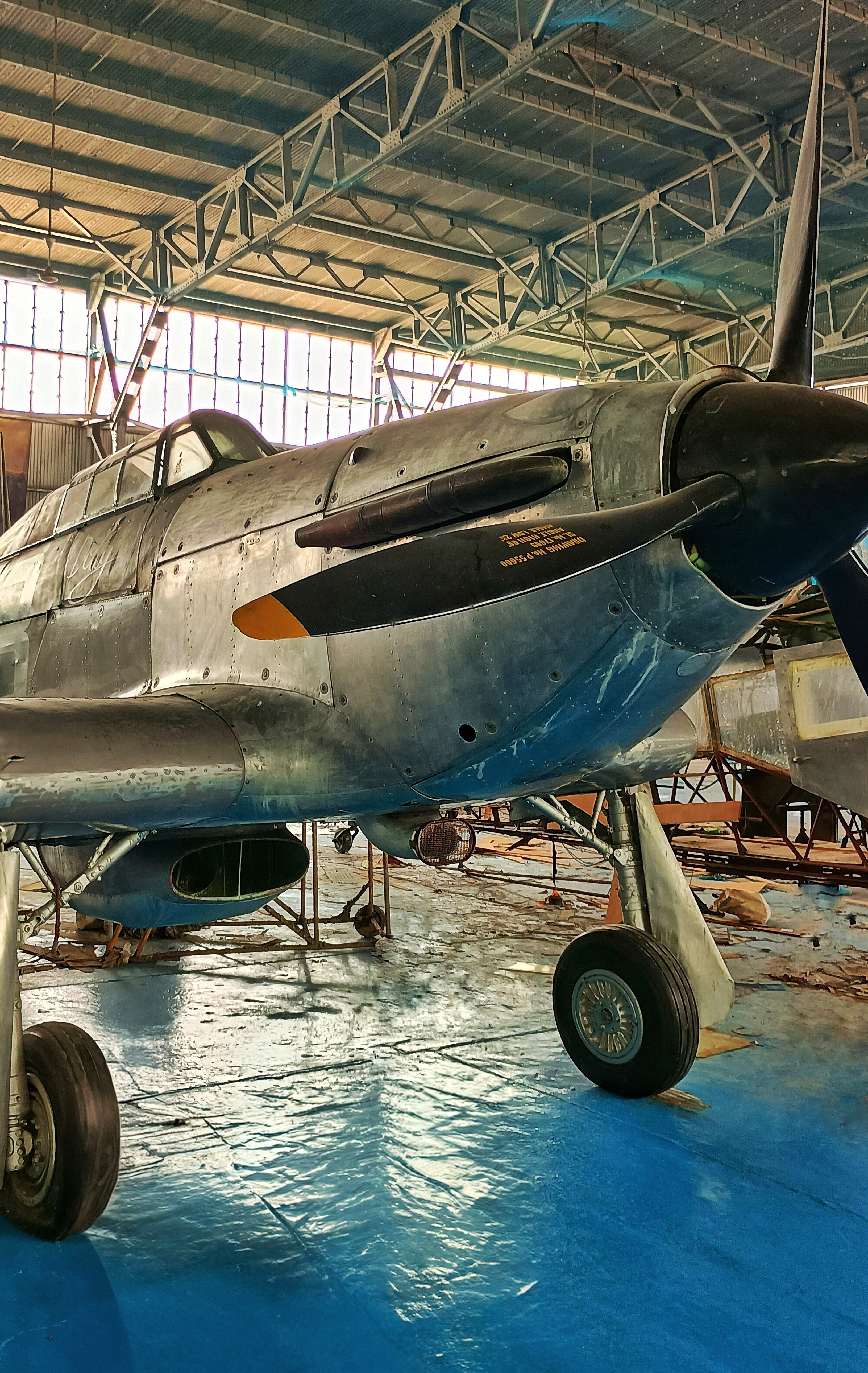
Under the fuselage the liquid-cooling radiator had a rectangular outlet aft covered by a hinged flap that allowed the pilot to regulate cooling. An unusual feature for the period was the use of Tungum alloy piping throughout the cooling system. A simple steel-tube structure supported the engine, and removable cowling panels gave access to almost the whole powerplant for maintenance. Camm's priority was visibility: the cockpit was mounted relatively high in the fuselage, which gave the aircraft its unmistakable hump-backed silhouette. Getting aboard was helped by a retractable stirrup step under the port wing's trailing edge, linked to a spring-loaded flap over a handhold set in the fuselage immediately aft of the cockpit; closing that flap pulled the step back up inside. Both wing roots also carried strips of non-slip material. The Hurricane was supplied equipped for day and night flying, with navigation lights, Harley landing lights, a full blind-flying panel and two-way radio. On entering service much of the performance data was deliberately withheld from the public, although it was released that the aircraft had a speed range of 6:1.
The metal wing and the propeller: two changes that changed the fighter
Two modifications separate the Hurricane of 1937 from the one that fought in 1940, and neither was visible from a distance.
The first was the wing. A fabric-covered wing was initially adopted to speed production, and in April 1939 a metal stressed-skin wing in duralumin (a DERD specification similar to AA2024) was introduced and used on all later versions. The difference was substantial: "The metal-covered wings allowed a diving speed 80 mph (130 km/h) higher than the fabric-covered ones. They were very different in construction, but interchangeable with the fabric wings; one test Hurricane, L1877, was flown with a fabric port wing and a metal starboard wing. The great advantage of the metal wings over the fabric-covered ones was that the metal wings could take much greater loads without needing as much structure." Changing an aircraft's wings required only three hours' work. Several fabric-winged Hurricanes were still in service during the Battle of Britain, although many had had their wings replaced during overhaul or after repair.
The second was the propeller. The prototype and the earliest production aircraft carried a two-bladed fixed-pitch Watts wooden propeller. *Flight* recorded the puzzlement of the day: "Many have expressed surprise that the Hurricane is not fitted with variable-pitch propellers." That two-blader proved inefficient at low speeds and imposed a long take-off run, something that worried Fighter Command. Trials with a de Havilland variable-pitch unit cut the take-off run to 750 ft (230 m) from 1,230 ft (370 m), and deliveries of it began in April 1939. Later came the hydraulically operated Rotol constant-speed propeller, which entered service in time for the Battle of Britain. The aviation author David Donald reckoned the Rotol lifted the Hurricane out of "disappointing" performance and into "acceptable mediocrity"; squadrons still flying the two-position de Havilland unit clamoured for the modified machines.
Against the Spitfire, its contemporary and of all-metal monocoque construction, the Hurricane was heavier and structurally weaker, though more tolerant of bullet damage. With its ease of maintenance, its wide-track undercarriage and its benign handling, it stayed in use in theatres where reliability, simple handling and steadiness as a gun platform mattered more than outright performance: above all in ground attack.
The first 600 and Hawker's industrial gamble
The decisive step in the Hurricane's industrial history was taken by the company, not the state. Frank Murdoch, a Hawker engineer, returned from a tour of several German diesel-engine manufacturers convinced that armament plans of enormous scale were under way in Germany. His findings went to Thomas Sopwith, who pressed the British government to see that the RAF needed modernising. What the Air Ministry offered at first was an order for twelve machines. In early 1936, in the absence of official authorisation and at the company's own expense, the Hawker board decided to release the design drawings to the production office and begin tooling up a line capable of building a batch of 1,000 Hurricanes.
The gamble paid off quickly. The Ministry's first substantial order, covering 600 aircraft, came in June 1936. On 26 June 1936 it approved the type name "Hurricane", proposed by Hawker, and the following month an informal naming ceremony was held during an official visit by King Edward VIII to Martlesham Heath.
The industrial decision rested on a real cost difference. The Hurricane was significantly cheaper to produce than the Spitfire and required 10,300 man-hours per airframe against the Spitfire's 15,200, many of whose parts were hand-formed with English wheels. With war in sight and time the critical factor, the authorities expected problems with the more advanced Spitfire, while the Hurricane used well-proven manufacturing techniques; service squadrons, moreover, already had experience of maintaining structurally similar aircraft.
The first production Hurricane I flew on 12 October 1937, piloted by Flight Lieutenant Philip Lucas and powered by a Merlin II. Hawker had the 600-aircraft contract in hand on 2 June 1936, yet deliveries ran some six months behind, the cause being a December 1936 decision: out went the Merlin I, in came the improved Merlin II, and with it a long tail of detail modifications. Merlin I production ended after 180 units; that engine had been prioritised for the Fairey Battle light bomber and for the Hawker Henley, the Battle's unsuccessful competitor, briefly adapted as a target tug and sharing common elements with the Hurricane's design.
By the outbreak of the Second World War more than 550 Hurricanes had been produced, equipping eighteen squadrons, with 3,500 more on order. During 1940 Lord Beaverbrook, Minister of Aircraft Production, created the Civilian Repair Organisation, through which several manufacturers repaired and overhauled battle-damaged aircraft, Hurricanes included; some of them subsequently went to training units or to other air forces. The plants drawn in included Cofton Hackett, run by the Austin Aero Company, and David Rosenfield Ltd, whose base was Barton aerodrome, near Manchester.
The final distribution of production gives the measure of the programme. In total about 14,487 Hurricanes and Sea Hurricanes were built in England and Canada. Hawker itself accounted for the bulk, 9,986 machines: Brooklands turned them out between December 1937 and October 1942, Langley aerodrome in Berkshire between October 1939 and July 1944. The sister company Gloster Aircraft Company built 2,750; the Austin Aero Company completed 300; Canadian Car and Foundry produced 1,451.
No. 111 Squadron and the flight of "Downwind" Gillan
The Hurricane entered service with No. 111 Squadron at Northolt: the first four aircraft arrived in December 1937, ahead of the official acceptance date of 1 January 1938. By February 1938 the squadron had received sixteen. It was the RAF's first monoplane fighter and the first capable of exceeding 300 mph.
By way of demonstration the squadron's commander, Squadron Leader John Gillan, took L1555 up on the night of 10 February 1938 and ran from Turnhouse, near Edinburgh, down to Northolt: 327 miles in 48 minutes, an average of 408.75 mph. A strong tailwind had helped, which earned him the ironic nickname "Downwind Gillan". It was a propaganda success that its own protagonist treated as a joke, and also the first time the British public associated the aircraft's name with a number. Gillan was killed in action in August 1941.
The most quoted testimony about that early period is Peter Townsend's in *Duel of Eagles*: "... By December [1938] we had our full initial equipment of sixteen aircraft. The Fury had been a delightful toy; the Hurricane was a thoroughly war-like machine, rock solid as a platform for eight Browning machine-guns, highly manoeuvrable despite its great proportions and with an excellent view from the cockpit. The Hurricane lacked the speed and glamour of the Spitfire and was slower than the Me 109, whose pilots would develop a contempt for it and a snobbish preference for [the Spitfire]."
The rate of deliveries soon exceeded the service's capacity to absorb them. By mid-1938 the first fifty Hurricanes had reached the squadrons, and it was assessed that production was running slightly ahead of the RAF's already accelerated ability to introduce the type. The British government then authorised Hawker to sell surplus aircraft to nations likely to oppose German expansion. Despite that expansion, at the time of the Munich Crisis only two Hurricane squadrons were fully operational out of the twelve planned. By the time Germany invaded Poland there were sixteen operational squadrons and two more converting.
France: from the Phoney War to the first victories
On 24 August 1939 the British government ordered a partial mobilisation, and RAF No. 1 Group, under Air Vice-Marshal Patrick Playfair, sent its ten squadrons of Fairey Battle day bombers across to France under plans settled with the French earlier that year. That group formed the leading echelon of the Advanced Air Striking Force (AASF), flying out from Abingdon, Harwell, Benson, Boscombe Down and Bicester.
Faced with a French request for ten fighter squadrons, Air Chief Marshal Sir Hugh Dowding, Commander-in-Chief of Fighter Command, insisted that such a number would seriously weaken British defences, so that at first only four Hurricane squadrons — Nos. 1, 73, 85 and 87 — were moved to France, keeping the Spitfires for home defence. No. 73 Squadron got there first, on 10 September 1939, with the other three close behind; Nos. 607 and 615 came out somewhat later.
The choice had a material logic: because of its robust construction, ease of field maintenance and repair, docile take-off and landing behaviour and wide-track undercarriage, the Hurricane was selected as the RAF's principal fighter in France. Two squadrons, Nos. 1 and 73, formed 67 Wing of the AASF — No. 1 at Berry-au-Bac north-west of Paris and No. 73 at Rouvres — while Nos. 85 and 87 formed 60 Wing of the British Expeditionary Force's Air Component.
Even the markings distinguished one from the other. The two squadrons of 60 Wing had their Hurricanes in the standard home-based fighter scheme and markings, while those of 67 Wing differed considerably: probably because they operated very close to French fighter squadrons, they painted red, white and blue stripes over the full height of their rudders, in the style of French national markings. British code letters meant nothing to the French squadrons, and the risk of mistaken identification was real, so both Hurricane units painted out their unit letters and kept only the individual aircraft letter, in grey, behind the fuselage roundel. The decision appears to have been taken at 67 Group headquarters to suit local circumstances.
The type's first action came in the opening weeks of the Phoney War, on 21 October 1939. That day "A" Flight of No. 46 Squadron took off from the satellite airfield at North Coates on the Lincolnshire coast, ordered to intercept a formation of nine Heinkel He 115B floatplanes of 1/KüFlGr 906 hunting for ships to attack in the North Sea. Hugging the sea to stay clear of fighters, the Heinkels had already been hit and damaged by a pair of Spitfires from No. 72 Squadron by the time six Hurricanes found them. Four went down in quick succession to the Hurricanes; No. 46 Squadron's claim came to five, with two more claimed by the Spitfire pilots.
On 30 October 1939 Pilot Officer P. W. O. "Boy" Mould of No. 1 Squadron, flying Hurricane L1842, shot down a Dornier Do 17P of 2(F)/123. Sent to photograph Allied airfields close to the frontier, the German machine went down burning about 10 miles (16 km) west of Toul. That made Mould the first RAF pilot of the Second World War to bring down an enemy aircraft over continental Europe. Mason holds that what was learned in those first fights proved invaluable for tactics, which were tried out and passed quickly round Fighter Command.
The first encounter with a Messerschmitt Bf 109 fell to Pilot Officer Peter Ayerst, of No. 73 Squadron, on 6 November 1939; he came home with five holes in his fuselage. No. 73 Squadron's first victory was scored on 8 November 1939, from Rouvres, by the New Zealand Flying Officer "Cobber" Kain, who would become one of the RAF's first fighter aces of the war with sixteen credited victories. First losses in France came on 22 December: three machines trying to intercept an unidentified aeroplane between Metz and Thionville were jumped by four Bf 109Es of III./JG 53, whose Gruppenkommandeur was the Spanish Civil War ace Werner Mölders. Shooting between them, Mölders and Leutnant Hans von Hahn accounted for the Hurricanes flown by Sergeant R. M. Perry and of J. Winn without loss to themselves.
The most flattering testimony of that campaign is Roland Beamont's, who first flew a Hurricane in October 1939 and fought with No. 87 Squadron, claiming three enemy aircraft during the campaign in France: "Throughout the bad days of 1940, 87 Squadron maintained a competent formation aerobatic team; the crisp controls and docile engines permitted precision formations through loops, slow rolls, 1g stall turns and rolls off the top... My Hurricane was never hit in the battles for France and Britain, and in over 700 hours on the type I never suffered an engine failure."
May 1940: the Battle of France
In May 1940, with the momentum of the German Blitzkrieg already under way, Nos. 3, 79 and 504 Squadrons reinforced the earlier units. Two men of No. 73 Squadron were the first RAF pilots into combat when the Battle of France opened on 10 May: Flight Lieutenant R. E. Lovett and Flying Officer "Fanny" Orton, who attacked one of three Dornier Do 17s of 4. Staffel/KG 2 flying over their airfield at Rouvres-en-Woëvre. The Dornier escaped unharmed and Orton, hit by defensive fire, had to make a forced landing. That same day Hurricane squadrons claimed 42 German aircraft shot down — none of them fighters — in 208 sorties; seven Hurricanes were lost with no pilots killed.
On 12 May several Hurricane units were assigned to escort bombers. That morning five volunteer Fairey Battle crews of No. 12 Squadron took off from Amifontaine to bomb the Vroenhoven and Veldwezelt bridges over the Meuse at Maastricht. The escort was eight Hurricanes of No. 1 Squadron, led by Squadron Leader P. J. H. "Bull" Halahan. Sixteen Bf 109Es of 2./JG 27 fell on the formation as it neared Maastricht. Shot down were two Battles and two Hurricanes, Halahan's among them; anti-aircraft fire claimed two further Battles, and the fifth bomber came down in a forced landing. The pilots of No. 1 Squadron claimed four Messerschmitts and two Heinkel He 112s; the Luftwaffe in fact lost a single Bf 109. It is an early and well-documented example of the gap between claims and actual losses that runs through the aircraft's whole history.
On 13 May another 32 Hurricanes arrived. The ten squadrons requested were now operating from French soil and took the full force of the offensive. The next day the Hurricanes suffered very heavy losses: 27 shot down, 22 of them by Messerschmitts, with fifteen pilots killed — another died days later — among them Squadron Leader J. B. Parnall of No. 504 and the Australian ace Flying Officer Les Clisby of No. 1 Squadron. That same day No. 3 Squadron claimed seventeen German aircraft destroyed, Nos. 85 and 87 together four victories and No. 607 nine. Across the next three days, 15 to 17 May, losses to combat and accidents together reached 51 Hurricanes.
A week into the fighting, on 17 May, no more than three squadrons stood anywhere near operational strength — even though the Hurricanes had destroyed nearly double the German aircraft they had lost. Fighting ran from first light to dusk on 18 May, with Hurricane pilots claiming 57 German aircraft plus 20 probables; the Luftwaffe's own records put its losses at 39. The following day Nos. 1 and 73 Squadrons claimed eleven, three of them by "Cobber" Kain and three by Paul Richey. Over those two days losses were heavier: 68 Hurricanes shot down or forced to crash-land through combat damage, fifteen pilots killed, eight taken prisoner and eleven injured. Two thirds had fallen to Bf 109s and Bf 110s.
Orders reached the Hurricane units in northern France on the afternoon of 20 May 1940: give up their continental bases and go home to Britain. The same day "Bull" Halahan asked that No. 1 Squadron's pilots be sent home: across the previous ten days theirs had been the campaign's most effective unit, 63 victories claimed against five pilots lost — two killed, one a prisoner, two in hospital — and the Blitzkrieg brought it ten DFCs and three DFMs. Come the evening of 21 May, the AASF's machines, shifted to bases around Troyes, were the only Hurricanes left operational.
The overall reckoning for those eleven days of fighting over France and Dunkirk, from 10 to 21 May, was 499 kills and 123 probables claimed by Hurricane pilots. Contemporary German records, examined after the war, credit RAF fighters with 299 Luftwaffe aircraft destroyed and 65 seriously damaged. The last 66 Hurricanes of the 452 committed to the Battle of France left the country on 21 June; 178 were abandoned at various airfields, chiefly Merville, Abbeville and Lille/Seclin. Accounts differ according to source and time frame: the historian John Rickard, confining himself to the seven Hurricane squadrons that took part in the Battle of France, puts their losses at nearly 200 aircraft, 72 destroyed and 120 damaged and abandoned during the final retreat.
Dunkirk and the +12 lb boost
Through Operation Dynamo — the lifting from Dunkirk of the British, French and Belgian troops the German army had surrounded — the Hurricanes flew from bases in Britain. The fourteen Hurricane units taking part were credited with 108 aerial victories between 26 May and 3 June 1940. Twenty-seven Hurricane pilots became aces during Dynamo, led by the Canadian Pilot Officer W. L. "Willie" McKnight with ten victories and Pilot Officer Percival Stanley Turner with seven, both of No. 242 Squadron, largely manned by Canadian personnel. Against that, 22 pilots were killed and three taken prisoner. One of the Blitzkrieg's last great mass encounters came on 27 May 1940, when thirteen Hurricanes of No. 501 Squadron met a formation of 24 Heinkel He 111s with 20 Bf 110s escorting; the squadron claimed eleven of the Heinkels shot down and others damaged, at minimal cost to itself.
The campaign also claimed its first ace. On 7 June 1940 "Cobber" Kain was told he was to return to England to an operational training unit for a "rest". On leaving his airfield he threw an impromptu aerobatic display, and it killed him: the Hurricane crashed as he tried fast rolls low down after coming out of a loop.
The first encounters with the Luftwaffe had shown that the Hurricane was a stable, tight-turning platform, but that the two-bladed Watts propeller was clearly inadequate: at least one pilot complained that a Heinkel 111 — by then already obsolete — could pull away from him in a chase. When war began the engine was running on the standard 87-octane aviation fuel. Growing quantities of 100-octane fuel shipped in from the United States came on stream from early 1940, and February of that year saw Hurricanes with Merlin II and III engines start to receive the modification that permitted a further 6 psi (41 kPa) of supercharger boost over five minutes — though accounts exist of pilots holding it for thirty.
The extra boost, which increased engine power by almost 250 hp (190 kW), gave the Hurricane a speed increase of about 25 to 35 mph (40 to 56 km/h) below 15,000 ft (4,600 m) and greatly improved its rate of climb. "Overboost", or "pulling the plug" — war emergency power in an early guise — counted among the significant wartime modifications: it put the Hurricane on better terms with the Bf 109E and stretched its advantage over the Bf 110C, low down above all. On "emergency boost" at +12 psi (83 kPa) the Merlin III was good for 1,310 hp (980 kW), measured at 9,000 ft (2,700 m).
No. 87 Squadron's Flight Lieutenant Ian Gleed set down what the extra boost did for him as he chased a Bf 109 low down on 19 May 1940: "Damn it! We're going flat out already. Here goes the plug. A jerk – boost's shot up to 12 pounds; speed's increased by 30 mph. I'm gaining on him: 700, 600, 500 yards. Give him a burst. No, hold your fire, you fool! He hasn't seen you yet..." His ammunition gave out before he could finish it off, though he left it badly damaged and flying at about 50 ft (15 m).
The Battle of Britain: 55 per cent of the kills
France had fallen, and by the close of June 1940 Hurricanes equipped 31 of the 61 fighter squadrons in Fighter Command. Officially the Battle of Britain ran from 10 July to 31 October 1940, but the hardest fighting fell between 8 August and 21 September.
The division of roles was fixed by Dowding's doctrine and by respective performance: broadly, the Spitfires intercepted the German fighters and left the Hurricanes to concentrate on the bombers. Despite the Spitfire's undisputed capabilities, it was the "workhorse" Hurricane that scored the greater number of RAF victories in the period: according to Fighter Command, 55 per cent of the 2,739 German losses, against 42 per cent for the Spitfires. In a broader accounting of the whole campaign the Hurricane has been credited with 60 per cent of the losses suffered by the Luftwaffe. On 8 August 1940 the Hurricanes of No. 145 Squadron were the first to open fire in the battle. The highest-scoring Hurricane squadron was No. 303, Polish, which also had the best ratio of enemy aircraft destroyed to its own losses.
As a fighter the Hurricane had clear shortcomings. It was somewhat slower than the Spitfire I and II and than the Messerschmitt Bf 109E, and the thicker aerofoil sections compromised acceleration; but it could turn inside both. Outperformed by the Bf 109 though it was, the Hurricane could still destroy the German fighter, particularly lower down. The standard 109 tactic was to climb above the British fighters and "bounce" them in a dive; the Hurricanes could evade that manoeuvre by turning into the attacker or entering a "corkscrew dive" that the 109s, with their lower rate of roll, had difficulty following. If a 109 was caught in a turning fight, the Hurricane was as capable of turning inside it as the Spitfire. In a straight tail chase, on the other hand, the 109 could escape.
Between 10 July and 11 August 1940, RAF fighters opened fire on 114 German bombers and brought down 80 of them — 70 per cent; of 70 Bf 109s attacked, 54 fell, a rate of 77 per cent. It has been suggested that part of that performance was due to the use of the de Wilde incendiary round. In September 1940 the more powerful Hurricane Mk IIA Series 1, capable of 342 mph (550 km/h), began to enter service, though only in small numbers.
P3308, a Mk I, was the battle's highest-scoring Hurricane; the RAF auxiliary pilot Archie McKellar of No. 605 Squadron flew it from 15 August to 7 October 1940. He is credited with 21 kills, nineteen of them in a Hurricane during the battle. Five Bf 109s were credited to him on 7 October, a feat that made him one of just two RAF pilots to go "ace in a day" in the battle; the other was the New Zealander Brian Carbury. In his short combat career he won the DSO and the DFC and Bar. McKellar has remained in relative obscurity in the history of the battle because he was killed in action one day after the date the War Ministry set, after the war, as the official end of the campaign: he fell on 1 November 1940 taking on greatly superior numbers of Bf 109s.
The price of fabric: fire, the gravity tank and Linatex
The Hurricane was a stable gun platform and had proved its ruggedness — several returned to base badly damaged — but its construction made it dangerous if it caught fire: the wooden structure and fabric covering of the rear fuselage allowed fire to spread readily aft. Worse, the gravity fuel tank in the forward fuselage sat directly in front of the instrument panel, with no form of protection for the pilot. Many Hurricane pilots suffered serious burns from the jet of flame that could blow through the panel.
The matter worried Hugh Dowding enough that he had Hawker retrofit the fuselage tanks with Linatex, a self-expanding rubber covering: if a bullet punctured the tank, the Linatex swelled as it soaked in petrol and sealed the hole. Some pilots argued otherwise: the wing tanks, Linatex-covered as well, lay open to fire from astern, and it was they rather than the fuselage tank that posed the chief fire risk.
On top of that came a fault the Spitfire shared: the Merlin cut out under negative G, and nothing cured it until the device known as "Miss Shilling's orifice" arrived in early 1941.
Nicolson: Fighter Command's only Victoria Cross
The only Victoria Cross of the Battle of Britain, and the only one awarded to a member of Fighter Command in the whole war, was earned aboard a Hurricane. The award went to Flight Lieutenant James Brindley Nicolson, of No. 249 Squadron, for what he did on 16 August 1940, when Bf 110s dived on his section of three Hurricanes from above. All three took hits at once. Nicolson himself was badly wounded, his Hurricane damaged and burning. While trying to leave the cockpit he noticed that one of the Bf 110s had overshot in front of his aircraft; he climbed back into what was by then a blazing seat, attacked the enemy and may have shot it down. He then parachuted and landed safely in a field, where he was mistakenly fired on by members of the Home Guard who ignored his shouts that he was an RAF pilot.
Nicolson had been born in Hampstead, London, on 29 April 1917. He was educated at Yardley Court and Tonbridge School; in 1935 he began his career as an engineer with Ricardo Engines and in 1936 he joined the Royal Air Force with service number 39329. After training he joined No. 72 Squadron in 1937 and moved to No. 249 in 1940. He was 23 years old when the decoration was awarded; on that 16 August he had taken off from RAF Boscombe Down near Salisbury.
The announcement and citation were published in a supplement to the *London Gazette* on 15 November 1940: "During an engagement with the enemy near Southampton on 16th August, 1940, Flight Lieutenant Nicolson's aircraft was hit by four cannon shells, two of which wounded him whilst another set fire to the gravity tank. When about to abandon his aircraft owing to flames in the cockpit he sighted an enemy fighter. This he attacked and shot down, although as a result of staying in his burning aircraft he sustained serious burns to his hands, face, neck and legs."
His recovery complete by September 1941, Nicolson went out to India in 1942. From August 1943 to August 1944 he commanded No. 27 Squadron as a Squadron Leader, taking Bristol Beaufighters over Burma; the Distinguished Flying Cross came to him in those months. By then a Wing Commander, he was killed on 2 May 1945: the No. 355 Squadron B-24 Liberator he had gone up in as an observer caught fire and fell into the Bay of Bengal. No body was ever recovered; his name is on the Singapore Memorial. His Victoria Cross is on display at the Royal Air Force Museum in Hendon. For the battle's 75th anniversary in 2015 the RAF finished a modern Eurofighter Typhoon, ZK349, in Second World War colours and put Nicolson's squadron codes, GN-A, on it.
The Polish 303 and the Hurricane aces
The highest-scoring Hurricane squadron of the Battle of Britain was No. 303, Polish, which also achieved the best ratio of enemy aircraft destroyed to its own losses in the whole campaign. Among its pilots flew the Czech Josef František, who shot down at least seventeen enemy aircraft over south-east England between September and October 1940, and the Pole Witold Urbanowicz, with fifteen confirmed victories and one probable during the battle.
The list of the pilots who scored most heavily aboard the Hurricane spans much of the map of the war. Squadron Leader Marmaduke "Pat" Pattle ran up 35 victories on Hawker fighters with Nos. 80 and 33 Squadrons, part of a career total of fifty plus two shared; every one of his Hurricane kills came over Greece in 1941, and the Battle of Athens, on 20 April 1941, was where he was shot down and killed. Flying Hurricanes between 1939 and 1943, Wing Commander Frank Reginald Carey claimed 28 aerial victories. Squadron Leader William "Cherry" Vale scored twenty of a total of thirty in Greece and Syria with No. 80 Squadron. The Czech Flight Lieutenant Karel Kuttelwascher achieved all eighteen of his aerial victories in Hurricanes, most of them as a night intruder with No. 1 Squadron. Wing Commander Mark Henry Brown scored eighteen victories with No. 1 Squadron, was the first Canadian ace of the war and was killed on a strafing mission over Sicily in November 1941. Wing Commander Ian Gleed claimed most of his thirteen victories flying Hurricanes with No. 87 Squadron, from the Battle of France to the end of 1941. Pilot Officer Vernon Crompton Woodward of Nos. 33 and 213 Squadrons scored fourteen of his eighteen, three shared; Flying Officer Willie McKnight achieved at least seventeen in Hurricanes; Flight Lieutenant Richard P. Stevens claimed his 14.5 enemy aircraft entirely on the type. Richard "Dickie" Cork led the Fleet Air Arm's Sea Hurricane aces: nine destroyed and two shared, one probable, four damaged, plus seven destroyed on the ground.
Squadron Leader Douglas Bader flew Hurricanes too, in No. 242 Squadron through the Battle of Britain; his credit stands at 22 aerial victories with four shared, six probables and one shared probable, and eleven enemy aircraft damaged. Among the notable pilots is Air Chief Marshal Arjan Singh, DFC, a decorated British Indian fighter pilot honoured for his flying in the Burma campaign, who would become India's Chief of the Air Staff. Second Officer Winifred Crossley Fair, an Air Transport Auxiliary pilot, was the first woman to fly a Hawker Hurricane. And the writer Roald Dahl flew a Hurricane in the Battle of Athens, an episode he recounted in his second autobiography, *Going Solo*.
Night fighter and intruder over occupied Europe
The original specification had asked that both types, Hurricane and Spitfire alike, be fit for night fighting. The Hurricane proved a relatively straightforward aircraft to fly at night and shot down several German aircraft during night raids. From early 1941 it was also used as an "intruder", patrolling German airfields in France by night to catch bombers taking off or landing.
After the Battle of Britain the Hurricane remained in service, and during the Blitz of 1941 it was Fighter Command's principal single-seat night fighter. Flying Hurricanes in 1941, Flight Lieutenant Richard Stevens claimed fourteen Luftwaffe bombers. The cannon-armed Mk IIC ranged further out in 1942, intruding by night over occupied Europe; top of that list was Flight Lieutenant Karel Kuttelwascher of No. 1 Squadron, with fifteen German bombers claimed. Also in 1942, twelve Hurricane II C(NF) night fighters were built, equipped with Mark VI air interception radar operated by the pilot himself. After a brief operational deployment with Nos. 245 and 247 Squadrons, in which they proved too slow to operate in Europe, those aircraft were sent to India to serve with No. 176 Squadron in the defence of Calcutta, and were withdrawn from service at the end of December 1943.
The Mk II: Merlin XX, twelve guns and four cannon
The first production version, the Hurricane Mk I, had fabric-covered wings, a two-bladed fixed-pitch wooden propeller on the first 435 aircraft — or a three-bladed two-position unit afterwards — a Rolls-Royce Merlin Mk II of 1,030 hp (770 kW) on the first 364 or a Merlin III, and eight .303 in (7.7 mm) Browning machine guns. It was produced between 1937 and 1939. The revised Mk I series — constant-speed propellers by de Havilland or Rotol from February 1940, metal wings, armour and further improvements — took the Mk I total to 4,200: Hawker 1,924, the Gloster Aircraft Company 1,850 and Canadian Car and Foundry 426, all between December 1937 and October 1941. Thirty stayed in Canada; the rest of the Canadian Car and Foundry machines crossed to England for their engines to be fitted.
The real step change came with the Mk IIA Series 1, a Mk I with the improved two-speed supercharged Merlin XX. Its coolant was a mixture of 70 per cent water to 30 per cent glycol; since neat glycol burns, the change brought safety as well as a running temperature some 21 °C (38 °F) lower, and with it longer engine life and better reliability. The Merlin XX was longer than earlier marks, so the Hurricane gained a 4.5 in "plug" ahead of the cockpit, which made the aircraft slightly more stable through the small forward shift of the centre of gravity. It first flew on 11 June 1940 and entered squadron service in September 1940. Hawker built 418 and Gloster 33.
The Mk IIB added four more .303 in Browning machine guns in the wings, twelve in all, and 230 aircraft left the factory with racks allowing two 250 lb (110 kg) or 500 lb (230 kg) bombs to be carried. This lowered the Hurricane's top speed to 301 mph (484 km/h), but by then mixed sweeps of bomb-carrying Hurricanes screened by fighter Hurricanes were not uncommon. The same racks allowed two 45 imp gal (200 L) drop tanks to be carried instead of the bombs, nearly doubling the fuel load. 3,178 Mk IIBs were built in Britain up to November 1942 — 2,011 by Hawker, 867 by Gloster and 300 by Austin Aero — plus a further 515 by Canadian Car and Foundry between November 1941 and March 1943; many of the Canadian machines were fitted with "C" cannon wings before delivery to the RAF.
The Mk IIC replaced the machine-gun armament with four 20 mm Hispano Mk II cannon, two per wing. Later the new wings gained a hardpoint able to take a bomb of 500 or 250 lb (230 or 110 kg), and after that fuel tanks. By then performance was inferior to that of the latest German fighters and the Hurricane turned towards ground attack, under the informal designation "Hurribomber". Night fighting and intruder work also fell to the Mk IIC, and roughly three quarters of them were turned into fighter-bombers. Hawker built 4,751 Mk IICs between February 1941 and July 1944, making it the most numerous sub-variant of the type.
There were also designations that never became official. "Mk IIE" was used informally by the RAF for one hundred Mk IIBs with factory-fitted bomb racks built between September and December 1941, later redesignated Mk IIBB; the Ministry of Aircraft Production also used it between March and October 1942, with a total of 270 aircraft considered, and a signal to the Middle East dated 31 October 1942 clarified that the IIE was not an official mark. The Mk III, a version of the Mk II with an American Packard-built Merlin intended to release British engines for other designs, was abandoned: probably only two Canadian-built aircraft were flight-tested in Britain with Merlin 28s from May or June 1942, before becoming Merlin XX-powered Mk IIBs, and by the time production would have started British Merlin manufacture had grown enough to make it unnecessary. The Mk T.IIC, a two-seat trainer derived from the Mk IIC, ran to just two aircraft, both for the Imperial Iranian Air Force.
Malta: from "Faith, Hope and Charity" to the convoys
Malta's defence owed a good deal to the Hurricane. Italy came into the war on 10 June 1940 with the island's air defence resting on a few Gloster Gladiator biplanes, which held off far greater Italian numbers for the next seventeen days. Six Gladiators were there to begin with, but spares soon limited them to three airborne at a time, and for reasons never established — five different explanations have been advanced — the trio came to be called "Faith, Hope and Charity".
Four Hurricanes came to join them at the end of June, and together they stood through July against attacks by the 200 enemy aircraft based in Sicily, losing one Gladiator and one Hurricane. On 2 August reinforcements arrived: twelve more Hurricanes and two Blackburn Skuas. The increase in British aircraft on the island finally led the Italians to employ German Junkers Ju 87 dive bombers in an attempt to destroy the airfields, and eventually the Luftwaffe moved into the Sicilian fields to overcome the stubborn resistance of that handful of aircraft, only to find that Malta was no easy target. Months of repeated attacks followed; 23 more Hurricanes came in at the end of April 1941 and a further batch a month after that, and in June of the same year the Luftwaffe quit Sicily for the Russian front.
Because Malta sat astride the sea supply route, increasingly important to the North African campaign, the Luftwaffe returned in force for a second assault on the island in early 1942. It was not until March, with the offensive at its height, that fifteen Spitfires arrived from the carrier HMS *Eagle* to reinforce the defence, and many of the new aircraft were lost on the ground: the Hurricane bore the weight of those first battles until more reinforcements came.
North Africa: Hurribombers and "Flying Can Openers"
A Hurricane Mk I conducted tropical trials in Sudan in mid-1939, and several were hurriedly tropicalised after Italy entered the war in June 1940. Those aircraft were initially ferried by air through France and Malta to No. 80 Squadron in Egypt, replacing Gladiator biplanes. Its first Mediterranean kill fell on 19 June 1940 to Flying Officer P. G. Wykeham-Barnes, who reported two Fiat CR.42 Falcos shot down.
The Hurricane served with several British Commonwealth squadrons in the Desert Air Force. It suffered substantial losses over North Africa after the arrival of the E and F variants of the Bf 109, and from June 1941 it was progressively replaced in the air superiority role by Curtiss Tomahawks and Kittyhawks. The fighter-bomber variants, the "Hurribombers", nevertheless retained an advantage in ground attack thanks to their armament of four 20 mm (0.79 in) cannon and their 500 lb (230 kg) bomb load. A new and formidable opponent appeared from November 1941, first over the Libyan desert: the Regia Aeronautica's Macchi C.202 Folgore. The Italian machine had the better of the Hawker fighter: excellent agility and a newer, stronger in-line engine licence-built by Alfa Romeo let it turn inside the Hurricane in combat.
The Hurricane's role in the desert then shifted towards attacking armour, and here one of the type's most distinctive variants took the stage. For the Mk IID the armament became a pair of 40 mm (1.57 in) anti-tank autocannon, one slung under each wing in a gondola-style pod, with a Browning in each wing firing tracer to help the aim. The first aircraft flew on 18 September 1941 and deliveries began in 1942. It carried additional armour for the pilot, radiator and engine, and was armed initially with the Rolls-Royce gun and twelve rounds, later replaced by the 40 mm Vickers S with fifteen. Its outer wing attachments were strengthened to take 4G with the aircraft at 8,540 lb (3,870 kg). Guns and armour together cost a little performance. These Hurricanes were nicknamed "Flying Can Openers", perhaps playing on the emblem of No. 6 Squadron, which began flying them in 1942. Hawker built 296 between January 1942 and February 1943.
The weapon's development had a story of its own. Early Desert Air Force operations in the North African campaign showed that available armament was ineffective against newer German vehicles such as the Panzer III medium tank. In April 1941 a group was formed to study the question, considering a series of 37 and 40 mm weapons — among them the "S", the belt-fed variant of the Rolls-Royce gun and the American-built M4 automatic — all with armour-piercing ammunition; the Rolls-Royce "BF", which was drum-fed, was initially selected. Hurricanes fitted with two Vickers S guns were trialled without being adopted at the outset as anti-tank armament in the North African campaign.
The results in operations were remarkable. During the Second Battle of El Alamein's five-day artillery barrage, which opened on the night of 23 October 1942, and in the days after it, six Hurricane squadrons — the 40 mm cannon-armed Mk IID among them — claimed 39 tanks destroyed along with 212 lorries and armoured troop carriers, 26 fuel bowsers, 42 guns, 200 other vehicles and four small dumps of fuel and ammunition; the tally came from 842 sorties, at a cost of eleven pilots. On a ground-support mission on 10 March 1943, Hurricanes based at Castel Benito in Tripoli knocked out six tanks, thirteen armoured vehicles, ten lorries, five half-tracks, one gun with its trailer and a wireless van, without loss. When the German Ochsenkopf offensive struck Tunisia in the spring of 1943, Hurricane IIDs flew hard the moment fog cleared and helped stop the final attack at Hunts Gap.
Sea Hurricane: hooks, catapults and CAM ships
The versions for the Royal Navy, known as Sea Hurricanes, incorporated modifications such as an arrester hook near the tail that allowed operation from ships; some were converted into catapult-launched convoy escorts. The Sea Hurricane became operational in mid-1941 and achieved its first kill operating from HMS *Furious* on 31 July 1941. For the next three years Fleet Air Arm Sea Hurricanes were prominent aboard Royal Navy carriers, with a notable kill-to-loss ratio, chiefly in defence of the Malta convoys and from escort carriers in the Atlantic — as on 26 May 1944, when Sea Hurricanes off the escort carrier HMS *Nairana* claimed three Ju 290 reconnaissance machines destroyed while covering a convoy.
Behind the Sea Hurricane Mk IA lay a Hurricane Mk I reworked by General Aircraft Limited for carriage aboard CAM ships — catapult-armed merchantmen, manned by merchant seamen, though RAF personnel flew and serviced the Hurricanes — or aboard Fighter Catapult Ships, naval auxiliaries with Navy crews whose aircraft the Fleet Air Arm operated. These ships carried a catapult to launch an aircraft but no means of recovering it: if the aircraft was not within reach of a land base, the pilot had to bail out or ditch.
Neither option was good. In bailing out there was always the risk of hitting part of the airframe, and several pilots were killed that way. Ditching a Hurricane demanded skill: the radiator housing acted as a water brake and pulled the fighter's nose down on touching the water, while also working as a very efficient scoop that flooded the aircraft, so the pilot had to get out fast before it sank. He then had to be picked up by a ship. Turning a Hurricane into a Sea Hurricane took over eighty modifications, new radios that would work with Fleet Air Arm sets and instruments calibrated in knots instead of miles per hour among them. They were informally known as "Hurricats". Most of the modified aircraft were worn out from front-line squadron service, so much so that at least one example used in testing broke up under the stress of a catapult launch.
The concept was developed and tested by five catapult ships commissioned as warships and manned by the Royal Navy, while the CAM ships were ordinary merchantmen under merchant command. The origin lay in the threat of the long-range Focke-Wulf Fw 200 Condor, which attacked convoys unopposed and to lethal effect; large and slow, they made a vulnerable target for a fighter. The Admiralty ordered fifty rocket-propelled catapults for installation on merchant ships, and the aircraft were Hurricane Mk Is converted into Sea Hurricane IAs. The RAF formed the Merchant Ship Fighter Unit on 5 May 1941 at RAF Speke beside the River Mersey in Liverpool, under Wing Commander E. S. Moulton-Barrett, to train volunteer pilots, fighter direction officers and ground staff. A team held one pilot for Atlantic crossings, two when the voyage went to Russia, Gibraltar or the Mediterranean, plus a fitter, a rigger, a radio telephone operator, a fighter direction officer and a torpedoman who served the catapult as its electrician. Men of the MSFU signed the ship's articles as civilians under the master's authority; responsibility for the catapult lay with the chief engineer, while the first officer stood as catapult duty officer and fired it on order. The fighter was launched only when an enemy aircraft was sighted, and by prior agreement between pilot, catapult officer and master, communicated by hand signals and flags.
*Michael E*, the first CAM ship, was sponsored by the Royal Navy while the RAF units were still forming; after a test launch off Belfast she sailed with convoy OB 327 on 28 May 1941, and U-108 sank her on 2 June. For the RAF the first test launch came on 31 May 1941 from *Empire Rainbow*, lying at Greenock on the River Clyde; Pilot Officer Henry Davidson took the Hurricane off and put it down at Abbotsinch. June 1941 saw six CAM ships go out with convoys. Of the eight requisitioned from private owners, two were lost. No CAM aircraft were embarked in January and February 1942, when it proved impossible to keep catapult-mounted aircraft in flying condition through the North Atlantic winter; sailings resumed on 6 March 1942 on the North Atlantic convoys and in April on the Arctic convoys to Russia, with an RAF maintenance unit at Arkhangelsk. Operational launches from CAM ships came to eight in all, yielding six enemy aircraft shot down for one pilot killed. An Fw 200C Condor, brought down on 2 August 1941, was the Sea Hurricane Mk IA's first kill.
The Sea Hurricane Mk IB was a version of the Mk I with catapult spools and an arrester hook. From July 1941 it operated from HMS *Furious* and from October 1941 from MAC ships — large merchantmen fitted with a flight deck — which did allow aircraft to be both launched and recovered. Its first kill was on 31 July 1941, when Sea Hurricanes of 880 Squadron Fleet Air Arm, from *Furious*, shot down a Do 18 flying boat. Apart from the British conversions, fifty Sea Hurricane Mk Is were built in Canada, delivered in late 1941 and early 1942, initially with Merlin IIIs and reclassified Mk XIIA on receiving the Merlin 29. The Sea Hurricane Mk IC has had hundreds of conversions claimed for it from early 1942, yet only eight can be traced, every one out of a batch of ten machines that the Merchant Ship Fighter Unit sent to General Aircraft Limited in February 1943; seven came back in May as ICs.
For Operation Pedestal the Sea Hurricane Is had their Merlin IIIs altered to take 16 psi (110 kPa) of boost, good for better than 1,400 hp (1,000 kW) down low; Lieutenant R. J. Cork was credited with five kills flying a Sea Hurricane I during that operation. As of the end of June 1944 the RAF recorded a total of 378 conversions to Sea Hurricane I, discounting any returned to land standard; photographic evidence suggests these were 378 transfers to the Royal Navy, most of them converted. Hawker built sixty Sea Hurricane Mk IICs, carrying naval radio equipment, between November 1942 and May 1943, and further standard Mk IICs were converted for fleet carriers; the Merlin XX gave 1,460 hp (1,090 kW) at 6,250 ft (1,900 m), falling to 1,435 hp (1,070 kW) at 11,000 ft (3,400 m). A further 47 Mk IIBs were converted to Sea Mk II, and 45 of those received "C" wings in the process.
The Soviet Union: nearly 3,000 aircraft and an uncomfortable verdict
The Hawker Hurricane was the first Allied Lend-Lease aircraft delivered to the Soviet Union and became the most numerous British aircraft in Soviet service. The figures vary according to the accounting: one count gives 2,952 Hurricanes delivered in total, while file AIR 22/310 in the British archives breaks down 218 Mk IIAs sent or handed over with 22 lost before arrival, 1,884 Mk IIBs with 278 lost before arrival, 1,182 Mk IICs with 46 lost and 117 rejected, 60 Mk IIDs with 14 rejected and 30 Mk IVs transferred, for a total of 3,374 aircraft sent or delivered, 346 lost before delivery, 2,897 accepted by the Soviets and 131 rejected.
The origin of the shipments was operational. In 1941, with the German army pushing forward along an immense front that reached from Leningrad and Moscow down to the southern oilfields, Britain's decision to help the Soviets meant supplies going by sea into the far northern ports; the convoys had to pass within reach of Luftwaffe units in neighbouring Finland, so a quantity of Hurricane Mk IIBs was sent out with Nos. 81 and 134 Squadrons of RAF No. 151 Wing to cover them. Twenty-four arrived carried on the carrier *Argus*, off Murmansk, on 28 August 1941, with a further fifteen crated aboard merchantmen. Besides protecting the convoys, the aircraft escorted Soviet bombers.
Enemy attention on the area waned in October, at which point the RAF pilots instructed their Soviet counterparts in handling the Hurricanes. The RAF's own part in the region ended with the year, but the aircraft remained — the first of thousands of Allied aeroplanes the Soviet Union would take. The RAF Hurricane Mk IIBs that operated from Soviet soil in defence of Murmansk destroyed fifteen Luftwaffe aircraft for a single combat loss, and in 1942 four of the wing's airmen became the first foreigners to receive the Order of Lenin.
The verdict of Soviet pilots, however, was largely harsh, and it is worth recording because it is one of the worst-documented aspects of the aircraft's story in general literature. Although the twice Hero of the Soviet Union Lieutenant Colonel Boris Safonov "loved the Hurricane", some Soviet war memoirs describe it in unflattering terms. The pilot Vitaly Klimenko, whose reserve air regiment re-equipped with Hurricanes on 1 December 1941, was brutal: "It was a piece of junk rather than a fighter! A MiG might be clumsy at low altitude, but flying high I felt like a king. In comparison, the Hurricane was slow and clumsy: its wings were too thick." His criticism extended to the pilot armour, too thin compared with Russian aircraft, and to the armament: "At first eight machine guns in the wings looked like formidable armament, but the Hurricane's ammunition supply was minimal." And to the engine: "The Merlin XX engines were bad. They could overheat and seize even without using the boost" — a judgement probably connected with the use of Soviet 95-octane fuel in an engine designed for 100.
Igor Kaberov, whose regiment re-equipped with Hurricanes near Leningrad in May 1942, left a first-impression description hard to improve on: "There, waiting for us, were the new English fighters, the Hawker Hurricanes. The first thing that struck us was the size of the Hurricane. Both in length and in wingspan it was almost half as big again as our Yak. Humpbacked, on long 'legs', it looked rather strange." He and his comrades had to accustom themselves fast to English labels and imperial measures: height in feet, speed in miles per hour, fuel in gallons rather than litres.
The complaints translated into local modifications. Sometimes the eight or twelve rifle-calibre machine guns failed to damage German aircraft, which were sturdy and well armoured; as a result Soviet ground crews began removing the Brownings. Keeping only four or six of the twelve, they substituted two 12.7 mm Berezin UB machine guns or two — or even four — 20 mm ShVAK cannon, although overall performance deteriorated as a result. Kaberov records that his regiment was ordered to fly to Moscow to have the Hurricanes' armour and armament changed, and that a Russian test pilot, after flying his modified machine, declared that while it was no Yak, now that it carried real cannon he thought it usable in air combat. His final assessment sums up the Hurricane's problem in 1942: "The armament was good now: two 20 mm cannon and two large-calibre machine guns. One burst and pieces flew off any aircraft. The armour — taken from our LaGG — was fine: that protection was like a stone wall... But the speed, the speed. No, this aircraft was far from being a hurricane. It climbed slowly and was not good in a dive. As for vertical manoeuvrability, no good at all!"
On performance, the "Soviet" Mk IIB as a multi-purpose fighter-bomber laboured under concrete disadvantages: it was 25 to 31 mph (40 to 50 km/h) slower than its principal opponent, the Bf 109E interceptor, at low and medium altitude, and climbed worse; the Messerschmitt could out-dive it because of the thicker British aerofoil. In July 2023 a buried crate containing eight Hurricanes, supplied by the United States and never unpacked, was found in Ukraine: under Lend-Lease terms the Russians did not have to pay for material that did not survive the war.
The Far East: Singapore, Sumatra, Ceylon and Burma
After the outbreak of war with Japan, 51 Hurricane Mk IIBs then on their way to Iraq were diverted to Singapore; ten were crated and the rest partly dismantled. With them came 24 pilots posted into the theatre, a good many of them Battle of Britain veterans, and from that the nucleus of five squadrons was formed. Their arrival on 13 January 1942 came after the Allied fighter squadrons at Singapore, flying Brewster Buffalos, had already been swamped in the Malayan campaign: the quality, the numbers and the tactics of the Imperial Japanese Army's fighters — the Nakajima Ki-43 Oscar above all — had been underrated.
No. 151 Maintenance Unit had all 51 Hurricanes erected and ready for testing inside 48 hours, with 21 operational in three days. The aircraft, originally destined for the Middle East, carried the bulky Vokes dust filters under the nose and were armed with twelve machine guns instead of eight: the additional weight and drag made them slow to climb and sluggish to manoeuvre at altitude, though more effective against bombers.
The newly arrived pilots were organised into No. 232 Squadron, and No. 488 (NZ) Squadron, which flew Buffalos, converted to the Hurricane. The two squadrons became the basis of No. 226 Group on 18 January; No. 232 went operational on 22 January, and to it fell the type's first losses and first victories in South East Asia. Between 27 and 30 January a further 48 Hurricane Mk IIBs arrived with the carrier HMS *Indomitable*, from which they flew to the airfields code-named P1 and P2 near Palembang in Sumatra, in the Netherlands East Indies.
The first combat came on the morning of 20 January 1942, when twelve aircraft of No. 232 Squadron intercepted a mixed Japanese Navy and Army formation of some eighty bombers with fighter escort, in the heaviest raid Singapore had suffered. Eight kills and three probables were claimed, but three Hurricanes and two pilots were lost, among them Squadron Leader Leslie Ninian Landels.
The lack of early warning proved decisive: the first British radar stations did not come into service until late February, and Japanese raids were able to destroy thirty Hurricanes on the ground in Sumatra, most of them in a single attack on 7 February. Once the Japanese landed on Singapore on 10 February, what was left of Nos. 232 and 488 Squadrons pulled back to Palembang. The invasion of Sumatra opened on 13 February with Japanese paratroopers. Six Japanese transport ships were destroyed by the Hurricanes on 14 February, though seven aircraft were lost doing it. What was left of the Allied aircraft and crews shifted to Java on 18 February, eighteen Hurricanes serviceable out of the 99 originally sent. That month twelve Hurricane Mk IIB Trops were supplied to Dutch forces on Java; with the dust filters removed and the wing fuel and ammunition loads halved, those aircraft were able to hold a turn with the Oscars they faced. Some of the New Zealand pilots left by sea for Australia after Java was invaded.
When a Japanese carrier force under Admiral Chūichi Nagumo raided the Indian Ocean in April 1942, RAF Hurricanes based in Ceylon went into action. Captain Mitsuo Fuchida, the man who had led the Pearl Harbor attack, took a strike against Colombo on 5 April 1942: 53 Nakajima B5N torpedo bombers and 38 Aichi D3A dive bombers, with 36 Mitsubishi A6M Zeros escorting. Against them went up 35 Hurricane Is and IIBs from Nos. 30 and 258 Squadrons, plus six Fairey Fulmars belonging to 803 and 806 Naval Air Squadrons. The Hurricanes tried above all to shoot down the bombers, but the escorting Zeros engaged them hard: 21 Hurricanes were lost — two of them repairable — along with four Fulmars and six Swordfish of 788 Naval Air Squadron caught in the air by the raid. The RAF claimed eighteen Japanese aircraft destroyed, seven probably destroyed and nine damaged, one claimed by a Fulmar and five by anti-aircraft fire. Japan in fact lost one Zero and six D3As, and had seven more D3As, five B5Ns and three Zeros damaged. The Japanese force struck again on 9 April 1942, sending 91 B5Ns with 41 Zeros escorting against Trincomalee harbour and the China Bay airfield beside it; sixteen Hurricanes went up, of which eight were lost and three more damaged. Their claims came to eight Japanese aircraft destroyed, four probably destroyed and at least five damaged; the real Japanese loss was three A6Ms and two B5Ns, with ten further B5Ns damaged.
Over Arakan in 1943 came the last large-scale employment of the Hurricane as a pure fighter. In Burma, however, several squadrons flew Hurricane Mk IIs and Mk IVs in ground attack until the end of the war. Their pilots were occasionally drawn into air combat: on 15 February 1944, for example, Flying Officer Jagadish Chandra Verma of No. 6 Squadron, Royal Indian Air Force, shot down a Japanese Ki-43 Oscar, the RIAF's only air-to-air victory of the Second World War. Overall the Hurricane served in more theatres during the war than any other British fighter and, according to the historian John Rickard, it "remained a key British fighter in the Far East for the entire war": where the war caught up with the aircraft in Europe and left it obsolete, in Asia its numbers and its ruggedness kept it in the front line.
Canada: Canadian Car and Foundry and the "Queen of the Hurricanes"
Canadian Car and Foundry of Fort William, Ontario, was an important Hurricane manufacturer and produced the type from November 1938, after receiving its initial contract for forty aircraft. Elsie MacGill, the plant's chief engineer, earned the nickname "Queen of the Hurricanes". Commerce drove the initiative, though the British government stood behind it: after the Munich Crisis of 1938 Hawker took a major war to be unavoidable and sketched first plans for extending Hurricane production to a new factory in Canada. That plan sent out samples, pattern aircraft and design documentation held on microfilm.
Across 1938-39 the Royal Canadian Air Force ordered 24 Hurricanes for a fighter squadron and took delivery of twenty; two went to Canadian Car and Foundry to serve as patterns, but one of those probably never arrived and the second went back to Britain in 1940. February 1940 saw the first Hurricane completed at Canadian Car and Foundry, and Canadian-built machines sent over to Britain fought in the Battle of Britain. Even so, the aircraft shipped to Britain were often incomplete airframes and around 80 per cent were delivered without an engine.
The company's own figures show the scale: when Hurricane production closed in 1943, a CC&F workforce of 4,500, half of it women, had turned out more than 1,400 aircraft in Marks X, XI and XII — some 10 per cent of every Hurricane built. MacGill's refinements to the Hurricane included skis and de-icing gear, adaptations dictated by the Canadian winter. After the success of the Hurricane contract, CC&F sought and won a production order for the Curtiss SB2C Helldiver, of which it built 834 in several versions, and it built 1,798 North American Harvards under licence.
Canadian nomenclature is a permanent source of confusion and deserves detail. "Mk X" was never an official mark: certain RAF documents apply it to the Mk Is out of Canadian Car and Foundry, whereas plenty of references take it to mean Mk II airframes with a Merlin 28 installed. CC&F's records show 915 Mk II airframes built in all between November 1941 and May 1943: one for Holland, 514 for the RAF and 400 for the RCAF. Roughly two thirds of the Canadian Mk II airframes crossed to Britain with no engine at all and the remainder with a Merlin 28, which was nearly always taken out on arrival and a Merlin XX put in its place; the RAF counted such aircraft as Mk IIs. Only 285 Merlin 28s were imported into Canada for Hurricanes, and all of them went on to Britain either loose or fitted in an airframe; beyond a few test flights in Canada and England, no Hurricane ever flew on Merlin 28 power. "Mk XI" is likewise not an official mark: it is used for 150 aircraft from the RCAF's Mk XII order sent to Britain, from which many items and their Merlin 29 were removed before shipping, and which received Merlin XXs on arrival and became Mk IIs.
A genuinely Canadian variant did exist: the Mk XII. On 19 August 1941 the Canadian government ordered 400 Hurricanes from Canadian Car and Foundry, a hundred of them intended for the Netherlands and three hundred for China; the Dutch share was cut to 72, the Chinese chose American equipment instead — which left 328 aircraft offered to the USSR for shipment across the Pacific — and in the end the whole 400 went to the RCAF. First designated Mk IIB (Can), it was redesignated Mk XII in April 1943 — a single-seat fighter and fighter-bomber carrying a 1,300 hp (970 kW) Packard Merlin 29 and twelve 0.303 in machine guns, with production opening in June 1942. Of them 250 flew with the RCAF, while 150 crossed to Britain in 1943, engineless or with their Merlin 28s swapped for Merlin XXs on arrival. The Mk XIIA were the survivors of a batch of thirty British-ordered Mk I airframes retained in Canada in late 1941, which carried Merlin IIIs and Fairey Battle propellers and became Mk XIIAs on receiving the Merlin 29, with eight 0.303 in machine guns. There was even a "Hurricane Standard Holland": the airframe with British serial AM270 was completed around early March 1942 to Dutch standards — American-built Merlin, instruments and gunsight included — as the prototype of an order for the Netherlands East Indies, carrying the registration HC3-287; its later fate is unclear beyond having been used by Canadian Car and Foundry on test flights.
Yugoslavia, Belgium, Finland and the export users
The Hurricane's first foreign buyer was Yugoslavia. As soon as export was permitted, a former RAF Hurricane I was sent to Yugoslavia for evaluation, and shortly afterwards an order was received for 24 Hurricane Mk Is for the Royal Yugoslav Air Force, followed by the purchase of a production licence. The VVKJ took 24 Mk Is from the early production batches between 1938 and 1940, the type's first export sale; the first, number 205 and formerly L1751, made the journey from the United Kingdom to Belgrade by way of France and Italy and got there on 15 December 1938. Twenty more aircraft were built by Zmaj under licence in Yugoslavia. In 1939 production of one hundred Hurricanes began in Yugoslavia at Zmaj and Rogožarski, of which twenty had been built by Zmaj by April 1941. Aware that the supply of British Merlins might not be assured, it was decided to fit one of the Yugoslav Hurricanes with a Daimler-Benz DB 601 engine: that aircraft flew in 1941.
When the German-led Axis invasion dragged the country into war in April 1941, 41 of the 44 Hurricane Mk Is were in service as fighters. In service they went to the 2nd Fighter Regiment's 52nd Fighter Group at Knić and to the 4th Fighter Regiment's 33rd and 34th Groups at Bosanski Aleksandrovac, and were flown as well by the 81st Bomber Group's Independent Fighter Squadron and by the Air Training School, both of them at Mostar. Operation Retribution opened at 06:45 on 6 April 1941, the Luftwaffe throwing a series of concerted bombing raids at Belgrade while air and ground attacks went in across the country. Around 08:00 the Hurricanes of the 52nd Fighter Group attacked the second wave as it withdrew after bombing the city, and three pilots of the 163rd Squadron shot down one of the Ju 87s. Little else happened that first day, for all the ceaseless patrolling between Čačak, Kraljevo and Kragujevac: radio equipment was rare, and the fighters nearly always reached the fight too late.
The following days were ones of disintegration. On 7 April two Hurricanes of the Air Training School took off to intercept a small formation of Ju 88s over Mostar heading for Sarajevo; both were hit by defensive fire, one pilot was wounded and had to force-land, and the other, who continued chasing the bombers, was attacked by Bf 109s, bailed out badly wounded and bled to death. On 8 April, when the VVKJ had already lost more than 60 per cent of its aircraft, seventy aeroplanes were assembled from the remnants of several units to attack a German ground advance through the Kačanik gorge in southern Kosovo: the 52nd Group's Hurricanes formed the last wave of attacks over 13 km (8 mi) of tightly packed convoys, strafing beneath low cloud in very bad weather. Heavy snow lay in places on 9 April, when a substantial air battle developed in the north between Rovine and Bosanski Aleksandrovac, fought by Hurricanes of the 106th and 108th Squadrons: one or two Bf 109s went down and two Hurricanes were lost. On 10 April, at Knić, a rumour that German ground forces had arrived led the 164th Squadron to try to fly its Hurricanes out to a safer airfield: five managed to take off, two collided almost immediately and another crashed into a fog-shrouded mountain; the 163rd Squadron's Hurricanes had been disabled by their own crews to prevent capture, and when the rumour proved false desperate efforts were made to restore them to flying condition. On 11 April Hurricanes of the 4th Regiment shot down a Bf 110 over Nova. All the Yugoslav Hurricanes were destroyed or captured during the eleven days of the invasion.
The Yugoslav Hurricane story had a second act. In mid-1944 Yugoslav Partisans formed two RAF squadrons, Nos. 351 and 352, which operated Hurricanes as fighter-bombers: No. 351 flew Hurricane Mk IICs during training and was later equipped with Mk IVs, and No. 352 flew Mk IICs briefly before re-equipping with Spitfire Mk Vs. Both operated as part of RAF No. 281 Wing within the Balkan Air Force, on ground-attack missions supporting Partisan operations until the end of the war. In the post-war Yugoslav Air Force the type soldiered on into the early 1950s.
Belgium contracted in 1938 with Fairey's local subsidiary, Avions Fairey SA, for eighty Hurricanes for the Belgian Air Force, the intention being to arm them with four Browning machine guns of 13.2 mm (0.52 in). By the German invasion of Belgium in May 1940 three had been built and two flown with that armament, and Avions Fairey had completed a dozen more at least with the usual eight rifle-calibre guns.
Finland bought twelve Hurricanes during the Winter War, when the Finnish Air Force urgently needed modern fighters and sought them in several countries. Delivery began on 2 February 1940: the aircraft were flown from St Athan in Wales to Västerås in Sweden via Scotland and Norway by Finnish pilots and in two batches. The first arrived at Västerås on 29 February and the last aircraft on 10 March; two Hurricanes were lost during the second batch's flight, one crashed in Norway and another damaged on landing in Scotland and abandoned there. The Hurricanes were initially deployed with LLv 22, moved later to LLv 28 and finally to LLv 30. Two more were written off in accidents during the Interim Peace. When the Continuation War began on 25 June 1941 the Hurricanes stood assigned to LLv 30. On 2 July 1941 friendly anti-aircraft fire mistakenly shot down a Hurricane at Vainikkala. Finnish Hurricanes first fought on 3 July, three of them running into several Soviet fighters and downing an I-153 "Chaika"; a Tupolev SB bomber fell to a Hurricane the day after. More fighting followed on 15 July over the Karelian Isthmus, where two I-153s were claimed; the final victory for Finland's Hurricanes was an I-15, on 6 January 1942.
The map of users is completed by small destinations and by some accidents of history. By the end of August 1939 fourteen Hurricanes had gone to Poland — the SS *Lassel* sailed from Liverpool on 30 August 1939 bound for Constanza in Romania, and those aircraft never reached Poland but were sold instead to Turkey — along with seven ex-RAF machines to South Africa and thirteen more ex-RAF to Turkey, while thirteen had been built for Belgium, 21 for Canada (one of them a pattern aircraft for Canadian Car and Foundry), one apiece for Iran and Poland, three for Romania and twelve for Yugoslavia. All export aircraft were taken from the RAF order, so all originally had a British serial. There were further exports in the last four months of 1939 and early 1940. In 1939 Latvia ordered and paid for thirty Hurricanes that were never delivered because of the outbreak of war. And in some cases, as in Portugal and Ireland, the Hurricane entered service simply because an aircraft was forced to land in a neutral country.
The Mk IV, the universal wing and the end of production
The last major change to the Hurricane was the "universal wing", one design able to take any of several loads: two bombs of 250 or 500 lb (110 or 230 kg), two 40 mm (1.57 in) Vickers S cannon, two 40 mm Rolls-Royce B.H. type cannon, two small bomb containers, two smoke-curtain installations, two drop tanks of 45 or 90 gal, or eight "60 pounder" RP-3 rockets. A pair of .303 in (7.7 mm) Brownings went in to help aim the heavy weapons. Reports to the contrary have proved persistent, but the Mk IV in fact took the same Merlin XX as the Mk II: every Merlin 27 was brought up to Merlin 25 standard and went into Mosquitos, and production Merlin 24s numbered only sixteen by the time over three hundred Mk IVs had been delivered; the individual aircraft record cards kept by the RAF Museum show a Merlin XX in the last Mk IV of all. The radiator was deeper and armoured, and armour was added around the engine. Hawker built 524 between December 1942 and March 1944.
The Mk V was the last variant produced: only one was purpose-built and two Mk IVs were converted, and the variant never went into series production. It was planned with a Merlin 27, but was also tested with a Merlin 32 supercharged to give 1,700 hp (1,300 kW) at low altitude, and was conceived as a dedicated ground-attack aircraft for use in Burma. All three prototypes carried four-bladed propellers. The Mk V replaced the Mk IV's two 7.7 mm machine guns with two 20 mm cannon, something completed only on the third prototype. It made 326 mph (525 km/h) down at 500 ft (150 m).
There were also little-known reconnaissance conversions. The service depot at Heliopolis in Egypt converted several Hurricane Is for photographic reconnaissance: the first three in January 1941, two of them with a pair of eight-inch focal length F24 cameras and the third with one vertical and two oblique fourteen-inch F24s mounted in the rear fuselage near the wing trailing edge, with a fairing over the lenses behind the radiator housing. Another five Hurricanes were modified in March 1941 and two similarly in Malta in April 1941. Six Hurricane Mk IIs were brought to PR Mk II standard in October 1941, with one final batch — twelve aircraft, it is believed — later that year. Reports credited the PR Mk II with a shade over 350 mph (560 km/h) and a ceiling of 38,000 ft (12,000 m). For work closer to the front some Hurricanes were converted into tactical reconnaissance aircraft, with an additional radio to communicate with ground forces and, in some cases, a vertical camera in the rear fuselage; to compensate for the extra weight one or two Brownings, or two cannon, were deleted, so that externally they were distinguishable only by the missing armament.
In its final war years the Hurricane continued to serve as a fighter-bomber over the Balkans and in the United Kingdom, where it was used mainly on second-line duties and flown occasionally by veteran pilots: in mid-1944, for example, Squadron Leader "Jas" Storrar of No. 1687 Flight used a Hurricane to carry documents to Allied ground forces in France during the Normandy invasion. Production ended in July 1944.
The tight turn: what the figures do and do not say
No discussion of the Hurricane survives without addressing its turn. The aircraft lacked the speed and rate of climb of the Spitfire or the Bf 109, but its lower wing loading allowed it to turn in a tighter circle, an important advantage in certain phases of combat. It has sometimes been argued that the Bf 109 could turn inside the Hurricane, and the question deserves careful examination, because it is a good example of how a poorly founded figure becomes an accepted fact.
The classic division of fighters into "turn performance" and "energy performance" aircraft helps frame the problem: the latter have higher speeds and climb faster, while the former have better instantaneous turn and a tighter sustained turning radius. From the early 1930s, in what the aeronautical engineer Georg Hans Madelung called "speed fever", fighter designers prioritised maximum speeds and rates of climb; it was much later before a general requirement was formulated for a better performance balance that reduced wing loadings to gain turning agility.
In the Battle of Britain the Hurricanes had a defensive role assigned to them: they were encouraged to seek bombers, not fighters. The bombers were escorted, often by Bf 109s or Bf 110s, whose task was therefore to attack any Hurricanes that closed in. Most fighter pilots were taught the same standard approach: attack from astern, ideally by ambushing from above; go unseen and get in close enough and a victory was the likely outcome, whereas if the victim spotted the attacker in time the basic evasion was to haul round hard into him and try for his tail. Pilot Officer Geoffrey Page put it plainly: "In the Hurricane we knew that the Me 109 could out-dive us but that it could not out-turn us. With that knowledge one obviously used the turning manoeuvre rather than trying to beat the other fellow at the game at which he was clearly superior. With a 109 sitting behind you, you stayed in a really tight turn and, after a few turns, the position was reversed and you were on his tail."
The experimental data point the same way. A Messerschmitt Bf 109E-3 taken by French forces was flown against a Hurricane in May 1940, British pilots at both sets of controls; their report gave the Messerschmitt greater speed and the better climb and dive, but not the better turn. Through high-speed climbing and descending turns the 109 could not hold the Hurricane in its sights even when it began the fight on the British aircraft's tail, and four turns were enough for the Hurricane to come round behind it. The trials were, however, limited to altitudes below 15,000 ft for lack of oxygen equipment. An RAF Fighter Command report went so far as to state that "the Hurricane will easily out-turn the Spitfire in a simple tail chase, and will be able to get its sights on in two or three turns".
An aircraft's minimum turning radius, however, cannot be quoted as a single number: it varies with altitude and loading. Precise historical data, moreover, are thin: nothing was published at the time, security being the presumed reason, and no one has since dug through the archives in sufficient detail. That vacuum was filled in 1967 by the aviation author Francis K. Mason in *The Hawker Hurricane I* (Profile Publications No. 111, an eighteen-page booklet), where he presented for the first time comparative turning radii for the four main fighters of the Battle of Britain, resolved at a combat altitude of 10,000 ft and a true airspeed of 300 mph. Mason did not state his sources. His figures were repeated in Len Deighton's book *Fighter* in 1977, which gave them much wider circulation, and they were criticised by Ackroyd and Lamont of the Aerospace department at Manchester University, who argued that Mason had arrived at them by calculation and that the calculations were faulty: to obtain those values he had assumed the aircraft were flying at 300 mph at a sustained bank angle so steep — some 80° — that the G loads would have lain "beyond the limits of any pilot of the day and very probably beyond the structural limits of the aircraft", and no engine in those aeroplanes could have provided the necessary thrust, because a very steep turn requires far more power to overcome drag. Recalculating for thrusts actually attainable with those engines, and assuming the aircraft were flying at maximum power as close to the stall as possible, also at 10,000 ft, Ackroyd and Lamont arrived at different values, which they accepted as estimates but considered reasonable and consistent with the contemporary flight report on the captured Bf 109 E-3.
The episode is worth remembering: the Hurricane's turning advantage is well documented by comparative trials and by pilot testimony, but the specific turning-radius figures that have circulated since 1967 do not have the solidity their repetition suggests.
Assessment: in the Spitfire's shadow
In public memory the Hurricane was overshadowed by the Supermarine Spitfire during the Battle of Britain, and that imbalance has resisted eighty years of correction. The numbers, however, are unambiguous: the Hurricane inflicted 60 per cent of the losses suffered by the Luftwaffe in the campaign and fought in every major theatre of the Second World War.
The ultimate reason for that asymmetry between reputation and contribution is the same one that explains the aircraft's success. The Hurricane was designed using steel-bridge and aircraft-carpentry techniques at a moment when the metal monocoque was already the future, and precisely because of that it could be built cheaply, quickly and in enormous numbers, could be repaired at any airfield, could be assembled from crates in West Africa and hung dismantled from the bulkheads of a carrier hangar. The Spitfire was the superior fighter and the one that kept growing with the war; the Hurricane was the one that was there in 1940 and the one that, when it ceased to be competitive as an interceptor, found three new careers: fighter-bomber, anti-tank aircraft and improvised carrier fighter. No other British fighter of the Second World War served in as many theatres, and since in many places it took over from Gloster Gladiator biplanes, its arrival meant an enormous improvement wherever it went. The war, though, never stopped catching up with it. Against the Luftwaffe it fell out of date as a front-line fighter — at home first, then over Malta — yet in the Far East it stayed one of Britain's principal fighters for the war's whole length, and it was the aircraft of choice for the many smaller campaigns of the conflict, from the Allied invasion of Syria to the East African operations against the Italians.
Its reference figures as a Mk IIC, taken from *Jane's Fighting Aircraft of World War II*, place the aircraft well: a single-seat fighter 32 ft 3 in (9.83 m) long, with a 40 ft (12.19 m) span and 13 ft 1.5 in (4.001 m) height, 257.5 sq ft (23.92 m²) of wing area and a Clark YH aerofoil of 19 per cent at the root and 12.2 per cent at the tip; 5,745 lb (2,606 kg) empty, 7,670 lb (3,479 kg) gross weight and 8,710 lb (3,951 kg) maximum take-off weight; one liquid-cooled Rolls-Royce Merlin XX V-12 of 1,185 hp (884 kW) at 21,000 ft (6,400 m) driving a three-bladed propeller; 340 mph (550 km/h) maximum speed at 21,000 ft, 600 mi (970 km) range, 36,000 ft (11,000 m) service ceiling and 2,780 ft/min (14.1 m/s) rate of climb; a wing loading of 29.8 lb/sq ft (145 kg/m²) and a power-to-mass ratio of 0.15 hp/lb (0.25 kW/kg); armament of four 20 mm Hispano Mk II cannon and two 250 or 500 lb (110 or 230 kg) bombs.
Total production figures vary slightly between sources and this should be noted: the most cited accounting gives 14,487 Hurricanes and Sea Hurricanes built in England and Canada; other references speak of more than 14,483, and the record of the last aircraft built describes it as the last of 14,533 Hurricanes produced. The numbers are of the same order and the discrepancy comes from what is counted as a Hurricane — conversions, uncompleted airframes, production in Belgium and Yugoslavia — rather than from any fundamental disagreement.
Survivors and the Battle of Britain Memorial Flight
Of the more than 14,483 Hurricanes built, about sixteen — including three Sea Hurricanes — are in flying condition worldwide, and many other non-airworthy examples survive in aviation museums. The Royal Air Force Battle of Britain Memorial Flight keeps two Hurricanes in flying condition at RAF Coningsby in Lincolnshire, where the unit has been based since 1976 and where it forms a group of twelve aircraft: six Spitfires, the two Hurricanes, a Lancaster, a Dakota and two Chipmunks.
The first of those two Hurricanes is PZ865, "The Last of the Many", the last Hurricane built. It first flew at Langley on 22 July 1944 and, rather than being assigned to the RAF, was retained by its manufacturer, Hawker Aircraft, for test work. In 1950 it moved to Hawker's factory at Dunsfold aerodrome and on 1 May of that year received the civil registration G-AMAU; that same year Group Captain Peter Townsend flew it to second place in the King's Cup Air Race, finished then in Hawker Aircraft's dark blue, lettered and lined in gold. It served as a chase plane through the P.1127's flight trials and had a part in the 1968 film *Battle of Britain*. In 1972, restored, Hawker's successor Hawker Siddeley presented it to the Battle of Britain Memorial Flight, then based at Coltishall, and it recovered its military serial as its identity. It has worn several schemes: the JX-E codes of the "Night Reaper" flown by the No. 1 Squadron ace Flight Lieutenant Karel Kuttelwascher, DFC, on night intruder operations from Tangmere; from a rebuild started in 2010, a faithful replica of Hurricane Mk IIC HW840, coded EG-S, of No. 34 Squadron in South East Asia Command in 1944, the personal aircraft of the Canadian pilot Flight Lieutenant Jimmy Whalen, DFC; and since 2020 an all-black scheme with the codes ZY-V, representing No. 247 Squadron in the night fighter role.
The second is LF363, a Mk IIC that first flew on 1 January 1944 and is believed to have been the last Hurricane to enter service with the RAF. It served with Nos. 63 and 26 Squadrons and, with hostilities over, was saved from scrapping and used on station flights, as well as appearing in the films *Angels One Five*, *Reach for the Sky* and *Battle of Britain*. In September 1991, flying to Jersey, it suffered engine trouble and was diverted to RAF Wittering, but on final approach the engine failed completely and it had to make an emergency landing: the pilot escaped with relatively minor injuries — a broken ankle and minor burns — and the aircraft was badly damaged. Historic Flying Limited rebuilt it completely and by 1998 it was flying again with the Battle of Britain Memorial Flight. It has worn the scheme of a No. 17 Squadron Hurricane Mk I, P3878 "YB-W", flown by Flying Officer Harold Bird-Wilson at Debden and Tangmere — "Birdy" had been badly burned in a pre-war flying accident, fought in the Battles of France and Britain with six confirmed kills and was shot down on 24 September 1940 by Adolf Galland, who counted him as his fortieth victory — and also the code JX-B with eight machine guns, as in the Battle of Britain. Since June 2017 it has carried its port side marked as GN-F, representing Tom Neil's No. 249 Squadron Hurricane, and its starboard side as SD-A, for one of the No. 501 Squadron Hurricanes flown by Paul Farnes.
The man who made the aircraft possible had a career even longer than its own. Sydney Camm was born at 10 Alma Road, Windsor, Berkshire, the eldest of twelve children of Frederick Camm, a carpenter and joiner, and Mary Smith; his brother Frederick James Camm was a technical author and created the magazine *Practical Wireless*. In 1901 he began attending the Royal Free School in Windsor. At one point in the 1930s, 84 per cent of RAF aircraft were of his design. With the Hurricane he moved from biplane technology to the contemporary monoplane fighter, and from there went on to the Hawker Typhoon and Tempest and, after the war, to jet designs including the lineage that produced the Harrier: the P.1127 first flew on 21 October 1960. He was knighted on 2 June 1953, in Elizabeth II's coronation honours, and was President of the Royal Aeronautical Society from 1954 to 1955; since 1971 the society has held the biennial Sir Sydney Camm Lecture. One of his colleagues described him without embellishment: "Camm had a one-tracked mind: his aeroplanes were right, and everybody had to work on them to make them so. If they didn't there was hell to pay. He was a very difficult man to work for, but you could not have a better aeronautical engineer to work under."
Declared gaps in this research
This account rests on the reference material captured for the entry and leaves identified gaps that a later pass should cover. They are declared here because a recorded absence is information while a silent one is an oversight.
The Far East theatre and in particular the Burma campaign are unevenly covered: there is detail on Singapore, Sumatra and Ceylon, but the use of the Hurricane Mk II and Mk IV in ground attack over Burma up to 1945 — the period when the type mattered most there — is summarised in a few lines, and the richest British material on that front could not be incorporated.
The Sea Hurricane lacks a monograph of its own in the available material: what is recorded comes from the variant descriptions and the history of the CAM ships, so carrier operations from fleet and escort carriers, and in particular the detail of the Malta convoys, falls below the level of the rest of the text.
Exports are very thinly covered beyond Yugoslavia and Finland. The users in Romania, Turkey, Ireland and Persia/Iran appear only as delivery figures, with no operational history, and the same is true of South Africa and Portugal. The Canadian licence is documented from the company side — Canadian Car and Foundry, Elsie MacGill, the production figures — but not from that of the operational service of Canadian aircraft with the RCAF.
Constructional detail, finally, is scattered across several sources and does not come from primary technical documentation: the fabric-covered fuselage over its steel truss and the transition to the metal wing from 1939 are described with sufficient precision for the text, but not at the level a maintenance manual or an exploded drawing would allow.
Variants
| Hurricane Mk I | Hurricane Mk IIA | Canadian Hurricane Mk XII | Hurricane Mk IIB | Hurricane Mk IIC | Hurricane Mk IID | Hurricane Mk IV | Sea Hurricane Mk IA | Sea Hurricane Mk IIC | |
|---|---|---|---|---|---|---|---|---|---|
| First flight | October 12, 1937 | June 11, 1940 | — | — | — | — | — | — | — |
| Aircraft type | Single-seat fighter | Single-seat fighter | Single-seat fighter-bomber | Single-seat fighter and fighter-bomber | Single-seat fighter and fighter-bomber | Single-seat anti-tank fighter-bomber | Single-seat ground-attack fighter-bomber | Single-seat catapult-launched shipboard fighter | Single-seat carrier fighter |
| Powerplant | One Rolls-Royce Merlin V-12 liquid-cooled piston engine. Early "K" serialled airframes used the 1,029 hp (768 kW) Merlin C; from the "L" serials the 1,030 hp (768 kW) Merlin II was fitted, later replaced by the Merlin III of the same output. The first production aircraft drove a two-bladed wooden propeller. | One Rolls-Royce Merlin XX V-12 liquid-cooled piston engine with a two-speed supercharger whose gearing the pilot selected according to altitude; peak output 1,280 hp (950 kW). | One Packard Merlin 29 V-12 liquid-cooled piston engine of 1,300 hp (969 kW). | One Rolls-Royce Merlin XX V-12 liquid-cooled piston engine of 1,280 hp (950 kW). | One Rolls-Royce Merlin XX V-12 liquid-cooled piston engine rated at 1,185 hp (884 kW) at 21,000 ft (6,400 m), driving a three-bladed propeller. | One Rolls-Royce Merlin XX V-12 liquid-cooled piston engine of 1,280 hp (950 kW). | Merlin V-12 liquid-cooled piston engine. The exact designation is disputed between sources: some credit the Mk IV with the 1,620 hp (1,208 kW) Merlin 24 or 27, but RAF Form 78 shows otherwise, since only 16 production Merlin 24 existed by the time over 300 Mk IV had been delivered. The figure is left uncovered. | That of the Hurricane Mk I it was converted from: one Rolls-Royce Merlin V-12 liquid-cooled piston engine. The conversion introduced no documented change of powerplant. | That of the Hurricane Mk IIC it was derived from: one Rolls-Royce Merlin XX V-12 liquid-cooled piston engine. The naval conversion introduced no documented change of powerplant. |
| Powerplant | 1 × Rolls-Royce Merlin II/III | 1 × Rolls-Royce Merlin XX | 1 × Packard Merlin 29 | 1 × Rolls-Royce Merlin XX | 1 × Rolls-Royce Merlin XX | 1 × Rolls-Royce Merlin XX | 1 × piston | 1 × Rolls-Royce Merlin III | 1 × Rolls-Royce Merlin XX |
| Power per engine | 1,030 hp | 1,274 hp | 1,299 hp | 1,274 hp | 1,185 hp | 1,274 hp | — | — | 1,460 hp Best value in this row |
| Length | — | — | — | — | 9.8 m | — | — | — | — |
| Wingspan | — | — | — | — | 12.2 m | — | — | — | — |
| Height | — | — | — | — | 4 m | — | — | — | — |
| Wing area | — | — | — | — | 23.9 m² | — | — | — | — |
| Empty weight | — | — | — | — | 2,606 kg | — | — | — | — |
| MTOW | — | — | — | — | 3,951 kg | — | — | — | — |
| Top speed | 521 km/h | 550 km/h Best value in this row | — | — | 550 km/h Best value in this row | — | — | — | 550 km/h Best value in this row |
| Max speed altitude | 4,755 m | 6,706 m | — | — | 6,400 m | — | — | — | 6,706 m |
| Service ceiling | — | — | — | — | 11,000 m | — | — | — | — |
| Initial climb rate | — | — | — | — | 14.1 m/s | — | — | — | — |
| Range | — | — | — | — | 970 km | — | — | — | — |
| Range conditions | No published range figure was found for the production series; the only documented figure is the prototype's 525 miles. | No published range figure specific to the Mk IIA was found. | No published range figure specific to the Mk XII was found. | Drop-tank trials were aimed precisely at extending reach; no range figure in kilometres unambiguously attributed to the Mk IIB was found. | Range of 600 miles (970 km) per Jane's Fighting Aircraft of World War II. No published figure was found for combat radius, ferry range or endurance. | No published range figure specific to the Mk IID was found. | No published range figure specific to the Mk IV was found. | It flew one-shot sorties from the merchantman's catapult with no way of recovering aboard; no published range figure was found for the conversion. | No published range figure specific to the naval conversion was found. |
| Armament | Eight 0.303 in (7.7 mm) Browning machine guns, four in each wing. | Eight 0.303 in (7.7 mm) Browning machine guns, as on the Mk I. | Twelve 0.303 in (7.7 mm) machine guns. | Twelve 0.303 in (7.7 mm) Browning machine guns, six per wing: the original four in the existing gun bays plus two more in new bays outboard of the landing lights. Most Mk IIs were built able to carry external stores or converted to do so, initially two 250 lb bombs. | Four 20 mm (0.79 in) Hispano Mk II cannon in a slightly modified wing, two per side, plus two 250 or 500 lb (110 or 230 kg) bombs. Bombing trials began in April 1941 and the first Mark II trials with 500 lb (230 kg) bombs took place in February 1942, by which time the type had shifted to ground attack as the "Hurribomber". | One 40 mm cannon in a pod under each wing and a single Browning machine gun per wing loaded with tracer for aiming. Early aircraft carried the Rolls-Royce gun with 12 rounds and soon changed to the 40 mm (1.57 in) Vickers S gun with 15 rounds. | A single "rationalised" wing design able to mount two 250 or 500 lb (110 or 230 kg) bombs, two 40 mm (1.57 in) Vickers S guns, two 40 mm (1.57 in) Rolls-Royce B.H. guns, two small bomb containers (SBC), a smoke curtain installation (SCI), two 45 or 90 gallon drop tanks, or eight "60 pounder" RP-3 rockets. | No documented change from the Hurricane Mk I it was converted from: eight 0.303 in (7.7 mm) Browning machine guns. | No documented change from the Hurricane Mk IIC it was derived from: four 20 mm (0.79 in) Hispano Mk II cannon. |
| Max weapons load | 0 kg | 0 kg | — | 460 kg Best value in this row | 460 kg Best value in this row | — | — | — | — |
| Payload | 0 kg Best value in this row | 0 kg Best value in this row | 0 kg Best value in this row | 0 kg Best value in this row | 0 kg Best value in this row | 0 kg Best value in this row | 0 kg Best value in this row | 0 kg Best value in this row | 0 kg Best value in this row |
| Cargo capacity | Single-seat fighter: no cargo hold and no passenger cabin. | Single-seat fighter: no cargo hold and no passenger cabin. | Single-seat fighter: no cargo hold and no passenger cabin. | Single-seat fighter: no cargo hold and no passenger cabin; all external load is ordnance or drop tanks. | Single-seat fighter: no cargo hold and no passenger cabin; all external load is ordnance or drop tanks. | Single-seat fighter: no cargo hold and no passenger cabin; all external load is ordnance. | Single-seat fighter: no cargo hold and no passenger cabin; all external load is ordnance or drop tanks. It also carried an additional 350 lb (159 kg) of armour plating on the radiator housing, cockpit and fuel tanks. | Single-seat fighter: no cargo hold and no passenger cabin. The conversion added catapult fittings for carriage aboard CAM ships (catapult-armed merchantmen). | Single-seat fighter: no cargo hold and no passenger cabin. The conversion added catapult spools, an arrestor hook and full naval avionics. |
| Crew | 1 Best value in this row | 1 Best value in this row | 1 Best value in this row | 1 Best value in this row | 1 Best value in this row | 1 Best value in this row | 1 Best value in this row | 1 Best value in this row | 1 Best value in this row |
| Passengers | 0 Best value in this row | 0 Best value in this row | 0 Best value in this row | 0 Best value in this row | 0 Best value in this row | 0 Best value in this row | 0 Best value in this row | 0 Best value in this row | 0 Best value in this row |
| Units built | — | — | — | — | 4,711 Best value in this row | — | — | — | 60 |
Images
Elsewhere
- Australian War MemorialA HAWKER "HURRICANE" SINGLE SEATER FIGHTER AIRCRAFT OF THE ROYAL AIR FORCE. ↗
- Australian War MemorialHAWKER HURRICANE MK 1, V-7476, THE ONLY HURRICANE FLOWN IN AUSTRALIA. THIS SHOT, DATE UNKNOWN, ... ↗
- Australian War MemorialHAWKER HURRICANE AIRCRAFT (A60), PILOTED BY BRIAN EATON, RAF SERIAL NO. V7476. THIS HURRICANE WAS ... ↗
- Australian War MemorialIdku, Egypt. c. 1943. Ground crew fitting a new propeller to a Hawker Hurricane of No. 451 ... ↗
- Australian War MemorialIdku, Egypt. c. 1943. Ground crew fitting a new propeller to a Hawker Hurricane aircraft of No. ... ↗
- Australian War MemorialEgypt. c. 1943. RAAF fitters at work on a Hawker Hurricane aircraft belonging to No. 451 ... ↗
- Australian War MemorialHURRICANES TAKING OFF. (NEGATIVE BY SILK). ↗
- Australian War MemorialBrussels, Belgium. C. 1945. A Hawker Hurricane fighter aircraft "the last of the many" which came ... ↗
- Australian War MemorialHawker Hurricane fighter aircraft lined up ready to take off in defence of the island of Malta. ... ↗
- Australian War MemorialEGYPT, 1942-11-04. A HAWKER HURRICANE AIRCRAFT OVER THE WESTERN DESERT. ↗
- Australian War MemorialHAWKER HURRICANE FIGHTERS, RAF IN ECHELON STARBOARD FORMATION. MARKINGS OF SMALL ROUNDEL WITH NO ... ↗
- Australian War MemorialIndia. 1944-12-12. A bomb train pulls up, to a RAF Hawker Hurricane (Hurribomber) aircraft of the ... ↗
Show the 24 more
- Australian War MemorialC. 1945, RUSSIA. A FORMATION OF THREE HURRICANES FLYING LOW OVER ANOTHER HURRICANE ON AN AIRFIELD ... ↗
- Australian War Memorial1941-08-29. HAWKER HURRICANE, V-7476. THIS IS THE ONLY HURRICANE EVER FLOWN IN AUSTRALIA. PILOT ... ↗
- Australian War MemorialBOMB CARRYING HURRICANES. HURRICANE AIRCRAFT OF R.A.F. FIGHTER COMMAND ARE BEING EQUIPPED TO ... ↗
- Australian War MemorialC. 1943, ENGLAND. THREE HURRICANES SEARCHING FOR ENEMY AIRCRAFT ABOVE THE CLOUDS ON THE WESTERN ... ↗
- Australian War MemorialBurma. C. 1944-12. Ground crews preparing an RAF Hawker Hurricane (Hurribomber) aircraft of ... ↗
- Australian War MemorialStraight from the battle front is the bomb-carrying Hawker Hurricane fighter aircraft which are ... ↗
- RAF MuseumHawker Hurricane 1 ↗
- Science Museum GroupHawker Hurricane Mk.1 Airframe. No. L1592 ↗
- Imperial War MuseumsAIRCRAFT OF THE ROYAL AIR FORCE, 1939-1945: HAWKER HURRICANE ↗
- Imperial War MuseumsBRITISH AIRCRAFT IN ROYAL AIR FORCE SERVICE, 1939-1945: HAWKER HURRICANE ↗
- Imperial War MuseumsTHE HAWKER HURRICANE ↗
- Imperial War MuseumsAIRCRAFT IN ROYAL AIR FORCE SERVICE, 1939-1945: HAWKER HURRICANE ↗
- Imperial War MuseumsRAF HAWKER HURRICANE OPERATIONS ON THE IMPHAL FRONT, INDIA ↗
- Imperial War MuseumsHawker Hurricane Mk.IIb ↗
- Imperial War Museumsmodel, Hawker Hurricane Mk. I, P3320 DZ Y ↗
- Imperial War MuseumsHURRICANE MARK I (HAWKER) ↗
- Royal Air Force MuseumHawker Hurricane Mark IIc ↗
- Royal Air Force MuseumHawker Hurricane Mark I ↗
- Royal Air Force MuseumHawker Hurricane Wreck (P3175, No. 257 Squadron) ↗
- Royal Air Force MuseumHawker Hurricane Mk IIb aircraft of No. 151 Wing at Vaenga during Operation Benedict, 1941 ↗
- Royal Air Force MuseumHawker Hurricane Mk IIb aircraft of No. 134 Squadron at Vaenga, 1941, during Operation Benedict ↗
- Royal Air Force MuseumHawker Hurricane Mk IIb's of 151 Wing at Vaenga during Operation Benedict, 1941 ↗
- Royal Air Force MuseumA Soviet sentry guards a Hawker Hurricane Mk IIB of No. 134 Squadron at Vaenga during Operation Benedict, 1941 ↗
- FlightGlobal ImagesHawker Hurricane Mk1 cutaway drawing (Flight International archive) ↗