Fokker F28 Fellowship variant
Fokker F28 Fellowship F.28 Mk 3000
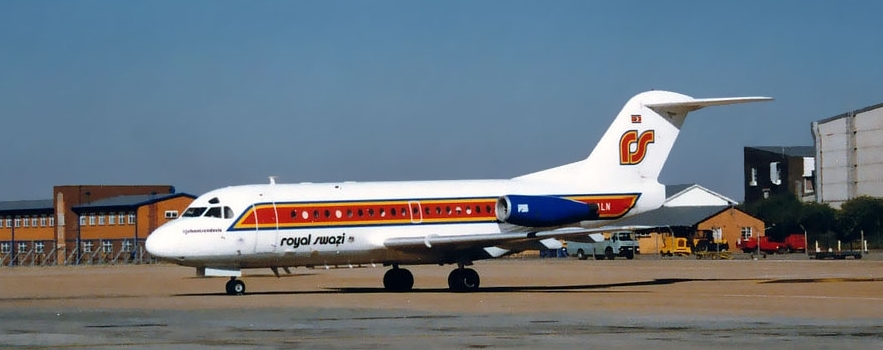
Short-fuselage version with the Mk 4000's 1.5 m wider wing: 65 seats, 33,110 kg maximum weight and the longest range of the F28. Certified in 1978; launched by Garuda.

- 2,872 km
- Range
- 65
- Passengers
History
A new wing on the short fuselage
The F.28 Mk 3000 is the short-fuselage version of the second-generation Fokker F28 Fellowship. It keeps the Mk 1000 airframe — 27.4 m long, 8.47 m high, 65 seats five abreast at 79 cm pitch and a 13 m³ hold — and adds the improvements Fokker developed at the same time for the long-fuselage Mk 4000: a wing extended by 1.5 m (60 in), 0.75 m at each tip, with greater structural strength and increased fuel capacity. Span thus grows from 23.6 m to 25.07 m and wing area from 76.4 m² to 79 m², with the same 16° sweep. It was conceived as the successor to the Mk 1000, just as the Mk 4000 replaced the stretched Mk 2000; unlike the Mk 6000 and the Mk 5000 project, it has no leading-edge slats.
It received its certificate of airworthiness on 19 July 1978, a year and a half after the Mk 4000, approved on 13 December 1976. The 3000C, with a large main-deck cargo door, was certified on the same basis, and the series was completed by the 3000R and 3000RC sub-variants, which have their own entries and their own figures.
Engines
Power comes from two Rolls-Royce RB.183 Spey Mk 555 turbofans of 9,850 lbf (43.9 kN) thrust each. Sources disagree on the sub-type: Wikipedia's comparison table lists the Spey 555-15H, the quieter engine introduced on the Mk 4000, while other sources give the Spey 555-15P.
More weight, more range
The new wing allowed maximum take-off weight to rise to 33,110 kg, against the Mk 1000's 29,480 kg, with an empty weight of 16,846 kg and a maximum payload of 8,620 kg; maximum fuel capacity, 13,040 litres, is the same on every version. The result was the longest range in the family: 1,550 nautical miles (2,872 km) with maximum payload, compared with 1,705 km for the Mk 1000 and 1,668 km for the Mk 4000. The Australian encyclopaedia Aeropedia gives a more cautious figure: 65 passengers over 2,777 km. In exchange, the larger wing cost some speed: 808 km/h maximum cruise and 656 km/h at long-range cruise, burning 2,260 kg/h and 1,475 kg/h respectively. Landing distance at maximum landing weight fell to 967 m (1,079 m on the Mk 1000); take-off distance at maximum weight stays at 1,676 m and the service ceiling at about 10,668 m.
Garuda and Merpati
The Mk 3000 entered revenue service with Garuda Indonesian Airways, which, with 62 aircraft of three F28 versions — 34 of them owned — was the world's largest user of the type; in 1984 that Fokker fleet made Garuda the second-largest airline fleet in the Asia-Pacific region, behind only Japan Airlines. After the Indonesian government decided in 1977 to join Garuda and Merpati Nusantara, 17 Fokker F-28 Mk 3000s were passed to Merpati in the early 1980s.
Executive, military and on other continents
Fokker also offered it as an executive aircraft, with 15 seats and a redecorated interior. The Indonesian Air Force flew it in VIP livery: serial number 11117, registered A-2803, is on static display at Halim Perdanakusuma air base in Jakarta. In Africa it flew with, among others, Air Namibia (V5-KEX), and three F-28-3000s were registered in Australia, against ten Mk 1000s and twelve Mk 4000s.
Place in the family
The Mk 3000 was the starting point for the Mk 5000 project, which sought to combine its short fuselage with a slatted wing and more powerful Spey 555-15H engines for short-runway operations; it was abandoned. The Mk 5000 and Mk 6000 followed, and the line's final development led to the Fokker 70 and Fokker 100, which are separate models.
Multimedia


_AN0669844-800.webp)


-800.webp)
-1600.webp)
-800.webp)
-800.webp)