Airliner · Civil · United States
Douglas DC-6
- February 15, 1946
- First flight
- 1947
- Introduced
- In service
- Status
- 704
- Units built


-1600.webp)


-1600.webp)


.jpg)
-1600.webp)


_en_vuelo%2C_a%C3%B1os_50-800.webp)
.jpg)


-1600.webp)
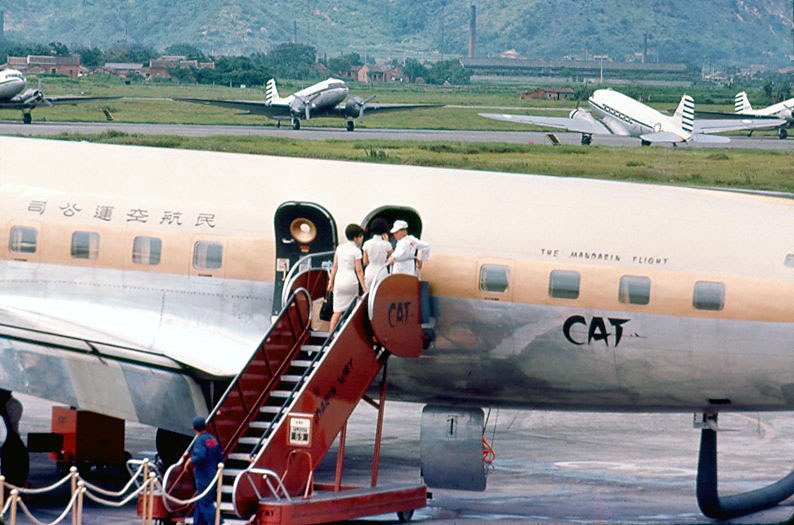
The Douglas DC-6 is the piston-engined four-motor airliner with which the Douglas Aircraft Company took on Lockheed in the post-war long-range commercial market. It began as a military order: in 1944 the United States Army Air Forces asked Douglas for a lengthened, pressurised derivative of the C-54 Skymaster with more powerful engines, and the XC-112A prototype flew on 15 February 1946, by which time the war was over and the requirement had been rescinded. Douglas reworked the project as a civil transport, stretching the fuselage over that of the DC-4, keeping its wing and fitting four Pratt & Whitney R-2800 Double Wasp radials. The civil DC-6 first flew on 29 June 1946 and reached American Airlines and United Air Lines in November of that year. Its entry into service almost killed the programme. A run of in-flight fires — the one that destroyed United Air Lines Flight 608 over Bryce Canyon on 24 October 1947, killing 52, and the one that forced an American Airlines DC-6 to land in flames at Gallup, New Mexico, on 11 November — grounded the whole fleet until the cause was traced: a fuel tank vent sited too close to the air scoop feeding the cabin heater. With every aircraft modified, the type returned to service in March 1948 and went on to earn a reputation as the most economical propliner of its generation. From that stem came the DC-6A freighter, with cargo doors and a strengthened floor; the DC-6B, widely regarded as the definitive piston airliner for ruggedness, reliability and operating economy; and the convertible DC-6C, alongside the military C-118A Liftmaster of the Air Force, the Navy's R6D and Harry Truman's presidential VC-118, named The Independence. A total of 704 were built up to 1958. Pushed off passenger routes by the jets, the DC-6 found a second life of decades as a freighter, flying tanker and water bomber, and still flies in Alaska.
Related sheets
Category
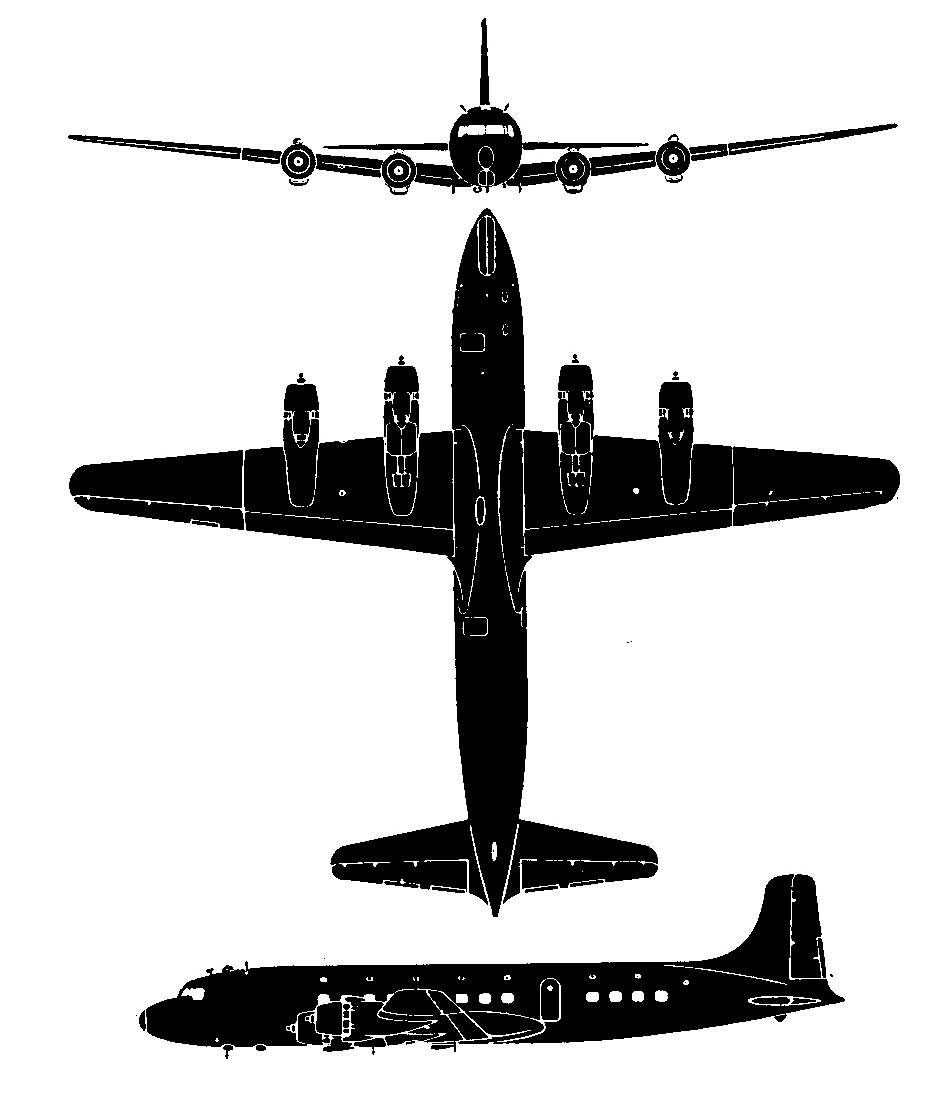
Three-view drawing
.jpg)
History
A military order that arrived too late
Through the Second World War the Douglas C-54 Skymaster — the military version of the DC-4 — was the workhorse of American strategic air transport, but it carried three obvious handicaps: no cabin pressurisation, modest speed and fewer passengers than the command wanted to move. In 1944 the United States Army Air Forces commissioned from Douglas a lengthened, pressurised derivative of that aircraft with more powerful engines, under the designation XC-112. The company had its own reasons to take the work. Lockheed had put the Constellation into military service late in the war, pressurised and with performance well beyond the DC-4, and Boeing was preparing an answer of its own. Douglas could claim to be the largest aircraft manufacturer in the United States when the war ended, but without a comparable model its commercial primacy would evaporate the moment military orders dried up.
Donald Douglas signed off on the design studies before the war was over. The solution was pragmatic: keep the DC-4 wing and build on it a stretched, pressurised fuselage with new engines. The DC-4 had no pressurisation, but it had been designed with the prospect in mind, and that foresight became the starting point for the post-war successor.
The XC-112A prototype, serial 45-873 and construction number 36326, was completed on 11 February 1946 and flew four days later, on 15 February. It was too late. The war had ended, the Army Air Forces had rescinded the requirement and no military order followed. The aircraft was redesignated YC-112A and retained by the Air Force before passing to the Civil Aeronautics Administration at Oklahoma City as a ground trainer. It carried four 2,100 hp Pratt & Whitney R-2800-34 Double Wasp radials and already had the stretched fuselage, the pressurisation, the greater accommodation and the performance improvements that would define the DC-6. Douglas had lost the customer but had the aeroplane.
From XC-112A to the civil DC-6
The conversion into a commercial transport was quick. Douglas stretched the fuselage over that of the DC-4 — by eighty inches, about two metres, according to the type record — and adopted the Pratt & Whitney Double Wasp eighteen-cylinder twin-row radial, an engine the war had refined to exhaustion in fighters such as the P-47 Thunderbolt, the F6F Hellcat and the F4U Corsair. Reversing propellers, wing heating elements against ice and a battery of electrical and avionics improvements were added. The civil DC-6 first flew on 29 June 1946, four months after the military prototype, and Douglas kept it for testing; the Civil Aeronautics Administration certificated the type nine months after that flight.
The first deliveries went simultaneously to American Airlines and United Air Lines in November 1946. American had signed for fifty aircraft even before the public money behind the XC-112A ran out, and United followed shortly after; delivering to both on the same day meant neither could claim the debut for itself. Commercial service began in the spring of 1947.
The step up from the DC-4 justified the wait: ninety miles per hour more speed, 3,000 pounds more payload and 850 miles more range on the same wingspan. It was also the first Douglas with a pressurised cabin, able to hold a cabin altitude of 5,000 feet while cruising at 20,000, and its 28,000 ft ceiling let it fly over bad weather rather than through it. Up there the thinner air cut drag and the radials pushed it along at around 300 mph. Depending on layout it seated between 48 and 86 passengers. On one of the final test flights the programme's chief test pilot, Larry Peyton, flew from Dallas to Los Angeles in just over three hours; at that cruising speed a New York to Los Angeles crossing fell below eight hours, putting American in a position to compete on speed with the Boeing Stratocruiser that Pan American was planning.
The 1947 crisis: fires in flight
On 24 October 1947 United Air Lines Flight 608, a DC-6 registered NC37510 with barely 933 airframe hours, left Los Angeles at 10:23 for a non-stop run to Chicago. It climbed to 19,000 feet and proceeded visually over Fontana, Daggett, Silver Lake, Las Vegas and Saint George. At 12:21 the crew reported a fire in the baggage compartment they could not put out and smoke filling the cabin, and asked for an emergency landing at Bryce Canyon Airport in Utah. The fire had broken out in the centre section, near the right wing fillet. Small parts of the aircraft were shed in flight and at least one of the emergency landing flares stowed at the trailing edge of that fillet ignited. Shortly afterwards the crew reported the tail giving way. The last transmission, at 12:27, said they were approaching a strip. The aircraft crashed at 12:29 some 2.4 kilometres south-east of the airport, on National Park Service land, after crossing the canyon mesa very low and being pulled out of control by gusts rising from the canyon floor. All 52 on board died: 47 passengers and five crew. Ground observers reported that occupants had been throwing objects out of the cabin door to lighten the aircraft during the descent. It was the first crash of a DC-6 and, at the time, the second-deadliest air accident in the United States.
Just over three weeks later, on 11 November 1947, a second DC-6 came close to the same fate. An American Airlines aircraft registered NC90741, flying San Francisco to Chicago with 25 people aboard, reported an on-board fire over Arizona and managed to land in flames at the airport at Gallup, New Mexico. All 25 escaped and the fire was extinguished. Unlike Bryce Canyon, this time investigators had a damaged but intact aeroplane in front of them.
The cause turned out to be a design flaw rather than an isolated failure. On the right side of the fuselage, near the wing leading edge and close to the lower fillet, was the vent outlet of the No. 3 alternate fuel tank. About ten feet aft and slightly to the left sat an air scoop that served both as the cabin heater's combustion-air source and as cooling for the cabin supercharger after-cooler and oil cooler. Flight tests with other DC-6s after the accident showed that fuel overflowing from that vent swept back in the slipstream and entered the scoop in appreciable quantity. Ground tests confirmed that, with the heater running, incoming fuel could make it backfire and propagate flame downstream into the scoop and duct, where the fuel went on burning. All it took was a crew letting a tank overfill during a routine fuel transfer between wing tanks — in United's case from the No. 4 alternate tank — for a few gallons to feed a fire.
The Civil Aeronautics Board attributed the Bryce Canyon accident to the combustion of petrol that had entered the cabin heater intake scoop, and named as contributing factors both the failure of the manufacturer and of the Civil Aeronautics Administration to exercise full caution in analysing the location of the fuel system vents, and the insufficient attention paid by manufacturer, administration and carriers to the fuel management procedures pilots were using. Inadequate crew training on the hazard and the crew's failure to stop the transfer before the tank overflowed completed the picture.
Four months on the ground, and the redesign
The consequences were immediate and unusually sweeping. The entire fleet then in existence — eighty DC-6s — was ordered grounded and recalled for modification, the President's aircraft, a sister ship, included. After the second fire, at Gallup, the three airlines operating the type voluntarily withdrew it from service. The wreckage of the Bryce Canyon aircraft was loaded onto trucks and taken to Douglas in California, where it was reassembled to establish the cause. The design changes introduced then still stand.
The DC-6 returned to service in March 1948. The type record puts the grounding at four months; other sources say five. Either way, the stoppage did not kill the programme: on the contrary, an aeroplane taken apart under public scrutiny came back with a reliability that would become its best selling point.
The family: DC-6, DC-6A, DC-6B and DC-6C
Douglas built four principal variants. The initial short-fuselage aircraft — 100 ft 7 in — came in two versions: the domestic DC-6-1156, seating 53 to 68 with R-2800-CA15 engines of 2,400 hp, and the trans-ocean DC-6-1159, seating 48 to 64 with extra crew, fuel capacity raised to 4,722 US gallons (17,870 litres), take-off weight raised to 97,200 lb (44,100 kg) and R-2800-CB16 engines of the same power.
The other three shared a fuselage sixty inches longer, higher gross weight and greater range. The DC-6A, introduced in 1948 and first flown on 29 September 1949, was the cargo version: reinforced floor, two upward-opening freight doors — one ahead of the wing and one behind, on the left side — no cabin windows on many examples and provision for seats on others. The rear cargo door came as standard with a built-in 4,000 lb lift elevator and, in a public-relations stunt Douglas soon dropped, with a jeep. Slick Airways was the first airline to operate the freighter, in April 1951.
The DC-6B was the DC-6A stripped of its cargo modifications: passenger doors only, a lighter floor and accommodation for up to 102. It too came in two configurations, the domestic DC-6B-1198A seating 60 to 89 with 2,400 hp R-2800-CB16 engines, and the trans-ocean DC-6B-1225A seating 42 to 89, with fuel raised to 5,512 US gallons (20,870 litres), take-off weight of 107,000 lb (49,000 kg) and 2,500 hp R-2800-CB17 engines. Fitted with Hamilton Standard 43E60 constant-speed reversing propellers, the DC-6B was regarded as the ultimate piston airliner for ruggedness, reliability, operating economy and handling. The DC-6C, finally, was the convertible: the two cargo doors of the DC-6A plus removable seats.
There were conversions outside the factory as well. Pacific Airmotive was licensed to turn DC-6Bs into DC-6As, and all-cargo rebuilds proliferated under unofficial designations such as DC-6AB, DC-6AC and DC-6BF. In 1968 Sabena converted two DC-6Bs into swing-tail freighters, the DC-6B-ST; one of that pair survives, stored by Buffalo Airways at Hay River in Canada's Northwest Territories.
Engines, propellers and performance
The Double Wasp was America's first eighteen-cylinder radial; Pratt & Whitney had begun its design in 1936. With water injection and turbo-supercharging it exceeded 46 kW per litre — one horsepower per cubic inch — which demanded unusually elaborate cooling fins to shed the heat. It powered the P-47, the Hellcat and the Corsair in the war and, afterwards, the DC-6 and other airliners. By the time production ended in 1960, more than 125,000 had been built by Pratt & Whitney and its licensees, one of the longest production runs of any aircraft engine.
The initial DC-6 carried four CA15s of 2,804.4 cubic inches (45.956 litres), air-cooled and supercharged, with a compression ratio of 6.75:1. Normal rating was 1,800 hp at 2,600 rpm at 6,000 feet and 1,600 hp at 16,000 feet, with 2,400 hp at 2,800 rpm on water injection for take-off. They drove three-bladed Hamilton Standard Hydromatic 43E60 constant-speed propellers of 15 ft 2 in (4.623 m) diameter through a 0.450:1 reduction gear. Each engine was 1.940 m long and 1.341 m in diameter and weighed 2,330 lb (1,057 kg).
That first DC-6 was 30.658 m long, 35.814 m in span and 8.612 m high, with an empty weight of 55,567 lb (25,205 kg) and a maximum take-off weight of 97,200 lb (44,090 kg). It cruised at 311 mph (501 km/h) with a range of 4,584 miles (7,377 km).
The DC-6B, on the same 35.81 m span, measured 32.18 m long with 135.9 square metres (1,463 sq ft) of wing area. With CB16s of 2,400 hp or CB17s of 2,500 hp, maximum take-off weight reached 107,000 lb, normal cruise 507 km/h (315 mph) at 20,600 feet, service ceiling 7,620 m (25,000 ft) and range with maximum payload some 4,815 km (2,600 nautical miles). The Navy's R6D used Curtiss Electric constant-speed reversing propellers in the late 1950s and early 1960s.
The commercial battle: Constellation, Stratocruiser and cost per seat
Competition among the big American propliners turned on two variables, speed and range. It was widely held that where a twenty-minute difference existed on a route, passengers would invariably book the faster aeroplane; range mattered because a non-stop flight usually arrived sooner than one that had to land. When the airlines competing with TWA realised their DC-4s would be hopelessly outclassed by the L-049 Constellation — pressurised, able to fly above the weather at 20,000 feet and to cross the United States in eleven hours against the DC-4's fourteen — many tried to buy Connies and were told to queue behind the early converts. Douglas was the logical alternative, and it had the XC-112 in the drawer.
The upshot was that the DC-6 arrived about a year after the L-049 and narrowly bettered it: a little faster, with a better interior and a better air-conditioning system, crossing the continent — still with one stop — in about ten hours, roughly an hour less than the Constellation. Lockheed responded by upgrading interiors, air conditioning, engines and fuel capacity, producing the L-649 in 1947 and, immediately after, the L-749 and L-749A. The «gold plate» Connie matched the DC-6 in almost every respect and clearly beat it on range, so airlines with international routes tended to choose it; on domestic networks the balance tipped towards the DC-6 for slightly better economics and simplicity, starting with aerodynamic tabs against the Lockheed's hydraulically boosted controls.
Boeing and Pan American played a different game. The Stratocruiser of 1949, derived from the B-29 and driven by four 3,500 hp R-4360 Wasp Majors, carried 60 passengers up to 3,000 miles at more than 300 mph in unmatched comfort, spiral staircase and lower-deck lounge included. Only 55 were built: expensive to buy and ruinous to run, they rarely made their owners much profit even with all-first-class cabins and berths, yet no transatlantic or transpacific operator dared drop them for fear the competition would take the traffic.
Douglas's answer to the L-749A was not a faster aeroplane but a cheaper seat. When Pratt & Whitney announced 2,400 hp R-2800s, Douglas stretched the DC-6 to fit more of them in: the result was the DC-6B of 1951, no faster and no longer-legged than the DC-6, but able to lower the operator's cost per seat on a given trip. That is why it became the aircraft of tourist class and why it is generally regarded as the most economical long-range piston airliner ever built; for those who flew it in first class it was simply very profitable. Almost every major US airline bought it, the exceptions being Delta, committed to the DC-7, and Eastern and TWA, both committed to the Constellation. In the final tally, 856 Constellations of all versions were built between 1943 and 1958 against 704 DC-6s.
By April 1949 the DC-6 was flying with United, American, Delta, National and Braniff within the United States. United took it to Hawaii, Braniff to Rio de Janeiro and Panagra flew Miami-Buenos Aires; KLM, SAS and Sabena crossed the Atlantic with it; BCPA linked Sydney with Vancouver and Philippine flew Manila to London and Manila to San Francisco.
Pan Am's «Super 6s» and transatlantic tourist class
The DC-6's contribution to air transport history goes beyond its performance: it was the aircraft that opened the North Atlantic to the ordinary passenger. Juan Trippe had been trying to cut transatlantic fares since 1945, when he proposed a New York to London ticket at 256 dollars and ran into the newly formed IATA, whose members defended a one-way fare of 375 dollars and an orderly division of traffic. The attempt failed, and round-trip fares stayed pegged at 711 dollars at a time when 5,000 dollars was a decent annual salary.
In the spring of 1952 IATA relented. From 1 May its airlines were free to offer a tourist fare of 486 dollars round trip between New York and London, and eleven carriers raced for the traffic. Pan American had taken delivery in February of its first DC-6B, N6518C, christened Clipper Liberty Bell, and built up a fleet of 39. On that 1 May, TWA and El Al got airborne first, at 12:01 and 12:09 am with their Constellations; Pan Am's first DC-6B left Idlewild for London in the early afternoon and another departed for Paris that evening, all of them booked solid. The difference was in the cabin: where the Connies topped out at around 60 seats, Pan Am's Douglas carried 82.
Those «Super 6s» were the best of the breed. They had R-2800 CB-17s of 2,500 hp running on 108/135 octane fuel, letting the DC-6B gross 107,000 lb; they carried more fuel, had greater range and introduced a completely redesigned flight deck with much improved avionics, to the point that the trade press of the day observed they might be tourist in cabin appointment but were super de luxe in cockpit appointment. In the cabin they brought an innovation with lasting consequences: a Pan Am-patented system of tracks with attachment sockets at one-inch increments running the length of the aircraft, allowing seats to be fitted and removed quickly. With it a «Super 6» could be converted in about ninety minutes from an all-tourist layout — Pan Am's Rainbow Service — to a 44-seat or 56-seat luxury arrangement. Tourist fares and variable seat pitch were born on the same day.
Pan Am worked the type on every front. On 5 January 1952 it inaugurated the first all-cargo service across the North Atlantic with DC-6As, and that same year used the Douglas to launch the first scheduled round-the-world flight, a journey of 83 hours. As a footnote to the calendar, on 2 May 1952, one day after tourist fares opened, the De Havilland Comet I left London for Johannesburg on the first commercial jet passenger flight: the era the DC-6B had just opened already had an expiry date.
On Atlantic routes the DC-6B and DC-6C could often fly non-stop from the eastern United States to Europe, but needed to refuel at Goose Bay, Labrador, or Gander, Newfoundland, when flying west into the prevailing winds.
The military versions: C-118 Liftmaster, R6D and the Independence
The first DC-6 to enter United States Air Force service was not a troop transport but a presidential aircraft. In 1947 one aeroplane from the initial series was ordered modified as a replacement for the ageing VC-54C Sacred Cow: the rear fuselage became a stateroom and the main cabin seated 24 or could be made up into twelve sleeper berths. Delivered on 1 July 1947 and formally commissioned on the 4th, it was designated VC-118 and named The Independence after Harry Truman's home town in Missouri. Its most historic flight carried the President to Wake Island on 15 October 1950 to discuss the Korean situation with General Douglas MacArthur; the rest of the party travelled in a Constellation and a Pan American charter with the press. Retired from presidential duty in May 1953 after nearly six years of White House service, it went on as a VIP transport with several Air Force organisations before passing to the museum in 1965. Restored in 1977-1978 to its original presidential markings and eagle-like scheme, it is preserved as 46-0505 at the National Museum of the United States Air Force at Wright-Patterson, Dayton, Ohio.
Military interest in the type revived with the Korean War. The Air Force and Navy ordered 167 C-118/R6D aircraft, all based on the DC-6A. The Navy went first: it ordered 65 in 1950, received 61 R6D-1s by 1952 and four R6D-1Z staff and VIP transports in 1954, operating them with fleet tactical support squadrons VR-1 and VR-21. Forty of those aircraft were later transferred to the Air Force to fly within the Military Air Transport Service with Navy crews. In 1962 those still in Navy hands became C-118Bs, and the R6D-1Zs VC-118Bs. The Air Force ordered 101 aircraft as the C-118A, powered by four 2,500 hp R-2800-52W engines and able to carry 74 troops or 27,000 lb of cargo; the forty handed over by the Navy joined them. There was also an aeromedical evacuation version, the MC-118A.
The Liftmaster's military career was long and varied. C-118As played a key part in Operation Safe Haven, which airlifted 14,000 Hungarian refugees to the United States in 1956-1957. A C-118 was for years the largest aircraft of the CIA's Detachment 2 and flew clandestine drops over Tibet from 1957, until its power limitations at altitude — a payload of barely 9,000 pounds per flight over the Tibetan mountains — forced the search for a replacement. In the strategic mobility exercises of the 1960s, BIG SLAM/PUERTO PINE in 1960 and LONG PASS in 1961, C-118s flew alongside C-124s and C-133s and served mainly to expose the shortcomings of that generation of transports. In 1965 casualties from Vietnam were loaded into C-118s and C-130s for Clark Air Base in the Philippines, and from 1968 specially modified C-118s were used for medical evacuation. One VC-118A, 53-3240, was John F. Kennedy's official Air Force One until 1962, when the VC-137C took over as primary presidential aircraft and it became the backup; it was the last propeller-driven aircraft in the presidential fleet and is preserved at the Pima Air and Space Museum in Tucson. The Navy's last C-118 Liftmaster was retired in the mid-1980s after 33 years of service, replaced by the C-9; squadron VR-54, which flew C-118s, was decommissioned in 1981.
The end of the piston era
From the mid-1950s many older DC-6s were displaced from passenger service by the Douglas DC-7, a direct derivative of the DC-6B with Turbo-Compound engines. But the DC-7 never had the DC-6's simplicity or economy, and that difference decided which of them lasted: the DC-6 outlived the DC-7, particularly in cargo work. Those DC-6s and DC-7s that survived into the jet age were replaced on front-line intercontinental routes by the Boeing 707 and the Douglas DC-8. DC-6 production ended in 1958; the last delivery, a DC-6B, went to Jugoslovenski Aero Transport on 17 November of that year.
The displacement was neither immediate nor total. In 1967 some 200 DC-6Bs were still in airline service. Prices trace the cycle: a new DC-6 cost around £210,000 to £230,000 in 1946-47 and had risen to £310,000 by 1951, while a used example fetched around £175,000 in 1960. A DC-6A went for £460,000 to £480,000 in 1957-58 and about £296,000 second-hand in 1960; a new DC-6B cost around £500,000 in 1958 and about £227,000 used in 1960. Demand had been such that by 1950 Douglas's backlog for the type was valued at 100 million dollars.
Second life: freight, tankers and water bombers
What saved the DC-6 from the scrapyard was exactly what had made it profitable in airline service: simple, reliable engines that were cheap to keep running. Turned into a freighter, it found work in the corners the jets never reached. In Alaska it became an institution: as of July 2016 Everts Air Cargo operated eleven DC-6s and two C-46s with several more in storage, while its sister company Everts Air Fuel flew three DC-6s and two C-46s. Everts uses them purely for cargo, with freight doors on every aircraft, and its operating figures explain why they still fly: an average useful volume of some 3,000 cubic feet, an average payload of 28,000 lb and a minimum runway length of 3,500 feet. Its aircraft came both from the military batches and from civil operators, and in their day carried passengers and freight for United, Sabena, Japan Airlines, Cathay Pacific, the Air Force and the Navy among others. The company says it sees a future in operating the type and plans to bring more aircraft on line.
The other late career was firefighting. Between 1977 and 1990 the French Sécurité Civile flew five yellow-painted DC-6Bs as water bombers, registered F-ZBAC, F-ZBAD, F-ZBAE, F-ZBAP and F-ZBBU. In the 1980s Conair Aerial Firefighting of Abbotsford, Canada, used several DC-6Bs as retardant tankers. There were odder uses too: in the 1960s two DC-6s served as transmitter platforms for educational television from Purdue University, in the Midwest Program on Airborne Television Instruction.
Outside North America the type took refuge in Africa and South America. One DC-6B, V5-NCG «Bateleur», flew with Namibia Commercial Aviation and by January 2017 was stored and derelict at Windhoek. In Colombia two DC-6s remain in storage at Alfonso Bonilla Aragón International Airport in Cali, left behind by the defunct Aerosur. In recent years the type has still been seen flying in Namibia, Alaska, Australia and the United Kingdom.
Production and survivors
Total production of the DC-6 series, military versions included, was 704 aircraft, built at Santa Monica, California, between 1946 and 1958, of which 167 were military. The variant census kept by aircraft-survivors credits 175 units to the original DC-6 — the presidential machine included — 74 to the DC-6A, 288 to the DC-6B, 101 to the C-118A and 65 to the R6D-1.
Several survivors carry histories of their own. DC-6B c/n 45563, once the private luxury transport of Yugoslav President Josip Broz Tito, flies today with the Flying Bulls aerobatic team of Salzburg as N996DM. The German D-ABAH, the fourth aircraft built and the oldest surviving DC-6, served the Jordanian royal family, flew scheduled services in the United States and reached Germany in 1965; withdrawn in 1969, it ended up as an aircraft-themed café and, after being sold for a symbolic one euro, was restored in 2003 and put on display at Bad Laer. The British DC-6A G-APSA, which flew private charters in British Eagle colours, was dismantled in 2018 after wing spar damage proved beyond economic repair, and its parts went to the South Wales Aviation Museum in the spring of 2021. Aircraft c/n 45550, built in September 1958, spent most of its life in South-East Asia and served with the CIA and Royal Air Lao before Air Atlantique bought it in 1987; it made its last commercial flight on 26 October 2004, appeared in the 2006 film Casino Royale and is now the «DC-6 Diner» at Coventry Airport. In Alaska, DC-6A c/n 44075 «Good Grief» was flown by Everts Air Cargo to the Chena Hot Springs resort on 2 October 2016 for static display after a 62-year flying career; N6174C, built as a DC-6A for the Flying Tiger Line, served with Everts between 2009 and 2016 and is one of three DC-6s on display in Alaska.
The prototype itself came to a late and tragic end. Sold as surplus, registered N6166G in 1956 and certificated in the transport category, it passed through Conner Airlines, Ecuador's CEA as HC-ADJ, Spain's TASSA as EC-AUC, TransAir Canada as CF-TAX and finally Mercer Airlines as N901MA. On 8 February 1976, three days short of the thirtieth anniversary of its completion at Douglas and with 10,280.4 flight hours on the airframe, it lost a propeller blade on take-off from Hollywood-Burbank; the vibration tore the number 3 engine off the wing and the thrown blade passed through the fuselage and struck the number 2. After a landing frustrated by the loss of brakes and reverse thrust, the crew took off again and tried to reach Van Nuys, but could not hold altitude and came down on a golf course. All three flight crew were killed. The National Transportation Safety Board found a fatigue fracture in the leading edge of the blade, missed because the last overhaul had not stripped the de-icing boots for a magnetic inspection of the whole surface.
Variants
| XC-112A / YC-112A | DC-6 | DC-6A | C-118A Liftmaster | C-118B | DC-6-1156 | DC-6-1159 | DC-6B | DC-6B-1198A | DC-6B-1225A | DC-6B-ST | DC-6C | R6D-1 | R6D-1Z | VC-118A | VC-118B | VC-118 «The Independence» | |
|---|---|---|---|---|---|---|---|---|---|---|---|---|---|---|---|---|---|
| First flight | February 15, 1946 | June 29, 1946 | September 29, 1949 | — | — | — | — | — | — | — | — | — | — | — | — | — | — |
| Aircraft type | Military transport | Long-haul airliner | Long-haul airliner | Military transport | Military transport | Long-haul airliner | Long-haul airliner | Long-haul airliner | Long-haul airliner | Long-haul airliner | Long-haul airliner | Long-haul airliner | Military transport | Military transport | Military transport | Military transport | Military transport |
| Powerplant | 4 × Pratt & Whitney R-2800-83AM3 Double Wasp radial piston engines. | 4 × Pratt & Whitney R-2800-CA15 Double Wasp radial piston engines of 1,789.7 kW (2,400 hp) each with water injection. | 4 × Pratt & Whitney R-2800-CB16 Double Wasp radial piston engines of 1,789.7 kW (2,400 hp) each with water injection. | 4 × Pratt & Whitney R-2800-52W Double Wasp radial piston engines of 1,864.2 kW (2,500 hp) each. | 4 × Pratt & Whitney R-2800-CB17 Double Wasp radial piston engines of 1,864.2 kW (2,500 hp) each. | 4 × Pratt & Whitney R-2800-CA15 Double Wasp radial piston engines of 1,789.7 kW (2,400 hp) each. | 4 × Pratt & Whitney R-2800-CB16 Double Wasp radial piston engines of 1,789.7 kW (2,400 hp) each. | 4 × Pratt & Whitney R-2800-CB17 Double Wasp eighteen-cylinder twin-row radial piston engines of 1,864.2 kW (2,500 hp) each on take-off with water injection, driving Hamilton Standard 43E60 constant-speed propellers with autofeather and reverse pitch. | 4 × Pratt & Whitney R-2800-CB16 Double Wasp radial piston engines of 1,789.7 kW (2,400 hp) each. | 4 × Pratt & Whitney R-2800-CB17 Double Wasp radial piston engines of 1,864.2 kW (2,500 hp) each. | 4 × Pratt & Whitney R-2800-CB17 Double Wasp radial piston engines of 1,864.2 kW (2,500 hp) each. | 4 × Pratt & Whitney R-2800-CB16 Double Wasp radial piston engines of 1,789.7 kW (2,400 hp) each. | 4 × Pratt & Whitney R-2800-CB17 Double Wasp radial piston engines of 1,864.2 kW (2,500 hp) each, with Curtiss Electric constant-speed reversing propellers. | 4 × Pratt & Whitney R-2800-CB17 Double Wasp radial piston engines of 1,864.2 kW (2,500 hp) each. | 4 × Pratt & Whitney R-2800-52W Double Wasp radial piston engines of 1,864.2 kW (2,500 hp) each. | 4 × Pratt & Whitney R-2800-CB17 Double Wasp radial piston engines of 1,864.2 kW (2,500 hp) each. | 4 × Pratt & Whitney R-2800-CA15 Double Wasp radial piston engines of 1,789.7 kW (2,400 hp) each. |
| Powerplant | 4 × Pratt & Whitney R-2800-83AM3 | 4 × Pratt & Whitney R-2800-CA15 Double Wasp | 4 × Pratt & Whitney R-2800-CB16 Double Wasp | 4 × Pratt & Whitney R-2800-52W Double Wasp | 4 × Pratt & Whitney R-2800-CB17 Double Wasp | 4 × Pratt & Whitney R-2800-CA15 Double Wasp | 4 × Pratt & Whitney R-2800-CB16 Double Wasp | 4 × Pratt & Whitney R-2800-CB17 Double Wasp | 4 × Pratt & Whitney R-2800-CB16 Double Wasp | 4 × Pratt & Whitney R-2800-CB17 Double Wasp | 4 × Pratt & Whitney R-2800-CB17 Double Wasp | 4 × Pratt & Whitney R-2800-CB16 Double Wasp | 4 × Pratt & Whitney R-2800-CB17 Double Wasp | 4 × Pratt & Whitney R-2800-CB17 Double Wasp | 4 × Pratt & Whitney R-2800-52W Double Wasp | 4 × Pratt & Whitney R-2800-CB17 Double Wasp | 4 × Pratt & Whitney R-2800-CA15 Double Wasp |
| Power per engine | — | 2,400 hp | 2,400 hp | 2,500 hp Best value in this row | 2,500 hp Best value in this row | 2,400 hp | 2,400 hp | 2,500 hp Best value in this row | 2,400 hp | 2,500 hp Best value in this row | 2,500 hp Best value in this row | 2,400 hp | 2,500 hp Best value in this row | 2,500 hp Best value in this row | 2,500 hp Best value in this row | 2,500 hp Best value in this row | 2,400 hp |
| Length | — | 30.7 m | 32.2 m Best value in this row | 32.2 m Best value in this row | 32.2 m Best value in this row | 30.7 m | 30.7 m | 32.2 m Best value in this row | 32.2 m Best value in this row | 32.2 m Best value in this row | 32.2 m Best value in this row | 32.2 m Best value in this row | 32.2 m Best value in this row | 32.2 m Best value in this row | 32.2 m Best value in this row | 32.2 m Best value in this row | 30.7 m |
| Wingspan | 35.8 m Best value in this row | 35.8 m Best value in this row | 35.8 m Best value in this row | 35.8 m Best value in this row | 35.8 m Best value in this row | 35.8 m Best value in this row | 35.8 m Best value in this row | 35.8 m Best value in this row | 35.8 m Best value in this row | 35.8 m Best value in this row | 35.8 m Best value in this row | 35.8 m Best value in this row | 35.8 m Best value in this row | 35.8 m Best value in this row | 35.8 m Best value in this row | 35.8 m Best value in this row | 35.8 m Best value in this row |
| Height | — | 8.7 m | 8.7 m | 8.7 m Best value in this row | — | 8.7 m | 8.7 m | 8.7 m | — | — | — | 8.7 m | 8.7 m | — | — | — | — |
| Wing area | — | 136 m² Best value in this row | 136 m² Best value in this row | 136 m² Best value in this row | — | — | — | 136 m² Best value in this row | — | — | — | — | — | — | — | — | — |
| Empty weight | — | 23,843 kg | 20,803 kg Best value in this row | 22,574 kg | — | — | — | 25,110 kg | — | — | — | — | — | — | — | — | — |
| MTOW | — | 44,089 kg | 48,625 kg | 48,534 kg | — | — | 44,089 kg | 48,534 kg | — | 48,534 kg | — | — | 48,626 kg Best value in this row | — | — | — | — |
| Top speed | — | — | — | — | — | — | — | 576 km/h | — | — | — | — | — | — | — | — | — |
| Max speed altitude | — | — | — | — | — | — | — | 4,000 m | — | — | — | — | — | — | — | — | — |
| Cruise speed | — | 500 km/h | 507 km/h Best value in this row | 507 km/h Best value in this row | — | — | — | 507 km/h Best value in this row | — | — | — | — | 507 km/h Best value in this row | — | — | — | — |
| Cruise altitude | — | — | — | — | — | — | — | 6,280 m | — | — | — | — | — | — | — | — | — |
| Service ceiling | — | — | 6,675 m | — | — | — | — | 7,620 m Best value in this row | — | — | — | — | — | — | — | — | — |
| Initial climb rate | — | 5.4 m/s | — | 5.1 m/s | — | — | — | 10 m/s Best value in this row | — | — | — | — | — | — | — | — | — |
| Range | — | 7,377 km | 5,459 km | 4,707 km | — | — | — | 4,840 km | 4,840 km | 7,600 km Best value in this row | — | — | — | — | — | — | — |
| Ferry range | — | — | 7,995 km Best value in this row | 7,596 km | — | — | — | 7,593 km | — | — | — | — | — | — | — | — | — |
| Combat radius | 0 km Best value in this row | 0 km Best value in this row | 0 km Best value in this row | 0 km Best value in this row | 0 km Best value in this row | 0 km Best value in this row | 0 km Best value in this row | 0 km Best value in this row | 0 km Best value in this row | 0 km Best value in this row | 0 km Best value in this row | 0 km Best value in this row | 0 km Best value in this row | 0 km Best value in this row | 0 km Best value in this row | 0 km Best value in this row | 0 km Best value in this row |
| Range conditions | — | Up to about 7,377 km with maximum fuel. | 5,459 km with maximum payload and up to about 7,995 km with maximum fuel. | 4,707 km carrying cargo and up to about 7,596 km when empty. | — | — | — | 4,840 km with maximum payload; up to about 7,593 km (4,100 nautical miles) with full tanks and a reduced load. | — | — | — | — | — | — | — | — | — |
| Armament | None | None | None | None | None | None | None | None | None | None | None | None | None | None | None | None | None |
| Max weapons load | 0 kg Best value in this row | 0 kg Best value in this row | 0 kg Best value in this row | 0 kg Best value in this row | 0 kg Best value in this row | 0 kg Best value in this row | 0 kg Best value in this row | 0 kg Best value in this row | 0 kg Best value in this row | 0 kg Best value in this row | 0 kg Best value in this row | 0 kg Best value in this row | 0 kg Best value in this row | 0 kg Best value in this row | 0 kg Best value in this row | 0 kg Best value in this row | 0 kg Best value in this row |
| Payload | — | — | 12,786 kg Best value in this row | 12,247 kg | — | — | — | 11,143 kg | — | — | — | — | — | — | — | — | — |
| Cargo capacity | Single prototype ordered by the US Army Air Forces: a lengthened, pressurised C-54. Unarmed; redesignated YC-112A once the military requirement was dropped. | Initial short-fuselage version seating 48 to 68 passengers depending on layout; no military capability or armament. | Freighter and convertible version with lengthened fuselage, reinforced floor and two large cargo doors; up to 12,786 kg of payload. No military capability or armament. | Unarmed personnel and logistics transport: 74 troops or 12,247 kg of cargo. | Designation adopted in 1962 by the R6D-1s still in Navy service. Unarmed logistics transport. | Domestic sub-variant of the short-fuselage DC-6, seating 53 to 68 passengers. | Trans-ocean sub-variant of the DC-6 seating 48 to 64, with extra crew and increased fuel capacity. | Civil passenger aircraft with no military capability: up to 102 seats in a single-class cabin (42 to 89 in typical airline layouts) and a maximum payload of 11,143 kg. | Domestic sub-variant of the DC-6B, seating 60 to 89 passengers. | Trans-ocean sub-variant of the DC-6B seating 42 to 89, with increased fuel capacity and higher take-off weight. | Swing-tail freighter conversion of the DC-6B carried out by Sabena; only two aircraft converted. | Convertible version of the DC-6A: removable seats allow a switch between passenger and all-cargo use. | US Navy designation for the DC-6A, used as a logistics transport by squadrons VR-1 and VR-21. Unarmed. | Four R6D-1s converted as VIP and staff transports, delivered to the Navy in 1954. Unarmed. | C-118As converted as staff transports, with VIP accommodation and no armament. | Designation adopted in 1962 by the R6D-1Zs, unarmed staff transports. | One-off presidential transport — the twenty-ninth DC-6 built — flown by Harry S. Truman from 1947 to 1953, with a special 25-seat interior and twelve berths. Unarmed. |
| Crew | 3 Best value in this row | 3 Best value in this row | 3 Best value in this row | 3 Best value in this row | 3 Best value in this row | 3 Best value in this row | 4 | 3 Best value in this row | 3 Best value in this row | 4 | 3 Best value in this row | 3 Best value in this row | 3 Best value in this row | 3 Best value in this row | 3 Best value in this row | 3 Best value in this row | 3 Best value in this row |
| Passengers | — | 68 | — | 74 | — | 68 | 64 | 89 Best value in this row | 89 Best value in this row | 89 Best value in this row | — | 89 Best value in this row | — | — | — | — | 25 |
| Units built | 1 | — | — | 101 | — | — | — | 288 Best value in this row | — | — | 2 | — | 65 | 4 | — | 4 | 1 |
Images
Elsewhere
- Wikimedia CommonsDouglas DC-6, Balair, Basle Airport, 1976 ↗
- Wikimedia CommonsDouglas DC-6A carguero N313RS, Northern Air Cargo, Anchorage 1985 ↗
- Wikimedia CommonsDouglas DC-6B N996DM, The Flying Bulls, Geilenkirchen 2007 ↗
- Wikimedia CommonsDouglas DC-6B, The Flying Bulls, ILA Berlin 2014 ↗
- Wikimedia CommonsDouglas C-118A Liftmaster 53-3245, U.S. Air Force ↗
- JetPhotosDouglas DC-6, D-ABAH, Private ↗
- JetPhotosDouglas DC-6, XA-JOT, Mexicana ↗
- JetPhotosDouglas DC-6, EC-AVA, Private ↗
- Airliners.netDouglas DC-6B EC-ASS, Aviaco / TASSA, London-Gatwick 1964 ↗
- Airliners.netDouglas DC-6, Flugzeug Cafe, Preussisch Oldendorf 1999 (uno de los DC-6 más antiguos conservados) ↗
- Airliners.netDouglas DC-6, N37546, United Airlines, Washington National 1966 ↗
- Airliners.netDouglas DC-6, Sabena, Manchester-Ringway 1954 ↗
Show the 15 more
- Airliners.netDouglas DC-6, Aviateca, Guatemala-La Aurora 1974 ↗
- Airliners.netDouglas DC-6, Braniff International Airways, Dallas-Love Field 1962 ↗
- Airliners.netDouglas DC-6, Conner Air Lines, Miami International 1993 ↗
- Airliners.netDouglas DC-6 cisterna, Everts Air Fuel ↗
- ABPicDouglas DC-6, I-DIMS, Alitalia, London Heathrow 1959 ↗
- ABPicDouglas DC-6, SE-BDL, SAS - Scandinavian Airlines System ↗
- ABPicDouglas DC-6, F-BHVA, Air France, London Heathrow 1959 ↗
- ABPicDouglas DC-6B, VR-BBQ, Cunard Eagle Airways ↗
- FlickrDouglas VC-118 "The Independence", National Museum of the U.S. Air Force ↗
- FlickrDouglas VC-118 "Independence", avión presidencial de Truman ↗
- FlickrDouglas DC-6B cisterna N444CE, Everts Air Fuel, Fairbanks ↗
- FlickrDouglas DC-6B cisterna N651CE, Everts Air Fuel, PAEN 2022 ↗
- FlickrDouglas DC-6 cisterna N7780B, Everts Air Fuel, Fairbanks 2022 ↗
- FlickrDouglas DC-6B cisterna N444CE, Everts Air Fuel, Fairbanks 2011 ↗
- National Museum of the U.S. Air ForceDouglas VC-118 "The Independence", National Museum of the U.S. Air Force, Dayton ↗