Douglas DC-4 variant
Douglas DC-4M-2/3 North Star
Pressurised civil version of the DC-4 built by Canadair for Trans-Canada Air Lines with four Rolls-Royce Merlin 622 engines: 20 aircraft delivered in 1947-1948, faster and longer-ranged than the original DC-4, famed for their reliability and for the noise of their exhausts.
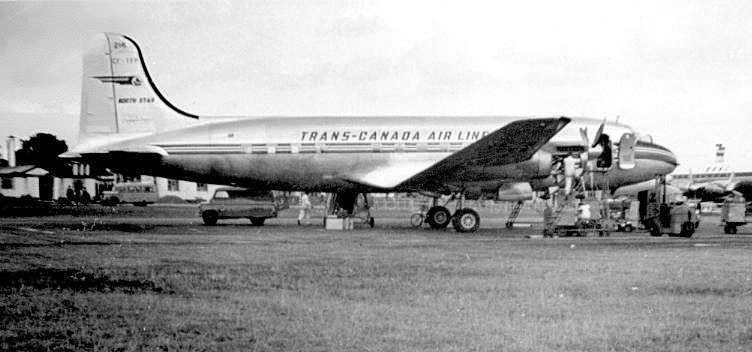
- 20
- Units built
- 6,212 km
- Range
- 62
- Passengers
History
The DC-4M-2/3 North Star was the pressurised, definitive version of the Canadian DC-4 that Canadair built at Cartierville (Montreal) for Trans-Canada Air Lines (TCA). It grew out of an inherited contract: when Canadair Aircraft Ltd. took over the operations of Canadian Vickers on 11 November 1944, alongside the Canso flying boats still in production it acquired a development contract for an improved variant of the Douglas DC-4 that TCA had requested that same year. The Canadian government had bought from Douglas a licence to build the DC-4 in the country, restricted to sales on the civil and military markets of Canada and the United Kingdom, a condition that would later shape the type's list of operators.
The outcome was far more than an engine swap. In place of the DC-4's Pratt & Whitney R-2000 radials, Canadair fitted four liquid-cooled Rolls-Royce Merlin V12s in Universal Power Plant installations, the so-called power eggs, which packaged the engine and its ancillaries with standardised attachment points to speed up engine changes. The airframe drew on three Douglas designs: the nose, landing gear and forward fuselage of the DC-6 (shortened by some 80 inches), the empennage, rear fuselage, flaps and wing tips of the DC-4, and the centre fuselage sections and wing panels of the C-54, together with cabin pressurisation and a different electrical system. The prototype, designated DC-4M-1X, first flew from Cartierville on 15 July 1946 and later became part of the TCA order. With Merlin power the North Star cruised at 523 km/h against the 396 km/h of the standard DC-4, was faster than a Lockheed L-049 Constellation and offered 17 per cent more range.
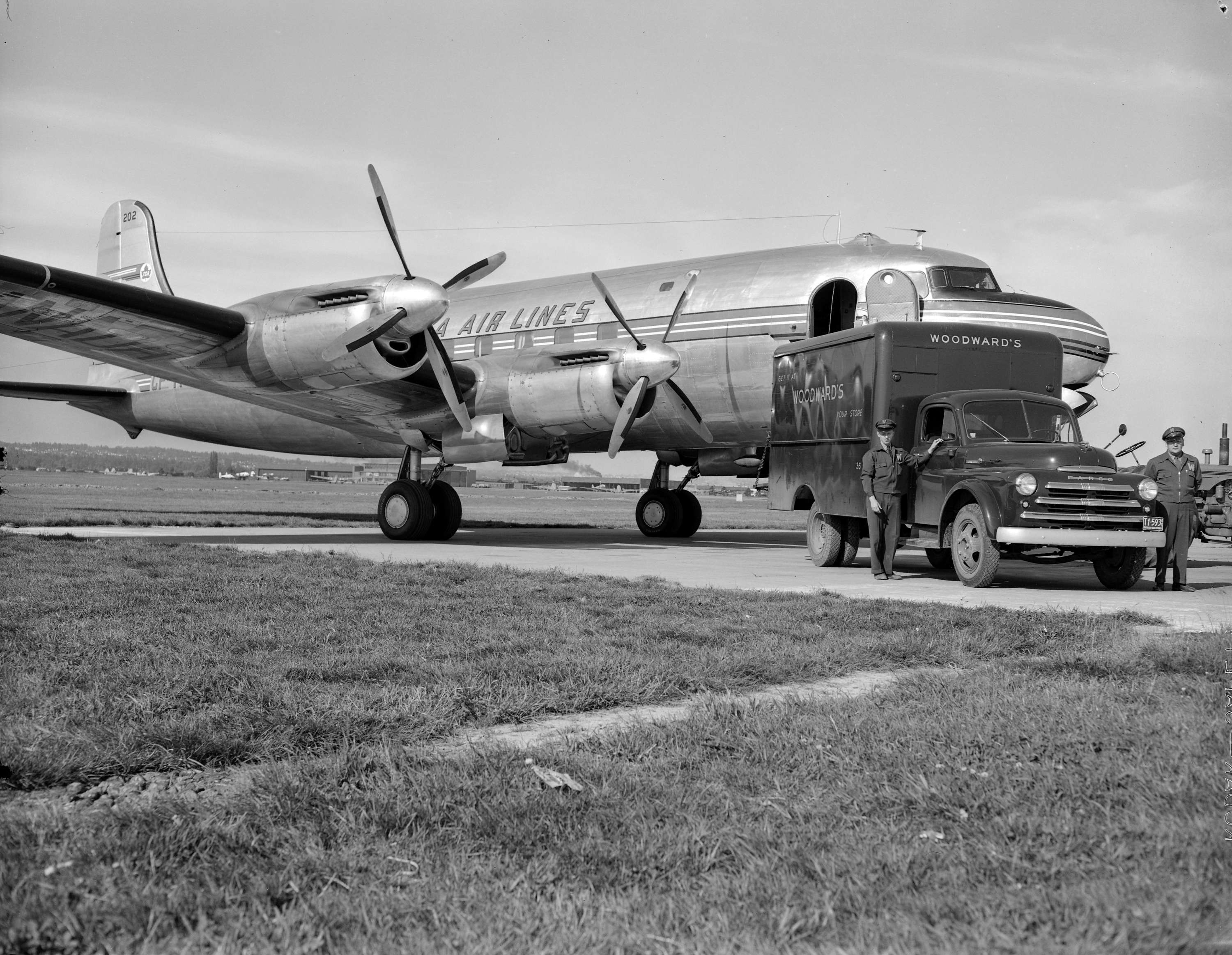
Within the family the -2 suffix identified the pressurised, higher take-off weight version, and -2/3 the sub-variant with 1,760 hp Merlin 622 engines and three-blade propellers (the later DC-4M-2/4 had Merlin 624s and four-blade propellers, and some were turned into DC-4M-2/4C freighters between 1954 and 1961). Sources agree that Canadair built 71 aircraft in all under the designations North Star, DC-4M, C-4 and C-5, all Merlin-powered except the single R-2800-engined C-5; they disagree on how many were pressurised (51 according to the English and Spanish encyclopaedias, 47 according to the German one) and on the make-up of the TCA fleet: the variant list credits the airline with 20 newly built DC-4M-2/3s plus six unpressurised DC-4M-1s on loan from the RCAF, whereas the French source speaks of 20 North Stars, five of them DC-4M-1s and fifteen DC-4M-2s. The factory designation for all these machines was CL-2. BOAC's C-4 Argonauts and Canadian Pacific Air Lines' four C-4-1 Canadair Fours belong to a separate branch of the family (CL-4) and are covered elsewhere.
TCA took delivery of its fleet of twenty DC-4M-2s during 1947 and 1948; transatlantic service had begun on 15 April 1947 on routes such as Montreal-Paris. The North Stars flew TCA's domestic routes and services to the United States until 1961, and its European routes until 1954, when Lockheed Super Constellations replaced them across the Atlantic. The aircraft's great weakness was noise: unlike a radial, whose exhausts are collected into a single outlet, each Merlin cylinder discharged through its own ejector stub in high-pressure bursts, and the stubs on the inboard side of each nacelle pointed straight at the fuselage. Faced with passenger complaints, TCA engineers developed a cross-over exhaust that ducted the gases outboard and cut cabin noise by 6 to 8 decibels, to about 102 decibels by the windows and 93 in the aisle. Rolls-Royce later marketed its own cross-over system as a kit, turning the Merlin TML (Transport Merlin L) into the Merlin TMO: besides a 5 to 8 decibel reduction it gave 38 hp more, around 5 knots of true airspeed and roughly 4 per cent more still-air range. The RCAF, which operated the unpressurised military C-54GM version, made no attempt to quieten its aircraft.
In service the North Star earned a reputation as rugged and dependable. A single-class cabin seated up to 62 passengers, and up to 80 seats were fitted for the charter flights of its second life. The TCA fleet nevertheless suffered serious accidents: on 12 August 1948 CF-TEL struck an unlit mound of earth on landing at Sydney, Nova Scotia, and burned out, although all 17 occupants survived; on 8 April 1954 an RCAF Harvard collided in flight over Moose Jaw, Saskatchewan, with North Star CF-TFW, killing 36 aboard and one person on the ground, an accident that led to training flights being confined south of the Trans-Canada Highway; and on 9 December 1956 TCA Flight 810 flew into Mount Slesse on the Vancouver-Calgary route with the loss of all 62 on board, among them five Canadian Football League players. Of the 71 North Stars built, 22 were written off, 17 of them in flying accidents.
Once retired by TCA, the DC-4M-2s passed to second-tier operators such as Overseas Aviation, British Midland Airways, Air Links, Flying Enterprise, East African Airways and Lineas Aereas Unidas Mexicanas, many of them converted to freighters; one, CF-TFM, ended up in 1966 running arms to West Africa under a false registration. CF-UXA, a former RCAF C-54GM (17510), was the last DC-4M in airline service, completing its final flight at Miami on 19 June 1975. No civil DC-4M-2 survives; the only North Star preserved is RCAF C-54GM 17515, delivered in March 1948, a Korean airlift veteran with 426 Squadron, transferred in 1966 to the Canada Aviation and Space Museum in Ottawa, where it is under restoration.
Multimedia


-800.webp)