Douglas DC-4 variant
Douglas DC-4 C-54
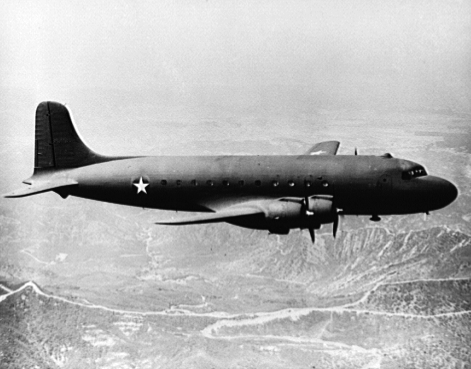
First military version of the DC-4: 24 civil airframes taken over on the Santa Monica line in 1942, with R-2000-3 engines, four auxiliary cabin tanks and 26 seats.

- February 14, 1942
- First flight
- 24
- Units built
- 26
- Passengers
History
The unsuffixed C-54 is the first military version of the Douglas DC-4 and, strictly speaking, was never designed as a military aircraft: it comprises the first 24 civil DC-4s that the United States Army Air Forces (USAAF) took straight off the Santa Monica production line in 1942. Its origin lies in the DC-4A, the design with which Douglas replaced the unsuccessful DC-4E prototype of 1935, which the airlines had rejected: a smaller and simpler four-engined aircraft with a circular-section fuselage, Pratt & Whitney R-2000 Twin Wasp engines, a single fin and rudder in place of the DC-4E's triple tail, retractable tricycle landing gear and an unpressurised cabin. The project attracted a satisfactory number of orders from the American carriers, but the outbreak of war in Europe almost ended it: Donald Douglas was only given permission to prepare for production after assuring the War Department that the DC-4 would not delay the delivery of the military aircraft already on order, among them the C-47, the C-53 and the A-20.
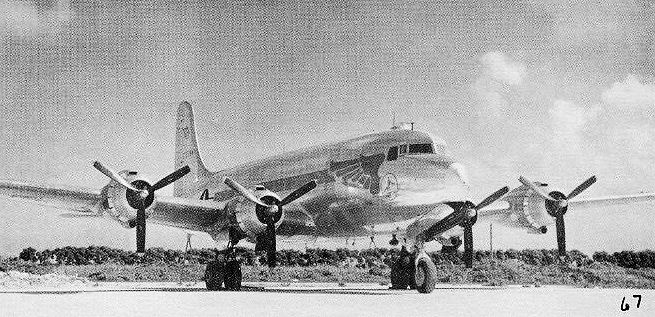
With the entry of the United States into the war, the War Department took over the airlines' provisional orders and allocated them to the USAAF under the designation C-54 Skymaster. Sources differ on the exact timing of the takeover (the English Wikipedia article on the C-54 places the decision in June 1941, while the DC-4 article places it in December 1941, after Pearl Harbor), but they agree on the outcome: when the first DC-4 was completed, in February 1942, the USAAF requisitioned every aircraft on the line. Those nearest to completion were finished as C-54s with little military equipment, and the remainder were completed as fully militarised C-54As. Eliot Elisofon's photographs for Life magazine show that first batch of DC-4s being completed, partly outdoors, as military C-54s, recognisable by the absence of the large cargo door that would characterise the later versions.
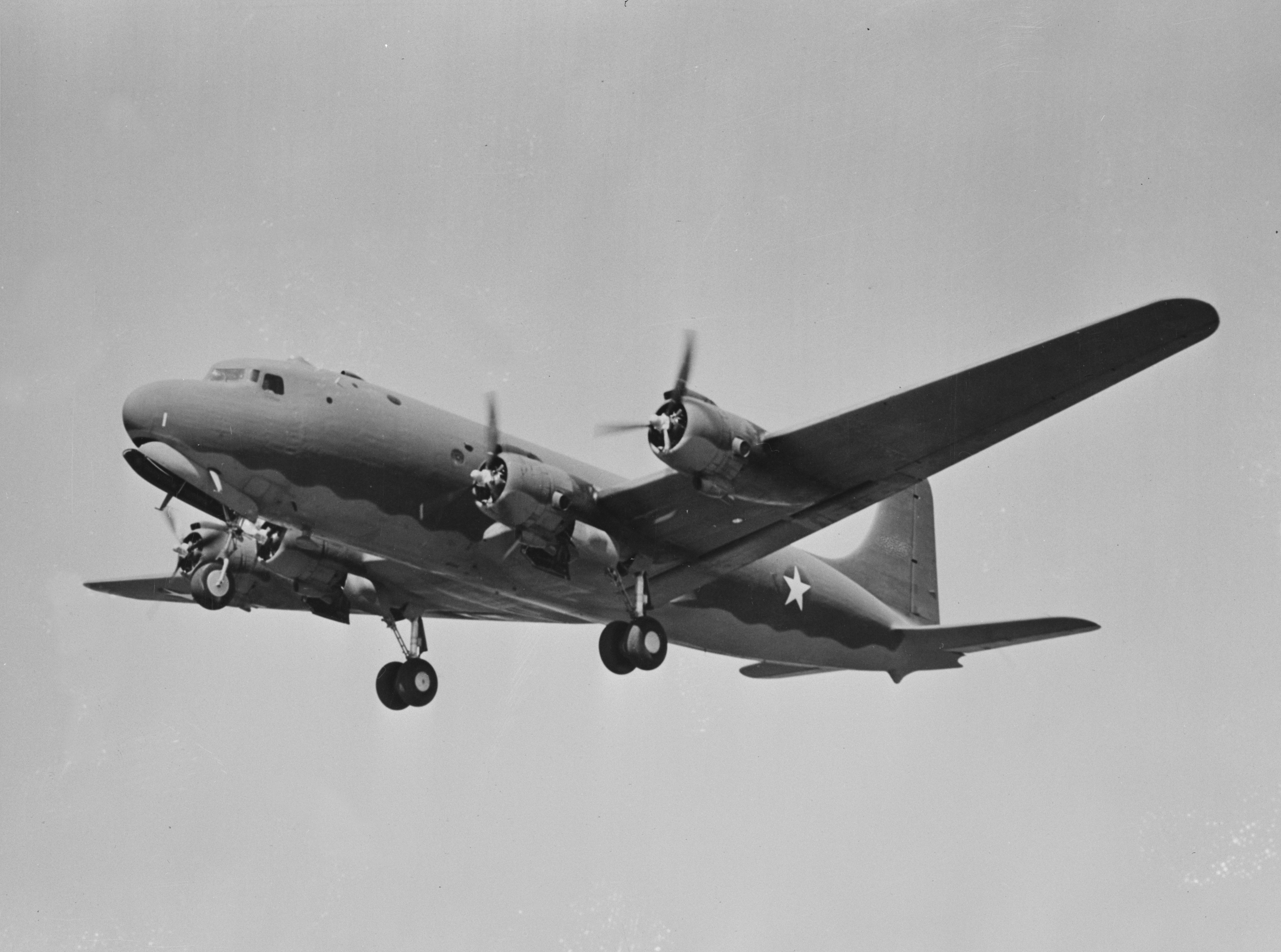
The first aircraft, 42-10237, took off from Clover Field in Santa Monica, California, on 14 February 1942, already in military markings; it was the first DC-4/C-54 of any kind to fly, since no civil DC-4 had flown before it. To meet military long-range requirements, these first aircraft received four additional auxiliary fuel tanks in the main cabin, which reduced seating to 26 passengers. They were powered by four R-2000-3 engines of 1,350 hp each. Maximum take-off weight was 29,873 kg. Like all DC-4s and C-54s, and although pressurisation was offered as an option, they were built without a pressurised cabin. Douglas also reserved the commercial designation DC-4A for the civil equivalent of the C-54.
All 24 C-54s were built at Santa Monica and delivered to the USAAF during 1942; the acceptance table in the German Wikipedia places every one of them in that year and at that plant, with no involvement of the Chicago factory, which joined the programme with the later versions. Sources also disagree on the entry into service: historyofwar.org dates it to 20 March 1942, the German Wikipedia to 15 May 1942. Either way, by the end of the year enough had been delivered to begin to make a real impact. These aircraft inaugurated the role that would define the whole family: Air Transport Command (ATC) used them on the long-range routes linking the continental United States with the various theatres of war, while the shorter-ranged C-47s did most of the work within each theatre. Over five years ATC Skymasters would make 79,642 transoceanic flights with only two forced ditchings, a figure that covers every version but whose path was opened by these 24 aircraft.
The original C-54 was soon overshadowed by the C-54A, the first version conceived from the outset as a military transport, with a strengthened floor and a cargo door with hoist and winch, and by the B, D, E and G versions that progressively moved fuel from the cabin into the wings. Between 1942 and January 1946 Douglas delivered 1,163 C-54/R5Ds to the United States armed forces, of which 515 came from Santa Monica and 655 from Chicago; the 24 original C-54s are the smallest fraction of that output, but also its starting point. After the war some 500 surplus C-54s and R5Ds came onto the civilian market, many of them converted by Douglas to DC-4 standard, and became direct competition for the 79 new post-war DC-4s that Douglas itself built. The individual fate of each of the 24 C-54s (serial numbers, later civil operators, losses) is not documented in the sources consulted.
Multimedia