C-212 Aviocar: The Spanish Aircraft That Connected the World's Most Remote Regions
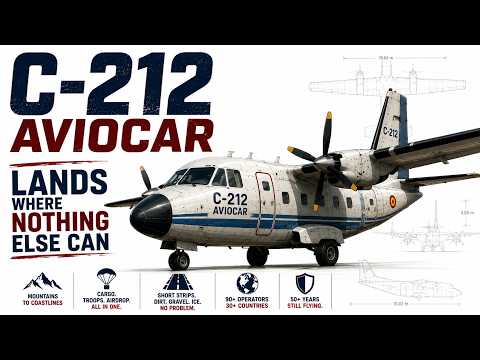
Video from the channel Hangar Archives about CASA C-212 Aviocar, linked on its Above Ten Thousand entry. Duration: 16:12. Language: English. Video type: Documentary.
What it's about
History of the CASA C-212 Aviocar, CASA's first in-house aircraft design, from its commissioning to the complete transfer of its production to Indonesia. It opens with a ski-equipped flight in Antarctica in January 2006, about 460 km from Davis Station, after which the aircraft returned with damaged landing gear to Casey Station.
Historical background
Founded in Getafe in 1923 by José Ortiz Echagüe, CASA spent half a century building other companies' designs under licence: the Breguet 19, the Dornier Do J Wal flying boat and, after the Civil War, the CASA 2.111 (Heinkel He 111), the CASA 352 (Junkers Ju 52) and Bücker and Gotha trainers. In 1967 the Spanish Air Force, which was still flying Ju 52s and C-47s, requested a tactical transport designed in Spain. The first of two prototypes flew at Getafe on 26 March 1971, and the first military order arrived in 1974.
Key facts
It is a high-wing, fixed-gear twin with a rear ramp, powered by Garrett TPE331 turboprops rated at 715 shp in the Series 100, 900 shp in the Series 200 (1979) and 925 shp in the Series 400, unveiled at the 1997 Paris Air Show. It carries up to 18 passengers, 16 paratroopers or around 2,000 kg of cargo. Indonesia built it under licence in Bandung through IPTN, and regional airlines in the United States and the Caribbean used it on short routes; the video attributes the crashes of American Eagle flights 5452 (1987) and 5456 (1992) to maintenance and procedures rather than design. After CASA merged into EADS in 1999, the last Seville-built C-212 was delivered in December 2012 to the Vietnamese Marine Police, and since 2013 Indonesian Aerospace has held exclusive production rights. The United States operates it as the C-41A.