Beechcraft 1900 variant
Beechcraft 1900D
The 1900D is the version that defines the Beechcraft 1900: a thorough redesign of the 1900C announced in 1989, with a stand-up cabin, winglets, an enlarged tail, PT6A-67D engines and EFIS avionics, certificated in the FAR Part 23 commuter category. It first flew on 1 March 1990, was delivered from November 1991 (first to Mesa Airlines) and became the most-produced variant: 439 aircraft with UE serial numbers before the line closed in 2002.

- March 1, 1990
- First flight
- 439
- Units built
- 707 km
- Range
- 19
- Passengers
History
A nineteen-seater you can stand up in
The 1900 and 1900C shared the drawback of almost every nineteen-seat airliner and many business jets: a cabin ceiling so low that a passenger of average height could not walk the aisle without stooping. At the 1989 conference of the US Regional Airlines Association, Beech announced the answer: a new version called the 1900D. It was not a touch-up but a major redesign of the 1900C, also meant to meet the new FAR Part 23 commuter category rules taking effect in October 1991, which replaced the old SFAR 41C under which the 1900 and 1900C had been certificated.
The cabin gained 36 centimetres of height over the 1900C: it reached 1.8 metres, except over the ramp across the wing carry-through, where it dropped to 1.65 metres. With a flat floor, cabin volume grew 28.5 per cent compared with the 1900C. In its class only British Aerospace's Jetstream 31/32 also offered a stand-up cabin. The rear baggage compartment held about 4.97 m³ and 740 kg.
The whole aircraft had to follow the cabin
A taller cabin adds weight and drag, and one design goal was to carry all nineteen passengers and all their baggage at the same time, which demanded more power and a wider centre-of-gravity range. A chain of changes followed. The engines became two Pratt & Whitney Canada PT6A-67Ds, flat rated from 1,203 kW (1,613 shp) down to 954 kW (1,279 shp), driving Hartzell four-blade composite, reversible-pitch propellers; the 1900 and 1900C used the 820 kW PT6A-65B. Winglets were added to cut drag and improve hot-and-high performance. The T-tail was enlarged and swept, with small fins ("tailets") under the tailplane tips; the "stabilons", fixed horizontal surfaces on each side of the rear fuselage that widen the centre-of-gravity range, were retained, and twin ventral strakes for directional stability and a small vortex generator ahead of the wing roots were added.
_(2).jpg)
The wet wing held two integral tanks per side, 2,528 litres in all (2,519 usable). The cabin was pressurised to 0.35 bar, keeping a sea-level cabin up to 3,350 metres and a 2,745-metre cabin at 7,620 metres. The flight deck received a four-tube Collins EFIS-84 system and Pro Line II digital radios. Like the King Air it derives from, the 1900D is certificated for single-pilot operation in corporate or cargo use, although US airline passenger operations require two pilots.
Prototype and certification
The prototype was converted from a 1900C-1, N5584B, and first flew on 1 March 1990. FAA Type Certificate Data Sheet A24CE records approval of the Model 1900D Airliner, commuter category, on 19 March 1991, with PT6A-67D engines and maximum weights of 7,815 kg ramp, 7,766 kg take-off, 7,604 kg landing and 6,879 kg zero fuel; serial numbers UE-1 and after are eligible. The aircraft carry the UE prefix because UD was already in use by the military 1900s. Full certification with supplements came in November 1991, when deliveries began. In 1991 an airline 1900D cost 3.95 million dollars; in 2001, 4.995 million.
Mesa, production and the end of the line
The first delivery went to Mesa Airlines in November 1991; the airline had ordered 118 aircraft. China joined the supply chain: in February 1997 a contract was signed with Xian Aircraft Company to supply Raytheon with 800 metal-bonded subassemblies for the 1900D, for delivery between 1997 and 2001. The 500th 1900 of the whole family was delivered in March 1997, and the 400th 1900D, N44640, was rolled out on 21 March 2000. According to Jane's, deliveries were 65 in 1995, 69 in 1996, 42 in 1997, 45 in 1998, 24 in 1999, 54 in 2000, 11 in 2001 and 11 more in 2002, plus one in the first half of 2003.
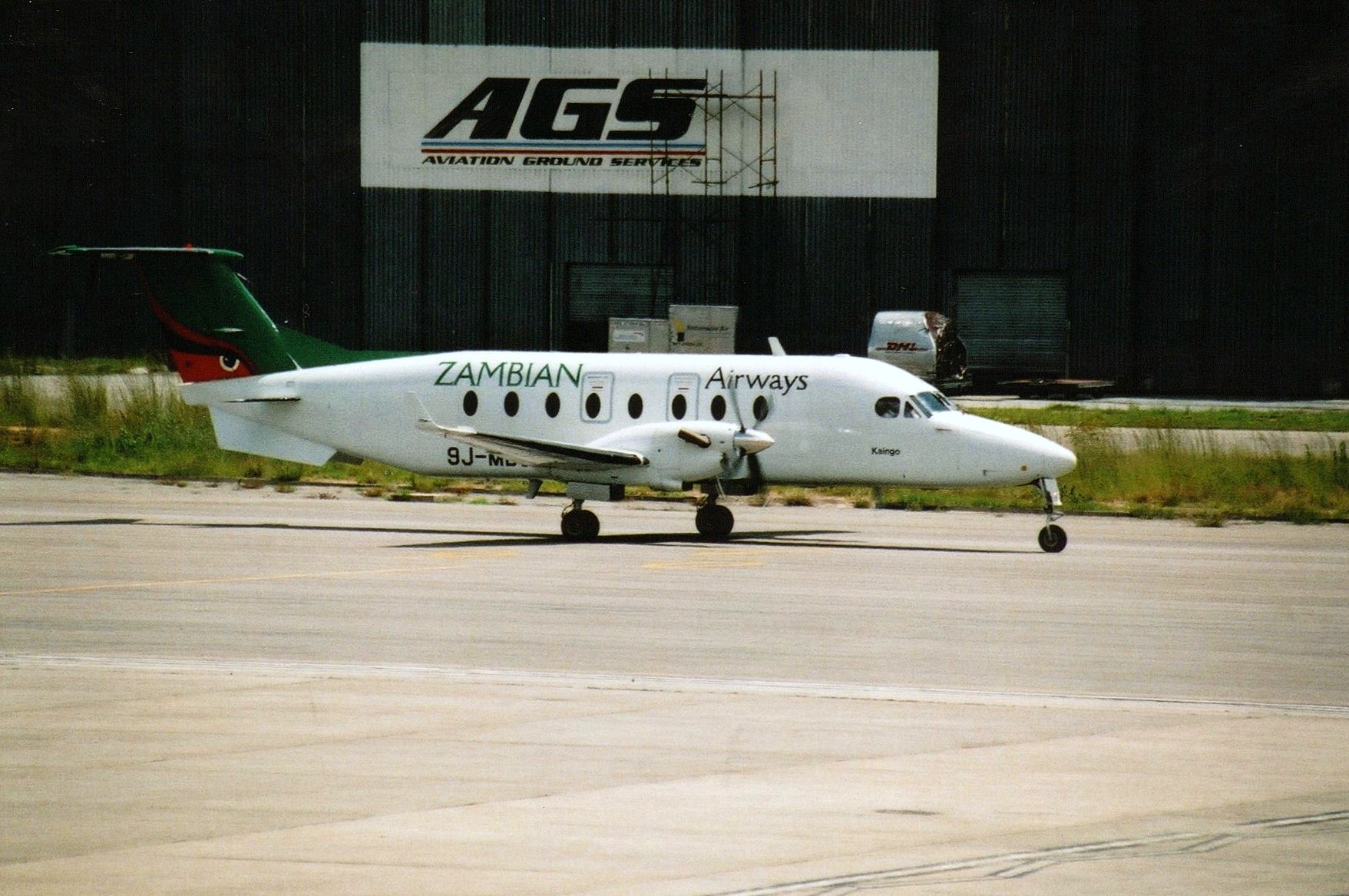
The last large order came from Air New Zealand, which in April 2001 ordered 16 aircraft for its regional subsidiary Eagle Airways. The last of them, ZK-EAP (UE-439), was delivered on 29 November 2001 as the final new-build 1900, although deliveries of already-built "white tail" aircraft continued. With the market turning to 50- to 90-seat regional jets, Raytheon ended production in October 2002. 439 1900Ds were built, the most numerous variant of the type, out of a family total that Wikipedia puts at 695 and Jane's at 690.
Beech also offered a 1900D Executive with custom interiors of 10 to 18 seats, and special-mission versions; the Algerian Air Force ordered 12 in 2000 in signals-intelligence configuration, with Northrop Grumman radar and FLIR. The US Army received a 1900D (96-0112) in March 1997 for the Chemical and Biological Defense Command at Aberdeen Proving Ground. An Alpine Air Express supplemental type certificate allows the 1900D to be converted into a freighter: the tall cabin gives it about 25 m³ of cargo space.
In service
In Australia the type was introduced by Impulse Airlines: its first example, VH-SMH, arrived to distribute the Sydney Morning Herald across north-western New South Wales and south-western Queensland. After Qantas acquired Impulse in 2001, the 1900Ds flew with QantasLink until withdrawn in 2002. In late 1999 it was announced that the RAAF would obtain four to replace its HS 748 navigation trainers. In New Zealand, Eagle Airways flew them in Air New Zealand Link colours; on 11 November 2014 Air New Zealand announced their withdrawal from Hamilton by August 2016 and their replacement by ATR 72s. In Spain the airline Naysa operated several. In July 2018, 192 1900Ds remained in airline service.
The fleet has suffered several accidents: Air St. Martin in Haiti on 7 December 1995 (20 killed), the mid-air collision of Proteus Airlines Flight 706 over Quiberon Bay on 30 July 1998, Régionnair Flight 347 at Sept-Îles on 12 August 1999, Air Midwest Flight 5481 at Charlotte on 8 January 2003 (21 killed) and the gear-up landing of Eagle Airways Flight 2300 on 18 June 2007, which all 17 on board survived.
Multimedia
_(2)-1600.webp)


-1600.webp)


-800.webp)