Avro Lancaster – How the Bombsight Mk XIV Worked
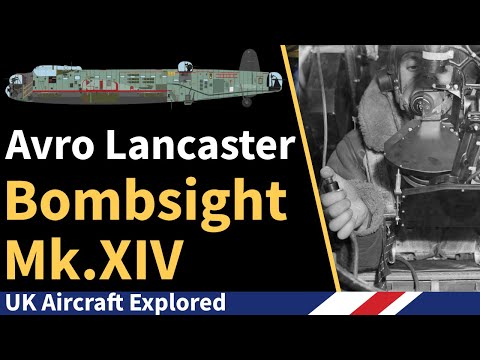
Video from the channel UK Aircraft Explored about Avro Lancaster, linked on its Above Ten Thousand entry. Duration: 24:45. Language: English. Video type: Documentary.
What it's about
An explanatory piece on the Mk XIV bombsight fitted to the Avro Lancaster bomber, drawn from period technical manuals of the British Air Ministry and supported by coloured diagrams. It covers the sight's construction, its handling by the bomb aimer and its internal workings, and closes with its fitment to the Lancaster, the Handley Page Halifax, the Short Stirling and the Vickers Wellington.
Historical context
According to the video, experience had shown that a general-purpose bombsight needed, besides accuracy, to demand the least possible time of straight and level flight on the approach to the target and to keep in-flight adjustments and calculations to a minimum. The Mk XIV, operational from 1942, met both conditions: it allowed evasive manoeuvres almost up to the moment of release, even in coordinated turns, in a gentle dive or while climbing. The video adds that it was fitted to many other wartime aircraft and that the Americans adopted it under the designation T.1.
Key facts
The system consists of two units: the sighting head, in the nose, and the computer, a rectangular box set some distance away and linked to the head by two flexible shafts that transmit the sighting angle and the drift angle. The bomb aimer sees, on a glass reflector, a sword-shaped graticule whose long line marks drift and whose short line marks the moment of release. The sighting plane is stabilised in roll because the reflector, linked to a gyroscope, turns by half the aircraft's bank angle: at 40 degrees of bank, the reflector turns 20. Only five values are set by hand: wind direction and speed over the target, target altitude, the bomb's terminal velocity and levelling; height, speed and drift are measured automatically. The computer is analogue and mechanical, with no memory, powered at 24 volts for the gyroscopes and compressors, with two electric motors driving four servos. The presenter puts the gain in accuracy at going from about two miles around the target early in the war to about 150 yards by 1945.