Antonov An-225 Mriya variant
Antonov An-225 Mriya An-225
The An-225 is the Mriya's original configuration, developed by Antonov from the An-124 Ruslan to carry the Buran orbiter and the Energia rocket's core components. It first flew on 21 December 1988 with a 600-tonne maximum take-off weight, no rear cargo door and a twin tail to cope with loads carried on top of the fuselage. Only one was completed and it flew until 1994; a second airframe was left half-built in Kyiv and remains the basis for any future Mriya.
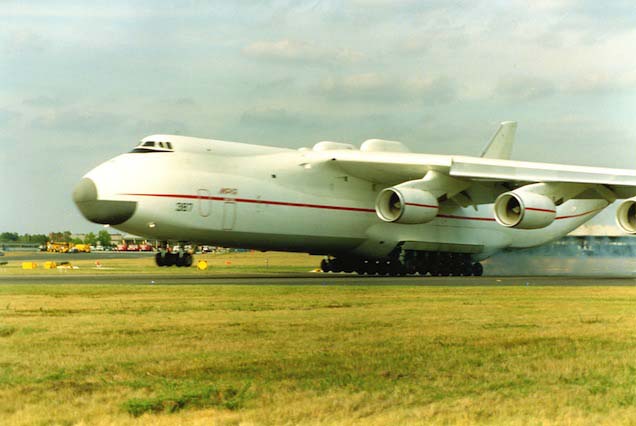
- December 21, 1988
- First flight
- 1
- Units built
- 4,500 km
- Range
History
A requirement from the space programme
The An-225 designation covers the Mriya as it left the Antonov design bureau in the late 1980s, before it was converted into a commercial freighter. The Soviet government issued the requirement in 1984: it wanted an airlifter able to carry up to 231,838 kg, either inside or on top of the fuselage, and to operate from any runway at least 3,500 m long. It was to replace the Myasishchev VM-T Atlant and move the Energia rocket's components and the Buran orbiter from the factories to the launch site. Its mission was essentially that of the American Shuttle Carrier Aircraft, and the delivery schedule was tight, so development had to move quickly.
Antonov answered by enlarging the An-124 Ruslan. Fuselage barrels were added ahead of and behind the wing; a new centre section increased the span and made room for two more Progress D-18T engines, six in all. The Ruslan's single fin gave way to a twin tail with a large swept tailplane, essential so that the wake of a bulky load strapped to the back would not disturb the empennage. The lead designer of the An-225, as of the An-124, was Viktor Tolmachev. According to German Wikipedia, the project carried the internal designation 402, and in 1987 aircraft plant No. 84 in Tashkent built six wing sections that were flown to Kyiv one at a time on the back of an An-22. Sources disagree on the original order: English Wikipedia speaks of two aircraft ordered, German Wikipedia of three with an option on two more.
What set this version apart
The first concept, the An-224, kept the An-124's rear door and ramp. The An-225 deleted them to save weight: it was not intended as a tactical transport or for short fields. Instead it received a 32-wheel landing gear, some wheels steerable, which let it turn on a 60 m wide runway; a nose gear that could "kneel" to ease loading through the nose; four overhead cranes running the whole length of the hold, each able to lift 5 t; and mounting points along the top of the fuselage for external loads. The pressurised hold was 43.35 m long, 6.4 m wide and 4.4 m high, with a volume of 1,300 m³. Flight controls were fly-by-wire with triple-redundant hydraulics, and the flight deck largely repeated the Ruslan's. In this original configuration the maximum take-off weight was 600 tonnes, already the highest in the world.
First flight and test records
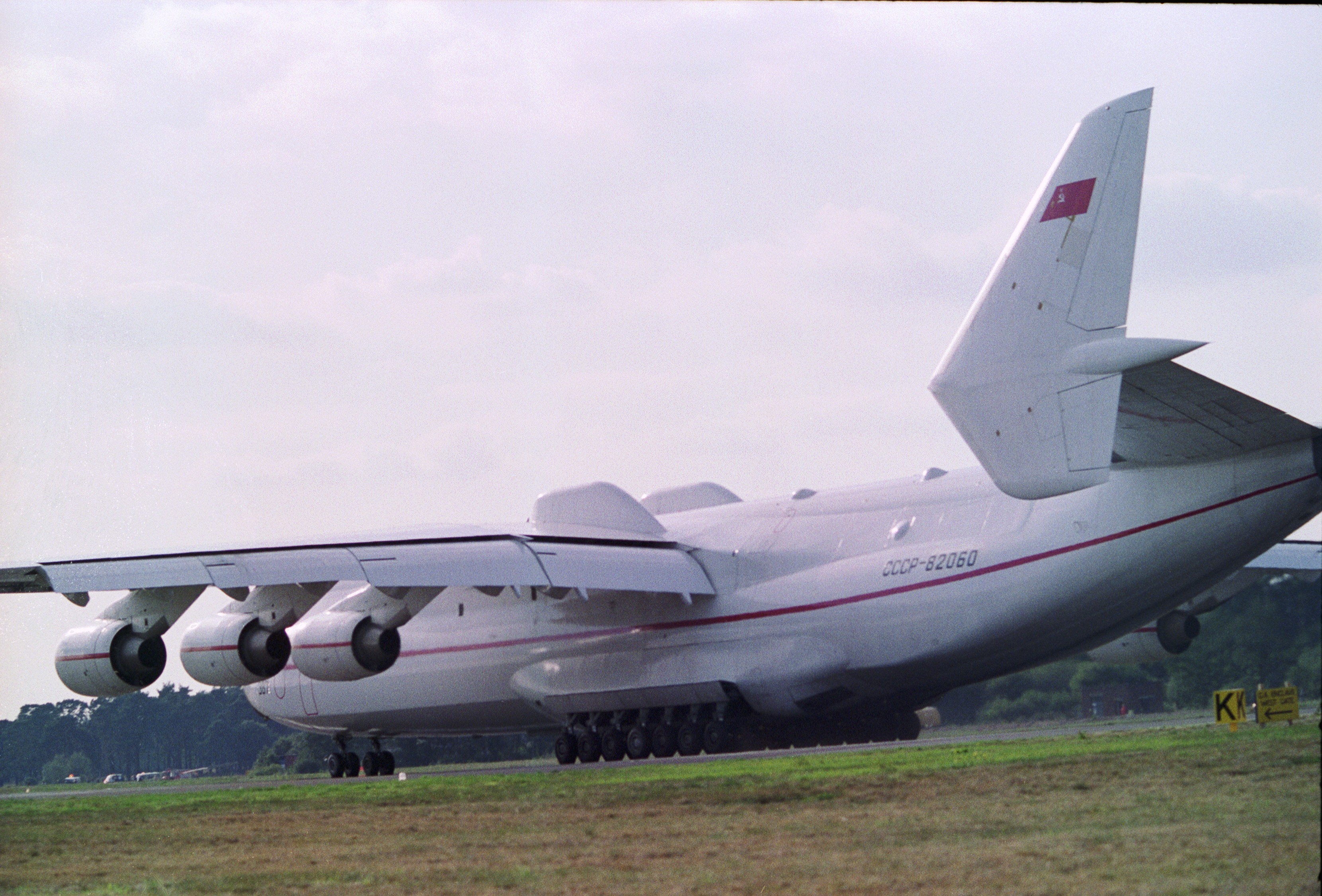
The aircraft was rolled out on 30 November 1988 and first flew on 21 December 1988 from the Antonov factory airfield, a flight of an hour and a half. During trials in March 1989 it set 106 FAI-recognised world records for weight, distance and altitude, among them the highest weight in flight, at 506.8 tonnes. Its first registration was SSSR-480182; from June 1989 it carried SSSR-82060 and, from 1992, now a Ukrainian aircraft, UR-82060.
Serving Buran
Flight tests carrying the orbiter began in May 1989, and that same year the Mriya made its first appearance outside the Soviet Union at the Paris Air Show with a Buran on its back. A year later it flew a display at Farnborough. The irony, noted by Russian Wikipedia, is that by the time the aircraft was finished the VM-T Atlant had already made the transport flights the programme required: the An-225 did little more than take Buran to Paris and fly demonstrations over Baikonur in April 1991. In August 1993 it appeared at the MAKS-93 show in Zhukovsky with the Ukrainian flag on its tail, and until 1994 it was a regular guest at the Moscow and Singapore air shows.
End of the first chapter
The collapse of the Soviet Union and the end of the Buran programme left the only An-225 without a mission. In 1994 it was put into long-term storage: it stopped flying and its six engines and other equipment were removed for use on Antonov Airlines' An-124s. That is where the An-225 in its original configuration ends; the aircraft flew again in 2001, modernised, as the An-225-100.
The second airframe
Work on the second aircraft began in 1989. According to German Wikipedia, its structure was first used for static load tests. Assembly continued after 1991 but stopped in 1994, when the aircraft's enormous capacity was no longer in demand; Flightline Weekly puts it at 70% complete at that point, and other sources at 60 to 70%. Before the war, CNN confirmed that the essential components had been manufactured: fuselage, wings, nose gear and tail.
The airframe then spent three decades between announcements. In 1998 completing it for the cargo operator Air Foyle was studied, at an estimated cost of 160 million dollars; later, carrying parts of Delta or Atlas rockets was considered. In September 2006 it was decided to complete it for around 2008, but by August 2009 the work was reported abandoned. In May 2011 Antonov's chief executive said at least 300 million dollars and three years would be needed; in 2012 Antonov Airlines ruled out assembly for lack of demand. On 30 August 2016 Antonov signed a letter of intent with Aerospace Industry Corporation of China to complete and modernise the second aircraft as an air-launch platform for satellites, but in December 2017 it emerged that China had lost interest. In October 2020 Turkish President Erdoğan raised the idea again.
The Russian invasion of 2022 gave it new meaning. Stored at the Sviatoshyn plant in Kyiv, the airframe survived artillery strikes on its hangar. After the An-225-100 was destroyed at Hostomel, Antonov announced in November 2022 that design work had begun to finish the second aircraft, that about 30% of usable components were available and that the cost would be at least 500 million euros; it also denied a report in the newspaper Bild that construction was already 70% complete. Four months later it confirmed that parts had been removed from the destroyed aircraft to be mated to the unfinished fuselage.
Multimedia


