Family: Starship
Starship
Launch statistics
- 13
- Launches (as of July 27, 2026)
- 2
- Successes
- 0
- Failures
- 100.0 %
- Success rate
.png)


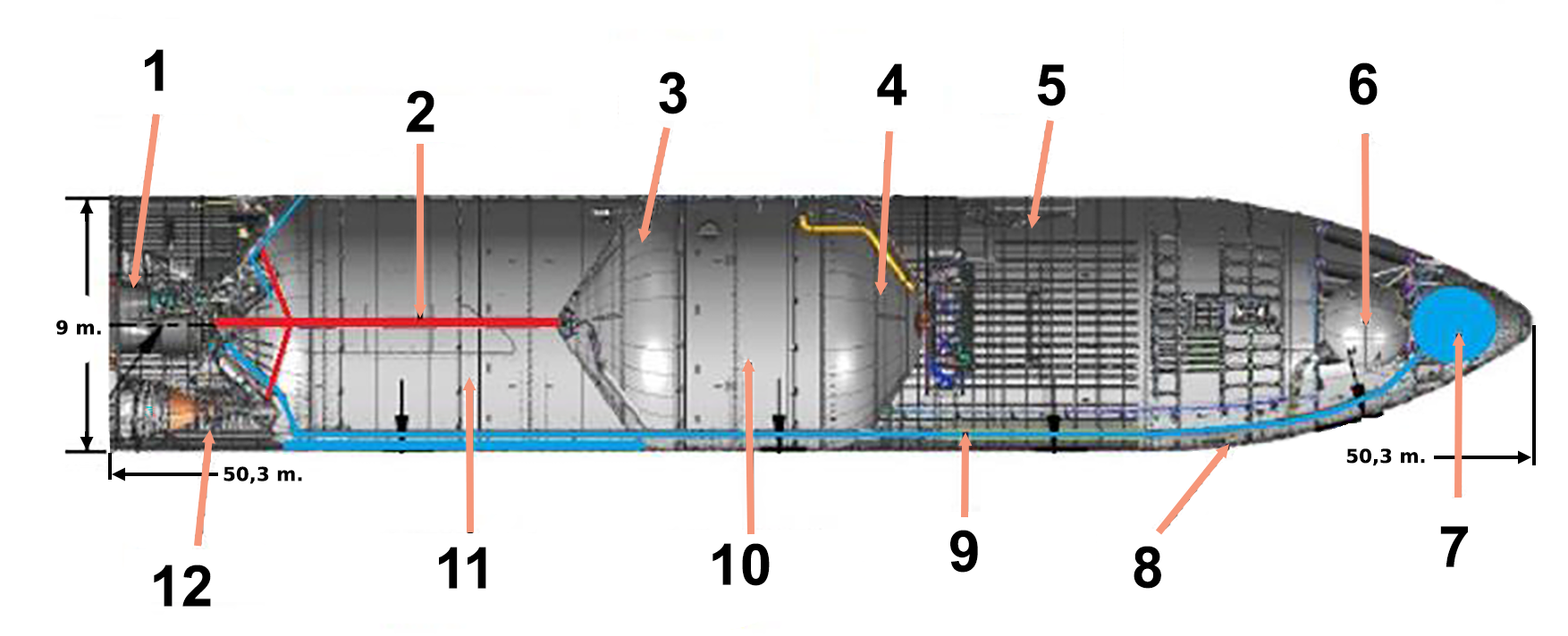
Starship is a two-stage, fully reusable, super heavy-lift launch vehicle under development by the American company SpaceX. It is built and launched from Starbase in Texas and is intended as the successor to the company's Falcon 9 and Falcon Heavy rockets within its broader reusable launch system development programme. If completed as designed, it would be the first fully reusable orbital rocket and would have the highest payload capacity of any launch vehicle to date. The vehicle consists of the Super Heavy booster and the Starship upper stage, both powered by Raptor engines burning liquid methane and liquid oxygen in a full-flow staged combustion cycle. The bodies of both stages are made from stainless steel, stacked and welded from cylinders 6 ft tall and 3.97 mm thick. Both stages are intended to return to the launch site and land vertically at the tower. Stacked and fully fuelled, the vehicle has a mass of approximately 5,300 t, a diameter of 9 m and a height of 121.3 m in its initial block. For its "baseline reusable design" SpaceX states a payload capacity of 100–150 t to low Earth orbit and 27 t to geostationary transfer orbit. Development follows an iterative and incremental approach involving many prototypes and test flights, organised into successive blocks: Block 1 (121.3 m, 15 t payload), Block 2 (123.1 m, 35 t), Block 3 (124.4 m, 100 t) and the planned Block 4 (142 m, 200 t). SpaceX has invested more than US$15 billion in the programme. A crewed variant, the Starship Human Landing System, is being developed for NASA's Artemis programme.
Three-view drawing
History
From early concepts to the first integrated flight
SpaceX began developing concepts for a super heavy-lift reusable launch vehicle as early as 2005; the current design and name were introduced in 2018. After a campaign of low-altitude flight tests between 2019 and 2021, the first full Starship rocket launched on 20 April 2023 and exploded four minutes after liftoff. The programme has failed to meet many of its optimistic schedule goals and has suffered notable setbacks, among them the failure of the first four Block 2 upper stages during 2025.
The successive blocks
On 4 April 2024 Elon Musk announced two new versions at Starbase, Block 2 and Block 3, intended to address the shortcomings of the pre-production prototypes. Block 3 ships have an improved tile design, Raptor 3 engines and hardware for refuelling operations in LEO such as docking ports and a redesigned quick disconnect; Block 3 boosters integrate a vented interstage into the forward dome, drop from four grid fins to three and use those fins as tower catch points. The switch to Raptor 3 allows removal of most of the aft section's shielding, saving over a ton per engine. First test flights of Block 3 ships began in 2026.
Recent flights
The eleventh flight test, on 13 October 2025, largely repeated the profile of the tenth and was the final launch of the Block 2 configuration. The twelfth, on 22 May 2026 with Ship 39 and Booster 19, debuted Version 3: the ascent burn with 33 engines was successful, but the booster went into an off-nominal flip, an explosion in engine E6 knocked out neighbouring Raptors, and the vehicle lost control and broke apart over the Gulf of Mexico. The thirteenth flight, launched on 24 July 2026 after two scrubs with Ship 40 (S40) as the upper stage, deployed 20 Starlink V3 satellites, relit an engine in orbit and achieved a soft splashdown in the Indian Ocean, becoming the first Starship to remain intact after toppling over post-splashdown. SpaceX filmed the gentle touchdown from a drone flying beside the splashdown point in the Indian Ocean and released the footage publicly. As of 24 July 2026 the vehicle had launched 13 times, with 8 successful flights and 5 failures.
Launch timeline
| Date | Launch site | Outcome | Payload |
|---|---|---|---|
| Jul 24, 2026, 10:51 PM | Orbital Launch Pad 2 | Success | 13th test flight of the two-stage Starship launch vehicle. Second flight of Starship V3. For the first time, Starship will carry 20 V3 Starlink satellites to space, which will extend solar arrays and antennas and will attempt to connect with ground stations in South Africa and the larger Starlink constellation via high-capacity lasers. 6 of the satellites have been modified with a suite of cameras to scan Starship’s heat shield and transmit imagery down to operators to continue testing methods of analyzing Starship’s heat shield readiness for return to launch site on future missions. Several tiles on Starship have been painted white to simulate missing tiles and serve as imaging targets in the test. |
| May 22, 2026, 10:30 PM | Orbital Launch Pad 2 | Success | 12th test flight of the two-stage Starship launch vehicle. Maiden Flight of Starship V3. The flight test’s primary goal will be to demonstrate each of these new pieces in the flight environment for the first time, with each element of the Starship architecture featuring significant redesigns to enable full and rapid reuse that incorporate learnings from years of development and test. The Starship upper stage will target multiple in-space and reentry objectives, including a payload deployment of 20 Starlink simulators, similar in size to next-generation Starlink V3 satellites, and two specially modified Starlink satellites. The two modified satellites will test hardware planned for Starlink V3 and will attempt to scan Starship’s heat shield and transmit imagery down to operators to test methods of analyzing Starship’s heat shield readiness for return to launch site on future missions. Several tiles on Starship have been painted white to simulate missing tiles and serve as imaging targets in the test. The Starlink simulators will be on the same suborbital trajectory as Starship. A relight of a single Raptor engine while in space is also planned. For Starship entry, a single heat shield tile has been intentionally removed to measure the aerodynamic load differences on adjacent tiles when there is a tile missing. Finally, the ship will perform experimental actions tested on previous flight tests, including a maneuver to intentionally stress the structural limits of the vehicle’s rear flaps and a dynamic banking maneuver to mimic the trajectory that future missions returning to Starbase will fly. |
Versions
| Block 1 | Block 2 | Block 3 | |
|---|---|---|---|
| First launch | April 20, 2023 | January 16, 2025 | May 22, 2026 |
| Last launch | November 19, 2024 | October 13, 2025 | — |
| Height | 121 m | 123 m | 124 m Best value in this row |
| Diameter | 9 m Best value in this row | 9 m Best value in this row | 9 m Best value in this row |
| Mass | 5,000,000 kg Best value in this row | 5,000,000 kg Best value in this row | 5,000,000 kg Best value in this row |
| Stages | 2 Best value in this row | 2 Best value in this row | 2 Best value in this row |
| LEO capacity | — | — | 100,000 kg |
| Reusable | Yes | Yes | Yes |
Images