Family: Jielong (Smart Dragon) · CALT
Smart Dragon 3
Launch statistics
- 11
- Launches (as of July 27, 2026)
- 2
- Successes
- 0
- Failures
- 100.0 %
- Success rate
_launch_vehicle-1600.webp)

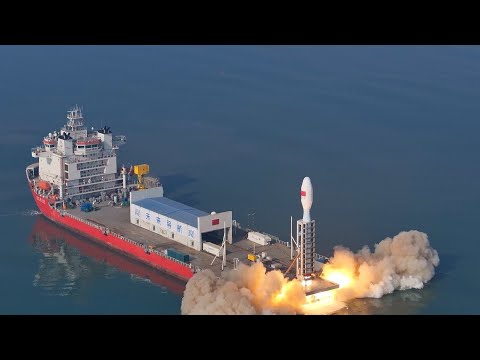
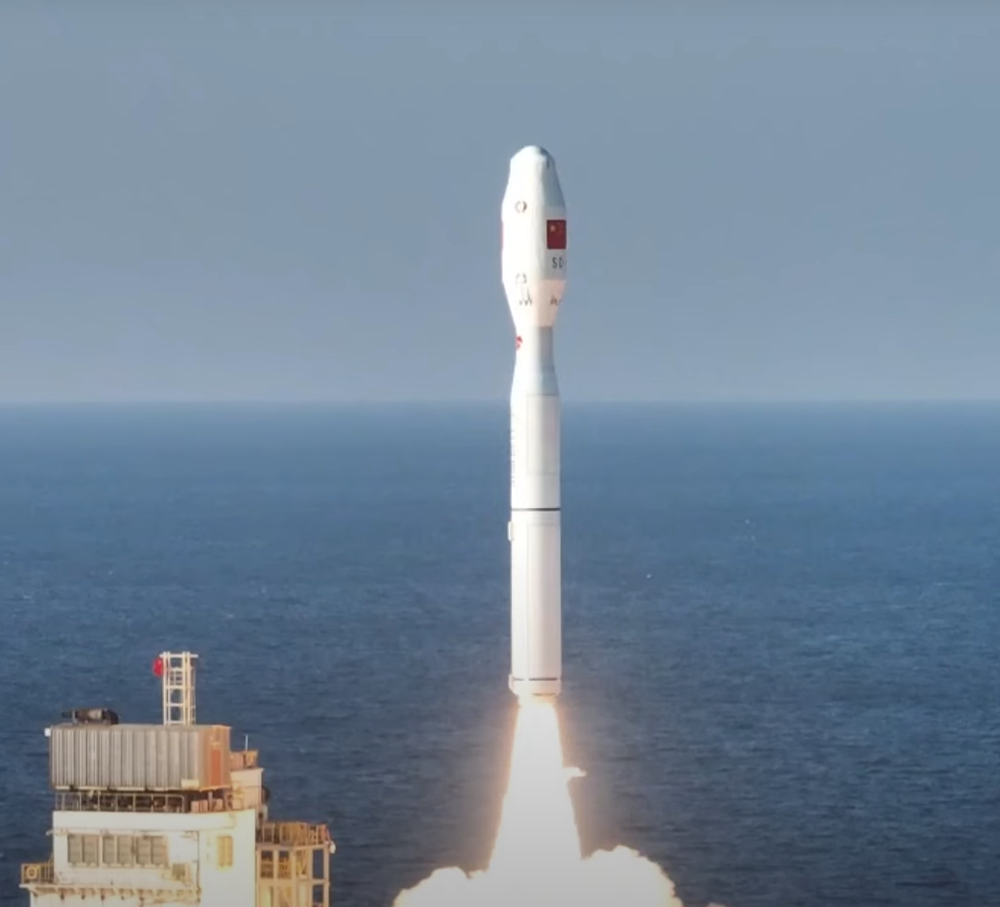
Jielong 3, marketed internationally as Smart Dragon 3 or SD-3, is a solid-propellant orbital launch vehicle developed by China Rocket, the commercial subsidiary of the China Academy of Launch Vehicle Technology (CALT). It stands 31 metres tall, is 2.65 metres in diameter and weighs 145 tonnes at lift-off. All four of its stages burn solid propellant, a choice that trades efficiency against liquid designs for operational simplicity and very short preparation times. Its natural market is the satellite constellation: the rocket places up to 1,600 kilograms into a 500-kilometre Sun-synchronous orbit, and its 3.35-metre payload fairing is unusually roomy for the class, allowing dense clusters of small spacecraft to fly together. To shorten development, the vehicle reuses the same rocket motors as the Zhongke-1 (ZK-1, also known as Lijian-1) launcher. It is worth stressing that Jielong 3 is not a configuration of another rocket but a vehicle in its own right within CALT's Jielong ("agile dragon") series, considerably larger than Jielong 1 and comparable in class to Minotaur I, Pegasus or Electron. Every flight so far has departed from converted sea-going barges, a practice China has normalised for solid-fuelled launchers because it avoids overflying populated areas.
History
Origin and concept
Jielong 3 was developed at the China Academy of Launch Vehicle Technology through China Rocket, the arm created to compete in the commercial small-launch market. The design follows a cost-and-cadence logic: four solid stages, 31 metres tall, 2.65 metres in diameter, 145 tonnes at lift-off and no cryogenic operations to complicate the launch campaign. Reusing the same motors as the Zhongke-1 let the programme draw on an existing production line rather than start from scratch.
Maiden flight
The debut came on 9 December 2022 at 06:35 UTC from a converted barge, the Tai Rui, stationed in the East China Sea. The mission succeeded and deployed fourteen small satellites into polar orbit, among them several Jilin-1 Gaofen and Pingtai spacecraft, HEAD 2H, Qilu-1 05 and 06, Tianqi 07, Huoju 1 and CAS 5A. It was a deliberate demonstration of the vehicle's multi-payload deployment capability.
Growing performance
The capacity announced at first was 1,560 kilograms to a 500-kilometre Sun-synchronous orbit, a figure raised to 1,600 kilograms by the fifth flight on 13 January 2025. That same month Gao Lijun, of the China Aerospace Science and Technology Corporation (CASC), said further improvements were planned with the goal of eventually carrying two metric tons to that orbit.
Operational record
Since the maiden flight, Jielong 3 has accumulated eleven launches with eleven successes and no failures, the most recent on 11 April 2026. The barge fleet has migrated from the East China Sea to the South China Sea and finally to Yellow Sea waters off Rizhao and Haiyang Port. Its manifest has alternated institutional payloads — Earth observation satellites, the CentiSpace-1 navigation augmentation constellation — with commercial customers such as GeeSat and with test satellites for China's satellite internet networks. A further flight, Y12, was listed as planned for June 2026.
Launch timeline
| Date | Launch site | Program | Outcome | Payload |
|---|---|---|---|---|
| Aug 5, 2026, 2:38 AM | Haiyang offshore launch location | — | Success | 2 hyper-spectral Earth observation satellites from Chinese company STAR.VISION. Both satellites are built in corporation with foreign customers: * Lampung-1: Built in close partnership with Lampung Province, Indonesia, to accelerate marine economy growth, environmental governance, and regional industry collaboration. * Samarkand 2028: Jointly created with Uzcosmos, Uzbekistan, to support regional ecological monitoring and technological innovation. |
| Apr 11, 2026, 11:32 AM | South China Sea (launch location 3) | — | Success | Officially described as "Satellite-Internet Technology Demonstration Satellite". Probable 1 (?) test satellite for the Chinese state-owned LEO communication satellite constellation SatNet. |
Images


![[79th live stream] CASC's Jielong-3 (Smart Dragon-3; SD-3) rocket - Y10 - Flight 10 launch mission.](https://i.ytimg.com/vi/DwQC6OI0-C4/hqdefault.jpg)