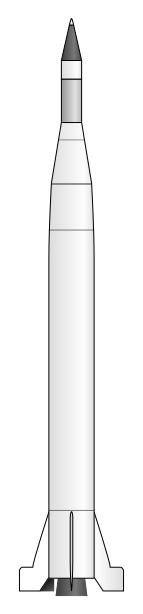
Redstone version
Redstone Sparta
Sparta, or Redstone-Sparta, was the last incarnation of the Redstone family: a surplus US Army Redstone missile topped with two solid-propellant stages, an Antares 2 and a BE-3 Alcyone, launched ten times from pad LA-8 at Woomera, South Australia, between November 1966 and November 1967. The first nine flights carried test warheads to study atmospheric re-entry for the joint American, British and Australian SPARTA programme; the first of them failed. The tenth, using the reserve vehicle the United States handed over to Australia, placed WRESAT, Australia's first satellite, into a near-polar orbit.

- November 28, 1966
- First launch
- 45 kg
- LEO capacity
- 416 kN
- Thrust
- No
- Reusable
History
A three-nation programme
The name comes from the programme's acronym, Special Anti-missile Research Tests, Australia, which is why the vehicle is known both as Sparta and as Redstone-Sparta. It should not be confused with the LIM-49 Spartan anti-ballistic missile, an entirely different system. SPARTA was a joint programme of the United States, the United Kingdom and Australia, a follow-up to earlier projects of the same kind, intended to improve understanding of re-entry phenomena using a range of model warheads. The re-entry profiles of the test vehicles were tracked and analysed from ground-based systems to support the development of anti-missile defences. The United States supplied the hardware: the Department of Defense brought ten Redstone missiles to Woomera, nine for the test series and one spare. Australia provided the Woomera range, at the time a hub of space research that was home to thousands of British, American and Australian military personnel and civilians.
The stack
Sparta stood 21.8 m tall and 1.78 m in diameter, and weighed around 30 t at lift-off. The first stage was a modified Redstone with an A-7 engine burning liquid oxygen and ethanol, credited by the Wikipedia data sheet with 416 kN of thrust, a specific impulse of 265 s and a 155 s burn (Encyclopedia Astronautica gives 357 kN for the vehicle). Above it sat a Thiokol Antares 2 taken from the Scout launcher, with an X-259 motor delivering 93 kN for about 36 s, and the third stage was a BE-3 Alcyone solid motor of 34 kN burning for about 9 s. Both upper stages were spin-stabilised, turning at roughly 150 revolutions per minute before first-stage separation. On the re-entry tests the third stage was there for speed rather than height: it drove the test article back down so that it entered the atmosphere at about 6 km/s.
Nine re-entry flights
Every launch left from pad LA-8 at Woomera, and the payloads were simply designated Sparta SV-1 to SV-9. The first, on 28 November 1966, suffered a first-stage failure and was destroyed by range safety. It was followed by SV-2 on 13 December 1966 and, in 1967, by SV-3 on 20 April, SV-4 on 4 July, SV-5 on 24 July, SV-6 on 17 August and SV-7 on 15 September, all reaching apogees of about 90 km. SV-8, on 11 October, climbed to 137 km and SV-9, on 31 October, to 111 km. The eight flights after the first were all successful.
The spare rocket and WRESAT
The reserve Redstone was not needed for the series, and by then Redstone had been superseded as an operational missile, so the Americans had little interest in shipping it home. According to space historian Kerrie Dougherty, it is not entirely clear whether the Australians or the Americans first suggested giving it to Australia as a satellite launcher. A formal offer came just before Christmas 1966, with a condition: if Australia could have its satellite ready before the Americans returned home at the end of 1967, they would carry out the launch as the final part of the SPARTA programme. The Weapons Research Establishment and the University of Adelaide designed, built and tested WRESAT in eleven months.

On 29 November 1967, at 04:49 GMT, the last Sparta placed it into a near-polar orbit of 198 by 1252 km, inclined at 83.3 degrees, with a period of 99.3 minutes. The 45 kg satellite remained attached to the third stage. With that flight Australia became the seventh nation to have its own satellite and the third to launch one from its own territory, after the Soviet Union and the United States. WRESAT returned upper-atmosphere data during its first 73 orbits and re-entered over the Atlantic on 10 January 1968 after 642 revolutions. Encyclopedia Astronautica puts Sparta's payload capability at the same 45 kg, but to a 300 km orbit at 28 degrees rather than the polar orbit actually flown.
Epilogue in the desert
The first stage of that final rocket came down in the Simpson Desert; the re-entry of the second stage, over the Gulf of Carpentaria, went unobserved. The first stage stayed in the desert until searches by the explorer Dick Smith located it, and it was recovered in 1990. Remains of a Sparta first stage are on display today at the Woomera Rocket Park.
Multimedia
.jpg)

.jpg)